Aircraft Hydraulic System Market Size, Share & Trends Analysis Report By Component (Hydraulic Fluid, Reservoir, Pump, Actuator, Valves), By Type (Closed-Center and Open-Center), By Solution (Line Fit and Retrofit), By Application (Flight Controls, Landing Gear, Brakes, Thrust Reversers and Others), By Platform (Fixed Wing, Rotary Wing and Unmanned Aerial Vehicles) Forecasts, 2026–2034
USD 3950
Aircraft Hydraulic System Market Size
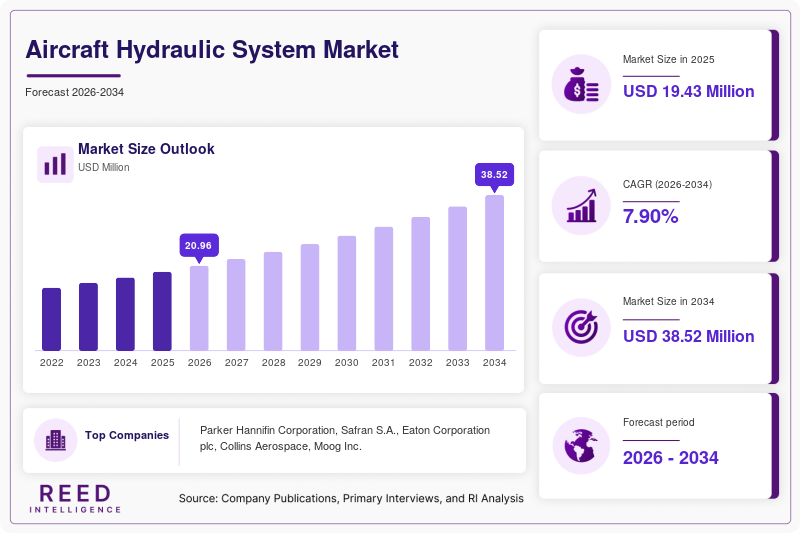
The global aircraft hydraulic system market was valued at USD 19.43 billion in 2025 and is projected to grow from USD 20.14 billion in 2026 to USD 38.52 billion by 2034, registering a CAGR of 7.90% during the forecast period from 2026 to 2034. The market encompasses hydraulic power-generation, distribution and actuation equipment used for flight controls, landing gear, braking, steering, thrust-reverser and other flight-critical functions.
Aircraft hydraulic systems convert pressurized fluid power into controlled mechanical movement. Pumps generate hydraulic pressure, reservoirs manage fluid volume, valves regulate flow and pressure, and actuators transform hydraulic energy into movement. These subsystems are integrated into flight controls, landing gear, brakes, steering and thrust-reverser architectures.
The market is simultaneously being shaped by two opposing engineering requirements. Aircraft manufacturers continue to require hydraulic systems because of their power density, reliability and established certification base, while new-generation aircraft programs seek lower weight, reduced maintenance and greater electrical integration. Safran's current portfolio illustrates this transition, combining conventional 3,000- and 5,000-psi hydraulic solutions with electro-hydraulic and electric actuation.
Aircraft Hydraulic System Market Drivers
Commercial Aircraft Production and Fleet Expansion
Increasing commercial aircraft production directly expands demand for hydraulic pumps, actuators, valves, reservoirs and associated control equipment. Hydraulic systems are embedded in multiple aircraft functions, meaning every new aircraft platform creates a package of hydraulic equipment requirements rather than a single component purchase. The resulting demand extends from OEM system integration to certified replacement parts and maintenance throughout the aircraft lifecycle.
Fleet modernization adds another layer of demand. Airlines replacing older aircraft with newer narrow-body and wide-body platforms require hydraulic architectures that accommodate higher system pressures, tighter weight constraints and greater integration with electronic controls. Aircraft such as the Boeing 787 and Airbus A350 demonstrate how modern architectures combine sophisticated hydraulic and electrical systems to meet redundancy, performance and maintenance requirements.
Expansion of Aftermarket and MRO Requirements
Aircraft hydraulic equipment generates recurring aftermarket demand because pumps, actuators, valves, filters, accumulators and associated components must be inspected, repaired or replaced during aircraft service. The aftermarket therefore provides a more persistent demand stream than aircraft deliveries alone.
The importance of this channel is demonstrated by Safran's July 2026 agreement with Lufthansa Technik covering Airbus A320-family, A330, A340 and A350 landing gear and hydraulic equipment. The 10-year support agreement includes certified spare parts, technical assistance, engineering support and maintenance documentation for Lufthansa Technik's global MRO operations.
Integration of Hydraulic and Electrical Actuation
Aircraft designers are increasingly combining hydraulic, electro-hydraulic and electromechanical technologies. The objective is not simply to replace hydraulics but to reduce piping, weight and maintenance requirements while maintaining redundancy for safety-critical functions.
Safran's landing-system portfolio includes hydraulic, electric and electronic equipment, while its electromechanical backup actuator architecture combines electrical backup with hydraulic normal operation. Liebherr is also developing modular electromechanical actuators and decentralized hydraulic supply solutions for next-generation civil and military aircraft.
Aircraft Hydraulic System Market Restraints
High Certification and Reliability Requirements
Hydraulic systems operate many safety-critical aircraft functions, creating demanding certification, qualification and reliability requirements. Component suppliers must demonstrate performance under pressure, temperature, vibration and contamination conditions while maintaining strict manufacturing traceability. These requirements increase development cycles and raise barriers for new suppliers.
The certification burden also makes aircraft manufacturers cautious about replacing proven hydraulic architectures with untested alternatives. Even where electric actuation is technically feasible, system-level redundancy, weight, thermal management and failure-mode requirements must be demonstrated before adoption.
Shift Toward More-Electric Aircraft Architectures
The move toward more-electric aircraft creates a structural challenge for conventional hydraulic equipment. Aircraft manufacturers are evaluating electrical actuation and decentralized power-generation approaches to reduce hydraulic lines, fluid requirements and maintenance complexity.
This does not eliminate hydraulic demand across the aviation industry, but it can change the composition of future demand. Suppliers increasingly need capabilities spanning hydraulic, electro-hydraulic and electromechanical systems. Liebherr's 2026 technology demonstrations of decentralized hydraulic supply alongside modular electromechanical actuators illustrate this transition.
Aircraft Hydraulic System Market Opportunities
Smart and Integrated Hydraulic Systems
The integration of sensors, electronic controls and condition-monitoring capabilities creates opportunities for suppliers to move beyond individual hydraulic components toward intelligent subsystems. Monitoring pressure, temperature, fluid condition and actuator performance can support predictive maintenance and reduce unnecessary component removal.
The commercial implication is a shift from component supply toward integrated lifecycle support. Suppliers able to combine hydraulic hardware with controls, diagnostics, engineering services and MRO capabilities can participate in more stages of an aircraft's operating lifecycle.
Aftermarket Expansion in Emerging Aviation Markets
Fleet growth in Asia Pacific and other emerging aviation markets is creating a larger installed base of aircraft requiring long-term hydraulic maintenance. The opportunity extends beyond initial equipment installation because hydraulic components must remain supported throughout aircraft service lives.
Regional MRO expansion can therefore increase demand for certified spare parts, repair capabilities and localized technical support. Long-term agreements such as Safran's 2026 partnership with Lufthansa Technik demonstrate how manufacturers are using service relationships to strengthen lifecycle support for hydraulic and landing-system equipment.
Aircraft Hydraulic System Market Segmental Analysis
By Component
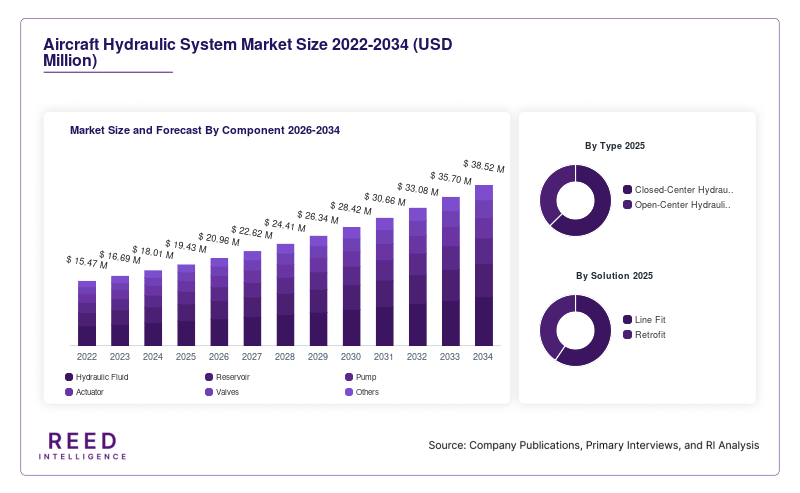
Actuators represent the dominant component category, accounting for approximately 51.20% of the market in 2026. Their position reflects the broad number of flight-control, landing-gear, braking and thrust-reverser functions requiring controlled mechanical movement. Pumps, valves and reservoirs remain essential supporting components, while integrated actuator technologies are increasingly incorporating electronic control and monitoring.
Actuators and electro-hydraulic systems are also positioned toward technology-driven demand as aircraft manufacturers seek lower weight and improved controllability. The increasing use of electro-hydraulic and electromechanical actuation creates differentiation opportunities for suppliers capable of combining hydraulic power with electronic control architectures.
By Type
Closed-Center Hydraulic Systems dominate the market, holding approximately 93.07% share in 2026. Their widespread use is linked to the ability to maintain system pressure while controlling hydraulic flow to multiple aircraft functions, making the architecture suitable for complex, redundant aircraft systems.
Open-Center systems retain applications where simpler hydraulic architectures are appropriate, particularly in selected aircraft and legacy platforms. Their comparatively narrower application base limits their overall share, while closed-center systems remain aligned with high-performance, multi-function aircraft hydraulic architectures.
By Solution
Line Fit represents the dominant solution category because hydraulic systems are integrated directly into new aircraft during manufacturing. Demand is therefore connected to commercial aircraft deliveries, military production programs and new platform development.
Retrofit is the faster-expanding solution channel as airlines and operators extend aircraft operating lives and upgrade safety-critical systems. Retrofit demand includes replacement of aging hydraulic equipment, modernization of control architectures and installation of newer components that improve reliability or maintenance performance.
By Application
Flight Controls represent one of the largest hydraulic applications because actuators must provide precise and reliable movement of primary and secondary control surfaces. Safran's portfolio includes hydraulic, electro-hydraulic and electrical backup actuation for rudders, elevators, spoilers, ailerons and stabilizer systems.
Landing Gear and Brakes form another major application cluster. These systems require high force and reliability during aircraft takeoff, landing and ground operations. Safran's landing-system portfolio integrates hydraulic, electric and electronic technologies across landing gear extension, braking and steering functions.
Thrust Reversers continue to use hydraulic actuation on many aircraft platforms, although electrical alternatives are increasingly available. Safran provides both 3,000- and 5,000-psi hydraulic thrust-reverser solutions alongside electric and hybrid architectures, demonstrating the coexistence of technologies during the transition toward more-electric aircraft.
By Platform
Fixed-Wing Aircraft represent the dominant platform category because commercial and military fixed-wing aircraft incorporate hydraulic systems across multiple flight-critical functions. High production volumes for narrow-body aircraft combined with the extensive installed base of wide-body and military aircraft support recurring equipment and aftermarket requirements.
Rotary-Wing Aircraft and UAVs provide additional growth channels. Helicopters require hydraulic or electro-hydraulic actuation for flight controls, landing systems and other high-load functions, while UAV designers increasingly seek compact, lightweight actuation systems. The adoption of miniaturized and decentralized power architectures creates additional opportunities for specialized hydraulic suppliers.
Aircraft Hydraulic System Market Regional Analysis
North America Aircraft Hydraulic System Market
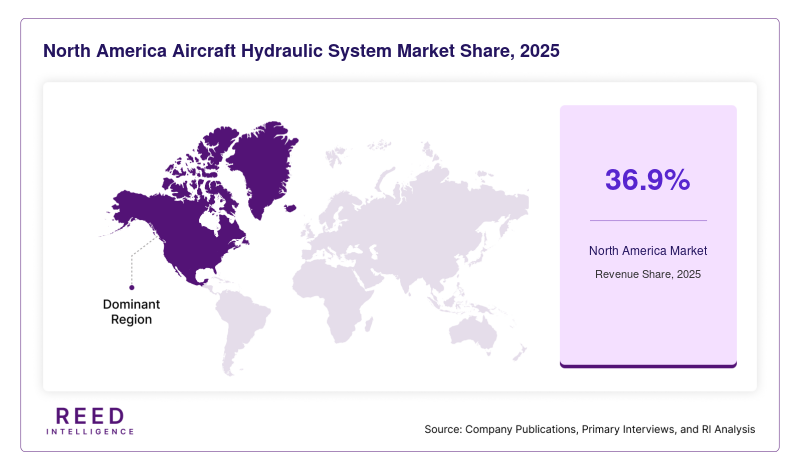
North America is the dominant regional market, accounting for approximately 36.90% share in 2025. The region benefits from a large installed commercial aircraft fleet, extensive defense aviation programs, major aircraft OEMs and a dense network of aerospace-system suppliers. Parker Hannifin, Eaton, Collins Aerospace, Honeywell and other established companies maintain significant aerospace capabilities, reinforcing the region's position across OEM and aftermarket channels.
The United States represents the primary regional demand center, supported by commercial aviation, military aircraft procurement, MRO activity and aerospace manufacturing. Hydraulic component demand also benefits from defense sustainment programs; for example, 2026 U.S. government orders included hydraulic pistons and other hydraulic components supplied by Collins Aerospace.
Europe Aircraft Hydraulic System Market
Europe is characterized by strong aircraft manufacturing, defense programs and aerospace-system integration, with Airbus and its extensive supplier ecosystem generating demand for hydraulic and electro-hydraulic equipment. Europe is estimated to expand at approximately 7.2% CAGR during 2026–2034, supported by aircraft production, MRO requirements and investment in lower-weight actuation technologies.
France, Germany and the United Kingdom remain important aerospace centers. Safran's landing-system and actuation activities span hydraulic braking, landing gear and flight-control technologies, while Liebherr is developing decentralized hydraulic and electromechanical solutions for future aircraft.
Asia Pacific Aircraft Hydraulic System Market
Asia Pacific is estimated to register the fastest regional growth at approximately 9.1% CAGR during 2026–2034. Expansion of commercial aviation fleets, increasing aircraft manufacturing capabilities and growing MRO infrastructure are strengthening demand for hydraulic components and lifecycle services. The region also has a large installed base requiring replacement and maintenance parts.
China, India, Japan and Southeast Asian aviation markets provide multiple demand channels. Aircraft production programs, airline fleet expansion and regional MRO investment are increasing the importance of localized aerospace supply chains, while established suppliers continue to participate through long-term OEM relationships and technology partnerships.
Latin America Aircraft Hydraulic System Market
Latin America is projected to expand at approximately 7.4% CAGR during 2026–2034. Regional demand is supported by airline fleet renewal, increasing aircraft utilization and maintenance requirements for commercial and regional aviation. The aftermarket therefore represents an important component of hydraulic-system demand.
Brazil is the principal aerospace manufacturing and aviation center in the region, while Mexico contributes through its aerospace manufacturing ecosystem. Airlines and MRO providers across the region require certified hydraulic components, replacement actuators, valves, pumps and associated equipment to maintain operational fleets.
Middle East & Africa Aircraft Hydraulic System Market
Middle East & Africa is estimated to register approximately 8.0% CAGR during 2026–2034. Gulf aviation hubs support demand through fleet expansion, wide-body aircraft operations and large-scale MRO infrastructure. Defense modernization across several regional markets adds another demand channel for hydraulic systems used in military aircraft.
The United Arab Emirates, Saudi Arabia and other Gulf markets are strengthening aerospace maintenance and service capabilities, while African aviation markets provide longer-term aftermarket potential. The combination of commercial fleet growth, defense procurement and aircraft maintenance supports demand for certified hydraulic components and repair services.
Aircraft Hydraulic System Market Competitive Landscape
The aircraft hydraulic system market is characterized by established aerospace suppliers with long certification histories, broad component portfolios and close relationships with aircraft OEMs. Parker Hannifin and Safran represent two leading competitive positions because their portfolios extend across hydraulic power generation, actuation, landing systems and related aerospace technologies. Parker supplies complete hydraulic systems and components, while Safran combines hydraulic equipment with landing gear, braking and flight-control actuation.
Parker's competitive differentiation is based on system-level integration across pumps, reservoirs, manifolds, accumulators, valves, filtration and hydraulic controls. Its aerospace business has historically supplied complete hydraulic systems for major aircraft programs, providing experience across both OEM installation and lifecycle support.
Key Market Players
- Parker Hannifin Corporation
- Safran S.A.
- Eaton Corporation plc
- Collins Aerospace
- Moog Inc.
- Liebherr Group
- Honeywell International Inc.
- Woodward, Inc.
- Triumph Group, Inc.
- Crane Aerospace & Electronics
- CIRCOR International, Inc.
- Senior plc
- Nabtesco Corporation
- Sumitomo Precision Products Co., Ltd.
- TransDigm Group Inc.
- HYDAC Technology GmbH
- Arkwin Industries, Inc.
- Curtiss-Wright Corporation
- GKN Aerospace
- Meggitt PLC
Aircraft Hydraulic System Market Recent Developments
-
July 2026 -Safran: Safran Landing Systems and Lufthansa Technik signed a 10-year Support and Services Agreement covering Airbus A320-family, A330, A340 and A350 landing gear and hydraulic equipment. The agreement includes certified spare parts, engineering assistance and technical support for Lufthansa Technik's worldwide MRO operations.
-
June 2026 -Liebherr: Liebherr-Aerospace presented modular electromechanical actuators and decentralized hydraulic-supply solutions at ILA Berlin 2026, highlighting its development of hydraulic and electrical technologies for next-generation civil and military aircraft.
Aircraft Hydraulic System Market Segments
By Component
- Hydraulic Fluid
- Reservoir
- Pump
- Actuator
- Valves
- Others
By Type
- Closed-Center Hydraulic System
- Open-Center Hydraulic System
By Solution
- Line Fit
- Retrofit
By Application
- Flight Controls
- Landing Gear
- Brakes
- Thrust Reversers
- Others
By Platform
- Fixed Wing
- Rotary Wing
- Unmanned Aerial Vehicles
By Region
- North America
- Europe
- APAC
- Middle East and Africa
- LATAM