Aircraft Landing Gear Repair And Overhaul Market Size, Share & Trends Analysis Report By Landing Gear Type (Main Landing Gear, Nose Landing Gear), By Aircraft Type (Commercial Aircraft, Military Aircraft), By Service Type (Repair, Overhaul, Inspection & Testing), By End User (Airlines & Commercial Operators, MRO Providers) and By Region (North America, Europe, APAC, Middle East and Africa, LATAM) Forecasts, 2026–2034
USD 3950
Aircraft Landing Gear Repair and Overhaul Market Size
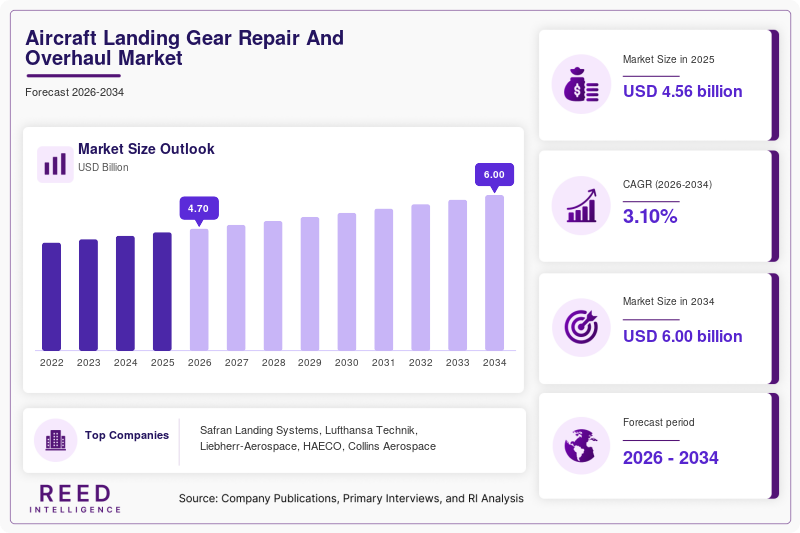
The global Aircraft Landing Gear Repair and Overhaul Market size was valued at USD 4.56 billion in 2025 and is projected to grow from USD 4.70 billion in 2026 to USD 6.00 billion by 2034, registering a CAGR of 3.10% during the forecast period from 2026 to 2034.
Aircraft landing gear is a safety-critical system with a recurring maintenance requirement because landing, braking, taxiing, towing and ground operations expose components to high mechanical loads, wear, corrosion and fatigue. Landing gear maintenance therefore creates a recurring aftermarket requirement even when aircraft production growth is moderate. Lufthansa Technik notes that landing gear can contain up to 1,000 components on an A320 and requires disassembly, cleaning, inspection, repair, surface treatment, reassembly and testing during overhaul.
The broader aircraft aftermarket is expanding alongside fleet size and utilization. Airbus projects the global commercial fleet to reach more than 49,000 aircraft by 2044 and forecasts a US$311 billion aviation services market, with off-wing maintenance reaching US$218 billion. Boeing's 2026 Commercial Services Market Outlook similarly values commercial aviation support and services at US$4.9 trillion over 2026–2045, covering MRO, parts, supply-chain and digital services.
Landing-gear MRO is also becoming more geographically distributed. Safran expanded its Singapore facility in September 2026 with a US$22 million investment and a 7,500-square-meter extension dedicated partly to landing-gear overhaul, strengthening its Asia-Pacific and Middle East support capability.
Aircraft Landing Gear Repair and Overhaul Market Drivers
Aging and Growing Aircraft Fleets Create Recurring Landing-Gear Shop Visits
The fundamental demand mechanism is the installed aircraft fleet. Landing gear is not simply replaced when an aircraft reaches retirement; components undergo inspections, repairs, refurbishment and scheduled overhauls during the aircraft's operating life. Airbus states that its aftermarket forecast directly considers in-service fleet size, aircraft age, flight cycles and aircraft type when assessing future services demand.
The expanding fleet therefore increases the installed base requiring landing-gear maintenance, while older aircraft can require more extensive repair work. Boeing expects the global commercial fleet to nearly double over the next two decades as passenger traffic expands and aircraft remain in service longer.
For MRO companies, this produces a recurring workload across main landing gear, nose landing gear, actuators, uplocks, downlocks, bearings, bushings, wheels and related hydraulic systems. The commercial implication is a relatively stable aftermarket compared with new-aircraft equipment demand. The counterbalance is that newer aircraft can incorporate lighter materials, longer component lives and improved monitoring, moderating the number of intensive overhaul events per aircraft.
High Aircraft Utilization Is Increasing Maintenance Intensity
Aircraft utilization directly affects components measured in flight cycles and operating hours. Landing gear experiences repeated take-off and landing loads, making flight-cycle growth particularly relevant for overhaul planning.
Airbus reported that global aviation services demand is supported by increased aircraft utilization, while its aftermarket methodology specifically incorporates flight cycles and aircraft age.
The effect is especially important for narrowbody fleets, which perform numerous short- and medium-haul sectors each day. Regional aircraft can also accumulate cycles quickly. Liebherr's April 2026 agreement with Envoy Air illustrates the cycle-based nature of landing-gear maintenance: the Embraer 175-E1 fleet is subject to restoration intervals of 30,000 flight cycles or 12 calendar years, depending on the applicable maintenance requirement.
This makes landing-gear MRO demand closely connected to airline network utilization rather than aircraft count alone.
Safety and Airworthiness Requirements Require Documented Inspection and Overhaul
Landing gear is subject to strict continuing-airworthiness requirements because failures can directly affect aircraft ground operations and landing safety. EASA's Part-145 framework identifies landing gear under C14 component maintenance, while approved organizations must hold applicable maintenance data and follow specified inspection, disassembly, repair, reassembly and testing procedures before releasing an overhauled component.
Regulatory activity continues to generate specific inspection requirements. In June 2026, EASA issued an airworthiness directive covering inspection of Airbus A350 main landing gear axles, while another 2026 directive addressed inspection or replacement of Fokker F28 main landing gear pistons.
These requirements create a structural floor under demand because airlines cannot simply defer mandatory maintenance indefinitely. They also favor certified MRO providers with appropriate approvals, technical documentation, traceability and specialist equipment.
Aircraft Landing Gear Repair and Overhaul Market Restraints
Skilled-Labor, Capacity and Turnaround-Time Constraints
Landing-gear overhaul is labor-intensive and requires specialized technicians, inspection personnel, surface-treatment capabilities, tooling and engineering expertise. Lufthansa Technik describes overhaul as a coordinated process covering disassembly, stripping, damage assessment, electroplating and final assembly, while maintaining dedicated teams for AOG support and on-site repairs.
The industry-wide shortage of skilled aviation workers can therefore constrain capacity. Boeing identifies workforce and supply-chain capacity constraints among the major factors shaping the aviation services market through 2045.
For airlines, longer shop turnaround times can increase spare landing-gear requirements and aircraft downtime. MRO providers are consequently investing in automation, regional facilities, exchange pools and standardized processes to increase throughput.
High Certification, Traceability and Equipment Requirements
Landing-gear MRO requires specialized processes such as non-destructive testing, plating, shot peening, corrosion treatment, dimensional inspection and component testing. The maintenance provider must also demonstrate appropriate regulatory approval and maintain detailed component histories.
Lufthansa Technik highlights back-to-birth traceability as a critical requirement for landing-gear components, particularly where life-limited parts are involved. EASA likewise requires approved maintenance organizations to use applicable maintenance data when releasing components as overhauled.
These requirements raise barriers to entry. Smaller MRO companies may need substantial capital investment in facilities, approvals, equipment and specialized personnel before they can support major commercial aircraft landing-gear programs.
Aircraft Landing Gear Repair and Overhaul Market Opportunities
Expansion of Asia-Pacific Landing-Gear MRO Capacity
Asia-Pacific is becoming a larger center of aircraft aftermarket activity as fleets expand. Aviation Week's 2026 fleet forecast indicates that the commercial aircraft fleet across Asia-Pacific, China and India is expected to grow by nearly 50% over the next decade.
Safran's September 2026 Singapore expansion directly responds to this demand, adding a dedicated landing-gear overhaul assembly line and increasing capacity for airlines across Asia-Pacific and the Middle East.
HAECO is also expanding its landing-gear portfolio in China. In May 2026, HAECO completed the first major overhaul of a COMAC C909 landing gear in Xiamen in cooperation with Liebherr-Aerospace.
Long-Term Fleet Support Contracts
Long-term agreements provide MRO companies with predictable workloads and allow airlines to secure capacity before future overhaul waves arrive. In May 2026, Liebherr and Finnair signed an A350 nose-landing-gear overhaul agreement extending through 2034.
In July 2026, Safran and Lufthansa Technik signed a 10-year support agreement covering Airbus A320-family, A330, A340 and A350 landing gear and hydraulic equipment. The arrangement includes certified spare parts, engineering assistance and updated maintenance documentation.
Such contracts allow providers to plan tooling, spare pools and technician capacity while giving airlines greater predictability over maintenance slots and component availability.
Predictive Maintenance and Digital MRO
Digital maintenance systems provide another opportunity because landing-gear condition can be incorporated into broader aircraft-health and maintenance-planning systems. Safran's Landing Life offering includes predictive maintenance, remote assistance, services-by-the-hour and digital customer support.
The commercial benefit is reduced unscheduled downtime and better spare-part planning. Digital records can also improve traceability and help operators distinguish between components that require complete overhaul and those that can be repaired through targeted intervention.
Lufthansa Technik's landing-gear service model similarly emphasizes on-site repair and spare-gear pools to avoid unnecessary shop visits and reduce aircraft downtime.
Segmental Analysis
By Landing Gear Type
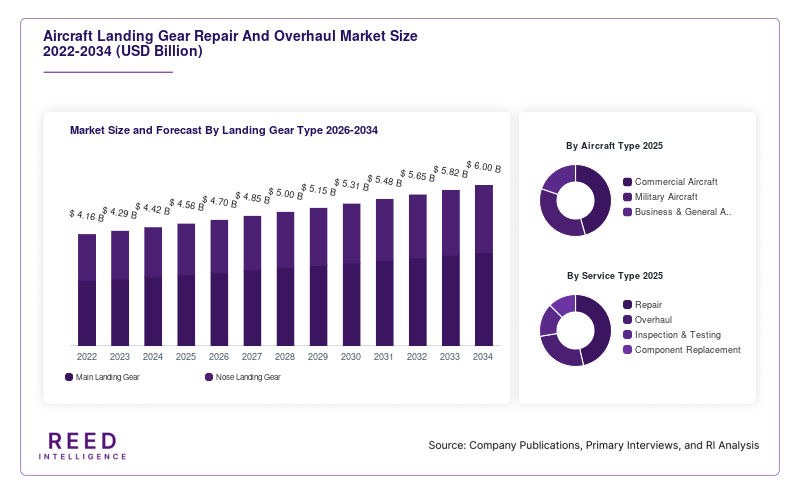
Main Landing Gear represents approximately 68% of the global market in 2025, making it the dominant landing-gear segment. Main gear assemblies carry most of the aircraft's ground load and contain multiple structural, hydraulic and braking-related components, creating substantial inspection and overhaul requirements. Lufthansa Technik's A320 overhaul process can involve approximately 2,100 components requiring cleaning, repair and overhaul.
Nose Landing Gear accounts for approximately 32% of the market and is the fastest-growing landing-gear type, with a CAGR of approximately 3.6% through 2034. Growth is supported by increasing overhaul activity on newer aircraft programs. Liebherr began its first Airbus A350 nose-landing-gear overhaul in April 2026 and subsequently secured a Finnair A350 overhaul program extending through 2034.
By Aircraft Type
Commercial Aircraft accounts for approximately 72% of the market in 2025. The segment benefits from the large global passenger fleet, high aircraft utilization and recurring maintenance requirements. Airbus forecasts the global passenger and freighter fleet within its services scope to exceed 49,000 aircraft by 2044.
Military Aircraft represents approximately 17%, with demand shaped by fleet readiness, mission cycles, depot maintenance and government support contracts.
Business & General Aviation Aircraft represents approximately 11%.
Business & General Aviation Aircraft is the fastest-growing aircraft category, with a CAGR of approximately 4.1%, supported by increasing utilization of business aircraft and specialist MRO requirements.
By Service Type
Overhaul represents approximately 43% of the market in 2025. Full overhaul involves substantial disassembly, inspection, repair, surface treatment, reassembly and testing, creating the largest revenue pool among landing-gear MRO activities.
Repair accounts for approximately 27%, while Inspection & Testing represents 18% and Component Replacement represents 12%.
Inspection & Testing is the fastest-growing service segment, with a CAGR of approximately 3.9%, supported by continuing-airworthiness requirements and more detailed component monitoring. EASA issued multiple landing-gear-specific airworthiness directives during 2026, illustrating the continuing role of inspection requirements in the aftermarket.
By End User
Airlines & Commercial Operators represent approximately 61% of demand. High aircraft utilization and the large commercial fleet make airlines the principal purchasers of landing-gear repair and overhaul.
MRO Providers account for approximately 17%, including third-party maintenance organizations that subcontract specialist landing-gear work.
Leasing Companies represent approximately 10%, particularly when aircraft undergo transitions, redelivery checks or refurbishment.
Military & Government Operators account for approximately 12%.
Leasing Companies are the fastest-growing end-user segment, with a CAGR of approximately 4.0%, as aircraft leasing continues to make component condition, traceability and asset-life management important commercial considerations.
Regional Analysis
North America Aircraft Landing Gear Repair And Overhaul Market
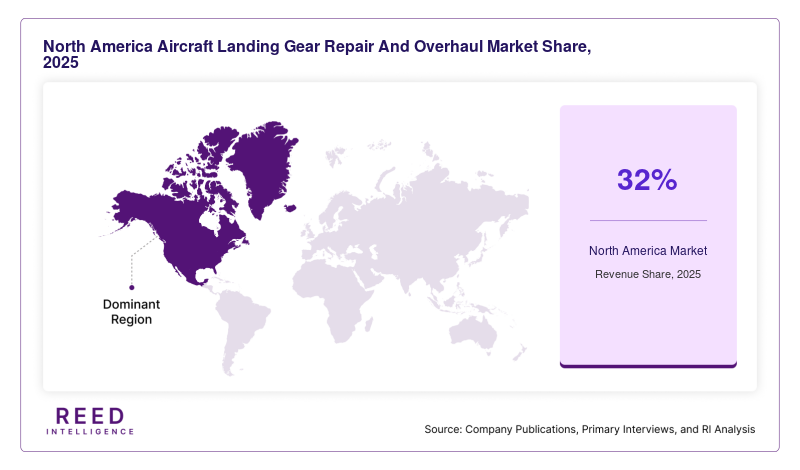
North America represents approximately 32% of the global Aircraft Landing Gear Repair And Overhaul Market in 2025. The region benefits from a large installed aircraft fleet, major airlines, aircraft leasing companies, military fleets and an established aerospace MRO ecosystem.
The U.S. has a particularly deep supplier base covering OEMs, independent MRO providers and component specialists. Lufthansa Technik, Safran, Collins Aerospace, GA Telesis and other providers operate within the region's broader aircraft-component aftermarket.
Regulatory requirements from the FAA create a formal framework for continued airworthiness, while life-limited components require accurate service-life records and status information. FAA guidance describes life limits in terms such as operating hours, cycles or calendar time and emphasizes maintaining current records for such parts.
North America is projected to grow at approximately 2.6% CAGR through 2034. The region remains commercially important because mature fleets generate continuing repair requirements even as new aircraft enter service. However, relatively high labor costs and competition from lower-cost international MRO centers can constrain expansion.
Europe Aircraft Landing Gear Repair And Overhaul Market
Europe accounts for approximately 27% of the global market in 2025. The region has a strong aerospace manufacturing and MRO ecosystem, including Airbus, Safran, Liebherr, Lufthansa Technik and numerous specialist component providers.
European MRO demand is supported by large commercial fleets and strict EASA continuing-airworthiness requirements. EASA's Part-145 framework specifically identifies landing gear as a component-maintenance category and establishes requirements for organizations performing component overhaul.
The region is projected to expand at approximately 2.7% CAGR. Long-term contracts are becoming increasingly important. Liebherr's 2026 agreements with Finnair, Horizon Air and Envoy Air demonstrate how OEM-linked providers are securing future overhaul slots across multiple aircraft platforms.
Europe's competitive strength comes from engineering depth, certification capability and proximity to aircraft OEMs. Higher labor costs and capacity constraints remain important counterbalances.
APAC Aircraft Landing Gear Repair And Overhaul Market
APAC represents approximately 25% of the global market in 2025 and is the fastest-growing region, with a CAGR of approximately 4.6%.
The region is supported by rapid fleet expansion, high aircraft utilization and growing demand for local MRO capacity. Aviation Week forecasts nearly 50% fleet growth across Asia-Pacific, China and India over the next decade.
China is particularly important. Airbus identifies China as the world's largest single-country market for its aircraft fleet and forecasts approximately 9,570 new aircraft deliveries to China over the next 20 years. Airbus estimates Chinese aviation aftermarket services at US$24.8 billion in 2025, rising to US$63.8 billion by 2044.
Recent landing-gear investments reinforce the trend. HAECO completed the first COMAC C909 landing-gear overhaul in China in May 2026, while Safran expanded its Singapore landing-gear MRO center in September 2026.
APAC's main constraints are workforce availability, certification complexity and the need to establish sufficient regional spare pools and specialist equipment. However, localized MRO reduces aircraft downtime and transportation costs, strengthening the business case for additional regional capacity.
Middle East and Africa Aircraft Landing Gear Repair And Overhaul Market
Middle East and Africa represents approximately 9% of the global market in 2025 and is expected to expand at approximately 3.8% CAGR.
The Middle East benefits from large airline fleets, long-haul connectivity and major aviation hubs in the Gulf. Airlines operating high-utilization widebody fleets create demand for specialized landing-gear support, spare pools and AOG services.
Africa has a smaller installed fleet but presents opportunities for regional MRO development as air traffic and fleet modernization continue. Providers can benefit from offering exchange landing gear and mobile support because transporting heavy landing-gear assemblies over long distances can increase turnaround time and logistics costs.
Safran's Singapore investment specifically targets Asia-Pacific and Middle Eastern customers, illustrating how MRO networks are increasingly organized around regional support hubs rather than single-country workshops.
The main constraints are uneven MRO infrastructure, technician availability and lower fleet density in several African markets.
LATAM Aircraft Landing Gear Repair And Overhaul Market
LATAM accounts for approximately 7% of the global market in 2025 and is projected to grow at approximately 3.4% CAGR.
Brazil and Mexico provide the region's largest aerospace and airline maintenance ecosystems, while regional carriers operate fleets that include Airbus, Boeing and Embraer aircraft. Embraer aircraft are particularly relevant to the region because the E-Jet family generates a specialized landing-gear aftermarket.
The commercial opportunity is strongest for MRO providers that can offer localized component repair, exchange units and rapid AOG response. Safran's global landing-gear network includes facilities and customer-support capabilities across the Americas, while its MRO network covers aircraft such as the A320 family, Boeing 737NG, ATR and regional aircraft.
LATAM's principal constraints are currency volatility, uneven MRO infrastructure and smaller fleet scale compared with North America, Europe and APAC.
Competitive Landscape
The Aircraft Landing Gear Repair And Overhaul Market is characterized by strong participation from OEM-linked MRO providers, specialist aircraft-component companies and large independent MRO organizations. Technical certification, installed-base knowledge, proprietary repair procedures, spare pools and global geographic coverage are major competitive differentiators.
Safran Landing Systems has one of the broadest landing-gear aftermarket networks, with eight industrial facilities and dedicated support centers across major regions. Its Landing Life portfolio includes MRO, predictive maintenance, AOG support, leasing and services-by-the-hour.
Lufthansa Technik differentiates through extensive in-house repair capabilities, landing-gear spare pools, on-site repair teams and Total Landing Gear Support. Its process includes non-destructive testing, surface treatment, component repair and complete overhaul.
Liebherr-Aerospace combines OEM engineering with MRO. Its 2026 landing-gear agreements with Finnair, Horizon Air and Envoy Air expand its contracted overhaul pipeline across Airbus A350 and Embraer E175 fleets.
Key Market Players
Recent Market Developments
- September 2026 –Safran expanded its Singapore landing-gear MRO center. The US$22 million project added a 7,500-square-meter extension and a dedicated landing-gear overhaul assembly line, increasing capacity for Asia-Pacific and Middle Eastern fleets.
- May 2026 – Liebherr and Finnair signed an A350 nose-landing-gear overhaul agreement. The program begins in 2026 and runs through 2034, creating a long-duration OEM-linked maintenance pipeline.
Aircraft Landing Gear Repair And Overhaul Market Segments
By Landing Gear Type
- Main Landing Gear
- Nose Landing Gear
By Aircraft Type
- Commercial Aircraft
- Military Aircraft
- Business & General Aviation Aircraft
By Service Type
- Repair
- Overhaul
- Inspection & Testing
- Component Replacement
By End User
- Airlines & Commercial Operators
- MRO Providers
- Leasing Companies
- Military & Government Operators
By Region
- North America
- Europe
- APAC
- Middle East and Africa
- LATAM