Aircraft Seat Actuation System Market Size, Share & Demand Report By Actuation Type (Electric Actuation Systems, Electromechanical Actuation Systems, Smart Integrated Actuation Systems), By Aircraft Type (Business Jets, Regional Aircraft, Military Aircraft), By Seat Class (Premium Economy, Business Class, First Class), By Region & Segment Forecasts, 2026–2034
USD 3950
Market Overview
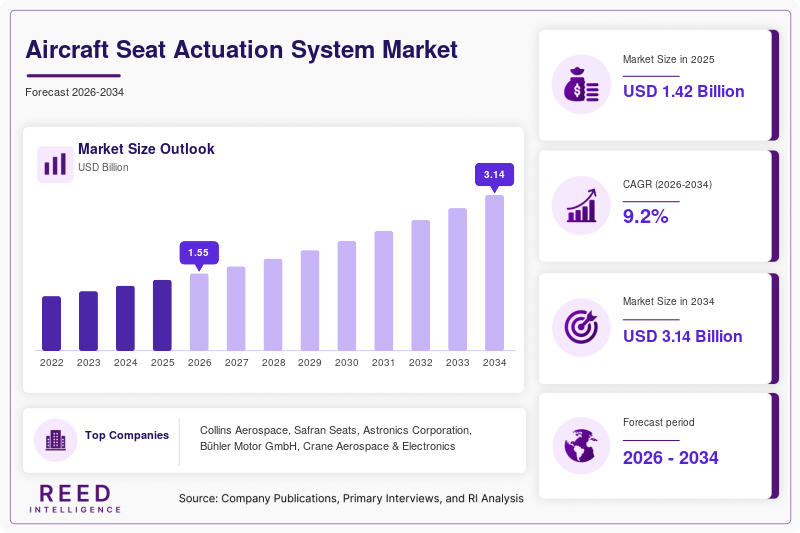
The global Aircraft Seat Actuation System Market size was valued at USD 1.42 billion in 2026 and is projected to reach USD 2.87 billion by 2034, expanding at a CAGR of 9.2% during the forecast period from 2026 to 2034. The market continues to gain momentum as airlines invest in cabin modernization, passenger comfort enhancement, and premium seating solutions. Aircraft seat actuation systems have become an essential component of modern aircraft interiors, supporting automated adjustments, ergonomic seating configurations, and integrated passenger experience features across commercial and business aviation segments.
A major global factor supporting market growth is the continuous expansion of air passenger traffic and fleet modernization programs. Airlines worldwide are introducing new-generation aircraft equipped with advanced cabin technologies to improve customer satisfaction and operational efficiency. Growing demand for long-haul travel has increased the adoption of fully reclining business-class and first-class seats that require sophisticated actuation systems. At the same time, aircraft manufacturers are focusing on lightweight components that reduce fuel consumption while maintaining reliability and functionality.
Key Highlights
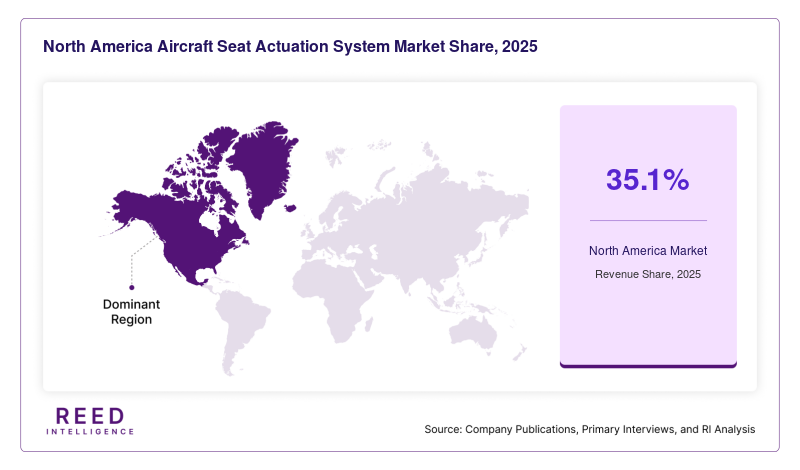
- North America dominated the market with a 35.1% share in 2025.
- Asia Pacific is expected to grow at the fastest CAGR of 10.8% during 2026–2034.
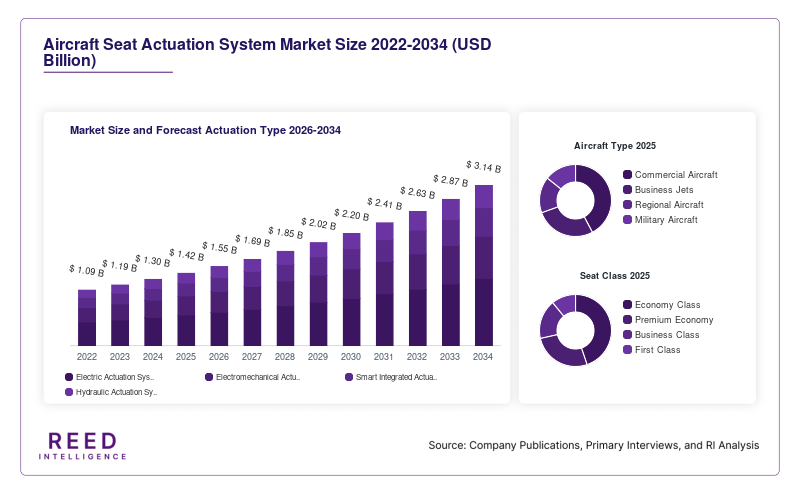
- By actuation type, electric actuation systems accounted for the largest share of 61.8%.
- while smart integrated actuation systems are projected to grow at a CAGR of 11.5%.
- By aircraft type, commercial aircraft led with a 68.4% share.
- whereas business jets are expected to expand at a CAGR of 10.9%.
- By seat class, business class represented the largest share of 39.6%.
- while premium economy is anticipated to grow at a CAGR of 11.2%.
- The United States remained the dominant country, with market values of USD 372 million in 2024 and USD 411 million in 2025.
Market Trends
Rising Integration of Smart Seating Technologies
The aircraft industry is increasingly adopting smart seating technologies that combine seat actuation systems with digital control platforms. Airlines are introducing seats equipped with memory settings, automated recline functions, personalized comfort controls, and connectivity-enabled interfaces. These systems allow passengers to adjust seating positions through integrated touch panels while enabling airlines to monitor seat performance remotely. The trend is particularly visible in premium cabins where passenger comfort directly influences brand differentiation. Manufacturers are responding by developing intelligent actuators with enhanced precision, lower power consumption, and improved durability. As airlines compete through superior onboard experiences, demand for digitally integrated seat actuation systems continues to increase across new aircraft deliveries and retrofit programs.
Growing Demand for Lightweight Electromechanical Components
Weight reduction remains a major focus area across the aviation industry. Aircraft manufacturers and airlines are seeking lighter cabin components to improve fuel efficiency and reduce operating costs. This trend has accelerated the adoption of compact electromechanical actuators that deliver reliable performance while minimizing overall aircraft weight. Advanced materials, miniaturized motors, and optimized actuator designs are being incorporated into next-generation seat systems. The trend extends beyond premium cabins into economy and premium economy seating, where airlines aim to balance comfort improvements with operational efficiency. As sustainability targets become more prominent, lightweight seat actuation technologies are expected to play a growing role in aircraft cabin design strategies worldwide.
Market Drivers
Expansion of Premium Air Travel and Cabin Upgrades
The growing popularity of premium travel services is a significant driver for the Aircraft Seat Actuation System Market. Airlines are investing heavily in business-class, first-class, and premium economy cabins to attract high-value travelers and increase revenue per seat. Advanced seat configurations require sophisticated actuation systems capable of supporting multiple movement functions, including recline, lumbar adjustment, headrest positioning, and lie-flat bed conversion. Long-haul routes are especially contributing to demand as passenger expectations continue to evolve. Airlines view cabin upgrades as a strategic tool for differentiation, leading to increased procurement of technologically advanced seating solutions. This trend is generating substantial opportunities for seat actuation system manufacturers across both OEM and aftermarket channels.
Increasing Aircraft Deliveries Across Global Fleets
The steady growth of commercial aviation is driving significant aircraft procurement activity worldwide. Airlines are expanding fleets to accommodate rising passenger volumes and replace aging aircraft with more efficient models. Each new aircraft delivery creates demand for multiple seat actuation systems across various cabin classes. Narrow-body and wide-body aircraft programs are particularly supporting volume growth in the market. Business aviation is also contributing through rising purchases of private jets equipped with premium seating arrangements. As global aviation infrastructure expands and airlines introduce additional routes, the demand for reliable, lightweight, and efficient seat actuation systems is expected to increase consistently throughout the forecast period.
Market Restraint
High Development and Certification Costs
One of the primary challenges affecting the Aircraft Seat Actuation System Market is the high cost associated with product development, testing, and certification. Aviation safety standards require extensive validation processes before seat actuation systems can be installed in commercial aircraft. Manufacturers must demonstrate reliability, durability, electromagnetic compatibility, and passenger safety under various operating conditions. These requirements increase research expenditures and lengthen product development cycles. In addition, integration with modern aircraft cabin architectures often necessitates customized engineering solutions, adding further costs. Smaller suppliers may face difficulties competing with established manufacturers that possess extensive certification experience and long-term relationships with aircraft OEMs. For example, introducing a new smart actuator platform may require years of qualification testing before receiving approval for commercial deployment. Such regulatory and financial barriers can slow innovation adoption and create entry challenges for new market participants.
Market Opportunities
Expansion of Aircraft Retrofit Programs
A substantial opportunity exists in the growing market for aircraft cabin retrofit projects. Many airlines are upgrading existing fleets to improve passenger comfort, increase seat functionality, and extend aircraft service life. Retrofit programs frequently involve replacing older manual or basic electric seat systems with advanced actuation technologies offering enhanced performance and reliability. As carriers seek cost-effective alternatives to fleet replacement, retrofit investments are becoming increasingly common across both developed and emerging aviation markets. Seat actuation manufacturers can capitalize on this trend by offering modular solutions compatible with various aircraft platforms. The expanding retrofit ecosystem is expected to generate recurring revenue opportunities throughout the forecast period.
Growth of Emerging Aviation Markets
Emerging economies are creating favorable conditions for long-term market expansion. Rapid urbanization, rising disposable incomes, and increasing air travel demand are encouraging airlines in Asia Pacific, the Middle East, Latin America, and parts of Africa to expand fleets and enhance cabin offerings. New airlines entering the market often prioritize modern aircraft equipped with advanced passenger comfort features. At the same time, governments are investing in airport infrastructure and aviation development programs to support economic growth. These developments are creating additional demand for aircraft seating technologies, including advanced actuation systems. Suppliers that establish regional manufacturing capabilities and strategic partnerships are likely to benefit from accelerating aviation growth in these markets.
Segmental Analysis
By Actuation Type
Electric actuation systems represented the dominant subsegment and accounted for 61.8% of market share in 2024. Their leadership position is attributed to widespread adoption across commercial aircraft cabins due to efficiency, reliability, and ease of integration. Electric actuators support multiple seat functions including recline, height adjustment, leg-rest movement, and lumbar support. Compared with hydraulic alternatives, they offer lower maintenance requirements and reduced system complexity. Airlines increasingly prefer electric solutions because they improve operational efficiency while supporting modern passenger comfort requirements. Their compatibility with advanced cabin electronics further strengthens adoption across both OEM and retrofit applications.
Smart integrated actuation systems are expected to record the fastest CAGR of 11.5% through 2034. These systems combine advanced actuators, sensors, and digital control technologies to deliver enhanced functionality and passenger personalization. Growth is driven by increasing demand for connected aircraft cabins and intelligent seating platforms capable of monitoring performance in real time. Airlines are deploying these systems to improve passenger experiences while reducing maintenance costs through predictive diagnostics. As cabin digitization continues, smart integrated actuation technologies are anticipated to gain significant traction across premium and next-generation aircraft programs.
By Aircraft Type
Commercial aircraft constituted the largest subsegment, accounting for 68.4% of total market share in 2024. The segment benefits from large aircraft production volumes and extensive seating requirements across narrow-body and wide-body fleets. Airlines continue investing in cabin upgrades to improve passenger satisfaction and increase competitiveness. Growth in international travel and expanding airline networks support sustained demand for advanced seat actuation technologies. Commercial aircraft typically require a large number of seat assemblies, making this segment a primary revenue contributor for market participants. Continuous fleet modernization programs further reinforce the segment’s leading position.
Business jets are forecast to witness the fastest CAGR of 10.9% during the forecast period. Demand is being driven by increasing corporate travel, rising wealth among high-net-worth individuals, and expanding private aviation services. Business jet operators prioritize premium comfort and personalized cabin experiences, creating strong demand for sophisticated seat actuation systems. Advanced seating configurations featuring multiple adjustment functions and luxury amenities are becoming standard across new aircraft models. As business aviation expands globally, suppliers of high-performance seat actuation technologies are expected to benefit from growing procurement activity.
By Seat Class
Business class emerged as the dominant subsegment, holding 39.6% of the market share in 2024. Airlines increasingly view business-class cabins as a key source of profitability, prompting substantial investments in advanced seating technologies. Modern business-class seats incorporate multiple movement functions, lie-flat capabilities, massage features, and personalized comfort settings. These requirements necessitate highly reliable and sophisticated actuation systems. Long-haul international routes have particularly contributed to segment growth as carriers compete to provide superior passenger experiences. Continuous innovation in premium seating design supports sustained demand for advanced actuation solutions.
Premium economy is projected to be the fastest-growing subsegment, registering a CAGR of 11.2% through 2034. Airlines are expanding premium economy offerings to bridge the gap between economy and business class while generating additional revenue opportunities. Enhanced seat comfort, greater recline capability, and additional adjustment features are driving demand for modern actuation technologies within this cabin category. Passengers increasingly seek improved travel experiences without paying premium business-class fares. As more airlines adopt premium economy configurations, demand for compact, cost-effective, and efficient seat actuation systems is expected to rise steadily.
Regional Analysis
North America
North America accounted for 35.1% of the global Aircraft Seat Actuation System Market in 2025 and continues to maintain a leading position due to its established aerospace manufacturing ecosystem. The region is projected to expand at a CAGR of 8.6% through 2034. Strong demand for premium aircraft interiors, extensive commercial airline operations, and continuous fleet modernization programs contribute significantly to market growth. The presence of major aircraft manufacturers, seat suppliers, and technology developers supports innovation and large-scale deployment of advanced seat actuation systems.
The United States remains the dominant country within the region and represents the largest revenue contributor. A unique growth factor is the strong emphasis on premium cabin differentiation among major airlines. Carriers are investing in advanced lie-flat seats, personalized comfort technologies, and next-generation business-class cabins. These investments are driving continuous demand for sophisticated electric and smart seat actuation systems across both new aircraft deliveries and retrofit projects.
Europe
Europe held approximately 27.4% of the global market in 2025 and is expected to record a CAGR of 8.9% during the forecast period. The region benefits from a mature aviation sector, extensive aircraft production activities, and growing emphasis on sustainable aircraft technologies. Airlines are increasingly replacing older cabin components with lightweight alternatives that improve operational efficiency. Demand for advanced seat actuation systems is also supported by rising passenger expectations regarding comfort and cabin functionality.
Germany represents the dominant national market in Europe. A unique growth factor is the region's focus on lightweight engineering and energy-efficient aircraft components. European manufacturers are actively developing compact actuators and advanced motion-control technologies designed to reduce aircraft weight while maintaining performance standards. This engineering focus is encouraging broader adoption of modern seat actuation solutions across commercial and business aviation platforms.
Asia Pacific
Asia Pacific accounted for 23.8% of global revenue in 2025 and is forecast to register the fastest CAGR of 10.8% between 2026 and 2034. The region is witnessing rapid growth in air passenger traffic, airline fleet expansion, and airport infrastructure development. Rising middle-class populations and increasing international travel demand are encouraging airlines to acquire new aircraft and enhance onboard passenger experiences. These factors are generating strong demand for modern aircraft seating technologies.
China remains the dominant country in the regional market. A unique growth factor is the aggressive expansion of domestic airline fleets and regional aviation networks. Airlines are investing heavily in modern aircraft equipped with advanced cabin interiors to meet evolving passenger expectations. The combination of fleet growth and increasing premium travel demand is accelerating adoption of seat actuation systems throughout the country.
Middle East & Africa
The Middle East & Africa region represented 7.2% of the global Aircraft Seat Actuation System Market in 2025 and is expected to grow at a CAGR of 9.5% during the forecast period. Regional airlines continue to invest in premium cabin offerings, particularly on long-haul international routes. Demand for advanced seat technologies is supported by fleet expansion programs and increasing competition among carriers seeking to improve passenger experiences.
The United Arab Emirates is the dominant market within the region. A unique growth factor is the concentration of long-haul hub operations that require premium seating configurations. Airlines operating extensive international networks prioritize luxury cabin experiences, leading to significant investments in advanced seat actuation technologies. This focus on passenger comfort supports steady market growth across the regional aviation sector.
Latin America
Latin America captured 6.5% of global market revenue in 2025 and is projected to expand at a CAGR of 8.3% through 2034. Increasing air travel demand, fleet renewal initiatives, and growing regional connectivity are supporting market development. Airlines are gradually modernizing cabin interiors to improve competitiveness and attract passengers seeking enhanced comfort. These modernization efforts are contributing to rising adoption of electric seat actuation systems.
Brazil remains the leading country in the region. A unique growth factor is the expansion of regional aviation services connecting secondary cities and underserved routes. Airlines are investing in newer aircraft models that incorporate advanced cabin technologies and improved passenger seating systems. This trend is creating consistent opportunities for seat actuation system suppliers operating across the Latin American aviation market.
Competitive Landscape
The Aircraft Seat Actuation System Market is characterized by the presence of established aerospace component manufacturers and specialized seating technology providers. Companies compete through product innovation, lightweight designs, certification capabilities, and long-term relationships with aircraft OEMs and airline customers. Strategic collaborations, product launches, and capacity expansion initiatives remain common competitive strategies.
Collins Aerospace continues to be a leading participant in the market due to its broad aircraft interior portfolio and extensive global customer base. The company recently expanded its intelligent seating technology platform to support enhanced passenger comfort and predictive maintenance capabilities. Other major participants are focusing on advanced electric actuators, integrated seat controls, and lightweight component development to strengthen market positioning. Growing demand for premium seating solutions is encouraging manufacturers to invest in research and development activities. Competitive intensity is expected to increase as airlines pursue greater cabin differentiation and passenger experience enhancement across both new aircraft and retrofit programs.
Key Players
- Collins Aerospace
- Safran Seats
- Astronics Corporation
- Bühler Motor GmbH
- Crane Aerospace & Electronics
- Moog Inc.
- Kyntronics
- ITT Inc.
- RTX Corporation
- Parker Hannifin Corporation
- Woodward Inc.
- Diehl Aviation
- RECARO Aircraft Seating
- ST Engineering Aerospace
- HÜBNER Group
Recent Developments
- Collins Aerospace introduced an enhanced intelligent seat actuation platform featuring advanced monitoring and predictive maintenance capabilities.
- Safran Seats expanded production capacity for premium aircraft seating systems to support increasing global airline demand.
- Astronics Corporation launched a new generation of lightweight electric seat motion solutions designed for next-generation commercial aircraft cabins.
- RECARO Aircraft Seating partnered with technology providers to improve integration of smart seat control systems across premium cabin products.
- Diehl Aviation expanded research efforts focused on energy-efficient cabin components, including advanced seat actuation technologies
Aircraft Seat Actuation System Market Segments
Actuation Type
- Electric Actuation Systems
- Electromechanical Actuation Systems
- Smart Integrated Actuation Systems
- Hydraulic Actuation Systems
Aircraft Type
- Commercial Aircraft
- Business Jets
- Regional Aircraft
- Military Aircraft
Seat Class
- Economy Class
- Premium Economy
- Business Class
- First Class
By Region
- North America
- Europe
- APAC
- Middle East and Africa
- LATAM