Aircraft Seat Upholstery Market Size, Share & Demand Report By Material Type (Leather Upholstery, Fabric Upholstery, Synthetic Composite Upholstery, Vinyl Upholstery), By Aircraft Type (Commercial Aircraft, Regional Aircraft, Business Jets, Military Aircraft), By End Use (OEM Installations, Aftermarket Refurbishment Services), By Region & Segment Forecasts, 2026–2034
USD 3950
Market Overview
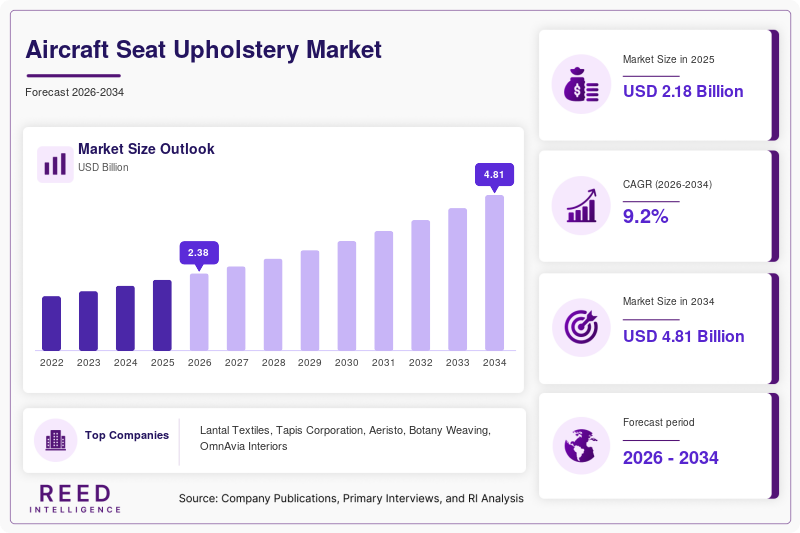
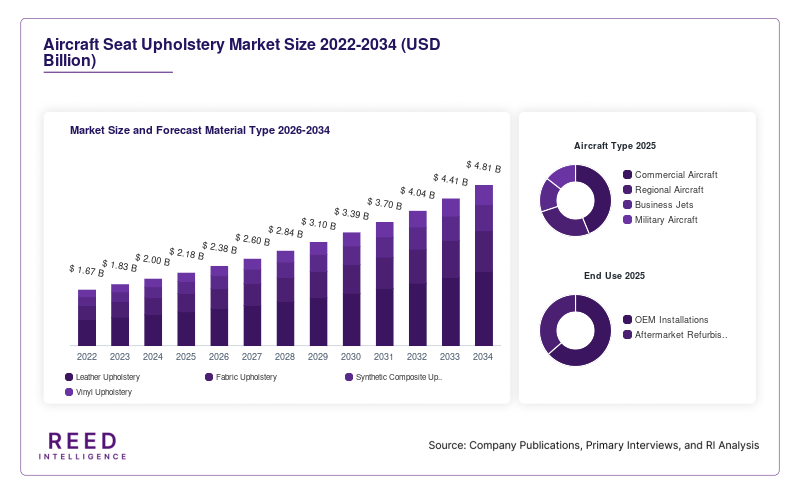
The global Aircraft Seat Upholstery Market size was valued at approximately USD 2.18 billion in 2026 and is projected to reach nearly USD 4.41 billion by 2034, expanding at a CAGR of 9.2% during the forecast period. The market is gaining momentum due to the steady increase in commercial aircraft deliveries, cabin refurbishment programs, and airline investments in passenger comfort solutions. Aircraft seat upholstery includes leather, fabric, synthetic composites, and fire-resistant materials used across economy, premium economy, business, and first-class seating systems. Airlines are increasingly focusing on lightweight upholstery materials to improve fuel efficiency and reduce operational costs. The integration of durable and antimicrobial fabrics has also become an important purchasing factor among airline operators and aircraft interior suppliers.
A major factor supporting market expansion is the rise in global air passenger traffic and the modernization of aging airline fleets. Several carriers are replacing conventional seating materials with advanced upholstery systems that offer longer lifecycle performance, lower maintenance requirements, and improved aesthetic appeal. Growing demand for premium cabin experiences in long-haul aviation has also accelerated spending on customized seating interiors. In addition, aircraft manufacturers and maintenance providers are collaborating with upholstery suppliers to comply with strict aviation safety and sustainability standards.
Key Highlights
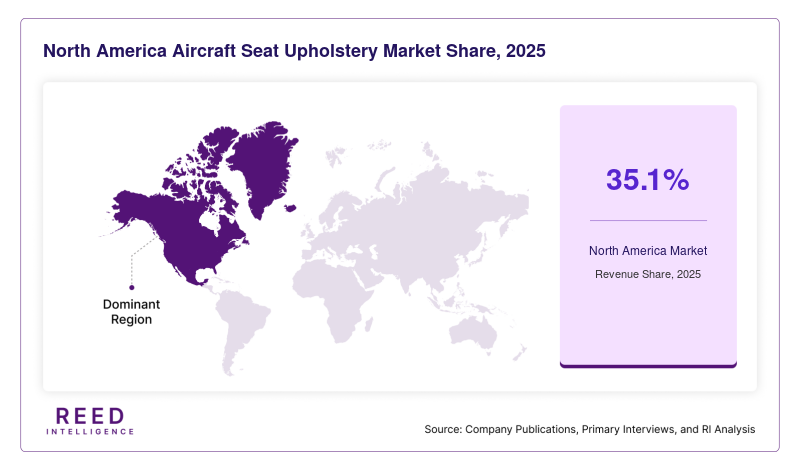
- North America dominated the market with a 35.1% share in 2025.
- Asia Pacific is expected to grow at the fastest CAGR of 10.8% during 2026–2034.
- By material type, leather upholstery accounted for the largest share of 39.4%, while synthetic composite upholstery is projected to grow at a CAGR of 11.6%.
- By aircraft type, commercial aircraft led with a 63.8% share, whereas regional aircraft are expected to expand at a CAGR of 10.9%. By end use, OEM installations accounted for the largest share of 58.3%, while aftermarket refurbishment services are projected to grow at a CAGR of 10.7%.
- The United States remained the dominant country, with market values of USD 540 million in 2024 and USD 592 million in 2025.
Market Trends
Growing Preference for Lightweight and Sustainable Upholstery Materials
Airlines and aircraft manufacturers are increasingly adopting lightweight upholstery materials to reduce fuel consumption and improve aircraft operating efficiency. Advanced synthetic leather, recyclable textiles, and composite fabrics are replacing traditional heavy materials in cabin interiors. Upholstery suppliers are developing eco-friendly alternatives that meet fire resistance and durability standards while lowering aircraft weight. This trend is particularly visible among low-cost carriers seeking cost optimization through fuel savings. Sustainability initiatives across the aviation industry are also encouraging airlines to use recyclable and low-emission cabin materials, creating long-term demand for innovative upholstery technologies across both new aircraft production and retrofit programs.
Rising Demand for Premium Cabin Customization
Airlines are expanding investments in premium seating interiors to improve passenger experience and strengthen brand differentiation. Business-class and premium economy cabins now feature customized upholstery textures, color schemes, ergonomic cushioning, and antimicrobial coatings. Long-haul carriers are focusing on luxury seating concepts that improve passenger comfort during extended flights. Digital cabin branding and personalized interior aesthetics are becoming important factors in airline refurbishment strategies. Upholstery manufacturers are responding by offering modular designs and customizable material options for airline operators. The trend is further supported by growing international travel demand and increasing competition among full-service airlines operating on intercontinental routes.
Market Drivers
Expansion of Global Commercial Aircraft Fleets
The steady rise in aircraft procurement activities is driving demand for seat upholstery solutions worldwide. Airlines are increasing fleet capacity to accommodate growing passenger traffic across domestic and international routes. Commercial aircraft deliveries from major manufacturers continue to support the installation of new seating systems and advanced upholstery materials. Several carriers are also upgrading existing cabin interiors to maintain competitive passenger standards. Aircraft seat upholstery plays an essential role in passenger comfort, safety compliance, and cabin aesthetics. The growing number of narrow-body aircraft used by low-cost airlines has created significant demand for durable and cost-efficient upholstery products across the aviation supply chain.
Increasing Aircraft Cabin Refurbishment Activities
Aircraft refurbishment programs are becoming a major growth contributor for the Aircraft Seat Upholstery Market. Airlines are extending aircraft service life through cabin modernization projects rather than immediate fleet replacement. Refurbishment initiatives often include replacement of worn seating covers, upgraded cushioning systems, and installation of premium upholstery materials. Demand for antimicrobial, stain-resistant, and fire-retardant fabrics has increased significantly after airlines intensified cabin hygiene measures. Maintenance, repair, and overhaul providers are partnering with upholstery manufacturers to deliver faster retrofit solutions for airline operators. This trend is particularly strong among mature aviation markets where aging fleets require regular cabin upgrades to maintain passenger satisfaction and regulatory compliance.
Market Restraint
High Regulatory Compliance and Material Certification Costs
Strict aviation safety regulations remain a major challenge for upholstery manufacturers operating in the aircraft interiors industry. Seat upholstery materials must comply with complex fire resistance, smoke toxicity, durability, and environmental standards established by aviation authorities. The testing and certification process for new upholstery products requires significant investment, extended approval timelines, and continuous quality monitoring. Smaller manufacturers often face difficulties entering the market due to high compliance costs and technical barriers. In addition, fluctuations in raw material prices can increase production expenses for premium aviation fabrics and leather products. Delays in aircraft production schedules may also affect procurement cycles for upholstery suppliers. Airlines typically require customized interior solutions that meet both operational and branding requirements, further increasing manufacturing complexity. These factors can reduce profit margins and limit rapid market expansion, particularly for suppliers serving multiple regional aviation standards across international markets.
Market Opportunities
Rising Demand for Antimicrobial and Smart Upholstery Solutions
The aviation industry is creating new opportunities for upholstery manufacturers through increased demand for hygienic and technology-enabled seating materials. Airlines are adopting antimicrobial fabrics and stain-resistant coatings to improve cabin cleanliness and passenger confidence. Smart upholstery systems with temperature regulation, moisture control, and enhanced durability are gaining attention among premium airlines. Manufacturers are investing in research to develop materials that combine comfort, lightweight performance, and easy maintenance. Growing awareness regarding passenger wellness and cabin hygiene is expected to create long-term demand for innovative upholstery technologies. This opportunity is particularly significant for suppliers capable of delivering advanced materials compatible with next-generation aircraft cabin concepts.
Growth of Aviation Markets in Emerging Economies
Emerging economies across Asia Pacific, the Middle East, and Latin America are generating strong opportunities for aircraft seat upholstery suppliers. Expanding middle-class populations and increasing air travel accessibility are encouraging airlines to add new aircraft and regional routes. Governments in developing economies are also investing in airport infrastructure and aviation connectivity programs. These developments are increasing demand for aircraft interiors and cabin refurbishment services. Regional carriers are focusing on affordable yet durable upholstery materials that improve operational efficiency and passenger comfort. International upholstery manufacturers are expanding production partnerships and distribution networks in high-growth aviation markets to strengthen long-term revenue opportunities and reduce supply chain costs.
Segmental Analysis
By Material Type
Leather upholstery accounted for the largest share of the Aircraft Seat Upholstery Market in 2024 due to its premium appearance, durability, and widespread adoption in business-class and first-class cabins. Airlines continue to prefer leather materials because they offer easier maintenance, longer service life, and enhanced passenger comfort compared to conventional fabric options. Full-service carriers are increasingly investing in luxury seating interiors to improve customer satisfaction and brand identity. Leather upholstery is also commonly used in private jets and premium commercial aircraft seating configurations. The growing demand for high-end travel experiences across international aviation routes has further strengthened the dominance of leather upholstery materials in both OEM and refurbishment applications.
Synthetic composite upholstery is projected to register the fastest CAGR of 11.6% during the forecast period due to rising demand for lightweight and sustainable seating materials. Airlines are adopting advanced synthetic alternatives that reduce aircraft weight while maintaining durability and compliance with aviation safety standards. These materials also offer improved stain resistance, antimicrobial protection, and lower maintenance costs. Upholstery manufacturers are introducing recyclable and environmentally friendly composites to align with sustainability goals across the aviation industry. Low-cost carriers and regional airlines are particularly interested in synthetic upholstery because it supports operational efficiency and reduces long-term replacement expenses associated with traditional seating materials.
By Aircraft Type
Commercial aircraft represented the dominant segment in 2024 with a market share of 63.8% due to increasing global passenger traffic and high aircraft production volumes. Narrow-body and wide-body aircraft continue to generate strong demand for seat upholstery solutions across economy, premium economy, and business-class cabins. Airlines are regularly replacing seating covers and cabin materials to maintain passenger comfort standards and comply with operational requirements. Major aircraft manufacturers are also integrating advanced upholstery systems into newly delivered aircraft models. The rapid expansion of low-cost carriers and international airline fleets has contributed significantly to the widespread use of durable upholstery materials in commercial aviation applications worldwide.
Regional aircraft are expected to witness the fastest CAGR of 10.9% during the forecast period because of rising regional connectivity and short-haul travel demand. Governments and airline operators are investing in regional aviation networks to improve transportation accessibility in emerging economies. Smaller aircraft operators increasingly require lightweight and cost-efficient upholstery materials that support frequent flight operations and quick maintenance cycles. Regional carriers are also modernizing cabins to compete with larger airlines by offering improved seating comfort and upgraded interior aesthetics. The growth of domestic tourism and regional business travel is expected to strengthen demand for specialized upholstery solutions in this expanding aircraft category.
By End Use
OEM installations held the largest share of the Aircraft Seat Upholstery Market in 2024, accounting for 58.3% of total revenue. The segment benefits from rising aircraft production and increasing collaboration between aircraft manufacturers and interior component suppliers. Upholstery materials installed during original aircraft assembly must meet strict aviation safety standards and long-term durability requirements. Airlines are also requesting customized cabin interiors during aircraft procurement processes to strengthen brand identity and passenger experience. OEM suppliers are investing in advanced production technologies and lightweight upholstery materials to improve manufacturing efficiency. The continued growth in global aircraft orders is expected to maintain strong demand for factory-installed seat upholstery systems.
Aftermarket refurbishment services are projected to expand at the fastest CAGR of 10.7% during the forecast period due to increasing airline investments in cabin modernization programs. Airlines frequently replace worn upholstery materials to maintain visual appeal, passenger comfort, and hygiene standards. Refurbishment activities are especially common among aging aircraft fleets operating in mature aviation markets. The demand for quick-turnaround retrofit solutions is encouraging maintenance providers to partner with upholstery manufacturers for customized replacement products. Airlines are also using refurbishment programs to introduce premium seating concepts and updated cabin branding without purchasing new aircraft, creating sustained growth opportunities for aftermarket upholstery suppliers.
Regional Analysis
North America
North America accounted for 35.1% of the global Aircraft Seat Upholstery Market in 2025 and maintained its leadership position due to strong aircraft manufacturing activities and large-scale airline refurbishment programs. The region is expected to expand at a CAGR of 8.7% during the forecast period. Airlines across the United States and Canada are investing heavily in premium cabin upgrades and lightweight seating materials. The presence of major aircraft interior manufacturers and established maintenance providers continues to support stable demand for advanced upholstery solutions.
The United States remained the dominant country in the region due to its large commercial aviation sector and extensive retrofit activities. Airlines are increasingly replacing conventional upholstery materials with sustainable and fire-resistant alternatives to improve operational performance. Another major growth factor is the rapid adoption of premium economy seating configurations among North American carriers. Demand for customized cabin branding and passenger comfort enhancements is also encouraging long-term investments in aircraft interior modernization projects across domestic and international fleets.
Europe
Europe represented a significant share of the Aircraft Seat Upholstery Market in 2025 and is projected to witness steady growth at a CAGR of 8.5% through 2034. The regional market benefits from the strong presence of aircraft interior suppliers, luxury airline operators, and strict aviation safety standards. Airlines in the region are increasingly focusing on sustainable cabin materials and recyclable upholstery fabrics. Demand for lightweight seating systems is rising as airlines aim to reduce fuel consumption and carbon emissions across short-haul and long-haul operations.
Germany emerged as the dominant country within Europe due to its advanced aerospace manufacturing capabilities and strong aviation engineering sector. Aircraft interior innovation centers and component suppliers in the country continue to support upholstery material development. A unique growth factor in the region is the increasing focus on environmentally compliant cabin interiors. European airlines are actively incorporating eco-friendly materials into refurbishment programs to align with regional sustainability initiatives and long-term carbon reduction strategies.
Asia Pacific
Asia Pacific is expected to register the fastest CAGR of 10.8% during the forecast period due to rapid expansion in regional air travel and increasing aircraft deliveries. The market is experiencing strong momentum from low-cost carrier growth, expanding tourism activities, and rising disposable income levels. Airlines across the region are modernizing fleets and increasing investments in passenger comfort. Aircraft refurbishment demand is also growing as regional carriers compete to improve cabin quality and brand image in high-density travel markets.
China dominated the Asia Pacific market owing to its expanding aviation infrastructure and increasing commercial aircraft procurement activities. Domestic airline operators are investing in new seating technologies and durable upholstery materials to support rising passenger traffic. One important regional growth factor is the increasing development of local aircraft manufacturing and aerospace supply chains. Governments in several Asia Pacific countries are supporting aviation production capabilities, creating opportunities for upholstery manufacturers to establish regional partnerships and long-term supply agreements.
Middle East & Africa
The Middle East & Africa market demonstrated moderate growth in 2025 and is anticipated to expand at a CAGR of 8.9% during the forecast period. Airlines in the region are recognized for investing heavily in premium cabin experiences and luxury seating interiors. Long-haul international routes operated by Middle Eastern carriers continue to generate demand for advanced upholstery materials with superior durability and comfort. Aircraft cabin modernization programs are also supporting aftermarket upholstery replacement across several regional fleets.
The United Arab Emirates remained the leading country in the regional market due to the presence of major international airlines and growing aviation investments. Carriers in the country are emphasizing luxury seating designs and customized interior branding solutions. A unique growth factor is the expansion of international transit aviation hubs in the Gulf region. Increasing passenger transfer traffic through major airports is encouraging airlines to maintain high-quality cabin standards, thereby strengthening demand for advanced seat upholstery systems.
Latin America
Latin America accounted for a smaller yet steadily growing share of the Aircraft Seat Upholstery Market in 2025 and is projected to grow at a CAGR of 8.3% through 2034. The region is benefiting from increasing regional connectivity and gradual recovery in commercial aviation activities. Airlines are focusing on cost-effective cabin refurbishment programs to improve operational efficiency and passenger retention. Demand for durable and low-maintenance upholstery materials is rising among low-cost carriers operating across domestic and regional routes.
Brazil dominated the Latin American market due to its large aviation network and expanding commercial airline industry. Aircraft maintenance and refurbishment activities are increasing as airlines extend the operational lifespan of existing fleets. One distinct growth factor in the region is the rising popularity of regional tourism routes and domestic air travel. Airlines are investing in upgraded seating interiors to improve passenger experience and strengthen competition within rapidly expanding regional aviation markets.
Competitive Landscape
The Aircraft Seat Upholstery Market remains moderately consolidated with the presence of global aerospace interior suppliers and specialized upholstery manufacturers competing through product innovation, customization capabilities, and long-term airline partnerships. Companies are focusing on lightweight materials, antimicrobial coatings, and sustainable upholstery technologies to strengthen market positioning. Strategic collaborations with aircraft OEMs and maintenance providers remain a key competitive strategy across the industry.
Lantal Textiles is recognized as one of the leading companies in the market due to its extensive portfolio of aircraft fabrics, leather solutions, and cabin interior technologies. The company recently expanded its sustainable aviation textile portfolio with recyclable upholstery materials designed for next-generation commercial aircraft cabins.
Other major companies are investing in regional manufacturing expansion, advanced material testing facilities, and digital customization platforms to address growing airline demand. Competitive intensity is also increasing as suppliers focus on faster refurbishment turnaround times and cost-efficient material innovations for low-cost carriers and regional aviation operators.
Key Players
- Lantal Textiles
- Tapis Corporation
- Aeristo
- Botany Weaving
- OmnAvia Interiors
- ELeather
- Desso Aviation
- Sage Automotive Interiors
- AIM Altitude
- Spectra Interior Products
- Geven
- Recaro Aircraft Seating
- Collins Aerospace
- Safran
- Thompson Aero Seating
Recent Developments
- Safran introduced lightweight fire-resistant upholstery materials for long-haul commercial aircraft seating programs in 2025.
- Recaro Aircraft Seating expanded its collaboration with airline refurbishment providers to accelerate premium cabin retrofit projects across Asia Pacific.
- Collins Aerospace launched advanced antimicrobial upholstery solutions designed for high-frequency commercial airline operations in 2024.
Aircraft Seat Upholstery Market Segments
Material Type
- Leather Upholstery
- Fabric Upholstery
- Synthetic Composite Upholstery
- Vinyl Upholstery
Aircraft Type
- Commercial Aircraft
- Regional Aircraft
- Business Jets
- Military Aircraft
End Use
- OEM Installations
- Aftermarket Refurbishment Services
By Region
- North America
- Europe
- APAC
- Middle East and Africa
- LATAM