Airport Stands Equipment Market Size, Share & Demand Report By Equipment Type (Passenger Boarding Bridges, Ground Power Units, Pre-Conditioned Air Units, Aircraft Docking Systems, Stand Entry Guidance Systems, Others), By Application (Commercial Airports, Military and Defense Airports, Cargo Airports, Private Aviation Airports), By End Use (Airport Authorities, Ground Handling Service Providers, Airline Operators, Defense Aviation Agencies) By Region & Segment Forecasts, 2026–2034
USD 3950
Market Overview
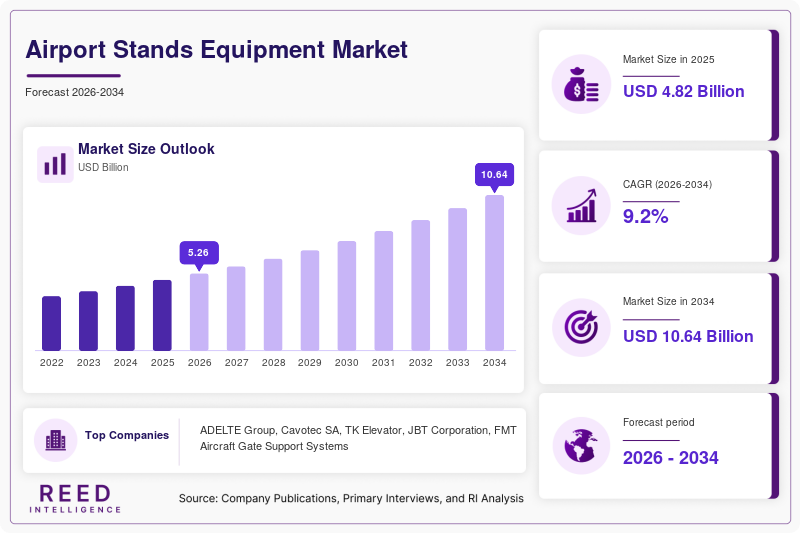
The global Airport Stands Equipment Market size was valued at USD 4.82 billion in 2026 and is projected to reach USD 9.76 billion by 2034, expanding at a CAGR of 9.2% during the forecast period from 2026 to 2034. The market is experiencing stable growth due to rising investments in airport modernization, fleet expansion programs, and increasing aircraft movements across international and domestic routes. Airport stand equipment plays a critical role in improving aircraft turnaround efficiency, passenger handling, and apron safety. The equipment includes passenger boarding bridges, pre-conditioned air units, ground power units, aircraft docking systems, and apron service technologies that support airport stand operations.
The steady recovery of global air traffic and the expansion of smart airport infrastructure projects have supported demand for advanced airport stand systems. Governments and airport authorities are allocating larger infrastructure budgets to reduce aircraft congestion and improve gate utilization rates. Airports are increasingly deploying automated docking systems, electric ground power units, and digital monitoring solutions to reduce emissions and optimize operational efficiency. The integration of predictive maintenance technologies and IoT-enabled stand management systems is also strengthening long-term market growth.
Key Highlights
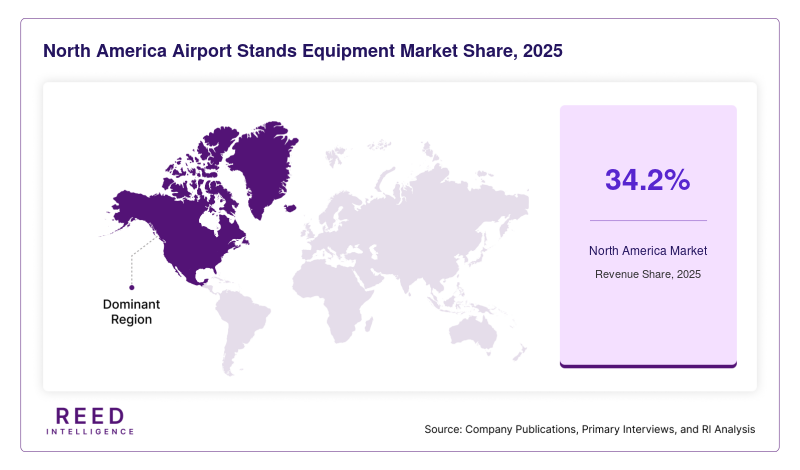
- North America dominated the market with a 34.2% share in 2025, while Asia Pacific is expected to grow at the fastest CAGR of 11.4% during 2026–2034.
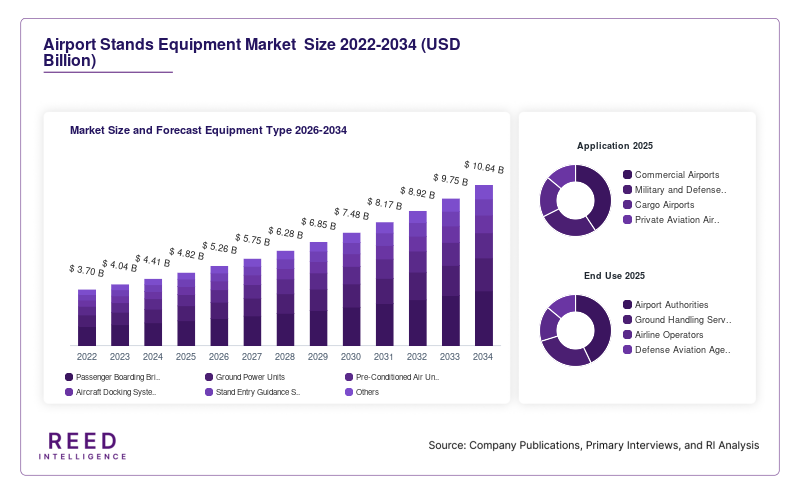
- By equipment type, passenger boarding bridges accounted for the largest share of 36.8%, while electric ground power units are projected to grow at a CAGR of 12.1%.
- By application, commercial airports led with a 58.6% share, whereas military and defense airports are expected to expand at a CAGR of 10.8%.
- The United States remained the dominant country, with market values of USD 1.08 billion in 2024 and USD 1.18 billion in 2025.
Market Trends
Expansion of smart airport infrastructure projects
Airport authorities across developed and emerging economies are increasing investments in smart airport projects to improve operational efficiency and passenger movement. Modern airport terminals are integrating automated stand allocation systems, digital docking technologies, and centralized apron management platforms to reduce aircraft turnaround time. Smart airport development is creating strong demand for connected airport stand equipment that can communicate with airport control systems in real time. Several airports are replacing conventional ground support infrastructure with intelligent and energy-efficient equipment that supports predictive maintenance and operational visibility.
The growing adoption of data analytics and IoT-based monitoring systems is improving stand utilization and reducing maintenance downtime. Airports are also introducing integrated passenger boarding bridges and automated visual docking guidance systems to improve safety standards. These investments are becoming increasingly important as passenger traffic rises across major international hubs. Airport operators are prioritizing scalable stand infrastructure that supports larger aircraft fleets and future expansion plans, which is expected to accelerate market demand over the coming years.
Growing adoption of electric and low-emission ground equipment
Sustainability goals within the aviation industry are encouraging airports to replace diesel-powered stand equipment with electric and low-emission alternatives. Airport operators are investing in electric ground power units, battery-powered pre-conditioned air systems, and energy-efficient docking solutions to comply with environmental regulations and reduce operational emissions. Airlines are also supporting the transition toward cleaner apron operations to align with broader carbon reduction commitments.
The shift toward electrification is gaining momentum in Europe, North America, and parts of Asia Pacific where airport sustainability programs are receiving government support. Electric stand equipment reduces fuel dependency, lowers maintenance requirements, and minimizes noise pollution near terminal areas. Technological advancements in battery systems and charging infrastructure are further improving equipment performance and operational reliability. As airports continue to modernize their apron infrastructure, demand for electric airport stands equipment is expected to rise significantly during the forecast period.
Market Drivers
Rising global passenger traffic and airport expansion activities
Increasing air passenger traffic is one of the primary growth drivers for the Airport Stands Equipment Market. International tourism recovery, rising middle-class travel demand, and expanding low-cost airline operations are creating pressure on airports to improve stand capacity and aircraft handling efficiency. Several airport authorities are expanding terminals, constructing new runways, and adding aircraft parking bays to support higher flight frequencies. These developments are increasing the installation of advanced stand equipment across both existing and newly developed airports.
Airports are also focusing on minimizing aircraft turnaround times to improve scheduling efficiency and maximize gate utilization. Passenger boarding bridges, docking guidance systems, and ground power units are becoming essential for maintaining operational continuity in busy airport environments. Emerging economies in Asia Pacific, the Middle East, and Latin America are witnessing particularly strong infrastructure investments due to rising domestic aviation demand. These factors are collectively supporting sustained market growth.
Increasing emphasis on operational safety and turnaround efficiency
Airports and airlines are placing stronger emphasis on operational safety, equipment reliability, and turnaround performance. Aircraft stand operations involve multiple safety-critical activities including passenger boarding, aircraft docking, power supply management, and apron vehicle coordination. Modern airport stand equipment helps reduce human error and improves the accuracy of aircraft positioning and servicing activities.
Advanced visual docking guidance systems and automated monitoring technologies are improving apron safety while supporting faster gate operations. Airports are also implementing digital management platforms that provide real-time data on stand occupancy, maintenance schedules, and equipment performance. Faster turnaround times enable airlines to optimize fleet utilization and reduce operational delays, which creates additional demand for advanced airport stand solutions. The need to meet stricter international aviation safety standards is encouraging airport operators to replace outdated infrastructure with modern equipment that improves reliability and operational efficiency.
Market Restraint
High installation and maintenance costs associated with advanced airport stand systems
The high capital investment required for advanced airport stand equipment remains a major challenge for market growth, particularly in developing economies and smaller regional airports. Equipment such as automated passenger boarding bridges, electric ground power units, and intelligent docking guidance systems involves substantial procurement, installation, and integration costs. Airports must also invest in supporting infrastructure including electrical upgrades, charging systems, software integration platforms, and maintenance facilities.
Long replacement cycles and high maintenance requirements can further increase operational expenditure for airport authorities. Many airports operating with limited infrastructure budgets delay modernization projects or continue using conventional equipment to avoid large upfront costs. In addition, integrating modern stand technologies with existing airport systems may require complex retrofitting processes that increase project timelines and costs. Smaller airports in Africa, Latin America, and parts of Asia often face financing limitations, which slows the adoption of technologically advanced stand equipment. These cost-related barriers can restrict market penetration despite the growing need for modernization and operational efficiency improvements.
Market Opportunities
Development of green airports and sustainable aviation infrastructure
The growing focus on sustainable aviation infrastructure is creating new opportunities for airport stand equipment manufacturers. Governments and airport operators are introducing green airport initiatives that encourage the adoption of energy-efficient and low-emission technologies across airport operations. Electric ground support systems, smart power management solutions, and environmentally friendly boarding bridge technologies are gaining attention as airports seek to reduce their carbon footprint.
Several international airports are implementing sustainability targets that include electrified apron operations and reduced fossil fuel dependency. Equipment suppliers are responding by developing battery-powered systems and integrated energy management platforms that improve operational efficiency while supporting environmental compliance. The expansion of green airport programs in Europe, North America, and Asia Pacific is expected to create long-term opportunities for manufacturers offering sustainable stand infrastructure solutions.
Rising investments in regional airports and secondary aviation hubs
Regional airports and secondary aviation hubs are becoming important growth areas for the Airport Stands Equipment Market. Many governments are investing in regional connectivity programs to improve domestic air transportation and support economic development. Smaller airports are expanding operational capacity by constructing additional aircraft stands, improving terminal infrastructure, and upgrading apron systems.
The rise of low-cost carriers and short-haul routes is increasing aircraft movement across regional airports, particularly in Asia Pacific and Latin America. These facilities require cost-effective and scalable stand equipment solutions that improve operational reliability without significantly increasing infrastructure costs. Manufacturers are introducing modular boarding bridges, compact docking systems, and mobile power units designed specifically for regional airport applications. As regional aviation networks continue to expand, demand for efficient airport stand equipment is expected to increase steadily throughout the forecast period.
Segmental Analysis
By Equipment Type
Passenger boarding bridges accounted for the largest share of the Airport Stands Equipment Market in 2024, representing 36.8% of total revenue. These systems are widely deployed across commercial airports due to their importance in improving passenger convenience, operational safety, and boarding efficiency. Large international airports continue to invest in advanced boarding bridge technologies capable of supporting different aircraft models and improving passenger accessibility. Automated bridge positioning systems and integrated safety controls are becoming common features in newly installed infrastructure. Airports are also focusing on upgrading older bridge systems to improve energy efficiency and reduce maintenance costs. The increasing expansion of terminal infrastructure and the construction of additional contact gates are contributing to the strong demand for passenger boarding bridges worldwide.
Electric ground power units are expected to witness the fastest CAGR of 12.1% during the forecast period due to rising sustainability initiatives and the transition toward low-emission airport operations. These units provide electrical power to aircraft while parked at airport stands, reducing dependence on onboard auxiliary power units and lowering fuel consumption. Airports are increasingly adopting electric power systems to comply with environmental regulations and reduce operating costs associated with conventional diesel-powered equipment. Technological improvements in battery performance and charging infrastructure are enhancing equipment reliability and efficiency. Government incentives supporting airport electrification projects are also accelerating adoption rates. The growing focus on green aviation infrastructure is expected to sustain strong growth for electric ground power units over the coming years.
By Application
Commercial airports represented the dominant application segment in 2024, accounting for 58.6% of the global market share. The increasing volume of international and domestic passenger traffic has encouraged airport authorities to invest heavily in stand infrastructure modernization. Commercial airports require advanced stand equipment to support high aircraft movement, reduce delays, and improve passenger handling efficiency. Passenger boarding bridges, docking guidance systems, and ground power units are essential components of airport operations in busy aviation hubs. Airports are also implementing integrated digital platforms that improve stand allocation, maintenance planning, and aircraft servicing coordination. The expansion of airline fleets and increasing frequency of flights continue to strengthen equipment demand across commercial airport applications.
Military and defense airports are projected to register the fastest CAGR of 10.8% during the forecast period due to increasing investments in aviation defense infrastructure and modernization programs. Governments are upgrading military airbases with advanced aircraft handling systems, power supply infrastructure, and automated docking technologies to support operational readiness. Several countries are expanding defense aviation capabilities and constructing new air force facilities to improve regional security operations. Military airports also require highly reliable stand equipment capable of supporting specialized aircraft and mission-critical operations. Technological advancements in durable and mobile stand systems are improving deployment flexibility for defense applications. Rising defense expenditure across Asia Pacific, North America, and the Middle East is expected to contribute significantly to segment growth.
By End Use
Airport authorities accounted for the largest share of the Airport Stands Equipment Market in 2024 due to their direct responsibility for infrastructure development and operational management. Public and private airport operators are investing in advanced stand equipment to improve aircraft turnaround efficiency, passenger safety, and apron management capabilities. Increasing passenger volumes and terminal expansion projects are encouraging airport authorities to adopt intelligent docking systems, electric power units, and automated stand management technologies. Many airports are also prioritizing sustainability goals by replacing conventional equipment with low-emission alternatives. Long-term infrastructure development plans and government funding support continue to drive procurement activities among airport authorities globally. The segment maintains a strong position due to ongoing modernization efforts across major international and regional airports.
Ground handling service providers are expected to witness the fastest CAGR of 10.9% during the forecast period due to the growing outsourcing of airport operational services. Airlines and airport operators are increasingly partnering with third-party service providers to improve operational efficiency and reduce infrastructure management costs. Ground handling companies are investing in mobile stand equipment, electric service systems, and advanced monitoring technologies to enhance service quality and operational flexibility. The increasing complexity of airport operations and rising aircraft movement volumes are creating demand for efficient ground support solutions. Service providers are also focusing on sustainability initiatives by introducing environmentally friendly equipment and digital fleet management systems. These developments are expected to accelerate growth opportunities within the segment.
Regional Analysis
North America
North America accounted for the largest share of the Airport Stands Equipment Market in 2025, representing 34.2% of global revenue. The region is projected to expand at a CAGR of 8.6% between 2026 and 2034 due to ongoing airport modernization programs and strong investments in smart aviation infrastructure. Major airports across the United States and Canada are upgrading passenger boarding systems, apron management technologies, and electric ground support infrastructure to improve operational efficiency. Increasing passenger traffic and the presence of large international airport hubs continue to support equipment replacement and expansion activities across the region.
The United States remained the dominant country within North America due to its extensive commercial aviation network and continuous airport expansion projects. Several large airports are investing in automated docking guidance systems and electric stand equipment to support sustainability objectives and improve turnaround performance. The country is also witnessing increased adoption of digital airport management technologies that enhance gate coordination and aircraft servicing efficiency. Strong regulatory standards related to airport safety and operational reliability continue to encourage investments in advanced stand equipment across both commercial and military aviation sectors.
Europe
Europe represented a significant share of the Airport Stands Equipment Market in 2025 and is expected to grow at a CAGR of 8.9% during the forecast period. Airports across the region are focusing on reducing carbon emissions and improving energy efficiency through the adoption of electric and low-noise apron equipment. The expansion of sustainable airport programs and modernization initiatives is increasing demand for electric ground power units, smart boarding bridges, and automated docking technologies. Several European airports are also integrating digital monitoring systems to improve stand utilization and maintenance planning.
Germany emerged as the dominant country in the European market due to its advanced airport infrastructure and strong focus on aviation sustainability. The country is investing heavily in environmentally friendly airport operations, including electrified apron systems and intelligent energy management platforms. German airports are also emphasizing operational automation to improve aircraft turnaround times and reduce congestion. The presence of leading aviation technology manufacturers and ongoing airport redevelopment projects further supports regional market expansion.
Asia Pacific
Asia Pacific is expected to register the fastest CAGR of 11.4% during the forecast period due to rapid airport construction activities and strong growth in passenger traffic. The region is experiencing substantial investments in new airport terminals, aircraft parking bays, and regional aviation infrastructure. Countries including China, India, Indonesia, and Vietnam are expanding airport capacity to accommodate rising domestic and international travel demand. The increasing number of low-cost carriers and government support for aviation infrastructure development are contributing to strong market growth.
China dominated the Asia Pacific market due to its large-scale airport expansion projects and rapidly growing commercial aviation sector. The country continues to construct new airports and modernize existing facilities to support rising passenger volumes and international connectivity. Chinese airports are increasingly deploying advanced stand equipment such as automated docking systems and electric ground power units to improve operational efficiency. Government-led infrastructure investments and the expansion of domestic airline fleets remain major growth factors for the market in the country.
Middle East & Africa
The Middle East & Africa market is projected to witness steady growth at a CAGR of 9.1% during the forecast period. Airport infrastructure development in the Gulf countries is creating strong demand for technologically advanced airport stand equipment. Several airports in the region are expanding terminal capacity and upgrading apron operations to strengthen their position as global transit hubs. Investments in smart airport technologies and premium passenger services are supporting the adoption of modern boarding bridges, docking systems, and power supply solutions.
The United Arab Emirates remained the leading country in the regional market due to its strong international aviation sector and large-scale airport expansion initiatives. Airports in Dubai and Abu Dhabi are continuously investing in modern stand infrastructure to improve passenger handling capacity and support long-haul airline operations. The country's focus on tourism development and global connectivity is increasing aircraft traffic volumes, which supports additional demand for efficient stand equipment. Advanced airport automation initiatives are also contributing to regional market growth.
Latin America
Latin America is anticipated to experience moderate growth in the Airport Stands Equipment Market, supported by airport modernization efforts and increasing regional air travel demand. The market is forecast to grow at a CAGR of 8.3% from 2026 to 2034 as governments and private operators continue investing in aviation infrastructure upgrades. Airports across Brazil, Mexico, and Colombia are improving terminal operations and expanding aircraft handling capacity to accommodate growing passenger traffic. Rising tourism activities and improving airline connectivity are further supporting infrastructure investments.
Brazil emerged as the dominant country in the regional market due to its extensive domestic aviation network and increasing airport redevelopment activities. The country is investing in terminal modernization and apron expansion projects to support major commercial airports and regional aviation hubs. Growing airline competition and rising passenger volumes are encouraging airports to adopt efficient stand management systems and advanced boarding infrastructure. Public-private partnership models are also helping improve funding availability for airport equipment upgrades across the country.
Competitive Landscape
The Airport Stands Equipment Market is moderately consolidated, with several international and regional companies competing based on product innovation, infrastructure integration capabilities, and long-term airport contracts. Leading companies are focusing on automation technologies, sustainable equipment solutions, and digital monitoring platforms to strengthen their competitive positions. Strategic partnerships with airport authorities and aviation infrastructure developers remain a key growth strategy across the market.
ADELTE Group is recognized as one of the leading companies due to its broad portfolio of passenger boarding bridges and apron technologies used across major international airports. The company continues to expand its presence through airport modernization projects and customized stand infrastructure solutions. Cavotec SA, TK Elevator, JBT Corporation, and FMT Aircraft Gate Support Systems are also important market participants offering advanced airport stand equipment and integrated operational technologies.
Key Players
- ADELTE Group
- Cavotec SA
- TK Elevator
- JBT Corporation
- FMT Aircraft Gate Support Systems
- Thyssenkrupp Airport Systems
- ShinMaywa Industries Ltd.
- UBS Airport Systems
- Adelte Airport Technologies
- Textron GSE
- TLD Group
- ITW GSE
- Siemens AG
- ADB SAFEGATE
- Guangtai Airports Equipment Co., Ltd.
Recent Developments
- In February 2026, Cavotec SA introduced a new electric ground power unit platform designed to reduce airport apron emissions and improve energy efficiency across large commercial airports.
- In June 2025, TK Elevator secured a contract to supply advanced passenger boarding bridges for a major airport expansion project in Southeast Asia.
- In September 2025, ADB SAFEGATE launched an upgraded aircraft docking guidance system featuring AI-enabled monitoring and predictive maintenance capabilities.
- In January 2026, JBT Corporation expanded its airport infrastructure portfolio through the development of modular stand equipment solutions for regional airports.
- In August 2025, ADELTE Group announced the deployment of automated boarding bridge technologies at a newly developed Middle Eastern international airport.
Airport Stands Equipment Market Segments
Equipment Type
- Passenger Boarding Bridges
- Ground Power Units
- Pre-Conditioned Air Units
- Aircraft Docking Systems
- Stand Entry Guidance Systems
- Others
Application
- Commercial Airports
- Military and Defense Airports
- Cargo Airports
- Private Aviation Airports
End Use
- Airport Authorities
- Ground Handling Service Providers
- Airline Operators
- Defense Aviation Agencies
By Region
- North America
- Europe
- APAC
- Middle East and Africa
- LATAM