Airspeed Indicator Market Size, Share & Demand Report By Type (Analog Airspeed Indicators, Digital Airspeed Indicators, Smart Integrated Airspeed Indicators), By Platform (Commercial Aircraft, Military Aircraft, Business Jets, Unmanned Aerial Vehicles, Helicopters), By End Use (Original Equipment Manufacturers, Aftermarket Services), By Region & Segment Forecasts, 2026–2034
USD 3950
Market Overview
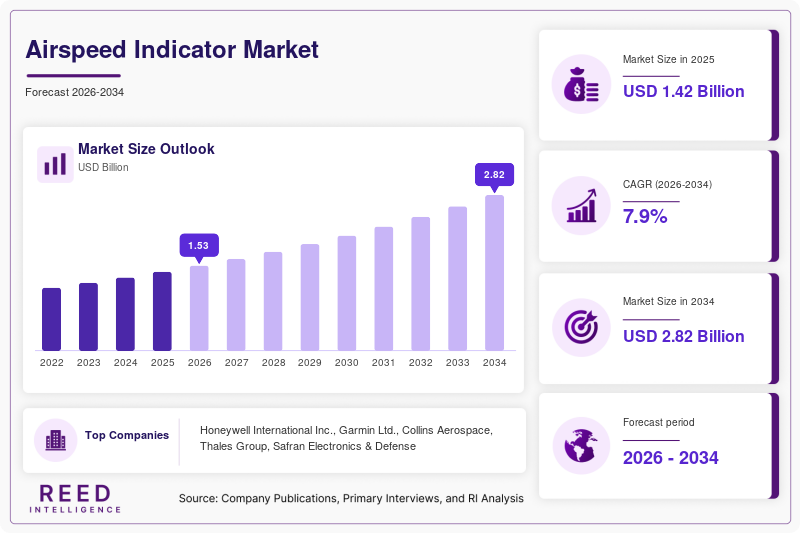
The global Airspeed Indicator Market size was valued at USD 1.42 billion in 2026 and is projected to reach USD 2.61 billion by 2034, expanding at a CAGR of 7.9% during the forecast period from 2026 to 2034. The market continues to gain momentum due to rising commercial aircraft production, increasing investments in military aviation modernization programs, and the growing demand for advanced cockpit instrumentation systems. Airspeed indicators remain a critical component in aircraft navigation and flight safety systems because they provide pilots with accurate speed readings that directly influence operational control and flight performance.
The increasing global air passenger traffic has encouraged airlines to expand their fleets and modernize aging aircraft. This factor has created strong demand for advanced avionics systems, including digital and integrated airspeed indicators. Aircraft manufacturers are focusing on lightweight and highly accurate flight instruments that support real-time data integration with electronic flight displays. In addition, the rise of unmanned aerial vehicles and next-generation urban air mobility platforms has widened the application scope for compact and high-precision airspeed measurement systems.
Key Highlights
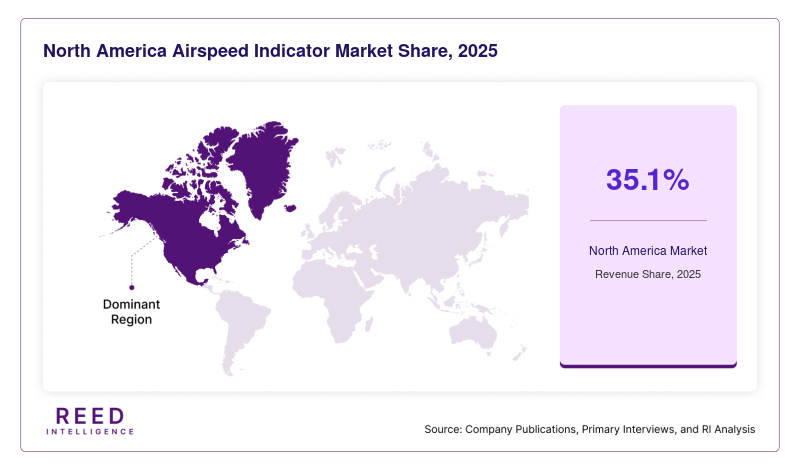
- North America dominated the market with a 35.1% share in 2025.
- Asia Pacific is expected to grow at the fastest CAGR of 9.8% during 2026–2034.
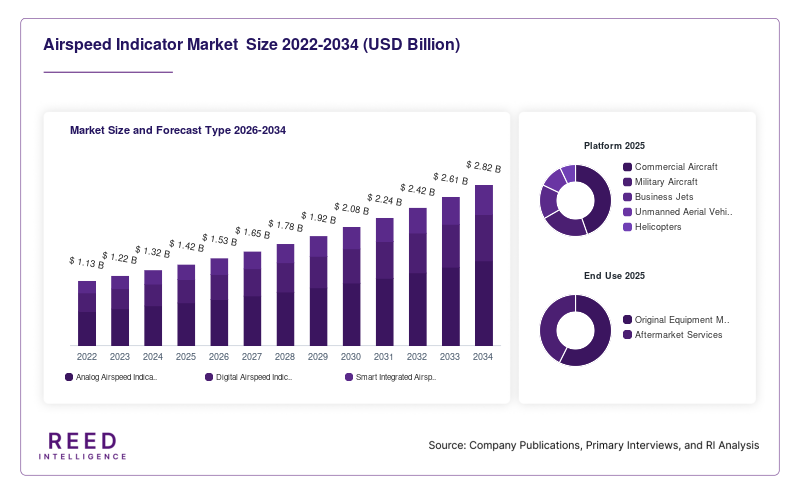
- By type, digital airspeed indicators accounted for the largest share of 44.6%.
- while smart integrated indicators are projected to grow at a CAGR of 10.7%.
- By platform, commercial aircraft led with a 48.9% share.
- whereas unmanned aerial vehicles are expected to expand at a CAGR of 11.4%.
- The United States remained the dominant country, with market values of USD 465 million in 2024 and USD 512 million in 2025.
Market Trends
Expansion of Glass Cockpit Systems Across Commercial Aviation
The increasing integration of glass cockpit systems in commercial and business aircraft has become a major trend influencing the Airspeed Indicator Market. Airlines and aircraft manufacturers are transitioning from analog instrumentation toward fully digital flight decks that improve operational visibility and navigation accuracy. Digital airspeed indicators are now being integrated into multifunction flight displays, enabling pilots to access multiple performance parameters through centralized interfaces. This trend is especially visible in newly manufactured narrow-body and wide-body aircraft designed for fuel efficiency and improved automation.
The adoption of glass cockpit technology has also increased demand for compact electronic airspeed systems with enhanced data processing capabilities. Aircraft operators are prioritizing systems that support real-time diagnostics, predictive maintenance, and lower lifecycle costs. The growing use of touchscreen cockpit displays and advanced avionics software further supports the adoption of intelligent airspeed indicator solutions. Regional airlines and private jet operators are increasingly upgrading older fleets with modern digital instrumentation, creating sustained aftermarket demand for technologically advanced airspeed measurement equipment.
Rising Adoption of Airspeed Indicators in Unmanned Aerial Vehicles
The rapid deployment of unmanned aerial vehicles for defense, logistics, agricultural monitoring, and surveillance applications is contributing to increased demand for lightweight and highly responsive airspeed indicators. UAV manufacturers are focusing on integrating compact avionics systems that support stable flight operations and accurate navigation in varying environmental conditions. Airspeed indicators are becoming essential in both fixed-wing and hybrid drone platforms due to their role in altitude control, speed optimization, and mission reliability.
Governments and defense organizations are increasing investments in long-range UAV programs, which is encouraging the development of miniaturized digital airspeed systems with enhanced precision. Commercial drone applications are also expanding rapidly in sectors such as infrastructure inspection and cargo transportation. This trend is driving innovation in low-power sensor technologies and integrated flight control systems. Manufacturers are increasingly designing airspeed indicators that can function efficiently in autonomous aviation ecosystems, thereby creating long-term opportunities for avionics suppliers and sensor developers.
Market Drivers
Growth in Global Commercial Aircraft Deliveries
The steady increase in global commercial aircraft deliveries is a major factor driving the Airspeed Indicator Market. Airlines across developed and emerging economies are expanding their fleets to accommodate growing passenger traffic and rising regional connectivity. Aircraft manufacturers are receiving large orders for fuel-efficient aircraft equipped with advanced avionics systems, including digital airspeed indicators. Every new aircraft requires reliable flight instrumentation systems to ensure compliance with aviation safety standards and operational efficiency requirements.
The replacement of aging aircraft fleets is also contributing to higher demand for modern airspeed indicator technologies. Airlines are prioritizing advanced cockpit systems that improve pilot situational awareness and reduce maintenance complexity. The increasing production of narrow-body aircraft for short-haul routes has particularly strengthened demand for lightweight and integrated airspeed monitoring solutions. In addition, the expansion of low-cost carriers in Asia Pacific and the Middle East has increased aircraft procurement activities, supporting long-term market growth for aviation instrumentation manufacturers.
Increasing Defense Aviation Modernization Programs
Rising military spending and defense aviation modernization initiatives are supporting the growth of the Airspeed Indicator Market. Several countries are investing in advanced fighter jets, surveillance aircraft, military transport aircraft, and unmanned aerial systems to strengthen national security capabilities. These platforms require accurate airspeed measurement systems that can operate effectively under high-performance and extreme environmental conditions. Defense agencies are also upgrading older aircraft with modern avionics suites to improve mission readiness and flight safety.
The adoption of electronic warfare systems and integrated flight control technologies has increased the need for sophisticated digital airspeed indicators capable of seamless data integration. Military aircraft operators require highly durable systems that deliver reliable performance during combat missions and long-duration operations. In addition, defense contractors are focusing on reducing aircraft weight and enhancing operational efficiency through smart avionics architecture. Growing cross-border defense collaborations and aircraft procurement contracts are expected to sustain strong demand for advanced airspeed indicator technologies during the forecast period.
Market Restraint
High Maintenance and Certification Costs Associated With Advanced Avionics
The high maintenance and certification costs associated with advanced avionics systems remain a key restraint for the Airspeed Indicator Market. Modern digital airspeed indicators require strict compliance with aviation safety regulations and certification procedures established by international aviation authorities. These approval processes often increase product development timelines and operational costs for manufacturers. Smaller avionics suppliers may face challenges in meeting evolving technical standards, particularly for integrated cockpit systems used in commercial and military aircraft.
Maintenance complexity also affects adoption rates among smaller airline operators and private aircraft owners. Electronic airspeed indicators depend on advanced sensors, software integration, and real-time calibration systems that require specialized technical expertise. Any malfunction or calibration issue can impact flight safety and increase aircraft downtime. In developing regions, limited access to skilled maintenance personnel and certified repair facilities further restricts widespread adoption of advanced instrumentation systems. For example, regional airlines operating older fleets may delay upgrades due to budget limitations and concerns regarding installation compatibility. These factors can slow the pace of modernization in cost-sensitive aviation markets.
Market Opportunities
Increasing Demand for Urban Air Mobility Platforms
The emergence of urban air mobility platforms is creating substantial opportunities for the Airspeed Indicator Market. Electric vertical takeoff and landing aircraft are being developed for urban transportation, emergency response, and short-distance passenger mobility applications. These aircraft require compact and highly responsive avionics systems capable of supporting automated navigation and flight stabilization. Airspeed indicators play a critical role in maintaining operational safety and efficient flight performance in congested urban airspaces.
Technology developers and aerospace startups are investing heavily in lightweight sensor systems that can support electric aircraft architectures. The growing focus on autonomous and semi-autonomous flight operations is expected to increase the need for integrated digital airspeed solutions. Governments and aviation regulators are also developing frameworks to support urban air mobility infrastructure, which may accelerate aircraft deployment over the next decade. This transition is likely to create new revenue opportunities for avionics manufacturers specializing in advanced airspeed sensing and cockpit integration technologies.
Expansion of Aircraft Retrofit and Aftermarket Services
The growing aircraft retrofit and aftermarket services sector presents another major opportunity for the Airspeed Indicator Market. Airlines and aircraft operators are increasingly upgrading legacy aircraft with digital avionics systems to improve operational efficiency and comply with updated aviation regulations. Retrofit projects often include the replacement of analog airspeed indicators with electronic flight instrumentation systems that provide enhanced visibility and data accuracy.
The rising demand for cost-effective modernization solutions is encouraging avionics manufacturers to introduce modular airspeed indicator systems compatible with older aircraft platforms. Business jet operators and regional carriers are actively investing in cockpit upgrades to improve flight safety and reduce maintenance costs. In addition, maintenance, repair, and overhaul service providers are expanding their avionics capabilities to address rising retrofit demand. The growing availability of customizable digital instrumentation packages is expected to strengthen aftermarket growth opportunities across both commercial and private aviation sectors.
Segmental Analysis
By Type
Digital airspeed indicators represented the dominant subsegment within the type category, accounting for 44.6% of the market share in 2024. The increasing adoption of electronic flight instrument systems across commercial and military aviation has significantly contributed to the expansion of this segment. Digital indicators provide enhanced accuracy, improved readability, and seamless integration with multifunction cockpit displays, making them more suitable for modern aviation requirements than traditional analog systems. Airlines and aircraft manufacturers are increasingly prioritizing digital avionics solutions to improve flight safety, reduce pilot workload, and support real-time operational monitoring.
The transition toward connected aircraft ecosystems has also strengthened demand for advanced digital airspeed measurement systems. These systems support predictive maintenance capabilities and enable efficient integration with navigation and autopilot technologies. Commercial aircraft manufacturers are particularly focusing on lightweight digital instrumentation systems that improve fuel efficiency and reduce maintenance complexity. The growing use of advanced avionics in regional jets and business aircraft is expected to further strengthen the position of digital airspeed indicators during the forecast period.
By Platform
Commercial aircraft accounted for the largest share within the platform segment, representing 48.9% of the market in 2024. Rising global passenger traffic and increasing airline fleet expansion have created strong demand for advanced airspeed indicators in commercial aviation. Airlines are modernizing aircraft fleets with digital avionics systems that improve navigation accuracy, flight efficiency, and operational safety. Narrow-body aircraft deliveries have increased substantially due to the expansion of low-cost carriers and regional air travel networks.
The commercial aviation industry is also witnessing growing adoption of connected cockpit technologies and integrated flight displays. Aircraft manufacturers are focusing on reducing aircraft weight and enhancing fuel efficiency through modern avionics integration. Digital airspeed indicators have become an essential component of electronic flight instrument systems used in both newly manufactured and retrofitted aircraft. Increasing regulatory emphasis on flight safety and pilot situational awareness is expected to sustain long-term demand for reliable and high-performance airspeed measurement systems across the commercial aviation sector.
By End Use
Original equipment manufacturers held the dominant share within the end-use segment, accounting for 61.3% of the market in 2024. Aircraft manufacturers are increasingly integrating advanced airspeed indicators into newly produced aircraft to meet rising demand for digital avionics systems. OEMs prefer highly integrated cockpit solutions that improve aircraft performance, operational efficiency, and safety compliance. The increasing production of commercial aircraft, military jets, and business aviation platforms has contributed significantly to growth in this segment.
OEM partnerships with avionics suppliers have also strengthened technological innovation within the market. Aircraft manufacturers are investing in next-generation cockpit systems that support automation, predictive maintenance, and real-time performance analytics. The transition from analog instrumentation to digital flight displays has increased demand for advanced airspeed indicators capable of seamless system integration. Growing investments in electric aircraft and urban air mobility platforms are expected to create additional opportunities for OEM-focused avionics manufacturers over the coming years.
Regional Analysis
North America
North America accounted for 35.1% of the global Airspeed Indicator Market in 2025 and is expected to maintain a stable growth trajectory with a CAGR of 7.1% during the forecast period. The region benefits from a strong aerospace manufacturing ecosystem, advanced aviation infrastructure, and high defense spending. Commercial airlines in the United States and Canada continue to modernize fleets with integrated avionics systems that improve operational safety and fuel efficiency. The presence of leading aircraft manufacturers and avionics suppliers further supports sustained demand for digital airspeed indicator technologies.
The United States remains the dominant country within the region due to large-scale aircraft production and rising investments in defense aviation programs. The country has witnessed increasing procurement of advanced fighter aircraft, surveillance drones, and commercial jets equipped with next-generation cockpit systems. Another major growth factor is the expansion of aircraft retrofit activities across regional and private aviation sectors. Airlines are upgrading older aircraft with modern flight instrumentation systems to comply with evolving safety standards and improve operational reliability.
Europe
Europe represented 27.4% of the global Airspeed Indicator Market in 2025 and is projected to grow at a CAGR of 7.4% through 2034. The region continues to benefit from strong aircraft manufacturing capabilities and increasing investments in sustainable aviation technologies. European airlines are focusing on fuel-efficient aircraft equipped with lightweight avionics systems that support digital flight operations. Demand for integrated airspeed indicators is also increasing due to the modernization of regional aircraft fleets and the expansion of cross-border air travel within the continent.
Germany remains the dominant country in the European market due to its advanced aerospace engineering sector and strong presence of avionics component manufacturers. The country is investing heavily in research and development activities related to smart aviation systems and digital cockpit technologies. A unique growth factor supporting the German market is the increasing collaboration between aerospace companies and technology developers focused on autonomous flight systems. These partnerships are driving innovation in sensor integration and intelligent airspeed measurement technologies.
Asia Pacific
Asia Pacific held 22.8% of the global Airspeed Indicator Market in 2025 and is anticipated to register the fastest CAGR of 9.8% during the forecast period. Rapid air passenger traffic growth, expanding airline networks, and rising aircraft procurement activities are major contributors to regional demand. Countries across Asia Pacific are investing in airport infrastructure and aviation modernization programs to strengthen regional connectivity. This environment is encouraging the adoption of advanced cockpit instrumentation systems, including digital airspeed indicators for commercial and military aircraft.
China dominates the Asia Pacific market due to its large-scale aviation expansion and increasing domestic aircraft production capabilities. The country continues to invest in indigenous aircraft manufacturing programs and advanced defense aviation systems. A major growth factor in China is the rapid expansion of unmanned aerial vehicle applications across logistics, surveillance, and agricultural operations. This trend has increased demand for compact and highly efficient airspeed indicators suitable for autonomous and remotely operated aircraft platforms.
Middle East & Africa
The Middle East & Africa region accounted for 8.2% of the global Airspeed Indicator Market in 2025 and is expected to grow at a CAGR of 7.6% through 2034. Rising investments in aviation infrastructure and increasing commercial airline expansion are supporting market development. Several Gulf countries are strengthening their positions as international aviation hubs by investing in fleet modernization and airport development projects. Demand for advanced airspeed indicators is increasing as airlines prioritize modern aircraft equipped with integrated avionics and navigation systems.
Saudi Arabia remains the leading country within the region due to significant investments in commercial aviation and defense modernization initiatives. The country is actively expanding its airline capacity and increasing procurement of advanced aircraft platforms to support tourism and economic diversification goals. One unique growth factor is the government’s focus on building a domestic aerospace manufacturing ecosystem. This strategy is encouraging partnerships with global avionics suppliers and supporting long-term demand for aviation instrumentation technologies.
Latin America
Latin America captured 6.5% of the global Airspeed Indicator Market in 2025 and is projected to witness a CAGR of 6.9% during the forecast period. The region is experiencing moderate growth due to gradual improvements in regional air connectivity and increasing airline fleet upgrades. Commercial aviation operators are focusing on enhancing aircraft operational efficiency through the adoption of modern avionics systems. Demand for digital airspeed indicators is also increasing among business jet operators and regional carriers seeking reliable and low-maintenance flight instrumentation solutions.
Brazil dominates the Latin American market because of its established aerospace manufacturing industry and expanding regional airline operations. The country has become an important center for aircraft production and aviation engineering within the region. A unique growth factor supporting the Brazilian market is the increasing use of agricultural and surveillance aircraft across remote operational environments. This trend has created demand for durable and accurate airspeed measurement systems capable of functioning effectively in diverse climatic conditions.
Competitive Landscape
The Airspeed Indicator Market is moderately consolidated, with leading avionics manufacturers competing through product innovation, strategic partnerships, and aircraft integration capabilities. Major companies are focusing on developing lightweight digital airspeed indicators with advanced sensor technologies and intelligent cockpit integration features. The competitive environment is shaped by increasing demand for connected avionics systems, modernization of commercial aircraft fleets, and rising defense aviation investments.
Honeywell International Inc. remains one of the leading companies in the market due to its broad avionics portfolio and strong partnerships with global aircraft manufacturers. The company continues to invest in digital flight instrumentation technologies designed for commercial, defense, and business aviation applications. Garmin Ltd., Collins Aerospace, and Thales Group are also strengthening their market positions through integrated cockpit solutions and advanced electronic flight display systems.
In a recent development, Collins Aerospace introduced an upgraded avionics platform featuring enhanced digital flight instrumentation and improved sensor integration for next-generation aircraft applications. Companies are also increasing investments in artificial intelligence-enabled avionics systems capable of supporting autonomous and semi-autonomous flight operations. Strategic collaborations between aircraft OEMs and avionics technology providers are expected to intensify competitive activity across the global market.
Key Players
- Honeywell International Inc.
- Garmin Ltd.
- Collins Aerospace
- Thales Group
- Safran Electronics & Defense
- L3Harris Technologies Inc.
- Astronautics Corporation of America
- Dynon Avionics
- Mid-Continent Instruments and Avionics
- Avidyne Corporation
- Curtiss-Wright Corporation
- Genesys Aerosystems
- Meggitt PLC
- Aspen Avionics Inc.
Recent Developments
- Honeywell International Inc. expanded its digital avionics product line in 2025 with upgraded airspeed monitoring systems designed for advanced commercial aircraft cockpit integration.
- Garmin Ltd. introduced a compact electronic airspeed indicator platform for light aircraft and unmanned aerial vehicle applications in 2024.
- Collins Aerospace announced the integration of enhanced sensor technologies into its flight instrumentation systems to improve operational accuracy and predictive maintenance capabilities.
- Thales Group partnered with regional aircraft manufacturers to develop lightweight avionics solutions for next-generation electric and hybrid aircraft platforms.
Airspeed Indicator Market Segments
Type
- Analog Airspeed Indicators
- Digital Airspeed Indicators
- Smart Integrated Airspeed Indicators
Platform
- Commercial Aircraft
- Military Aircraft
- Business Jets
- Unmanned Aerial Vehicles
- Helicopters
End Use
- Original Equipment Manufacturers
- Aftermarket Services
By Region
- North America
- Europe
- APAC
- Middle East and Africa
- LATAM