Aldehyde Tanning Agents Market Size, Share & Demand Report By Type (Glutaraldehyde, Oxazolidine, Formaldehyde-Based, Others), By Application (Automotive Leather, Footwear, Garments, Upholstery, Others), By End-Use Industry (Fashion, Automotive, Furniture, Industrial), By Formulation (Liquid, Powder), By Region & Segment Forecasts, 2025–2034
USD 3950
Market Overview
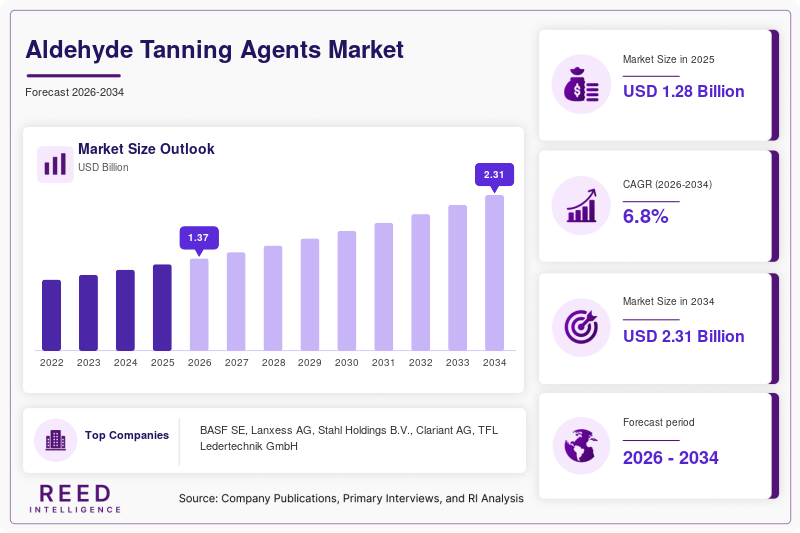
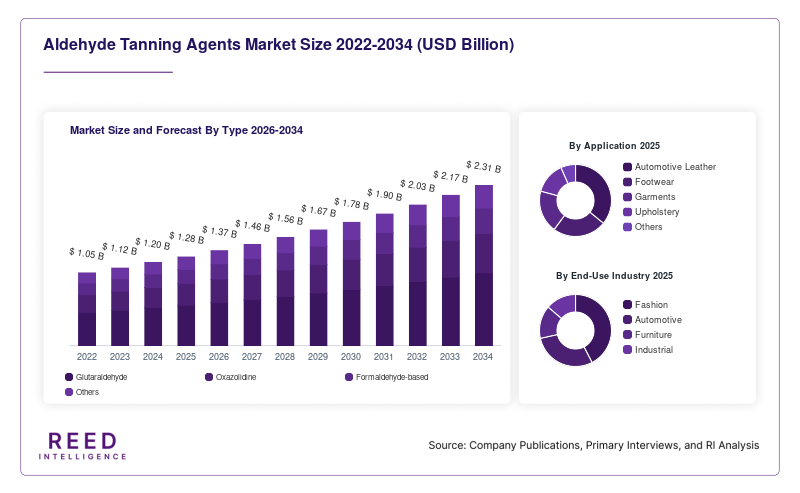
The global Aldehyde Tanning Agents Market size was valued at approximately USD 1.28 billion in 2025 and is projected to reach USD 2.31 billion by 2034, expanding at a compound annual growth rate (CAGR) of 6.8% during the forecast period (2025–2034). The market growth is primarily driven by increasing demand for eco-friendly leather processing solutions across the footwear, automotive, and fashion industries.
A key global factor supporting the growth of the Aldehyde Tanning Agents Market is the tightening of environmental regulations on chromium-based tanning processes. Regulatory authorities across major economies have encouraged the adoption of alternative tanning technologies, including aldehyde-based systems, due to their lower toxicity and improved biodegradability. This shift has significantly influenced manufacturers to adopt safer and more sustainable tanning methods, thereby boosting market expansion.
Key Highlights:
- Asia Pacific dominated the market with a 38.5% share in 2025, while Latin America is projected to register the fastest CAGR of 7.6% through 2034.
- By type, glutaraldehyde accounted for the largest share (46.2%), whereas oxazolidine-based agents are expected to grow fastest at a CAGR of 7.9%.
- By application, automotive leather held the leading share (34.1%), while footwear applications are anticipated to expand at the fastest CAGR of 7.3%.
- China remained the dominant country with a market value of USD 312 million in 2025, expected to reach USD 333 million in 2026.
Market Trends
Shift Toward Chrome-Free Tanning Technologies
The Aldehyde Tanning Agents Market is witnessing a growing shift toward chrome-free tanning processes. Manufacturers are increasingly adopting aldehyde-based formulations to comply with environmental standards and reduce hazardous waste. This transition is particularly prominent in premium leather goods and automotive upholstery, where sustainability certifications are becoming essential. As brands emphasize eco-conscious production, aldehyde tanning agents are gaining traction as a viable alternative, supporting long-term market growth.
Integration of Advanced Chemical Formulations
Continuous innovation in chemical engineering has led to the development of advanced aldehyde tanning agents with improved penetration and fixation properties. These formulations enhance leather quality by offering better softness, uniformity, and resistance to heat and moisture. Additionally, hybrid systems combining aldehydes with other synthetic agents are gaining popularity, as they provide optimized performance while maintaining environmental compliance. This trend is expected to expand application scope and drive competitive differentiation in the market.
Market Drivers
Increasing Demand for Sustainable Leather Processing
The rising emphasis on sustainable manufacturing practices is a major driver of the Aldehyde Tanning Agents Market. Industries such as fashion, automotive, and furniture are under pressure to adopt environmentally friendly materials and processes. Aldehyde tanning agents offer reduced environmental impact compared to traditional chromium-based methods, making them a preferred choice for manufacturers aiming to meet regulatory and consumer expectations.
Growth in Automotive and Luxury Goods Industries
The expanding automotive sector, particularly in emerging economies, is significantly contributing to market growth. High-quality leather interiors are increasingly used in passenger vehicles, driving demand for advanced tanning solutions. Similarly, the luxury goods industry continues to grow, with rising consumer spending on premium leather products. These industries require durable and aesthetically superior leather, which aldehyde tanning agents can effectively provide, thereby boosting market demand.
Market Restraint
High Cost and Performance Limitations Compared to Chromium Tanning
One of the key restraints in the Aldehyde Tanning Agents Market is the relatively higher cost of aldehyde-based tanning processes compared to conventional chromium tanning. Small and medium-scale tanneries often face financial constraints in transitioning to these alternatives, limiting widespread adoption.
Additionally, aldehyde tanning agents may not always match the performance characteristics of chromium-based systems, particularly in terms of tensile strength and heat resistance. This can restrict their use in certain high-performance applications, such as industrial leather products. Despite ongoing research and development efforts, these limitations continue to pose challenges for market penetration, especially in cost-sensitive regions.
Market Opportunities
Expansion in Emerging Markets
Emerging economies in Asia Pacific, Latin America, and Africa present significant growth opportunities for the Aldehyde Tanning Agents Market. Rapid industrialization, increasing urbanization, and growing consumer demand for leather products are driving the expansion of the tanning industry in these regions. As environmental awareness increases, manufacturers are likely to adopt aldehyde tanning agents, creating new growth avenues.
Development of Bio-Based Tanning Agents
The development of bio-based aldehyde tanning agents represents a promising opportunity for market players. Innovations in green chemistry are enabling the production of sustainable and renewable tanning solutions. These products not only reduce environmental impact but also appeal to eco-conscious consumers and brands. As research progresses, bio-based aldehyde agents are expected to gain traction, offering a competitive edge to companies investing in sustainable technologies.
Segmental Analysis
By Type
Glutaraldehyde dominated the Aldehyde Tanning Agents Market in 2025, accounting for 46.2% of the total share. Its widespread use is attributed to its effectiveness in producing soft and durable leather with good resistance to environmental factors. The availability and relatively established processing methods have further supported its dominance.
Oxazolidine-based tanning agents are expected to grow at the fastest CAGR of 7.9% during the forecast period. These agents offer improved environmental compatibility and enhanced performance characteristics, making them suitable for high-end applications. Their increasing adoption in premium leather production will drive segment growth.
By Application
Automotive leather held the largest share of 34.1% in 2025, driven by the growing demand for high-quality interiors in passenger vehicles. Aldehyde tanning agents provide the required softness and durability, making them ideal for automotive applications.
Footwear applications are projected to grow at the fastest CAGR of 7.3% through 2034. The rising demand for comfortable and stylish footwear, coupled with increasing consumer awareness of sustainable products, will drive the adoption of aldehyde tanning agents in this segment.
By End-Use Industry
The fashion industry dominated the market in 2025, accounting for 39.5% of the total share. The demand for premium leather products, including bags, jackets, and accessories, has driven the use of aldehyde tanning agents.
The furniture industry is expected to witness the fastest growth, with a CAGR of 7.2%. Increasing demand for leather upholstery in residential and commercial spaces will support the growth of this segment.
By Formulation
Liquid formulations accounted for the largest share of 58.3% in 2025 due to their ease of application and compatibility with existing tanning processes. These formulations are widely used in industrial-scale operations.
Powder formulations are expected to grow at a CAGR of 6.9%, driven by their longer shelf life and ease of transportation. Their adoption is likely to increase in regions with developing infrastructure.
Regional Analysis
North America
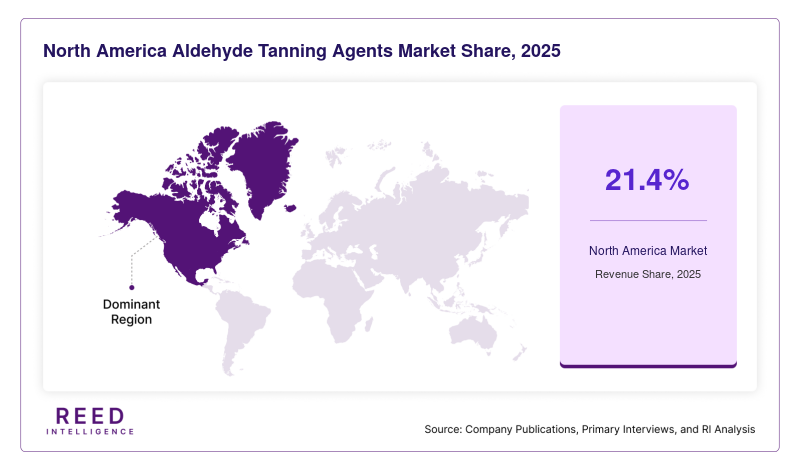
North America accounted for approximately 21.4% of the Aldehyde Tanning Agents Market share in 2025 and is expected to grow at a CAGR of 5.9% during the forecast period. The region’s growth will be driven by stringent environmental regulations and the presence of advanced leather processing technologies.
The United States dominated the regional market due to its strong automotive and luxury goods sectors. The country’s focus on sustainable manufacturing practices has encouraged the adoption of aldehyde tanning agents, supporting steady market growth.
Europe
Europe held a market share of 24.7% in 2025 and is projected to expand at a CAGR of 6.2% through 2034. The region has been at the forefront of environmental regulations, promoting the use of eco-friendly tanning solutions.
Germany emerged as the dominant country, supported by its well-established automotive industry and emphasis on high-quality leather products. The demand for premium and sustainable leather has driven the adoption of aldehyde tanning agents in the region.
Asia Pacific
Asia Pacific led the Aldehyde Tanning Agents Market with a 38.5% share in 2025 and is expected to grow at a CAGR of 7.1% over the forecast period. The region’s dominance is attributed to the large-scale leather production and increasing demand for footwear and automotive products.
China remained the leading country, driven by its extensive manufacturing base and export-oriented leather industry. The growing adoption of environmentally friendly processes is further boosting market growth in the region.
Middle East & Africa
The Middle East & Africa accounted for 8.6% of the market share in 2025 and is anticipated to grow at a CAGR of 6.5% during the forecast period. The region’s growth will be supported by expanding leather industries and increasing investments in manufacturing infrastructure.
South Africa led the regional market due to its established leather processing sector and growing demand for high-quality leather goods. Government initiatives to promote sustainable practices are also contributing to market expansion.
Latin America
Latin America held a market share of 6.8% in 2025 and is expected to register the fastest CAGR of 7.6% through 2034. The region’s growth is driven by rising demand for leather products and increasing awareness of environmentally friendly tanning methods.
Brazil dominated the regional market, supported by its large livestock industry and strong leather production capabilities. The adoption of advanced tanning technologies is expected to further accelerate market growth.
Competitive Landscape
The Aldehyde Tanning Agents Market is moderately fragmented, with several global and regional players competing on product innovation and sustainability. Leading companies are focusing on developing eco-friendly formulations and expanding their production capacities.
The market leader, BASF SE, has maintained its position through continuous investment in research and development. The company recently introduced a new range of low-emission aldehyde tanning agents aimed at improving environmental performance.
Other key players are actively strengthening their market presence through strategic collaborations, product launches, and geographic expansion. Companies are also investing in advanced technologies to enhance product efficiency and meet evolving industry requirements.
Key Players List
- BASF SE
- Lanxess AG
- Stahl Holdings B.V.
- Clariant AG
- TFL Ledertechnik GmbH
- Schill + Seilacher GmbH
- Zschimmer & Schwarz GmbH
- Trumpler GmbH & Co. KG
- Pulcra Chemicals GmbH
- Buckman Laboratories International Inc.
- Dow Inc.
- Eastman Chemical Company
- DyStar Group
- Tanatex Chemicals
- Elementis plc
Recent Developments
- BASF SE launched a new eco-efficient aldehyde tanning solution aimed at reducing water consumption in leather processing.
- Lanxess AG expanded its production capacity for specialty chemicals, including tanning agents, in Asia Pacific.
- Stahl Holdings introduced a sustainable product line focused on chrome-free leather processing technologies.
- Clariant AG partnered with regional distributors to strengthen its presence in emerging markets.
- TFL Ledertechnik developed advanced aldehyde formulations with improved biodegradability.
Aldehyde Tanning Agents Market Segments
By Type
- Glutaraldehyde
- Oxazolidine
- Formaldehyde-based
- Others
By Application
- Automotive Leather
- Footwear
- Garments
- Upholstery
- Others
By End-Use Industry
- Fashion
- Automotive
- Furniture
- Industrial
By Formulation
- Liquid
- Powder
By Region
- North America
- Europe
- APAC
- Middle East and Africa
- LATAM