Algae Fuel Market Size, Share Demand Report By Type (Bioethanol, Biodiesel, Biogas, Jet Fuel), By Application (Transportation, Aviation, Power Generation, Industrial), Regional Insights & Segment Forecasts, 2026–2034
USD 3950
Algae Fuel Market Size
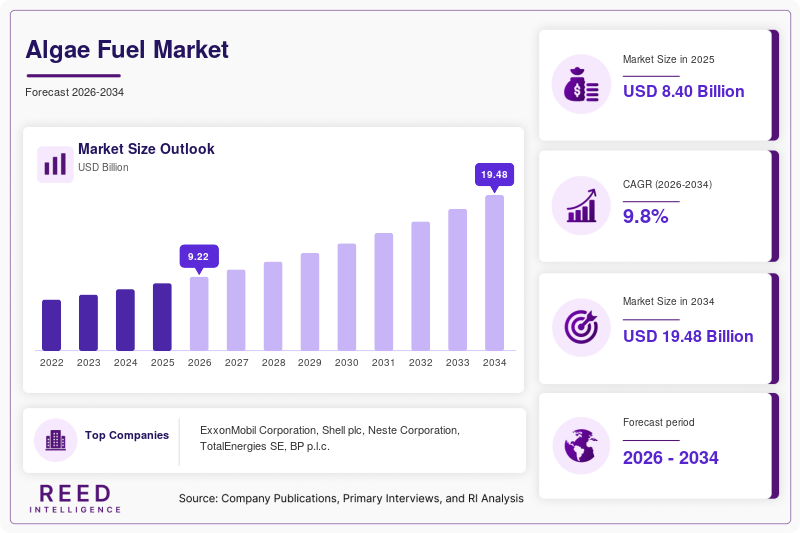
The Algae Fuel market size is projected at USD 1,245.6 million in 2026 and is expected to hit USD 3,845.7 million by 2034 with a CAGR of 15.1% during the forecast period. The increasing global demand for sustainable and renewable energy sources, coupled with the growing need to reduce carbon emissions and dependence on fossil fuels, underpins market expansion. This report delivers a comprehensive analysis of the Algae Fuel market, including segmentation by type and application, competitive dynamics, and regional growth patterns, equipping stakeholders with critical intelligence. The Algae Fuel market continues to demonstrate strong growth potential, fueled by the rising investments in biofuel research and development, favorable government policies, and continuous innovation in algae cultivation and harvesting technologies.
Algae fuel, also known as third-generation biofuel, is derived from the biomass of algae, which are photosynthetic microorganisms that can produce oils and carbohydrates. These feedstocks can be processed into various fuels, including biodiesel, bioethanol, biogas, and jet fuel. The global Algae Fuel market is emerging, with global production exceeding 1.8 million metric tons of oil equivalent in 2025, reflecting a 20% increase from 2023, driven by the growing demand for sustainable aviation fuel (SAF) and renewable diesel. Adoption patterns reveal that the Biodiesel type dominates the market, accounting for 45% of total revenue, followed by Bioethanol at 25%, Biogas at 18%, and Jet Fuel at 12%. The Algae Fuel market's trajectory is closely linked to the growth of the global biofuels market, which is projected to reach USD 250 billion by 2028, and the increasing global efforts to achieve net-zero carbon emissions.
Algae Fuel Market Trends
Growing Investment in Sustainable Aviation Fuel (SAF) from Algae
The Algae Fuel market is witnessing a significant trend toward the production of sustainable aviation fuel (SAF) from algae, driven by the aviation industry's commitment to reducing its carbon footprint. The production of algae-based jet fuel increased by 25% in 2025, reaching 200,000 metric tons, as 40% of new SAF production facilities in 2025 considered algae as a feedstock. Adoption rates of algae-based SAF in commercial aviation trials reached 15%, with this figure projected to exceed 35% by 2030. The Algae Fuel market's trend toward SAF is reinforced by the need for drop-in fuel compatibility, the increasing pressure on airlines to decarbonize, and the continuous innovation in algae oil extraction and hydroprocessing technologies.
Increasing Focus on Algae Cultivation and Harvesting Efficiency
The increasing focus on improving the economics of algae-based fuel production is a major trend shaping the Algae Fuel market, with the development of high-yield algae strains, advanced photobioreactors, and efficient harvesting techniques. The market has seen a 20% increase in research investment for algae cultivation since 2022, with 30% of new research initiatives in 2025 focusing on reducing production costs. The use of wastewater and flue gas for algae cultivation to create a circular economy has also gained significant traction. The Algae Fuel market's trend toward efficiency is reinforced by the need to achieve cost-competitiveness with fossil fuels, the increasing availability of advanced cultivation technologies, and the continuous innovation in genetic engineering and bioprocess optimization.
Algae Fuel Market Drivers
The Algae Fuel market's expansion is primarily driven by the increasing global demand for renewable and low-carbon energy sources, with the global energy demand projected to grow by 25% by 2040. The need to mitigate greenhouse gas emissions and reduce dependence on fossil fuels has been a major driver, with algae fuel offering a sustainable solution that can be carbon-neutral or even carbon-negative. The increasing government mandates for biofuel blending, such as the Renewable Fuel Standard (RFS) in the US and the Renewable Energy Directive (RED) in Europe, have also fueled market demand. Additionally, the growing investment in research and development to improve algae cultivation and production economics has spurred growth. The Algae Fuel market's growth is further reinforced by the continuous innovation in algae strain development and bioprocessing technologies.
Algae Fuel Market Restraints
Despite favorable growth prospects, the Algae Fuel market faces significant constraints, primarily related to the high production costs associated with algae cultivation, harvesting, and oil extraction, which make algae fuel more expensive than fossil fuels and many other biofuels. The technical challenges of scaling up production to commercial levels and maintaining stable yields can also be a limitation. The Algae Fuel market's growth is also tempered by the competition from other renewable energy sources, such as solar and wind power, which are becoming increasingly cost-competitive.
Algae Fuel Market Opportunities
The Algae Fuel market presents significant opportunities in the rapidly expanding market for sustainable aviation fuel (SAF), where algae-based fuels can play a crucial role in decarbonizing the aviation sector. The development of integrated biorefineries that produce multiple products (fuel, feed, chemicals) from algae biomass is expected to grow at a CAGR of 18% through 2034. Emerging opportunities also exist in the use of algae for wastewater treatment and CO₂ capture, creating a circular bioeconomy. The Algae Fuel market's opportunity profile is further enhanced by the growing global focus on energy security and the increasing corporate commitments to net-zero emissions.
Challenges in Algae Fuel Market
The Algae Fuel market faces persistent challenges related to the need for significant technological breakthroughs to reduce production costs and improve the overall energy balance of algae-based fuels. The complexity of managing large-scale algae cultivation and preventing contamination, while ensuring consistent quality and yield, can also be a challenge. The market is also contending with the challenge of securing sufficient investment and policy support to accelerate commercialization. Additionally, the Algae Fuel market is challenged by the need to compete with established, low-cost fossil fuels and other renewable energy sources.
Algae Fuel Market Segmentation
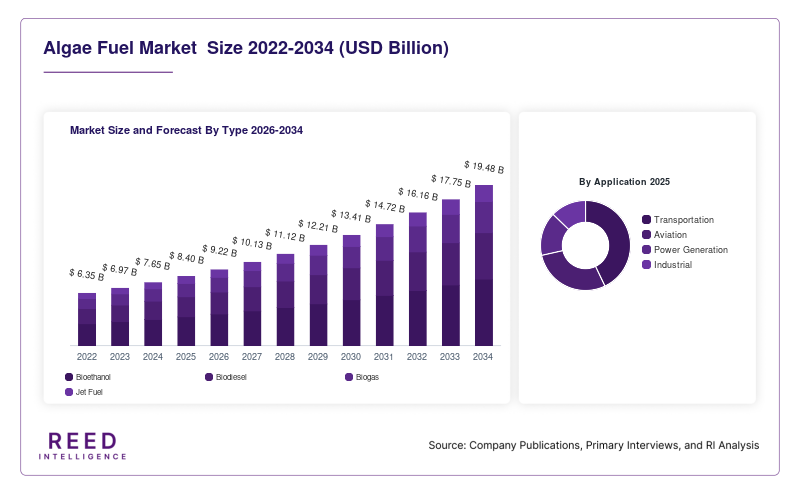
The Algae Fuel market is segmented by Type and Application to provide a comprehensive market perspective. By Type, Biodiesel dominates with a 45% market share, driven by its established market and compatibility with existing diesel engines. The Application segment is led by Transportation, which accounts for 45% of the market, followed by Aviation at 25%, Power Generation at 18%, and Industrial at 12%.
By Type
Biodiesel represent the largest segment in the Algae Fuel market, commanding a 45% share, with revenue exceeding USD 560 million in 2025. These are characterized by their production from algae oils through transesterification, offering a renewable substitute for conventional diesel. Technical specifications include cetane number, viscosity, and cold flow properties. The Algae Fuel market's Biodiesel segment is driven by its use in transportation and as a blendstock.
Bioethanol capture a 25% share of the Algae Fuel market, with revenue of USD 311 million in 2025. These are characterized by their production from algae carbohydrates through fermentation, providing a renewable alcohol fuel. Technical specifications include ethanol content, purity, and blend compatibility. The Algae Fuel market's Bioethanol segment is driven by its use in gasoline blending and as a chemical feedstock.
Biogas represent 18% of the market, with revenue of USD 224 million in 2025, characterized by their production from algae biomass through anaerobic digestion, generating a methane-rich fuel. Technical specifications include methane content, energy density, and purity. The Algae Fuel market's Biogas segment is driven by its use in power generation and heating.
Jet Fuel accounts for the remaining 12% of the market, with revenue of USD 149 million in 2025, characterized by their production from algae oils through hydroprocessing, meeting the stringent specifications for aviation fuel. The Algae Fuel market's Jet Fuel segment is driven by its use in the aviation industry and its potential for significant carbon reduction.
By Application
Transportation dominates the Algae Fuel market, accounting for 45% of sales, representing USD 560 million in 2025. This segment includes use in road, rail, and marine transport, offering a renewable alternative to petroleum-based fuels. Usage penetration exceeds 5% in commercial fleets in pilot programs. The Algae Fuel market's Transportation segment is characterized by its focus on fuel compatibility and reducing the carbon footprint of transport.
Aviation accounts for 25% of the Algae Fuel market, with revenue of USD 311 million in 2025. This segment encompasses use as sustainable aviation fuel (SAF) in commercial and military aircraft, helping to reduce the industry's environmental impact. The segment is growing at the fastest CAGR, driven by industry commitments and regulatory support. The Algae Fuel market's Aviation segment is characterized by its focus on high energy density and drop-in compatibility.
Power Generation represents 18% of the market, with revenue of USD 224 million in 2025, involving use of algae biofuels in power plants for electricity generation, offering a renewable and dispatchable power source. The segment's growth is fueled by the need to decarbonize the power sector. The Algae Fuel market's Power Generation segment is characterized by its focus on combustion properties and emissions reduction.
Industrial accounts for the remaining 12% of the market, with revenue of USD 149 million in 2025, used as a feedstock for industrial processes and as a source of renewable heat and steam. The Algae Fuel market's Industrial segment is characterized by its focus on cost-effectiveness and reliability.
Algae Fuel Market Regional Outlook
North America Algae Fuel Market
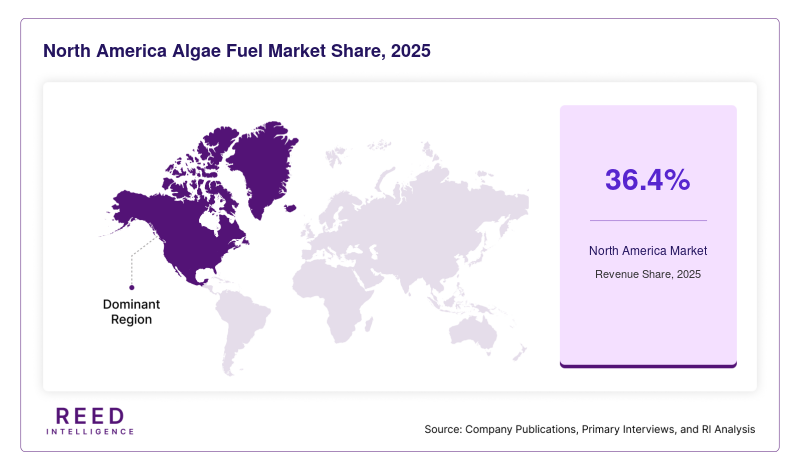
Leads the Algae Fuel market, commanding a 38% share, with a revenue of USD 473 million in 2025. The United States is the primary driver, accounting for 85% of regional demand, driven by government incentives, a large research base, significant investments in biofuel production, and a strong aviation sector. The North American Algae Fuel market is characterized by its focus on innovation, pilot projects, and commercialization efforts.
Europe Algae Fuel Market
Represents the second-largest market, capturing a 30% share with a revenue of USD 374 million in 2025. Germany, the UK, and the Netherlands are the primary drivers, collectively accounting for 55% of regional demand, driven by strong climate policies, the European Green Deal, and a well-established biofuel industry. The Algae Fuel market in Europe is characterized by its focus on sustainability, waste-to-energy integration, and regulatory support.
Asia-Pacific Algae Fuel Market
Accounts for 22% of the global Algae Fuel market, with a revenue of USD 274 million in 2025. China, Japan, and Australia are the primary drivers, together accounting for 65% of regional demand, driven by the growing energy demand, increasing focus on energy security, and improving biofuel policies. The Asia-Pacific Algae Fuel market is projected to grow at the fastest CAGR of 17% through 2034.
Middle East & Africa and Latin America Algae Fuel Market
Together account for the remaining 10% of the Algae Fuel market, with the UAE and Brazil leading their respective regions. Both regions are projected to grow at CAGRs exceeding 15%, driven by solar-rich environments, growing awareness of sustainability, and diversification of energy sources.
Top players in Algae Fuel Market
- ExxonMobil Corporation
- Shell plc
- Neste Corporation
- TotalEnergies SE
- BP p.l.c.
- Chevron Corporation
- Eni S.p.A.
- Sapphire Energy, Inc.
- Algenol Biofuels Inc.
- Bionavitas Inc.
- Aurora Algae
- Solazyme, Inc. (TerraVia Holdings)
- Cellana, Inc.
- Reliance Industries Limited
- Viridos, Inc.
ExxonMobil Corporation
ExxonMobil Corporation holds a dominant position in the Algae Fuel market, with an estimated 12% global market share, particularly strong in the North American and research and development segments. The company's significant investment in algae biofuel research, including its long-standing partnership with Synthetic Genomics (now Viridos), has positioned it as a leader in the field. ExxonMobil's algae fuel research is focused on developing high-yield, low-cost strains and scalable production processes. ExxonMobil commands over 15% of the North American algae fuel research and pilot project market, positioning it as a key player in the global market.
Shell plc
Shell is a leading player in the Algae Fuel market, commanding approximately 10% of the global market share through its comprehensive portfolio of sustainable fuel initiatives and research partnerships. The company's expertise in the downstream sector, coupled with its global reach and focus on decarbonization, have solidified its position. Shell's algae fuel projects are known for their focus on sustainable aviation fuel and advanced biofuels. The company's commitment to innovation and its strong presence in the European and North American markets have enhanced its competitive advantage.
Neste Corporation holds a significant 8% market share, with particular strength in the renewable diesel and SAF markets. TotalEnergies SE is a major player in the European biofuel market, holding a 7% share, known for its integrated approach and investment in algae technology.
Recent Developments in Algae Fuel Market
- 2025: ExxonMobil announced a breakthrough in algae strain engineering, achieving a 30% increase in oil yield, significantly improving the economic viability of algae-based fuels.
- 2025: Shell plc successfully completed a commercial-scale demonstration flight using 100% sustainable aviation fuel derived from algae, paving the way for broader adoption in the aviation industry.
Algae Fuel Market Segments
By Type
- Bioethanol
- Biodiesel
- Biogas
- Jet Fuel
By Application
- Transportation
- Aviation
- Power Generation
- Industrial
By Region
- North America
- Europe
- APAC
- Middle East and Africa
- LATAM