Algeria Food Fibers Market Size, Share & Demand Report By Type (Soluble Fiber, Insoluble Fiber, Resistant Starch), By Source (Cereals & Grains, Fruits & Vegetables, Legumes), By Application (Food & Beverages, Dietary Supplements, Animal Feed), By End-Use (Food Manufacturing, Nutraceuticals, Pharmaceuticals), By Distribution Channel (Direct Sales, Retail, Online) & Segment Forecasts, 2026–2034
USD 3950
Market Overview
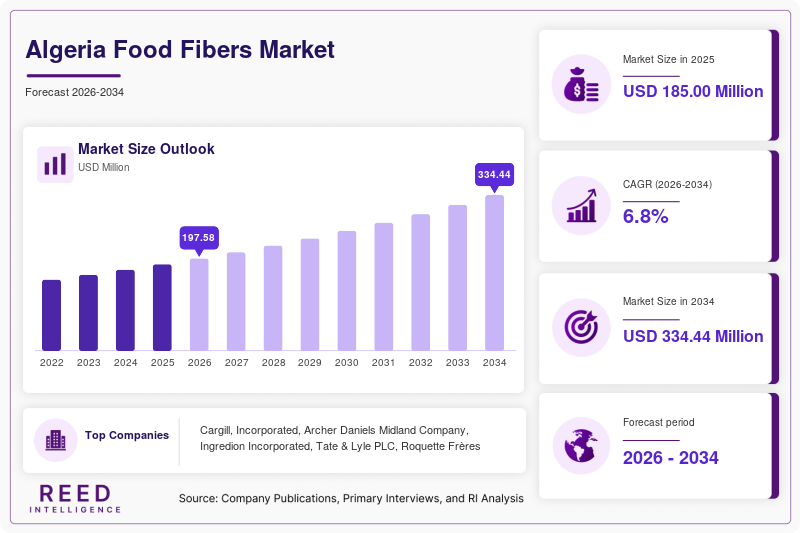
The Algeria Food Fibers Market size was valued at approximately USD 185 million in 2026 and is projected to reach around USD 315 million by 2034, expanding at a CAGR of 6.8% during the forecast period (2026–2034). The steady growth of this market reflects rising consumer awareness regarding digestive health, weight management, and functional food consumption. Increasing urbanization and shifts in dietary patterns toward processed and fortified foods have further supported the demand for food fibers across Algeria.
A major global factor contributing to the expansion of the Algeria Food Fibers Market is the growing emphasis on preventive healthcare. Worldwide dietary recommendations encouraging higher fiber intake have influenced both manufacturers and consumers. This has led to increased incorporation of soluble and insoluble fibers in bakery, dairy, and beverage products. Additionally, advancements in food processing technologies have enabled the efficient extraction and application of dietary fibers from natural sources such as cereals, fruits, and vegetables.
Key Highlights:
- The Middle East & Africa accounted for approximately 28% of the market share in 2025 and is projected to grow at a CAGR of 7.1%.
- Soluble fibers dominated the type segment with a 54% share, while resistant starch is expected to register the fastest CAGR of 7.6%.
- The food & beverages application segment held the largest share at 62%, while functional beverages are anticipated to grow at a CAGR of 7.9%.
- Algeria recorded market values of USD 170 million in 2024 and USD 177 million in 2025, reflecting consistent year-on-year growth.
Market Trends
Increasing Adoption of Functional Foods
The Algeria Food Fibers Market is experiencing a shift toward functional foods enriched with dietary fibers. Consumers are actively seeking products that provide health benefits beyond basic nutrition, such as improved digestion, cholesterol management, and blood sugar control. Food manufacturers in Algeria are incorporating fibers into staple products like bread, dairy items, and snack foods. This trend is supported by evolving retail channels and product innovation, where labels highlighting “high fiber” or “added fiber” claims are gaining prominence. As a result, functional foods are becoming a key growth driver in both urban and semi-urban regions.
Rising Demand for Plant-Based Ingredients
Another notable trend shaping the Algeria Food Fibers Market is the growing preference for plant-based ingredients. Consumers are increasingly favoring natural and clean-label products, prompting manufacturers to use fibers derived from sources such as oats, barley, fruits, and legumes. This shift aligns with broader global trends toward sustainability and healthier lifestyles. The demand for plant-based fibers is also supported by regulatory encouragement for healthier food formulations. As manufacturers expand their product portfolios to include plant-based alternatives, the demand for natural fiber ingredients is expected to rise significantly over the forecast period.
Market Drivers
Growing Health Awareness Among Consumers
Rising awareness about the health benefits of dietary fiber is a primary driver of the Algeria Food Fibers Market. Consumers are increasingly informed about the role of fiber in maintaining digestive health, preventing chronic diseases, and supporting weight management. Public health campaigns and nutritional guidelines have emphasized fiber intake, encouraging consumers to adopt healthier diets. This shift has led to increased demand for fiber-enriched food products across various categories, including bakery, dairy, and beverages. As awareness continues to grow, the market is expected to witness sustained demand.
Expansion of Processed Food Industry
The expansion of the processed food sector in Algeria has significantly contributed to the growth of the Algeria Food Fibers Market. With changing lifestyles and increased urbanization, consumers are relying more on convenience foods. Manufacturers are incorporating dietary fibers into processed products to enhance nutritional value and appeal to health-conscious consumers. Additionally, the rise of modern retail formats and improved distribution networks has facilitated the availability of fiber-enriched products. This ongoing expansion of the processed food industry is expected to drive market growth throughout the forecast period.
Market Restraint
High Cost of Functional Ingredients
One of the major challenges facing the Algeria Food Fibers Market is the relatively high cost associated with functional fiber ingredients. Extracting, processing, and incorporating dietary fibers into food products require advanced technologies and quality control measures, which increase production costs. These costs are often passed on to consumers, making fiber-enriched products more expensive than conventional alternatives.
In a price-sensitive market like Algeria, this can limit widespread adoption, particularly among lower-income groups. Small and medium-sized manufacturers may also face difficulties in sourcing high-quality fiber ingredients at competitive prices, restricting their ability to innovate and compete. Furthermore, the lack of local production capabilities for certain specialized fibers leads to reliance on imports, adding to overall costs.
While demand for healthy food options is rising, the affordability factor remains a critical barrier. Addressing this restraint through local sourcing, cost optimization, and technological advancements will be essential for ensuring long-term market growth.
Market Opportunities
Development of Local Fiber Sources
The Algeria Food Fibers Market presents significant opportunities in the development of locally sourced dietary fibers. Algeria’s agricultural sector produces a variety of crops such as wheat, barley, fruits, and vegetables that can serve as raw materials for fiber extraction. Investing in local processing facilities can reduce dependency on imports and lower production costs. This approach also supports sustainability and boosts the domestic economy. As demand for fiber-rich foods increases, leveraging local resources can create
Growth of Functional Beverage Segment
The functional beverage segment offers promising growth opportunities within the Algeria Food Fibers Market. Consumers are increasingly opting for convenient and health-focused beverage options, including fiber-enriched juices, smoothies, and dairy drinks. These products cater to on-the-go lifestyles while addressing nutritional needs. Innovation in flavor profiles and formulations is expected to drive consumer interest. Additionally, marketing strategies emphasizing digestive health benefits can further boost adoption. As the beverage industry continues to evolve, fiber-enriched drinks are likely to become a key growth area.
Segmental Analysis
By Type
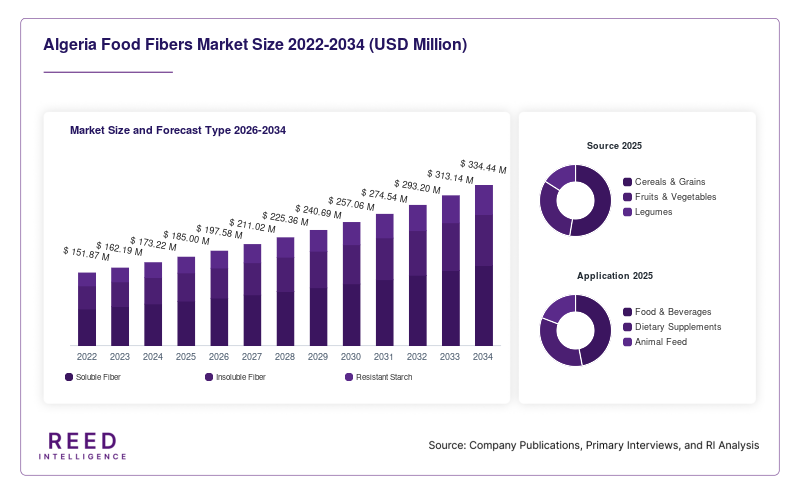
Soluble fibers dominated the Algeria Food Fibers Market in 2025, accounting for approximately 54% of the share. Their widespread use in food products due to their ability to dissolve in water and improve texture made them highly preferred. These fibers are commonly used in beverages, dairy products, and bakery items, contributing to their leading position.
Resistant starch is expected to be the fastest-growing subsegment, with a projected CAGR of 7.6%. Its ability to support gut health and act as a prebiotic is expected to drive demand. Increasing application in functional foods and health-focused products will further accelerate growth.
By Source
Cereal-based fibers held the dominant share of around 48% in 2025. The abundance of wheat and barley in Algeria supported the use of cereal-derived fibers in food manufacturing. These fibers are widely used in bakery and processed food products due to their functional properties.
Fruit-based fibers are projected to grow at the fastest CAGR of 7.5%. Rising demand for natural and clean-label ingredients is expected to drive this segment. The use of fruit fibers in beverages and snacks will further support growth.
By Application
The food & beverages segment dominated the market with a share of approximately 62% in 2025. The incorporation of dietary fibers into everyday food products contributed to its leading position. Bakery, dairy, and snack products are major contributors within this segment.
Functional beverages are expected to be the fastest-growing subsegment, registering a CAGR of 7.9%. Increasing consumer preference for convenient and health-oriented drinks will drive demand. Product innovation and marketing strategies will play a key role in segment expansion.
By End-Use
The food manufacturing sector held the largest share of about 58% in 2025. Manufacturers are increasingly incorporating dietary fibers to enhance nutritional value and meet consumer demand for healthier products.
The nutraceutical segment is anticipated to grow at the fastest CAGR of 7.8%. The rising popularity of dietary supplements and functional ingredients will support growth. Consumers seeking targeted health benefits are expected to drive demand in this segment.
Regional Analysis
North America
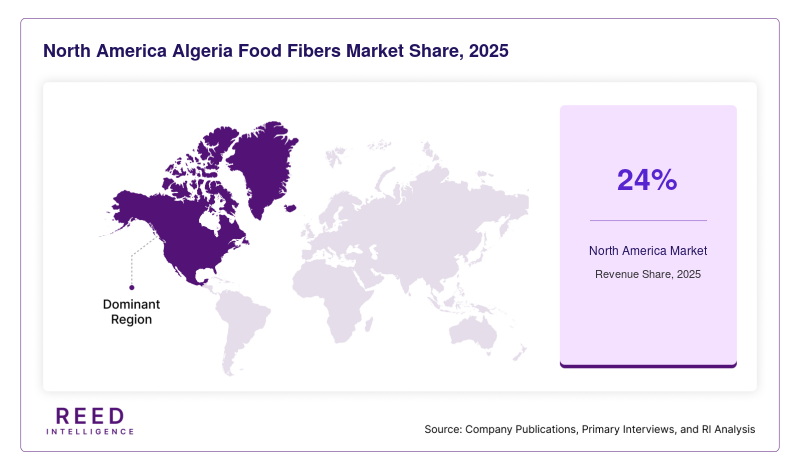
North America accounted for approximately 24% of the global market share in 2025 and is expected to grow at a CAGR of 6.5% during the forecast period. The region’s established food processing industry and high consumer awareness regarding dietary fibers contributed to its significant share.
The United States dominated the regional market due to strong demand for functional foods. The presence of advanced manufacturing technologies and widespread availability of fiber-enriched products supported growth. Increasing consumer focus on health and wellness further strengthened market expansion.
Europe
Europe held around 22% of the market share in 2025 and is projected to grow at a CAGR of 6.3% from 2026 to 2034. The region’s stringent food regulations and emphasis on nutritional labeling supported the adoption of dietary fibers.
Germany emerged as the dominant country, driven by its robust food and beverage industry. The country’s focus on product innovation and health-conscious consumer base contributed to sustained demand for fiber-enriched products.
Asia Pacific
Asia Pacific captured approximately 18% of the market share in 2025 and is anticipated to grow at a CAGR of 7.4% during the forecast period. Rapid urbanization and changing dietary habits supported market growth in the region.
China led the market due to its large population and expanding processed food sector. Increasing awareness of health benefits and rising disposable incomes further fueled demand for dietary fibers.
Middle East & Africa
The Middle East & Africa region accounted for about 28% of the market share in 2025 and is expected to grow at a CAGR of 7.1%. The region’s growing population and rising health awareness contributed to its leading position.
Algeria dominated the regional market, driven by increasing consumption of processed and fortified foods. Government initiatives promoting healthier diets and improved food distribution networks supported market expansion.
Latin America
Latin America held nearly 8% of the market share in 2025 and is projected to grow at a CAGR of 6.7% during the forecast period. The region’s evolving food industry and increasing consumer awareness supported growth.
Brazil emerged as the dominant country, benefiting from its strong agricultural base. The availability of raw materials for fiber production and growing demand for functional foods contributed to market development.
Competitive Landscape
The Algeria Food Fibers Market is moderately competitive, with the presence of both international and regional players. Companies are focusing on product innovation, strategic partnerships, and expansion of distribution networks to strengthen their market position.
A leading player in the market is Cargill, Incorporated, which has been actively expanding its portfolio of fiber ingredients. The company recently introduced new soluble fiber solutions tailored for functional food applications, enhancing its market presence.
Other key players are investing in research and development to create cost-effective and sustainable fiber solutions. Collaborations with local distributors and food manufacturers are also helping companies expand their reach within Algeria.
Key Players List
- Cargill, Incorporated
- Archer Daniels Midland Company
- Ingredion Incorporated
- Tate & Lyle PLC
- Roquette Frères
- Kerry Group
- DuPont Nutrition & Biosciences
- BENEO GmbH
- Nexira
- SunOpta Inc.
- Fiberstar Inc.
- Südzucker AG
- Lonza Group
- A&B Ingredients
- Grain Processing Corporation
Recent Developments
- In 2025, several manufacturers expanded their product portfolios with plant-based fiber ingredients.
- New partnerships between global suppliers and local distributors improved product availability in Algeria.
- Investment in local processing facilities increased to reduce dependency on imports.
- Product innovation in functional beverages gained momentum, supporting market growth.
Algeria Food Fibers Market Segments
Type
- Soluble Fiber
- Insoluble Fiber
- Resistant Starch
Source
- Cereals & Grains
- Fruits & Vegetables
- Legumes
Application
- Food & Beverages
- Dietary Supplements
- Animal Feed
End-Use
- Food Manufacturing
- Nutraceuticals
- Pharmaceuticals
Distribution Channel
- Direct Sales
- Retail
- Online
By Region
- North America
- Europe
- APAC
- Middle East and Africa
- LATAM