Alginate Casing Market Size, Share & Demand Report By Type (Food-Grade Alginate Casings, Industrial-Grade Alginate Casings), By Product Type (Edible Casings, Non-Edible Casings), By Application (Meat Processing, Plant-Based Food, Others), By End-Use Industry (Food Processing Industry, Food Service Industry), By Distribution Channel (Direct Sales, Distributors, Online Channels), By Region & Segment Forecasts, 2025–2034
USD 3950
Market Overview
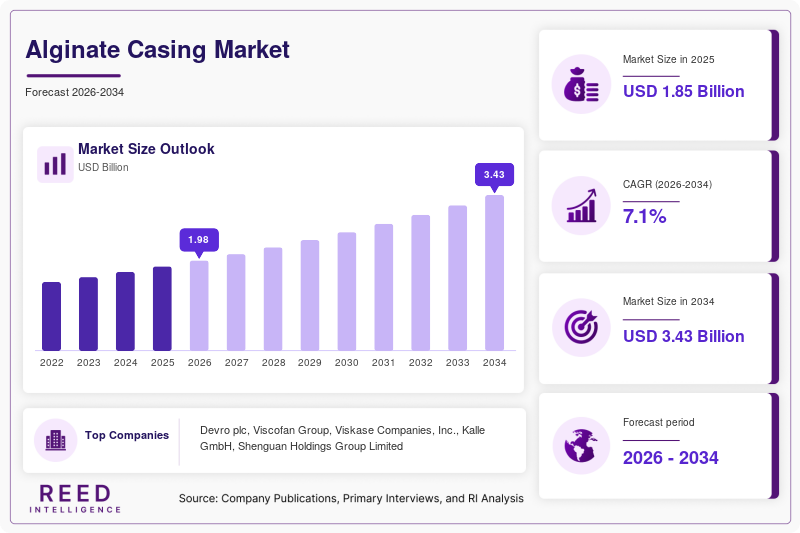
The Alginate Casing Market size was valued at approximately USD 1.85 billion in 2025 and is projected to reach USD 3.42 billion by 2034, expanding at a CAGR of 7.1% during the forecast period (2025–2034). Alginate casing, derived from natural seaweed extracts, has emerged as a viable alternative to traditional animal-based casings in the food processing industry. The increasing global preference for plant-based, clean-label, and sustainable food ingredients has significantly supported the expansion of this market.
A major global factor driving the market is the growing demand for vegan and vegetarian food products, especially plant-based sausages and processed meat alternatives. Manufacturers are increasingly adopting alginate casing due to its uniformity, cost-efficiency, and compatibility with automated production lines. Additionally, regulatory pressure to reduce reliance on animal-derived products and improve food safety standards has accelerated the shift toward alginate-based solutions.
Key Highlights
- Dominant region: Europe accounted for 34.6% market share in 2025, while Asia Pacific is expected to grow at a CAGR of 8.4% through 2034.
- Leading subsegments: Food-grade alginate casings led the type segment with 68.2% share, while edible casings are projected to grow at a CAGR of 7.9%.
- Dominant country: Germany led with USD 310 million in 2025 and is estimated to reach USD 328 million in 2026 due to strong processed meat consumption and advanced food processing infrastructure.
Market Trends
Rising Adoption of Plant-Based Food Processing Solutions
The transition toward plant-based diets is reshaping the Alginate Casing Market. Food manufacturers are increasingly using alginate casings in vegetarian sausages and meat analogs to replicate the texture and appearance of traditional products. This trend is supported by consumer awareness regarding sustainability, animal welfare, and health-conscious eating. Alginate casings provide consistent quality and are suitable for high-speed automated production, making them ideal for large-scale plant-based food manufacturing.
Technological Advancements in Co-Extrusion Processing
Innovations in co-extrusion technology are enhancing the efficiency of alginate casing production. Advanced systems allow simultaneous extrusion of meat or plant-based filling and alginate casing, improving productivity and reducing material waste. These technological improvements are enabling manufacturers to produce uniform, customizable casings with better mechanical strength and elasticity. As automation increases across food processing plants, demand for co-extrusion-compatible alginate casings is expected to grow steadily.
Market Drivers
Increasing Demand for Clean-Label and Natural Ingredients
Consumers are increasingly prioritizing transparency in food labeling, leading to a surge in demand for natural and recognizable ingredients. Alginate, derived from brown seaweed, aligns well with clean-label trends, making it an attractive alternative to synthetic or animal-based casings. This shift has encouraged food processors to integrate alginate casings into their product lines, particularly in premium and organic food categories.
Efficiency Gains in Industrial Food Processing
Alginate casings offer operational advantages such as uniform thickness, reduced breakage, and compatibility with automated production lines. These benefits enhance production efficiency and reduce labor costs. As food manufacturers seek to scale operations and maintain consistent quality, alginate casings have become a preferred choice, especially in high-volume sausage production facilities.
Market Restraint
Limited Consumer Awareness in Emerging Markets
Despite its advantages, the Alginate Casing Market faces challenges due to limited awareness in developing regions. Many small and medium-scale food processors continue to rely on traditional casings due to familiarity and lower upfront investment requirements. Additionally, the perception of alginate casings as a specialized or premium product restricts widespread adoption. In regions where processed food industries are still evolving, lack of technical expertise and limited access to advanced machinery further hinder market penetration. Overcoming these barriers will require targeted education, cost optimization strategies, and improved distribution networks.
Market Opportunities
Expansion in Plant-Based Meat Alternatives
The rapid growth of plant-based meat alternatives presents a strong opportunity for the Alginate Casing Market. As companies innovate to improve taste and texture, alginate casings provide an effective solution for replicating traditional sausage structures. This segment is expected to expand significantly as consumer demand for sustainable protein sources continues to rise globally.
Growth in Emerging Food Processing Economies
Developing regions such as Southeast Asia, Latin America, and parts of Africa are witnessing increased investment in food processing infrastructure. As these markets modernize, adoption of advanced technologies, including alginate casing systems, is expected to rise. Local manufacturers are gradually transitioning toward scalable and efficient production methods, creating new growth avenues for alginate casing suppliers.
Segmental Analysis
By Type
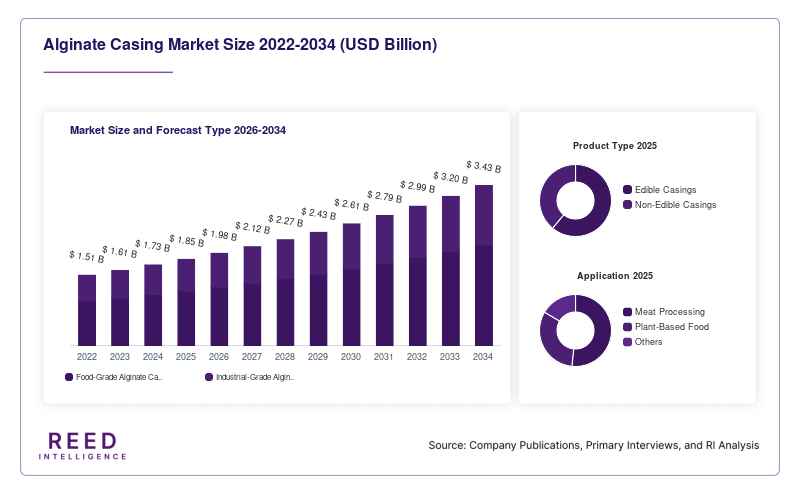
The food-grade alginate casing segment dominated the Alginate Casing Market with a 68.2% share in 2025. This dominance was attributed to its widespread use in edible applications, particularly in sausage production. Food-grade casings offer safety, consistency, and compliance with regulatory standards, making them the preferred choice for manufacturers.
The industrial-grade alginate casing segment is expected to grow at a CAGR of 6.9%. Growth will be driven by its application in non-food sectors and specialized processing requirements. Increasing diversification of alginate applications is expected to support this segment.
By Product Type
The edible casings segment accounted for 61.5% of the market share in 2025. These casings were widely used in food products due to their convenience and ability to enhance texture and flavor.
The non-edible casings segment is projected to grow at a CAGR of 7.3%, driven by demand in industrial and specialized applications where removal before consumption is required.
By Application
The meat processing segment held the largest share of 54.7% in 2025. Alginate casings were extensively used in sausage production due to their uniformity and compatibility with automated systems.
The plant-based food applications segment is expected to grow at a CAGR of 8.6%, supported by increasing demand for meat alternatives. This segment will benefit from ongoing innovation in plant-based product formulations.
By End-Use Industry
The food processing industry dominated with a 72.4% share in 2025, reflecting the primary use of alginate casings in food manufacturing.
The food service industry is anticipated to grow at a CAGR of 7.0%, driven by rising demand for ready-to-cook and ready-to-eat products in restaurants and catering services.
By Distribution Channel
The direct sales segment accounted for 65.8% of the market in 2025, as large manufacturers preferred direct procurement from suppliers to ensure quality and cost efficiency.
The online distribution channel is projected to grow at a CAGR of 8.1%, driven by increasing digitalization and the expansion of e-commerce platforms for industrial supplies.
Regional Analysis
North America
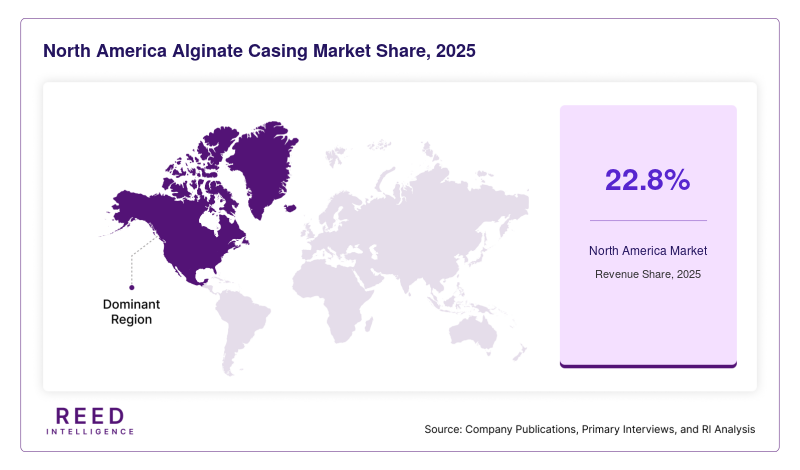
North America accounted for 22.8% of the Alginate Casing Market share in 2025 and is projected to grow at a CAGR of 6.5% from 2025 to 2034. The region’s growth was supported by the presence of a well-established processed food industry and increasing demand for alternative protein products. Consumers showed a strong inclination toward convenience foods, which boosted the use of alginate casings in ready-to-cook and ready-to-eat products.
The United States dominated the regional market due to its advanced food processing ecosystem. The country’s focus on innovation in plant-based food production and increasing investments in automation contributed to the steady adoption of alginate casing technologies.
Europe
Europe held the largest share of 34.6% in 2025 and is expected to grow at a CAGR of 6.8% through 2034. The region’s leadership was driven by stringent regulations on food safety and sustainability, encouraging the use of plant-based materials. High consumption of processed meat products also supported consistent demand for casing solutions.
Germany emerged as the dominant country, supported by its strong meat processing industry and technological advancements in food manufacturing. The country’s emphasis on sustainable production practices further accelerated the adoption of alginate casings.
Asia Pacific
Asia Pacific represented 18.9% of the market share in 2025 and is anticipated to register the fastest CAGR of 8.4% during the forecast period. Rapid urbanization, changing dietary habits, and increasing disposable incomes contributed to the expansion of processed food consumption in the region.
China led the regional market due to its large-scale food production capacity and growing demand for cost-effective casing solutions. The country’s expanding plant-based food sector is expected to further drive market growth.
Middle East & Africa
The Middle East & Africa accounted for 11.2% of the market in 2025 and is projected to grow at a CAGR of 6.2%. Growth in this region was supported by rising investments in food processing infrastructure and increasing demand for packaged foods.
Saudi Arabia dominated the region, driven by government initiatives to enhance food security and diversify the economy. The adoption of modern food processing technologies contributed to the gradual uptake of alginate casings.
Latin America
Latin America held 12.5% market share in 2025 and is expected to grow at a CAGR of 6.7%. The region’s growth was influenced by expanding meat processing industries and increasing exports of processed food products.
Brazil led the regional market due to its strong agricultural base and growing processed meat industry. Investments in industrial food production facilities are expected to support continued adoption of alginate casing solutions.
Competitive Landscape
The Alginate Casing Market is moderately consolidated, with key players focusing on product innovation, strategic partnerships, and geographic expansion. Leading companies are investing in advanced co-extrusion technologies and sustainable sourcing of raw materials to strengthen their market position.
One prominent market leader is Devro plc, which has expanded its product portfolio through technological advancements in alginate-based casing solutions. The company recently introduced enhanced co-extrusion systems designed to improve production efficiency and product consistency.
Other major players are focusing on expanding their presence in emerging markets and developing customized solutions to meet evolving customer requirements. Competitive strategies include mergers, acquisitions, and collaborations with food processing companies to enhance market reach and technological capabilities.
Key Players List
- Devro plc
- Viscofan Group
- Viskase Companies, Inc.
- Kalle GmbH
- Shenguan Holdings Group Limited
- Fibran Group
- DAT-Schaub Group
- Almol (Australia) Pty Ltd
- Qingdao Artificial Casing Co., Ltd.
- Selo B.V.
- Promar Sp. z o.o.
- Nitta Casings Inc.
- ViskoTeepak Holding AB
- Atlantis-Pak Co. Ltd.
- DeWied International
Recent Developments
- 2024: Devro plc launched a new range of high-strength alginate casings for automated production lines.
- 2024: Viscofan Group expanded its manufacturing facility in Asia to meet growing regional demand.
- 2023: Kalle GmbH introduced sustainable alginate casing solutions with reduced environmental impact.
- 2023: Shenguan Holdings invested in R&D to improve casing elasticity and durability.
- 2023: Viskase Companies partnered with food tech firms to develop advanced plant-based casing solutions.
Alginate Casing Market Segments
Type
- Food-Grade Alginate Casings
- Industrial-Grade Alginate Casings
Product Type
- Edible Casings
- Non-Edible Casings
Application
- Meat Processing
- Plant-Based Food
- Others
End-Use Industry
- Food Processing Industry
- Food Service Industry
Distribution Channel
- Direct Sales
- Distributors
- Online Channels
By Region
- North America
- Europe
- APAC
- Middle East and Africa
- LATAM