Alginic Acid Market Size, Share & Demand Report By Type (Sodium Alginate, Calcium Alginate, Potassium Alginate, Propylene Glycol Alginate), By Source (Brown Seaweed, Microbial Alginate Production), By Application (Food and Beverages, Pharmaceuticals, Cosmetics and Personal Care, Textiles), By End-Use Industry (Food Processing, Healthcare and Pharmaceuticals, Cosmetics and Personal Care), By Region & Segment Forecasts, 2026–2034
USD 3950
Market Overview
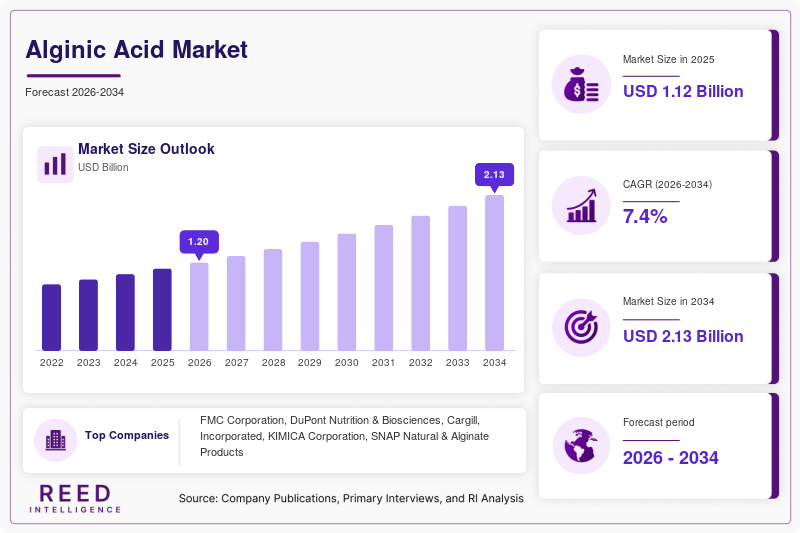
The Alginic Acid Market size was valued at USD 1.12 billion in 2026 and is projected to reach USD 1.98 billion by 2034, expanding at a CAGR of 7.4% during the forecast period of 2026–2034. The global Alginic Acid Market growth was supported by the increasing global demand for natural hydrocolloids and plant-derived functional ingredients across food, pharmaceutical, textile, and industrial applications. Manufacturers increasingly adopted alginic acid due to its excellent thickening, stabilizing, emulsifying, and gelling properties. The growing consumer preference for clean-label and bio-based ingredients further accelerated market expansion across developed and emerging economies.
The increasing use of alginic acid in processed food products significantly contributed to the growth of the Alginic Acid Market. Food manufacturers increasingly utilized alginic acid in dairy products, bakery items, sauces, frozen desserts, and convenience foods to improve texture and shelf stability. In addition, expanding pharmaceutical applications related to wound dressing materials, drug delivery systems, and antacid formulations strengthened demand for high-purity alginic acid products.a
Key Highlights
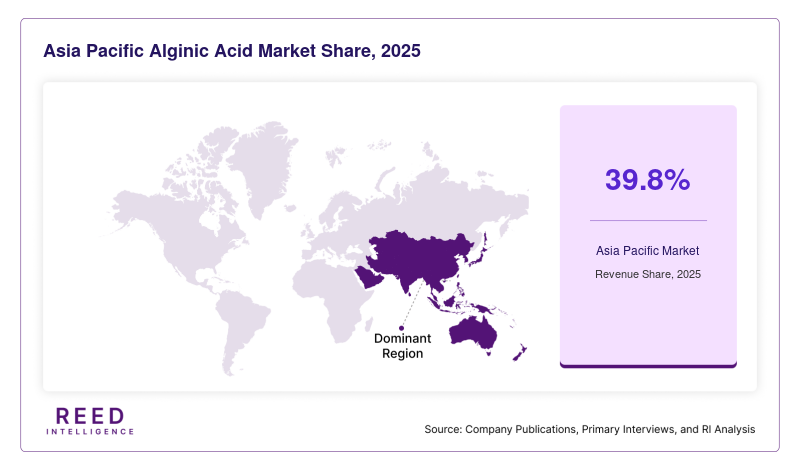
- Asia Pacific dominated the Alginic Acid Market with 39.8% share in 2025, while North America is projected to register the fastest CAGR of 8.1% during 2026–2034.
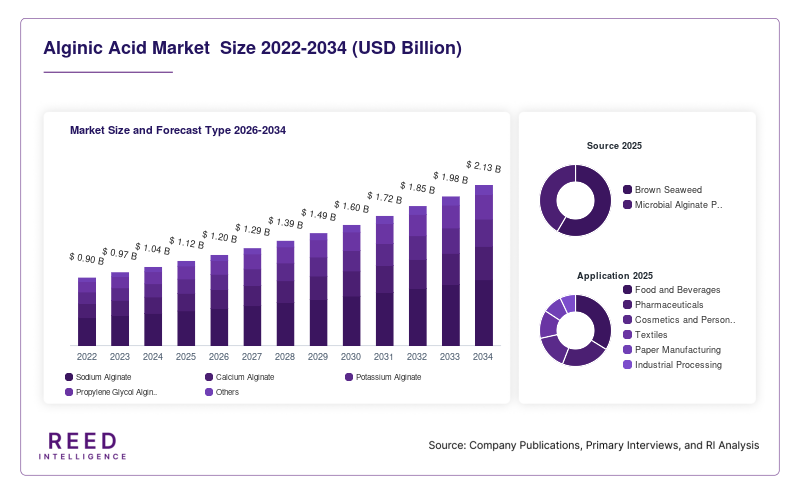
- By type, sodium alginate accounted for the largest market share of 46.7% in 2025, while calcium alginate is anticipated to witness the fastest CAGR of 8.4% during the forecast period.
- By source, brown seaweed held the dominant share of 72.5% in 2025, whereas microbial alginate production is forecast to grow at a CAGR of 8.9% through 2034.
- By application, food and beverages remained the leading segment with 41.3% share in 2025, while pharmaceuticals are expected to grow at a CAGR of 8.6%.
- By end-use industry, food processing held the dominant share of 38.9% in 2025, while biomedical and healthcare industries are forecast to grow at a CAGR of 8.8% during the forecast period.
- China Alginic Acid Market was valued at USD 168 million in 2024 and reached USD 182 million in 2025.
Market Trends
Increasing Demand for Clean-Label Food Ingredients
One of the major trends shaping the Alginic Acid Market is the increasing demand for clean-label and naturally derived food ingredients. Consumers are increasingly preferring food products formulated with plant-based stabilizers and thickening agents instead of synthetic additives. Alginic acid is gaining popularity across processed food applications because of its natural origin and multifunctional performance characteristics.
Food manufacturers are also reformulating products to comply with changing consumer preferences related to organic and sustainable food consumption. This trend is expected to support continuous demand for alginic acid in the global food industry.
Growing Adoption in Biomedical Applications
Another notable trend in the Alginic Acid Market is the growing use of alginic acid in biomedical and pharmaceutical applications. Researchers and healthcare manufacturers increasingly utilize alginate-based materials for wound healing products, tissue engineering, and controlled drug delivery systems due to their biocompatibility and moisture retention properties.
Advanced biomaterial research and increasing healthcare investments are encouraging development of innovative alginate-based medical products. This trend is expected to create favorable growth opportunities during the forecast period.
Market Drivers
Expansion of Processed Food Manufacturing
The increasing expansion of processed food manufacturing is a major driver supporting the growth of the Alginic Acid Market. Food producers increasingly require stabilizers and emulsifiers that improve texture consistency, shelf life, and product appearance across various food categories.
The growing demand for convenience foods, frozen products, dairy items, and bakery products continues to increase consumption of alginic acid globally. Expanding urbanization and changing dietary habits further support long-term market growth.
Rising Demand for Sustainable Industrial Ingredients
The growing demand for sustainable and biodegradable industrial ingredients is another important factor driving the Alginic Acid Market. Industries across paper, textile, cosmetics, and packaging sectors increasingly prefer naturally sourced additives to reduce environmental impact and improve product sustainability.
Alginic acid provides eco-friendly performance characteristics and supports regulatory compliance related to sustainable manufacturing practices. Increasing environmental awareness among manufacturers continues to support market expansion.
Market Restraint
Fluctuating Availability of Raw Seaweed Resources
One major restraint affecting the Alginic Acid Market is the fluctuating availability of brown seaweed raw materials. Environmental conditions, seasonal harvesting limitations, and marine ecosystem changes may affect seaweed production volumes and supply chain stability.
Variations in raw material availability may increase production costs and create operational challenges for alginic acid manufacturers dependent on marine biomass extraction.
Market Opportunities
Growth of Marine Biotechnology Research
The increasing expansion of marine biotechnology research is creating strong opportunities for the Alginic Acid Market. Governments and research institutions are increasingly investing in sustainable marine resource utilization and advanced biomaterial development.
Innovative extraction technologies and development of high-purity alginate products are expected to support new industrial and pharmaceutical applications during the forecast period.
Rising Use in Cosmetic and Personal Care Products
The growing use of natural ingredients in cosmetic and personal care products is creating additional growth opportunities for the Alginic Acid Market. Cosmetic manufacturers increasingly utilize alginic acid in facial masks, creams, lotions, and skincare products due to its moisturizing and stabilizing properties.
Increasing consumer preference for bio-based beauty products is expected to support demand for alginic acid across premium skincare applications.
Segmental Analysis
By Type
Based on type, the Alginic Acid Market is segmented into sodium alginate, calcium alginate, potassium alginate, propylene glycol alginate, and others.
Sodium alginate dominated the market with 46.7% share in 2025 due to its extensive utilization across food processing, pharmaceutical, and textile applications. Manufacturers preferred sodium alginate because of its strong thickening and stabilizing capabilities in processed food products.
Calcium alginate is projected to witness the fastest CAGR of 8.4% during the forecast period. Increasing use in wound care products, biomedical materials, and drug delivery applications will support segment growth. The growing demand for advanced healthcare biomaterials is expected to accelerate adoption globally.
By Source
Based on source, the market is categorized into brown seaweed and microbial alginate production.
Brown seaweed accounted for the largest market share of 72.5% in 2025 due to its widespread availability and established extraction infrastructure. Seaweed-derived alginic acid remained widely utilized across industrial and food-grade applications because of cost efficiency and scalability.
Microbial alginate production is anticipated to grow at the fastest CAGR of 8.9% during 2026–2034. Increasing focus on controlled production environments and sustainable biotechnology solutions will support segment growth. Advancements in microbial fermentation technologies are expected to improve commercial viability.
By Application
Based on application, the market includes food and beverages, pharmaceuticals, cosmetics and personal care, textiles, paper manufacturing, and industrial processing.
Food and beverages held the dominant market share of 41.3% in 2025 due to increasing use of alginic acid as a stabilizer, emulsifier, and thickening agent in processed food products. Manufacturers increasingly adopted alginic acid to improve texture and product consistency across dairy and bakery applications.
Pharmaceuticals are expected to register the fastest CAGR of 8.6% during the forecast period. Increasing demand for advanced wound care products and controlled drug delivery systems will support segment growth. Growing biomedical research activities are expected to accelerate market demand.
By End-Use Industry
Based on end-use industry, the market is segmented into food processing, healthcare and pharmaceuticals, cosmetics and personal care, industrial manufacturing, and biotechnology.
Food processing dominated the market in 2025 with 38.9% share due to increasing global consumption of convenience foods and processed food products. Food manufacturers increasingly integrated alginic acid into product formulations to improve stability and shelf performance.
Biomedical and healthcare industries are expected to witness the fastest CAGR of 8.8% during the forecast period. Increasing development of bioengineered materials and regenerative healthcare products will support segment growth. Rising investments in medical innovation are expected to create favorable opportunities.
Regional Analysis
Asia Pacific
Asia Pacific accounted for 39.8% of the Alginic Acid Market share in 2025 and is expected to grow at a CAGR of 7.8% during 2026–2034. The region maintained strong market demand due to abundant seaweed resources and rapid expansion of food processing industries. Manufacturers increasingly adopted alginic acid in processed food, textile, and pharmaceutical applications.
China remained the dominant country in the region due to extensive seaweed cultivation activities and strong industrial manufacturing capabilities. Increasing exports of seaweed-derived products significantly supported regional market growth.
North America
North America held 24.7% of the global Alginic Acid Market share in 2025 and is projected to expand at the fastest CAGR of 8.1% during the forecast period. The region experienced increasing demand for clean-label food ingredients and advanced biomedical materials.
The U.S. dominated the regional market owing to rising adoption of natural additives across food and pharmaceutical industries. Increasing investments in biotechnology research and sustainable product development contributed to market expansion.
Europe
Europe represented 21.2% of the global market share in 2025 and is anticipated to grow at a CAGR of 7.2% during 2026–2034. Strong environmental regulations and increasing preference for sustainable industrial materials supported regional market demand.
Germany emerged as the leading country in the region due to growing utilization of alginic acid in food manufacturing and pharmaceutical applications. Rising focus on biodegradable and eco-friendly industrial ingredients strengthened regional growth.
Middle East & Africa
The Middle East & Africa accounted for 7.3% of the Alginic Acid Market share in 2025 and is forecast to grow at a CAGR of 6.9% through 2034. The region witnessed increasing adoption of food additives and growing investments in healthcare manufacturing activities.
Saudi Arabia led the regional market due to expanding processed food industries and increasing demand for pharmaceutical excipients. Growing industrial diversification projects further contributed to regional market development.
Latin America
Latin America captured 7.0% of the global market share in 2025 and is expected to expand at a CAGR of 7.0% during the forecast period. Increasing food processing activities and rising use of natural stabilizers supported regional market growth.
Brazil remained the dominant country in Latin America owing to increasing production of processed food products and expanding cosmetics manufacturing activities. Rising consumer preference for sustainable ingredients contributed to market expansion.
Competitive Landscape
The Alginic Acid Market remains moderately fragmented with the presence of global hydrocolloid manufacturers, marine biotechnology companies, and specialty ingredient suppliers. Market participants are focusing on sustainable seaweed sourcing, advanced extraction technologies, and product portfolio expansion to strengthen their competitive position.
FMC Corporation remained a leading player in the market due to its extensive hydrocolloid product portfolio and strong global distribution capabilities. The company recently expanded production capacity for pharmaceutical-grade alginate ingredients to support growing healthcare demand.
DuPont Nutrition & Biosciences continued focusing on clean-label ingredient innovation and food stabilization technologies. Cargill, Incorporated increased investments in sustainable seaweed sourcing programs. KIMICA Corporation strengthened its alginate production capabilities for industrial and biomedical applications. SNAP Natural & Alginate Products focused on expanding marine-derived ingredient manufacturing for food and pharmaceutical industries.
Key Players List
- FMC Corporation
- DuPont Nutrition & Biosciences
- Cargill, Incorporated
- KIMICA Corporation
- SNAP Natural & Alginate Products
- Meron Group
- Qingdao Bright Moon Seaweed Group Co., Ltd.
- IRO Alginate Industry Co., Ltd.
- Ceamsa
- Shandong Jiejing Group Corporation
- Algaia S.A.
- Lianyungang Fengheng Biotech Co., Ltd.
- Marine Biopolymers Limited
- Zibo Wangfei Seaweed Tech Co., Ltd.
- Ingredients Solutions Inc.
Recent Developments
- In 2025, FMC Corporation expanded its pharmaceutical-grade alginate manufacturing capacity to support increasing healthcare demand.
- In 2024, DuPont Nutrition & Biosciences introduced advanced clean-label alginate stabilizer solutions for processed food applications.
- In 2025, Cargill, Incorporated strengthened sustainable seaweed sourcing partnerships across Asia Pacific.
- In 2024, KIMICA Corporation invested in advanced extraction technologies for high-purity alginate production.
- In 2025, Algaia S.A. launched new bio-based alginate ingredients for cosmetic and biomedical applications.
Alginic Acid Market Segments
Type
- Sodium Alginate
- Calcium Alginate
- Potassium Alginate
- Propylene Glycol Alginate
- Others
Source
- Brown Seaweed
- Microbial Alginate Production
Application
- Food and Beverages
- Pharmaceuticals
- Cosmetics and Personal Care
- Textiles
- Paper Manufacturing
- Industrial Processing
End-Use Industry
- Food Processing
- Healthcare and Pharmaceuticals
- Cosmetics and Personal Care
- Industrial Manufacturing
- Biotechnology
By Region
- North America
- Europe
- APAC
- Middle East and Africa
- LATAM