Alkaline Copper Quaternary Sales Market Size, Share & Demand Report By Formulation Type (Water-Based ACQ, Oil-Based ACQ, Micronized ACQ Formulations, High-Retention ACQ Formulations), By Application (Residential Construction, Commercial Construction, Marine Infrastructure, Utility Poles and Railway Sleepers, Outdoor Furniture and Landscaping, Agricultural Infrastructure), By End-Use Industry (Construction, Agriculture, Utilities, Transportation, Marine and Coastal Development, Hospitality and Re
USD 3950
Market Overview
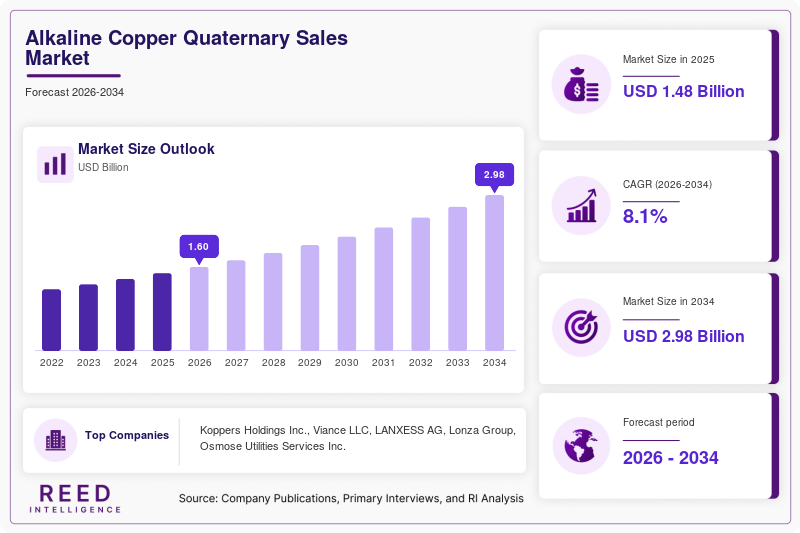
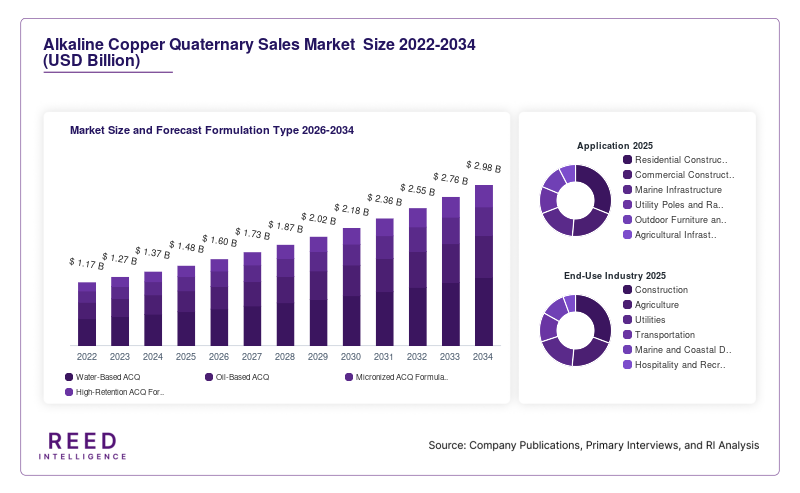
The global Alkaline Copper Quaternary Sales Market size was valued at USD 1.48 billion in 2026 and is projected to reach USD 2.76 billion by 2034, expanding at a CAGR of 8.1% during the forecast period from 2026 to 2034. The market is witnessing stable expansion due to the increasing use of pressure-treated wood products across residential construction, utility infrastructure, marine applications, and outdoor furniture manufacturing. Alkaline copper quaternary, commonly known as ACQ, is widely used as a wood preservative because of its ability to protect wood from fungal decay, termites, and insect damage without relying on arsenic-based compounds. The transition toward environmentally safer wood treatment solutions has strengthened demand across developed and emerging economies.
Growth in global housing development and commercial construction projects has also contributed to rising consumption of treated lumber products. Governments and construction companies are increasingly focusing on extending the lifecycle of wooden structures to reduce replacement costs and improve sustainability targets. In addition, utility pole manufacturers, railway infrastructure providers, and agricultural fencing companies continue to increase the use of ACQ-treated timber because of its durability and moisture resistance. The growing popularity of outdoor decking and landscaping products in urban residential projects has further supported product demand.
Key Highlights
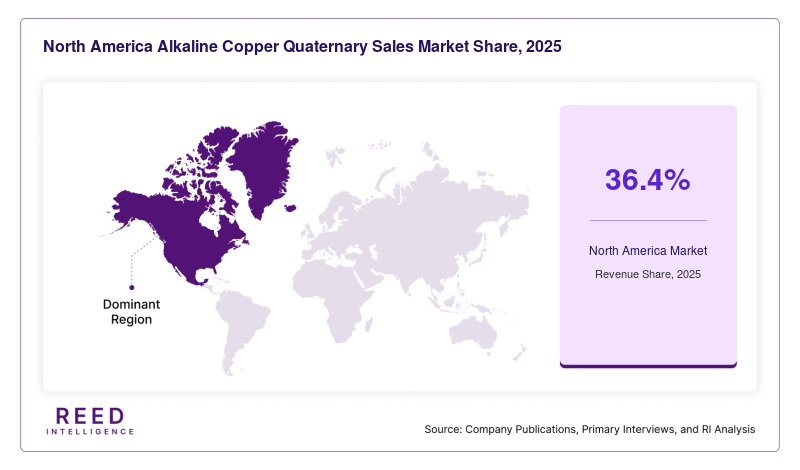
- North America dominated the market with a 36.4% share in 2025, while Asia Pacific is expected to grow at the fastest CAGR of 9.8% during 2026–2034.
- By formulation type, water-based ACQ accounted for the largest share of 44.1%, while micronized ACQ formulations are projected to grow at a CAGR of 10.2%.
- By application, residential construction led with a 39.5% share, whereas marine infrastructure is expected to expand at a CAGR of 9.6%.
- The United States remained the dominant country, with market values of USD 462 million in 2024 and USD 501 million in 2025.
Market Trends
Rising Adoption of Sustainable Wood Preservation Technologies
The Alkaline Copper Quaternary Sales Market is experiencing a significant shift toward sustainable wood preservation technologies as environmental concerns continue to influence purchasing decisions and industrial standards. Construction companies, municipal infrastructure developers, and furniture manufacturers are increasingly replacing traditional wood preservatives with ACQ-based products because they are free from arsenic and chromium compounds. The growing emphasis on eco-friendly construction materials has encouraged suppliers to develop advanced formulations with lower environmental impact while maintaining strong resistance against biological degradation. Demand is also rising from residential consumers who prefer treated wood products that align with green building certifications and sustainable housing practices. Several wood treatment facilities are upgrading their production systems to support water-based and low-emission ACQ formulations, creating stronger market penetration across developed economies.
Expansion of Outdoor Living and Landscaping Projects
The rapid growth of outdoor living spaces and landscaping projects has become an important trend shaping the Alkaline Copper Quaternary Sales Market. Urban homeowners and commercial property developers are increasingly investing in decks, pergolas, fencing systems, gazebos, playground equipment, and garden structures made from pressure-treated lumber. ACQ-treated wood is gaining popularity because it provides long-term durability in humid and variable weather conditions. Hospitality properties, resorts, and public recreation projects are also increasing procurement of treated timber products for outdoor infrastructure development. In addition, rising disposable income in emerging economies has encouraged consumers to spend more on home improvement and outdoor décor projects. The growing influence of modern landscaping trends is expected to support stable demand for ACQ preservatives over the next decade.
Market Drivers
Growth in Residential and Commercial Construction Activities
The continuous expansion of residential and commercial construction activities is a major driver supporting the growth of the Alkaline Copper Quaternary Sales Market. Rapid urbanization, population growth, and infrastructure modernization programs are increasing the demand for treated wood products used in structural framing, fencing, decking, and utility installations. ACQ-treated wood offers improved protection against termites, fungi, and moisture-related damage, making it suitable for long-term construction applications. Governments in multiple countries are also increasing investments in public infrastructure projects, including bridges, railway sleepers, marine docks, and utility poles. These projects require durable wood preservation solutions that can withstand harsh environmental conditions. The construction sector’s growing focus on lifecycle cost reduction and maintenance efficiency is further contributing to the widespread adoption of ACQ formulations across industrial and residential projects.
Regulatory Shift Away from Arsenic-Based Wood Preservatives
Increasing regulatory restrictions on arsenic-based wood preservatives are driving the transition toward alkaline copper quaternary solutions across global markets. Environmental agencies and public health organizations have raised concerns regarding the long-term effects of toxic chemicals used in older wood treatment technologies. As a result, manufacturers and construction companies are increasingly adopting ACQ preservatives as safer alternatives for residential and commercial applications. The product’s lower toxicity profile has made it more acceptable for playground equipment, garden structures, and public-use installations. Regulatory support for environmentally compliant construction materials is also encouraging wood treatment plants to modernize their operations and shift toward ACQ-based production lines. This transition is expected to continue strengthening market demand as sustainability regulations become stricter in both developed and emerging economies.
Market Restraint
Corrosion Concerns and High Treatment Costs Affect Adoption
Despite strong market growth potential, the Alkaline Copper Quaternary Sales Market faces challenges associated with corrosion issues and relatively high treatment costs. ACQ-treated wood contains higher copper concentrations, which can increase the risk of corrosion when used with standard steel fasteners and connectors. Construction companies and contractors often need to use specialized corrosion-resistant hardware such as stainless steel or hot-dip galvanized materials, increasing total project costs. Small-scale builders and residential consumers may hesitate to adopt ACQ-treated products because of these additional expenses. Furthermore, the treatment process itself requires advanced pressure-treatment systems and strict quality controls, which can increase manufacturing costs for suppliers. In price-sensitive markets, untreated wood and alternative materials such as plastic composites may limit the adoption of ACQ-treated timber. These factors could moderate growth in regions with limited infrastructure investment and lower construction spending.
Market Opportunities
Increasing Demand from Marine and Coastal Infrastructure Projects
Growing investments in marine and coastal infrastructure projects are creating new opportunities for the Alkaline Copper Quaternary Sales Market. Ports, boardwalks, docks, marinas, and waterfront developments require durable materials that can withstand moisture exposure and biological deterioration. ACQ-treated wood is increasingly preferred for such applications because it offers improved resistance against fungal decay and insect attacks in high-humidity environments. Governments and tourism authorities are also investing in coastal recreational facilities and waterfront redevelopment projects to support tourism growth and urban modernization. The expansion of fishing infrastructure and small harbor development in Asia Pacific and Latin America is further expected to create additional demand for treated wood products. Manufacturers that develop enhanced marine-grade formulations with longer durability are likely to gain competitive advantages during the forecast period.
Rising Penetration in Agricultural and Utility Applications
The increasing use of treated timber in agricultural and utility applications presents another major opportunity for market participants. Farmers and agricultural businesses are expanding the use of ACQ-treated fencing posts, barns, storage facilities, and greenhouse structures because of their longer service life and resistance to environmental damage. Utility companies are also increasing investments in treated wooden poles for electricity transmission and telecommunication networks, especially in rural and semi-urban regions. The expansion of renewable energy projects and rural electrification programs is expected to strengthen demand for durable utility infrastructure materials. In addition, growing investments in agricultural modernization across developing economies are encouraging the adoption of treated wood products with lower maintenance requirements. Suppliers that focus on cost-efficient and high-performance formulations are expected to benefit from rising industrial demand.
Segmental Analysis
By Formulation Type
Water-based ACQ formulations accounted for the dominant share of the Alkaline Copper Quaternary Sales Market in 2024, representing 44.1% of global revenue. These formulations are widely used because they provide effective wood penetration, reduced environmental impact, and compatibility with modern pressure-treatment systems. Manufacturers and wood treatment facilities continue to prefer water-based technologies because of increasing environmental regulations related to volatile organic compound emissions and hazardous chemical handling. Residential construction and outdoor infrastructure projects have significantly contributed to demand for water-based ACQ products due to their durability and lower toxicity profile. In addition, the availability of cost-efficient production technologies and simplified application processes has encouraged widespread commercial adoption. The segment also benefits from growing consumer awareness regarding environmentally responsible wood preservation solutions across North America and Europe.
By Application
Residential construction represented the largest application segment in the Alkaline Copper Quaternary Sales Market in 2024, accounting for 39.5% of total market revenue. The segment continues to benefit from growing housing construction activity, increasing home renovation spending, and the rising popularity of outdoor living structures. ACQ-treated wood is widely used in decking, fencing, pergolas, patios, playground equipment, and landscaping projects because of its resistance to insects and fungal decay. Consumers are increasingly preferring treated lumber products that provide longer service life and reduced maintenance costs compared to untreated wood materials. In addition, builders and contractors are adopting ACQ-based products to comply with environmental regulations restricting older preservative technologies. The growth of suburban housing developments and residential infrastructure modernization projects has further strengthened demand for treated wood products across developed and emerging economies.
By End-Use Industry
The construction industry accounted for the dominant share of the Alkaline Copper Quaternary Sales Market in 2024, contributing 46.3% of global revenue. Demand from the sector remains strong because treated wood products are widely used in residential buildings, commercial structures, outdoor recreational facilities, and utility infrastructure projects. Construction companies increasingly prefer ACQ-treated materials because they offer extended durability, lower maintenance costs, and compliance with environmental safety standards. The segment also benefits from rising investments in infrastructure modernization, urban development programs, and public recreational projects. Growing demand for sustainable building materials has encouraged architects and contractors to incorporate treated timber products into modern construction designs. In addition, the increasing use of wood in modular and prefabricated construction systems has further strengthened demand for high-performance preservation technologies across developed economies.
Regional Analysis
North America
North America accounted for the largest share of the Alkaline Copper Quaternary Sales Market in 2025, representing 36.4% of global revenue. The region is projected to expand at a CAGR of 7.6% during the forecast period due to stable construction activity and the extensive use of pressure-treated lumber across residential and utility applications. Demand for ACQ-treated wood remains strong in the United States and Canada because of strict regulations limiting the use of arsenic-based preservatives. The region also benefits from established wood treatment infrastructure, advanced manufacturing technologies, and widespread awareness regarding sustainable building materials.
The United States remained the dominant country within North America due to high consumption of treated lumber in housing construction, decking, fencing, and utility pole installations. One important growth factor is the strong home renovation and outdoor living market, which continues to support demand for pressure-treated wood products. Rising consumer spending on backyard landscaping, patios, and outdoor recreational structures has encouraged suppliers to expand product availability across retail and distribution channels. Government investments in infrastructure modernization projects are also expected to sustain long-term demand.
Europe
Europe held a substantial share of the Alkaline Copper Quaternary Sales Market in 2025 and is expected to register a CAGR of 7.4% between 2026 and 2034. The market is supported by increasing environmental regulations and the adoption of sustainable construction materials across residential and commercial sectors. Countries across Western Europe are reducing reliance on chemically hazardous wood preservatives and encouraging the use of safer treatment technologies. Demand for treated timber products is also rising in public infrastructure projects, including bridges, railway systems, and outdoor recreational facilities.
Germany emerged as the leading country in the European market because of its advanced construction industry and strong focus on sustainable building standards. A unique growth factor driving the country’s market is the increasing adoption of timber-based construction methods in urban development projects. Builders and architects are increasingly using treated wood materials in modular housing and energy-efficient buildings to support carbon reduction targets. The expansion of eco-friendly housing initiatives and investments in public infrastructure renovation are expected to support future market growth across the region.
Asia Pacific
Asia Pacific is projected to record the fastest CAGR of 9.8% during the forecast period, supported by rapid urbanization, industrial expansion, and rising construction activity. The region is experiencing increasing demand for pressure-treated wood products across residential housing, utility infrastructure, agriculture, and transportation sectors. Developing economies such as China, India, Indonesia, and Vietnam are investing heavily in infrastructure development, creating substantial opportunities for ACQ manufacturers. The growing awareness regarding wood preservation and the need for durable building materials are also contributing to market expansion.
China remained the dominant country in Asia Pacific due to its large construction industry and extensive manufacturing capacity. One unique growth factor is the rapid development of urban public infrastructure projects, including parks, tourism facilities, waterfront developments, and transportation networks. Government programs supporting sustainable urban planning are encouraging the use of treated wood products for outdoor applications. In addition, rising disposable income among middle-class consumers is driving demand for outdoor furniture, decking systems, and landscaped residential spaces, further supporting ACQ consumption.
Middle East & Africa
The Middle East & Africa region is expected to witness moderate growth in the Alkaline Copper Quaternary Sales Market, with a forecast CAGR of 6.9% during 2026–2034. Increasing investments in tourism infrastructure, urban development projects, and utility expansion programs are supporting regional demand for treated wood products. ACQ-treated lumber is gaining traction in outdoor construction applications because of its durability under challenging environmental conditions. Countries in the Gulf region are also focusing on sustainable urban development and recreational infrastructure projects, creating opportunities for suppliers of advanced wood preservation technologies.
Saudi Arabia emerged as the leading market within the region due to large-scale infrastructure and tourism development initiatives. A unique growth factor supporting the country’s market is the expansion of entertainment and hospitality projects linked to economic diversification programs. New resorts, public parks, waterfront developments, and recreational facilities require durable outdoor construction materials capable of withstanding harsh weather conditions. The increasing focus on modern urban infrastructure and tourism-related investments is expected to support higher consumption of ACQ-treated wood products in the coming years.
Latin America
Latin America accounted for a developing share of the Alkaline Copper Quaternary Sales Market in 2025 and is projected to grow at a CAGR of 7.1% during the forecast period. The market is supported by increasing agricultural investments, residential construction activities, and utility infrastructure development. Countries across the region are gradually increasing awareness regarding the advantages of pressure-treated wood in improving durability and reducing maintenance costs. Demand is also growing from fencing applications, outdoor furniture manufacturing, and agricultural storage infrastructure.
Brazil remained the dominant country in the Latin American market due to its large agricultural sector and expanding construction industry. One important growth factor is the rising adoption of treated wood products in agricultural fencing and farm infrastructure. Agricultural producers are increasingly investing in long-lasting wood materials to reduce replacement frequency and improve operational efficiency. The expansion of rural electrification projects and transportation infrastructure development is also expected to contribute to growing demand for ACQ-treated utility poles and construction materials across the country.
Competitive Landscape
The Alkaline Copper Quaternary Sales Market is moderately consolidated, with several international and regional companies competing through product innovation, distribution expansion, and strategic partnerships. Leading companies are focusing on advanced preservative technologies that improve durability, corrosion resistance, and environmental compliance. Market participants are also investing in production capacity expansion to meet growing demand from construction, marine infrastructure, and agricultural applications.
Koppers Holdings Inc. remains one of the leading players in the market due to its extensive wood treatment portfolio and strong distribution network across North America and Europe. The company recently expanded its treated wood production capabilities to support rising demand from utility and residential construction sectors. Other major participants are emphasizing sustainable formulations and improved treatment efficiency to strengthen their competitive positions.
Key Players
- Koppers Holdings Inc.
- Viance LLC
- LANXESS AG
- Lonza Group
- Osmose Utilities Services Inc.
- BASF SE
- Kurt Obermeier GmbH & Co. KG
- Janssen PMP
- Troy Corporation
- Remmers Group
- Arch Wood Protection Inc.
- Nisus Corporation
- Dolphin Bay Chemicals
- Borax Inc.
- RUTGERS Organics GmbH
Recent Developments
- In February 2025, Koppers Holdings Inc. announced the expansion of its wood treatment production facility in the United States to improve supply capacity for utility and residential applications.
- In July 2025, LANXESS AG introduced an advanced micronized ACQ formulation designed to improve corrosion resistance and extend wood durability in coastal environments.
- In November 2025, Viance LLC entered into a strategic partnership with regional distributors in Southeast Asia to strengthen the availability of pressure-treated wood preservatives across emerging markets.
- In March 2026, Lonza Group launched a new environmentally focused ACQ preservative solution aimed at supporting sustainable outdoor construction projects and green building initiatives.
Alkaline Copper Quaternary Sales Market Segments
Formulation Type
- Water-Based ACQ
- Oil-Based ACQ
- Micronized ACQ Formulations
- High-Retention ACQ Formulations
Application
- Residential Construction
- Commercial Construction
- Marine Infrastructure
- Utility Poles and Railway Sleepers
- Outdoor Furniture and Landscaping
- Agricultural Infrastructure
End-Use Industry
- Construction
- Agriculture
- Utilities
- Transportation
- Marine and Coastal Development
- Hospitality and Recreation
By Region
- North America
- Europe
- APAC
- Middle East and Africa
- LATAM