Alkaline Fuel Cell Market Size, Share & Demand Report By Application (Stationary Power Generation, Portable Power, Transportation), By End-Use (Industrial, Commercial, Residential, Transportation), By Component (Electrodes, Electrolytes, Bipolar Plates, Others), By Fuel Type (Hydrogen, Others), By Region & Segment Forecasts, 2025–2034
USD 3950
Market Overview
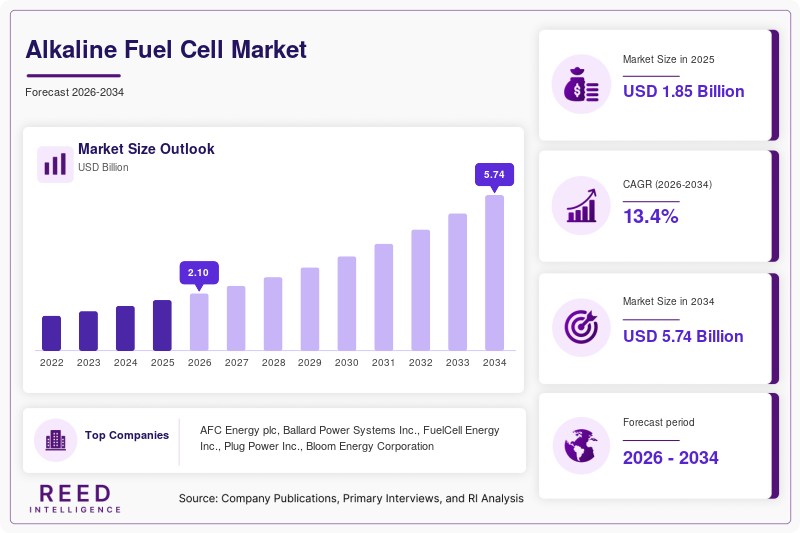
The global Alkaline Fuel Cell Market size was valued at approximately USD 1.85 billion in 2025 and is projected to reach USD 5.72 billion by 2034, expanding at a compound annual growth rate (CAGR) of 13.4% during the forecast period (2025–2034). The market has experienced steady expansion due to increasing investments in clean energy technologies and the rising adoption of hydrogen-based power systems across multiple industries.
A major global factor supporting market growth is the accelerating transition toward low-emission energy systems. Governments and private stakeholders are prioritizing decarbonization strategies, which has significantly increased demand for efficient fuel cell technologies such as alkaline fuel cells. These systems offer high electrical efficiency and cost-effective catalysts compared to other fuel cell types, making them increasingly viable for stationary and portable applications.
Key Highlights:
- North America dominated the market with a share of 36.8% in 2025, while Asia Pacific is projected to register the fastest CAGR of 15.2% through 2034.
- By application, stationary power generation led with a 41.5% share in 2024, whereas portable power is expected to grow at a CAGR of 16.1%.
- By end-use, the industrial segment dominated, while the transportation segment is forecast to expand at a CAGR of 15.8%.
- The United States accounted for USD 620 million in 2024 and increased to USD 665 million in 2025.
Market Trends
Integration with Hydrogen Infrastructure Development
The development of hydrogen infrastructure is significantly shaping the Alkaline Fuel Cell Market. Governments are investing in hydrogen production, storage, and distribution networks, enabling large-scale deployment of fuel cells. This integration is improving accessibility and reducing operational constraints, thereby enhancing adoption across stationary and mobility applications. The alignment of fuel cell technology with national hydrogen strategies is expected to strengthen market penetration in the coming years.
Advancements in Cost-Effective Catalyst Materials
A key trend is the shift toward non-precious metal catalysts in alkaline fuel cells. Unlike proton exchange membrane fuel cells, alkaline systems can utilize less expensive materials such as nickel and silver. This innovation is reducing overall system costs and improving commercial viability. Manufacturers are increasingly focusing on research and development to enhance catalyst performance and longevity, which is expected to further drive adoption in cost-sensitive applications such as backup power and off-grid energy systems.
Market Drivers
Growing Demand for Clean and Efficient Energy Systems
The rising need for low-emission energy solutions is a major driver of the Alkaline Fuel Cell Market. Industries are actively transitioning toward sustainable energy technologies to meet environmental regulations and reduce carbon footprints. Alkaline fuel cells provide high efficiency and low emissions, making them suitable for diverse applications, including power generation and energy storage.
Increasing Adoption in Aerospace and Defense Applications
Alkaline fuel cells have long been utilized in aerospace missions due to their reliability and efficiency. Their continued use in defense and space applications is driving technological advancements and expanding market scope. The demand for lightweight, high-performance power systems in critical operations is encouraging further adoption, particularly in unmanned systems and remote power supply units.
Market Restraint
Sensitivity to Carbon Dioxide Contamination
A significant challenge in the Alkaline Fuel Cell Market is the sensitivity of these systems to carbon dioxide. Exposure to CO₂ can lead to the formation of carbonates in the electrolyte, reducing efficiency and requiring frequent maintenance. This limitation restricts the use of alkaline fuel cells in environments where pure hydrogen and oxygen are not readily available.
Additionally, the need for high-purity gases increases operational complexity and cost, which can hinder widespread commercialization. While advancements are being made to improve tolerance levels, this technical limitation remains a key barrier compared to other fuel cell technologies that can operate under less stringent conditions.
Market Opportunities
Expansion in Distributed Energy Systems
The increasing demand for decentralized power generation presents a strong opportunity for the Alkaline Fuel Cell Market. These systems are well-suited for microgrids and off-grid applications due to their efficiency and scalability. Growing investments in rural electrification and energy resilience are expected to drive demand for alkaline fuel cell-based solutions.
Emerging Applications in Portable Power Devices
The rising need for reliable and lightweight portable power sources is creating new growth avenues. Alkaline fuel cells are being explored for use in consumer electronics, military equipment, and emergency backup systems. Their ability to deliver consistent power over extended periods makes them an attractive alternative to conventional batteries, particularly in mission-critical applications.
Segmental Analysis
By Application
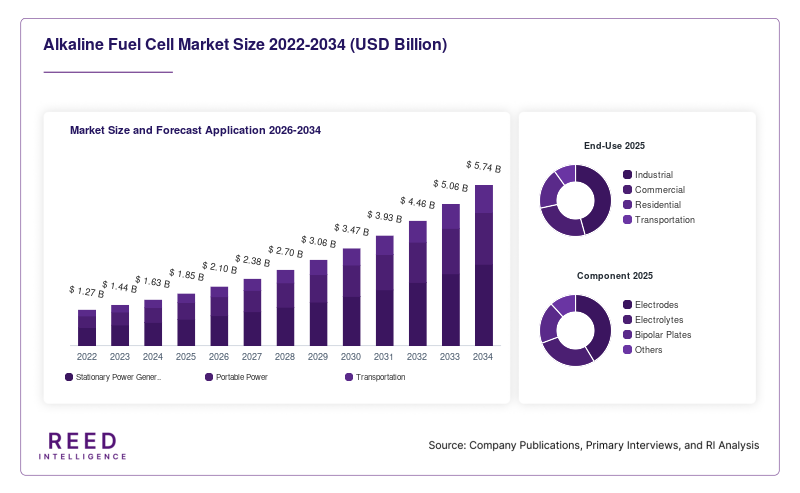
The stationary power generation segment dominated the Alkaline Fuel Cell Market, accounting for 41.5% of the total share in 2024. This dominance was attributed to the increasing use of fuel cells in backup power systems and distributed energy networks. Industries and commercial establishments have relied on stationary systems for consistent and efficient power supply.
The portable power segment is expected to grow at the fastest CAGR of 16.1% during the forecast period. This growth will be driven by rising demand for compact and reliable power solutions in military, emergency, and consumer electronics applications. The portability and efficiency of alkaline fuel cells make them suitable for use in remote and mobile environments.
By End-Use
The industrial segment held the largest share of 38.7% in 2024, driven by the adoption of fuel cells for power generation and energy storage. Industrial facilities have increasingly integrated alkaline fuel cells to improve energy efficiency and reduce emissions.
The transportation segment is projected to expand at a CAGR of 15.8% through 2034. The growing focus on hydrogen-powered mobility and the need for clean transportation solutions will drive demand. Fuel cells are being explored for use in buses, trucks, and other commercial vehicles, supporting long-term market growth.
By Component
Electrodes represented the dominant subsegment, accounting for 34.2% of the market in 2024. The performance of alkaline fuel cells largely depends on electrode efficiency, making this component critical to system functionality.
Electrolytes are expected to grow at the fastest CAGR of 14.9% during the forecast period. Innovations in electrolyte materials and improved durability will enhance system performance and expand application scope.
By Fuel Type
Hydrogen-based systems dominated the market with a share of 72.5% in 2024 due to their high efficiency and clean energy output. The availability of hydrogen as a fuel source has supported widespread adoption.
Alternative fuels are projected to grow at a CAGR of 13.7%, driven by ongoing research into flexible fuel options and improved system adaptability.
Regional Analysis
North America
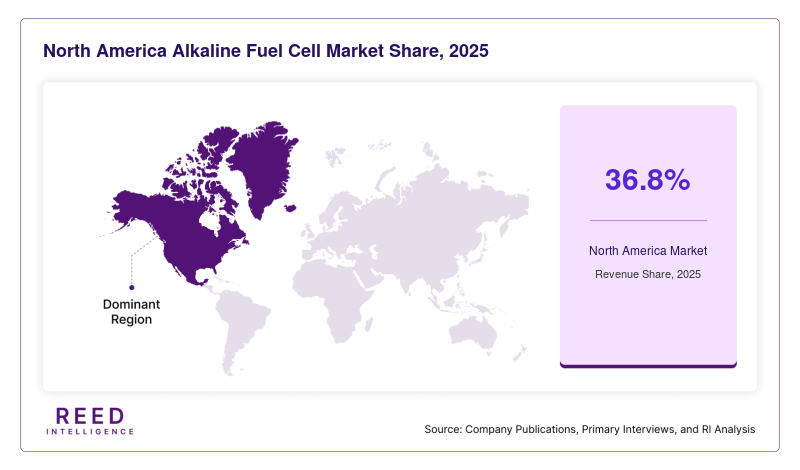
North America accounted for a 36.8% share of the Alkaline Fuel Cell Market in 2025 and is expected to grow at a CAGR of 12.9% during the forecast period. The region has demonstrated strong adoption due to advanced technological infrastructure and increasing investments in hydrogen-based energy solutions.
The United States remained the dominant country, driven by significant funding in clean energy projects and research initiatives. The presence of established fuel cell manufacturers and government incentives supporting hydrogen infrastructure development contributed to sustained market growth.
Europe
Europe held a 27.4% share in 2025 and is projected to expand at a CAGR of 13.1% through 2034. The region has shown steady progress due to stringent environmental regulations and ambitious carbon neutrality targets.
Germany led the regional market, supported by strong industrial demand and government-backed hydrogen strategies. The country’s focus on renewable energy integration and energy transition initiatives has accelerated the deployment of alkaline fuel cells in stationary and industrial applications.
Asia Pacific
Asia Pacific represented 22.6% of the market in 2025 and is expected to register the fastest CAGR of 15.2% during the forecast period. Rapid industrialization and increasing energy demand have contributed to market expansion.
China emerged as the dominant country due to large-scale investments in hydrogen production and infrastructure. The country’s focus on clean energy adoption and manufacturing capabilities has positioned it as a key growth hub for alkaline fuel cell technologies.
Middle East & Africa
The Middle East & Africa accounted for 7.1% of the market in 2025 and is anticipated to grow at a CAGR of 12.4%. The region has gradually adopted fuel cell technologies to diversify energy sources and reduce reliance on fossil fuels.
Saudi Arabia led the market, driven by its investments in hydrogen economy projects and renewable energy initiatives. The country’s strategic focus on energy diversification has created opportunities for alkaline fuel cell deployment.
Latin America
Latin America held a 6.1% share in 2025 and is projected to grow at a CAGR of 11.8% over the forecast period. The region has witnessed gradual adoption due to increasing focus on sustainable energy solutions.
Brazil dominated the regional market, supported by its renewable energy base and government initiatives promoting clean technologies. The growing need for reliable power in remote areas has further supported market growth.
Competitive Landscape
The Alkaline Fuel Cell Market is moderately competitive, with several established players focusing on innovation and strategic collaborations. Leading companies are investing in research and development to improve system efficiency and reduce costs.
A key market leader is AFC Energy plc, which has been actively developing hydrogen fuel cell systems for industrial applications. The company recently announced advancements in scalable alkaline fuel cell platforms, enhancing efficiency and commercial viability.
Other prominent players are expanding their global presence through partnerships and product launches. The competitive environment is characterized by technological advancements, capacity expansions, and increasing focus on sustainable energy solutions.
Key Players
- AFC Energy plc
- Ballard Power Systems Inc.
- FuelCell Energy Inc.
- Plug Power Inc.
- Bloom Energy Corporation
- SFC Energy AG
- Intelligent Energy Limited
- Hydrogenics Corporation
- Doosan Fuel Cell Co., Ltd.
- Ceres Power Holdings plc
Recent Developments
- AFC Energy plc introduced an advanced alkaline fuel cell system designed for industrial power applications in 2025.
- Plug Power Inc. expanded its hydrogen infrastructure network to support fuel cell deployment.
- Ballard Power Systems Inc. announced new partnerships to develop fuel cell solutions for transportation.
- Bloom Energy Corporation focused on integrating fuel cells with renewable energy systems.
- SFC Energy AG launched portable fuel cell solutions targeting defense and remote applications.
Alkaline Fuel Cell Market Segments
Application
- Stationary Power Generation
- Portable Power
- Transportation
End-Use
- Industrial
- Commercial
- Residential
- Transportation
Component
- Electrodes
- Electrolytes
- Bipolar Plates
- Others
Fuel Type
- Hydrogen
- Others
By Region
- North America
- Europe
- APAC
- Middle East and Africa
- LATAM