Alkaline Phosphatase Kits Market Size, Share Demand Report By Product Type (ELISA Kits, Chemiluminescent Kits, Colorimetric Kits), By Application (Clinical Diagnostics, Research Applications), By End-Use (Hospitals & Diagnostic Laboratories, Academic & Research Institutes, Pharmaceutical & Biotechnology Companies), By Distribution Channel (Direct Sales, Distributors, Online Sales), By Region & Segment Forecasts, 2026–2034
USD 3950
Market Overview
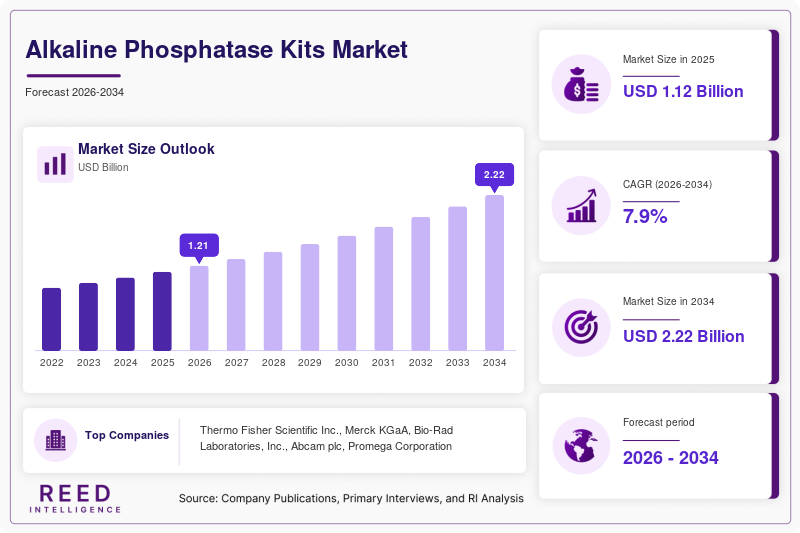
The Alkaline Phosphatase Kits Market size was valued at approximately USD 1.12 billion in 2026 and is projected to reach USD 2.05 billion by 2034, expanding at a CAGR of 7.9% during the forecast period (2026–2034). The market growth is primarily supported by the increasing demand for biochemical assays in clinical diagnostics and life science research. Alkaline phosphatase (ALP) kits are widely used in enzyme-linked immunosorbent assays (ELISA), diagnostic testing, and molecular biology workflows, making them essential tools across laboratories and healthcare settings.
A key global factor driving the Alkaline Phosphatase Kits Market is the rising prevalence of chronic diseases, including liver disorders, bone diseases, and metabolic conditions. These conditions require frequent diagnostic monitoring, boosting the demand for reliable enzyme-based test kits. Additionally, expanding research in genomics and proteomics has increased the utilization of ALP kits in experimental workflows, further contributing to market growth.
Key Highlights:
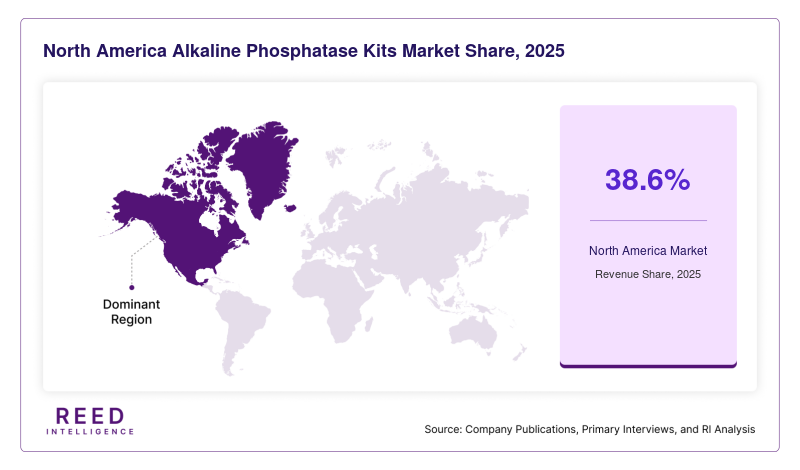
- North America dominated the market with a 38.6% share in 2025, while Asia Pacific is projected to grow at the fastest CAGR of 9.3% during the forecast period.
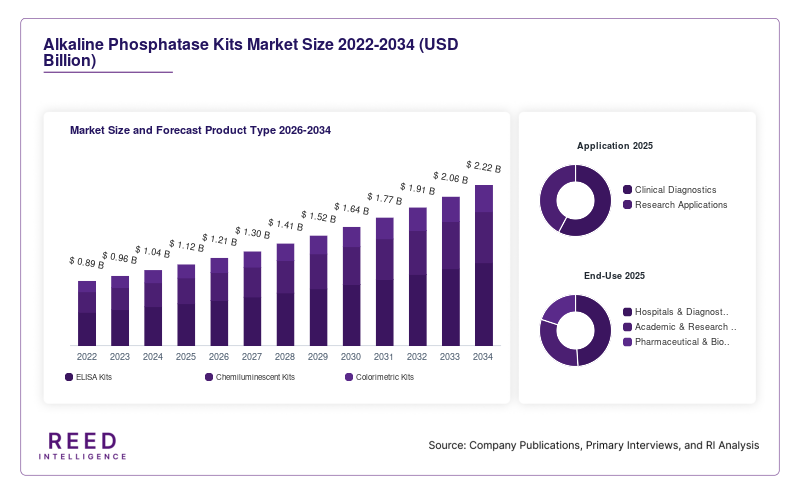
- By product type, ELISA-based kits held the largest share of 42.1% in 2025, whereas chemiluminescent kits are expected to grow at a CAGR of 9.8%.
- By application, clinical diagnostics accounted for the highest share of 47.5%, while research applications are anticipated to expand at a CAGR of 8.7%.
- The United States remained the dominant country, with market values of USD 385 million in 2024 and USD 402 million in 2025.
Market Trends
Integration of Automation in Diagnostic Workflows
Automation in laboratory processes has become a defining trend in the Alkaline Phosphatase Kits Market. Laboratories are increasingly adopting automated platforms that integrate ALP kits into high-throughput systems. This shift reduces human error, enhances reproducibility, and improves testing efficiency. Automated ELISA and chemiluminescent platforms are gaining traction in hospitals and diagnostic labs, enabling faster turnaround times. The trend is particularly prominent in developed regions where healthcare infrastructure supports advanced technologies.
Growing Preference for Multiplex Assay Kits
Another notable trend shaping the Alkaline Phosphatase Kits Market is the rising demand for multiplex assay kits. These kits allow simultaneous detection of multiple biomarkers in a single sample, improving diagnostic efficiency and reducing costs. Multiplexing is widely used in research settings, especially in immunology and oncology studies. The increasing focus on personalized medicine has further accelerated the adoption of such kits, as they provide comprehensive biomarker analysis. This trend is expected to influence product development strategies among manufacturers, encouraging innovation in kit design and performance.
Market Drivers
Increasing Demand for Clinical Diagnostic Testing
The growing need for accurate and timely diagnostic testing is a major driver of the Alkaline Phosphatase Kits Market. ALP tests are commonly used to assess liver function, bone health, and certain cancers. As healthcare systems emphasize early diagnosis and preventive care, the demand for enzyme-based diagnostic kits has increased. Rising healthcare expenditure and expanding diagnostic infrastructure further support this growth, particularly in emerging economies.
Expansion of Life Sciences Research Activities
The rapid expansion of life sciences research is another key driver. Alkaline phosphatase kits play a critical role in molecular biology, including DNA labeling and protein detection. Increased funding for research in genomics, proteomics, and drug discovery has significantly boosted the adoption of ALP kits. Academic institutions, biotechnology firms, and pharmaceutical companies are increasingly relying on these kits for experimental accuracy, driving consistent market demand.
Market Restraint
High Cost of Advanced Diagnostic Kits
One of the primary restraints in the Alkaline Phosphatase Kits Market is the high cost associated with advanced diagnostic kits. Chemiluminescent and automated assay kits often require specialized equipment and skilled personnel, increasing overall operational costs. This limits their adoption in cost-sensitive regions and smaller laboratories. Additionally, budget constraints in public healthcare systems can restrict procurement of premium diagnostic solutions. The cost factor also affects research institutions with limited funding, reducing the accessibility of advanced ALP kits. As a result, market growth may face challenges in low- and middle-income regions where affordability remains a concern.
Market Opportunities
Emerging Demand in Point-of-Care Testing
The growing demand for point-of-care testing presents a significant opportunity for the Alkaline Phosphatase Kits Market. Portable and rapid diagnostic kits are gaining popularity due to their convenience and quick results. These kits are particularly useful in remote and resource-limited settings where access to centralized laboratories is limited. Manufacturers focusing on developing compact and user-friendly ALP kits can capitalize on this expanding segment.
Growth in Personalized Medicine
Personalized medicine is creating new avenues for market growth. As healthcare shifts toward tailored treatment approaches, the need for precise biomarker analysis is increasing. Alkaline phosphatase kits are being integrated into diagnostic panels used for personalized treatment planning. This trend is expected to drive innovation and product differentiation, enabling companies to develop specialized kits for targeted applications.
Segmental Analysis
By Product Type
ELISA-based kits dominated the Alkaline Phosphatase Kits Market with a 42.1% share in 2025. Their widespread use in clinical diagnostics and research applications contributed to their leading position. These kits are known for their reliability and compatibility with standard laboratory equipment, making them a preferred choice among end users.
Chemiluminescent kits are expected to grow at the fastest CAGR of 9.8% during the forecast period. Their higher sensitivity and ability to deliver rapid results will drive their adoption. Increasing demand for advanced diagnostic techniques will further support this growth.
By Application
Clinical diagnostics accounted for the largest share of 47.5% in 2025. The frequent use of ALP tests in diagnosing liver and bone disorders contributed to this dominance. Hospitals and diagnostic laboratories heavily relied on these kits for routine testing.
Research applications are projected to grow at a CAGR of 8.7%. The expanding scope of life sciences research and increasing funding for scientific studies will drive this segment. Researchers are expected to adopt ALP kits for various experimental procedures.
By End-Use
Hospitals and diagnostic laboratories held the largest share of 44.3% in 2025. Their role as primary healthcare providers ensured consistent demand for diagnostic kits. High patient volumes and routine testing needs supported this segment’s growth.
Academic and research institutes are expected to grow at a CAGR of 8.5%. Increasing research activities and collaborations will drive demand for ALP kits in this segment.
By Distribution Channel
Direct sales dominated the market with a 51.2% share in 2025. Manufacturers preferred direct distribution to maintain better control over pricing and customer relationships.
Online sales are projected to grow at a CAGR of 9.1%. The convenience of online procurement and availability of a wide range of products will support this segment’s growth.
Regional Analysis
North America
North America accounted for a 38.6% share of the Alkaline Phosphatase Kits Market in 2025 and is expected to maintain steady growth with a projected CAGR of 7.2% during 2026–2034. The region benefited from well-established healthcare infrastructure and high adoption of advanced diagnostic technologies.
The United States dominated the regional market due to its strong presence of diagnostic laboratories and research institutions. A key growth factor in the country was the increasing integration of advanced biochemical assays into routine clinical testing, which enhanced diagnostic accuracy and efficiency.
Europe
Europe held a 26.4% share of the Alkaline Phosphatase Kits Market in 2025 and is anticipated to grow at a CAGR of 7.5% over the forecast period. The region experienced steady demand driven by expanding healthcare services and research initiatives.
Germany emerged as the dominant country, supported by its strong biotechnology sector. The country’s growth was influenced by increased investments in laboratory automation, which improved testing capabilities and supported the adoption of ALP kits.
Asia Pacific
Asia Pacific captured a 21.8% share in 2025 and is projected to grow at the fastest CAGR of 9.3% from 2026 to 2034. Rapid urbanization and improving healthcare access contributed to the region’s growth trajectory.
China led the regional market due to its expanding diagnostic industry. A significant growth factor was the increasing number of clinical laboratories and rising awareness about early disease detection, which boosted demand for ALP kits.
Middle East & Africa
The Middle East & Africa accounted for 7.1% of the Alkaline Phosphatase Kits Market in 2025 and is expected to grow at a CAGR of 6.8% during the forecast period. The region showed gradual growth supported by improving healthcare infrastructure.
Saudi Arabia dominated the regional market, driven by government initiatives to enhance diagnostic capabilities. Investments in healthcare facilities played a key role in increasing the adoption of diagnostic kits.
Latin America
Latin America held a 6.1% share in 2025 and is projected to expand at a CAGR of 7.0% from 2026 to 2034. The region experienced moderate growth due to rising healthcare awareness and expanding diagnostic services.
Brazil emerged as the leading country, supported by its growing healthcare sector. A key growth factor was the increasing availability of diagnostic testing services, which encouraged the use of ALP kits across laboratories.
Competitive Landscape
The Alkaline Phosphatase Kits Market is characterized by the presence of several established players focusing on product innovation and strategic collaborations. Companies are investing in research and development to enhance kit sensitivity and efficiency.
Thermo Fisher Scientific Inc. emerged as the market leader, leveraging its extensive product portfolio and global distribution network. The company recently introduced an advanced chemiluminescent ALP kit designed for high-throughput applications, strengthening its market position. Other key players are also focusing on expanding their product offerings and geographic presence to remain competitive.
Key Players List
- Thermo Fisher Scientific Inc.
- Merck KGaA
- Bio-Rad Laboratories, Inc.
- Abcam plc
- Promega Corporation
- Agilent Technologies, Inc.
- PerkinElmer, Inc.
- F. Hoffmann-La Roche Ltd
- Danaher Corporation
- Enzo Life Sciences, Inc.
- Cell Signaling Technology, Inc.
- GenScript Biotech Corporation
- Creative Diagnostics
- RayBiotech, Inc.
- Boster Biological Technology
Recent Developments
- In 2025, Thermo Fisher Scientific launched a next-generation ALP detection kit with enhanced sensitivity for clinical diagnostics.
- In 2024, Bio-Rad Laboratories expanded its ELISA kit portfolio to include advanced ALP-based assays.
- In 2025, Merck KGaA introduced a multiplex ALP kit targeting research applications.
- In 2024, Abcam plc focused on expanding its distribution network in Asia Pacific.
- In 2025, Agilent Technologies enhanced its diagnostic solutions portfolio with new ALP-based products.
Alkaline Phosphatase Kits Market Segments
Product Type
- ELISA Kits
- Chemiluminescent Kits
- Colorimetric Kits
Application
- Clinical Diagnostics
- Research Applications
End-Use
- Hospitals & Diagnostic Laboratories
- Academic & Research Institutes
- Pharmaceutical & Biotechnology Companies
Distribution Channel
- Direct Sales
- Distributors
- Online Sales
By Region
- North America
- Europe
- APAC
- Middle East and Africa
- LATAM