Alkenyl Succinic Anhydride (ASA) Market Size, Share & Trends Analysis Report By Application (Paper Sizing, Lubricant Additives, Fuel
USD
Alkenyl Succinic Anhydride (ASA) Market Size
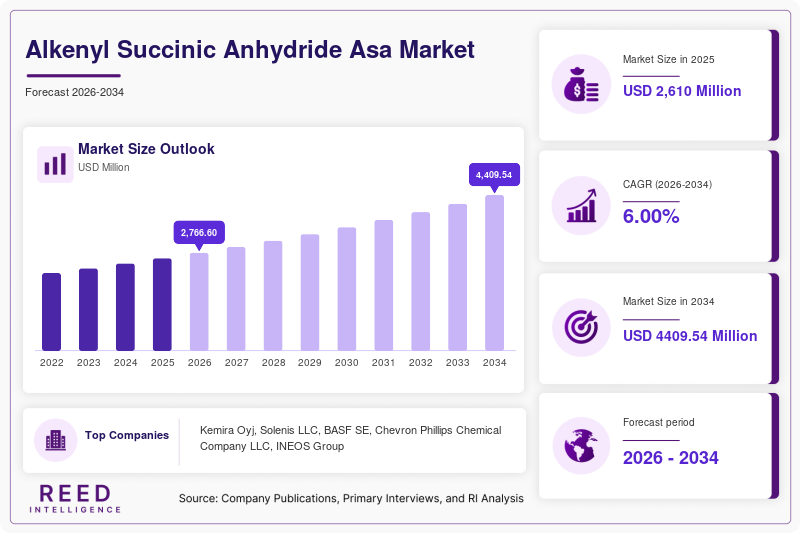
The global alkenyl succinic anhydride (ASA) market was valued at USD 2,610 million in 2025 and is projected to grow from USD 2,767 million in 2026 to USD 4,409.54 million by 2034, registering a CAGR of 6.00% during the forecast period from 2026 to 2034.
Alkenyl Succinic Anhydride is a reactive organic chemical primarily used as a sizing agent in papermaking. Its hydrophobic functionality helps control water and liquid penetration into paper fibers. Unlike conventional acidic rosin sizing, ASA is particularly suited to neutral and alkaline papermaking, including systems using calcium carbonate fillers. Its relatively high reactivity enables rapid sizing development, but that same reactivity makes hydrolysis and emulsion stability important operational considerations.
The ASA Market Growth is closely connected to packaging-board consumption. Paper and board producers need controlled liquid absorption to maintain converting performance, printability, dimensional stability and resistance to water-based materials. Kemira and Solenis both position ASA within portfolios serving packaging, paper and board applications.
Alkenyl Succinic Anhydride (ASA) Market Drivers
Expansion of Paper and Packaging Applications
Paper sizing remains the principal demand mechanism for ASA because the chemical directly controls liquid absorption during paper manufacturing. Packaging board, containerboard, linerboard and specialty paper require defined water-resistance characteristics to withstand converting, printing, storage and end-use conditions.
The expansion of fiber-based packaging increases the importance of sizing chemistry. Paperboard used in foodservice, cartons and other packaging applications must balance liquid resistance with recyclability and converting requirements. ASA therefore benefits from demand for paper-based materials while remaining exposed to competition from AKD, rosin and surface-sizing technologies.
Growth of Neutral and Alkaline Papermaking
ASA is particularly compatible with neutral and alkaline papermaking systems, where it is used alongside modern filler and retention chemistries. Its higher reactivity compared with AKD can provide rapid sizing development, which is valuable for high-speed paper machines.
The technical mechanism also creates demand for specialized application support. ASA is normally emulsified immediately before application because the aqueous emulsion has limited stability and the chemical is susceptible to hydrolysis. Mills therefore require appropriate emulsification, dosing, retention and process-control systems.
Increasing Emphasis on Chemical Efficiency
Paper mills increasingly focus on the amount of chemical required to achieve a specified Cobb value, water-resistance level or other quality target. This shifts the market from simple chemical-volume consumption toward performance per unit of ASA.
Solenis' OPTIX technology provides an example of this transition. In a North American recycled-packaging application, the company reported that autonomous control reduced ASA chemistry usage by at least 10% and lowered annual ASA consumption by approximately 175,000 dry pounds.
Alkenyl Succinic Anhydride (ASA) Market Restraints
Hydrolysis and Emulsion Stability
ASA's high reactivity creates a fundamental handling challenge. The chemical reacts with water, so commercial ASA is generally emulsified close to the point of application rather than stored as a ready-to-use aqueous emulsion. Poor stability, inadequate retention or inappropriate dosing can reduce sizing performance and increase chemical consumption.
This requirement increases the operational complexity of ASA programs. Paper mills need suitable emulsification equipment, controlled dosing and appropriate wet-end chemistry. As a result, suppliers increasingly compete through complete application programs rather than simply supplying ASA active material.
Competition From Alternative Sizing Chemistries
ASA competes with AKD, rosin-based systems, surface-sizing agents and other specialty chemistries. The choice depends on paper grade, machine configuration, pH, filler system, required liquid resistance and total operating economics.
Solenis maintains portfolios covering ASA, AKD, rosin and other sizing technologies, illustrating the competitive substitution available to paper mills. If another chemistry achieves the required performance with lower operational complexity or chemical consumption, ASA demand can be reduced within specific applications.
Alkenyl Succinic Anhydride (ASA) Market Opportunities
Renewable and Lower-Impact ASA Chemistry
The shift toward lower-fossil-content paper chemicals creates a differentiation opportunity for ASA suppliers. Kemira has developed sunflower-derived sizing chemistry using maleated high-oleic sunflower oil as a renewable alternative to conventional fossil-derived olefin feedstocks. Its FennoSize portfolio includes renewable-content sizing chemistry for paper and board.
The commercial opportunity is based on combining renewable feedstocks with equivalent sizing performance, food-contact suitability and acceptable mill economics. Kemira reports that its renewable ASA chemistry can be emulsified using equipment commonly available for conventional ASA, reducing the barrier to mill trials.
Packaging and Molded-Fiber Applications
Fiber-based packaging and molded-fiber products create an additional addressable market for sizing chemistry. These products require controlled resistance to water and other liquids while maintaining converting and structural properties.
ASA suppliers can capture this opportunity by developing formulations compatible with recycled fibers, food-contact applications and demanding packaging specifications. However, some molded-fiber applications require combined water, oil and grease resistance, meaning ASA may need to operate as part of a broader functional-chemistry system rather than as a standalone treatment.
Alkenyl Succinic Anhydride (ASA) Market Segmental Analysis
By Application
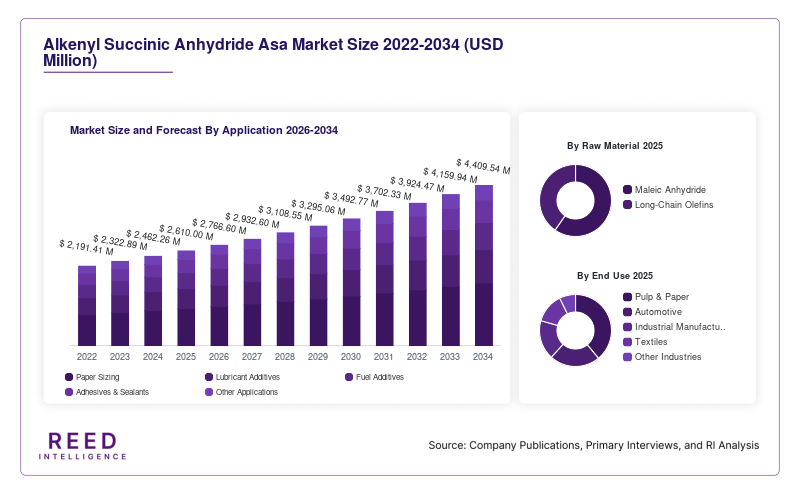
Paper Sizing is the dominant application, accounting for approximately 58% share in 2025, according to the Reed Intelligence allocation. The segment benefits from ASA's established use in controlling liquid absorption in paper and board, particularly packaging board, containerboard, linerboard and specialty paper.
Lubricant Additives represent approximately 18% share and are identified as the fastest-growing application at approximately 6.0% CAGR during 2026–2034. ASA derivatives can provide reactive functionality in specialty lubricant formulations, giving producers an avenue to diversify beyond the paper industry.
Fuel Additives remain a smaller application category, with demand linked to formulation requirements for fuel performance and deposit or corrosion control. Adhesives & Sealants similarly represent a specialized outlet where ASA chemistry can provide reactive functionality. Other applications include additional specialty chemical formulations.
By Raw Material
Long-Chain Olefins represent the principal conventional feedstock route for ASA production because they provide the hydrophobic alkenyl chain incorporated into the final molecule. Conventional ASA therefore remains closely connected with olefin availability and petrochemical feedstock economics.
Maleic Anhydride is the second key raw-material component and provides the reactive anhydride functionality. Its availability and pricing influence production economics because ASA manufacturing depends on consistent feedstock quality and controlled reaction conditions.
The shift toward renewable feedstocks provides an emerging alternative to conventional fossil-derived long-chain olefins. Kemira's sunflower-based sizing chemistry demonstrates the development of plant-oil-derived alternatives for paper and board applications.
By End Use
Pulp & Paper is the dominant end-use segment because paper sizing is the established commercial application of ASA. Demand spans packaging board, containerboard, linerboard, fine paper, printing paper and other grades where water absorption must be controlled.
Automotive represents a secondary demand channel through lubricant and specialty additive applications. Industrial Manufacturing covers additional formulation uses, while Textiles and other industries provide smaller specialty outlets.
The fastest expansion within end-use applications is expected to remain connected to packaging and specialty paper because the underlying consumption of sizing chemicals occurs continuously during paper manufacturing. Other end uses provide diversification but generally have a narrower installed application base.
Alkenyl Succinic Anhydride (ASA) Market Regional Analysis
North America Alkenyl Succinic Anhydride (ASA) Market
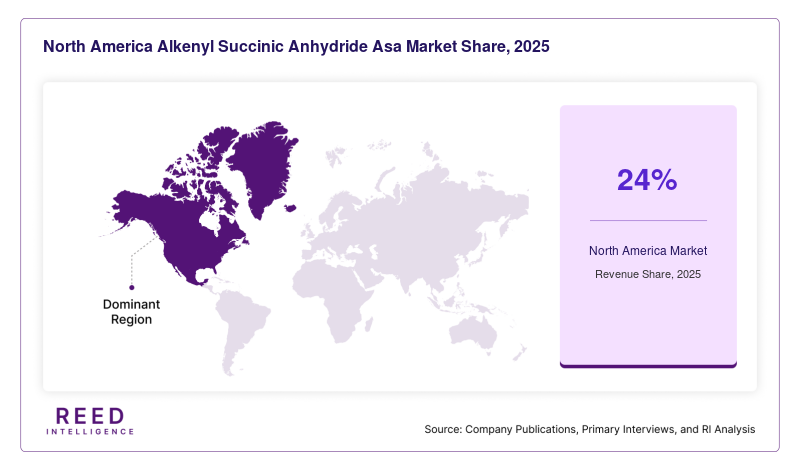
North America accounts for approximately 24% of the global ASA market in 2025. The regional market is supported by packaging paper, recycled containerboard and specialty-paper production. Demand is increasingly linked to chemical optimization because mills seek consistent sizing performance while controlling chemical consumption.
The United States is the primary regional market, supported by a large paper-converting industry and established specialty-chemical suppliers. Solenis' North American recycled-packaging application demonstrates the commercial importance of optimizing ASA dosage and Cobb-value control through digital process management.
Europe Alkenyl Succinic Anhydride (ASA) Market
Europe represents approximately 21% of the global ASA market in 2025, with growth shaped by mature paper manufacturing, packaging applications and sustainability requirements. European customers increasingly evaluate sizing chemistry according to performance, renewable-content potential, food-contact suitability and total process economics.
Germany, France, Italy and other European paper-producing markets provide established demand. Renewable ASA chemistry is particularly relevant because European paper and packaging producers are evaluating lower-fossil-content inputs while maintaining water-resistance and converting performance. Kemira manufactures its sunflower-derived sizing chemistry in Europe.
Asia Pacific Alkenyl Succinic Anhydride (ASA) Market
Asia Pacific is the dominant regional market, accounting for approximately 38% share in 2025. The region also represents one of the most important manufacturing and supply centers for ASA because China combines large paper and board production with substantial local sizing-chemical capacity.
China is the principal regional market, while India and Southeast Asia provide additional demand through expanding packaging and paper production. Kemira identifies Nanjing as its largest ASA production site and has repeatedly expanded its Asia-Pacific sizing capabilities to serve regional paper and board customers.
Latin America Alkenyl Succinic Anhydride (ASA) Market
Latin America represents approximately 10% of the global ASA market in 2025, with the regional market linked primarily to pulp, paper, packaging and board manufacturing. Demand depends more on mill production volumes and sizing requirements than on direct consumer consumption of ASA.
Brazil is the principal regional pulp and paper center, while other Latin American markets contribute through packaging and paper conversion. Local distribution, technical support and reliable supply are important because ASA requires controlled emulsification and dosing at the paper mill.
Middle East & Africa Alkenyl Succinic Anhydride (ASA) Market
Middle East & Africa account for approximately 7% of the global ASA market in 2025. The region remains smaller than Asia Pacific, North America and Europe, with demand concentrated in paper, board and specialty chemical applications.
Regional demand is influenced by development of paper-processing capacity, packaging production and the availability of technical support. Imported specialty chemicals remain important in several markets, making logistics, supply reliability and application engineering relevant factors in supplier selection.
Alkenyl Succinic Anhydride (ASA) Market Competitive Landscape
The Alkenyl Succinic Anhydride Market is concentrated around companies with established relationships with paper mills, formulation expertise and regional manufacturing capabilities. Kemira Oyj and Solenis LLC represent two prominent competitive positions because both companies offer ASA within broader paper-chemical portfolios and combine chemistry with application support.
Kemira has a particularly strong ASA-specific footprint in Asia Pacific. Its Nanjing facility is described by the company as its largest ASA sizing manufacturing plant, while the 2024 expansion added a third production line and additional storage and tank capacity. The investment was intended to improve supply reliability and respond to demand from paper, packaging and board producers.
Key Market Players
- Kemira Oyj
- Solenis LLC
- BASF SE
- Chevron Phillips Chemical Company LLC
- INEOS Group
- Vertellus Holdings LLC
- Mare Holding S.p.A.
- Tianyu Fine Chemical Co., Ltd.
- AnHui Sinograce Chemical Co., Ltd.
- Tokyo Chemical Industry Co., Ltd.
Alkenyl Succinic Anhydride (ASA) Market Recent Developments
-
April 2026 - Solenis: Solenis broke ground on a new 60,000-tonne-per-year production facility in Beihai, Guangxi, China, backed by an RMB 250 million investment. The facility is intended to support growing pulp and paper markets in Western China and Southeast Asia and will produce polymers, defoamers, silica and functional/process chemistries for papermaking.
-
July 2026 - Kemira: Kemira's H1 2026 report stated that Packaging & Hygiene Solutions revenue remained stable year over year, with volume growth offsetting weaker pricing and broader market softness. The company also highlighted continued cost and performance measures amid challenging packaging and pulp-market conditions.
Alkenyl Succinic Anhydride Asa Market Segments
By Application
- Paper Sizing
- Lubricant Additives
- Fuel Additives
- Adhesives & Sealants
- Other Applications
By Raw Material
- Maleic Anhydride
- Long-Chain Olefins
By End Use
- Pulp & Paper
- Automotive
- Industrial Manufacturing
- Textiles
- Other Industries
By Region
- North America
- Europe
- APAC
- Middle East and Africa
- LATAM