Alkenyl Succinic Anhydride Market Size, Share & Trends Analysis Report By Application (Paper Sizing, Lubricant Additives, Fuel Additives, Adhesives & Sealants, Other Applications), By Raw Material (Maleic Anhydride, Long-Chain Olefins), By End Use (Pulp & Paper, Automotive, Industrial Manufacturing, Textiles, Other Industries) and By Region (North America, Europe, APAC, Middle East and Africa, LATAM) Forecasts, 2026–2034
USD 3950
Alkenyl Succinic Anhydride Market Size
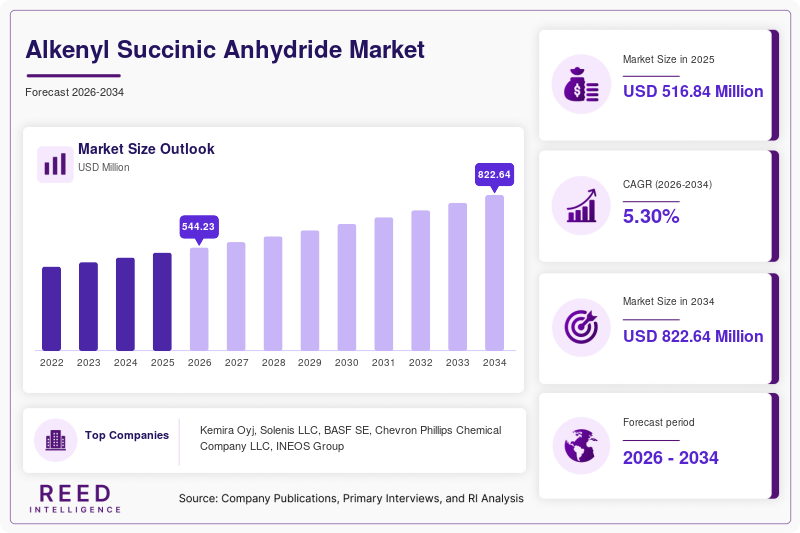
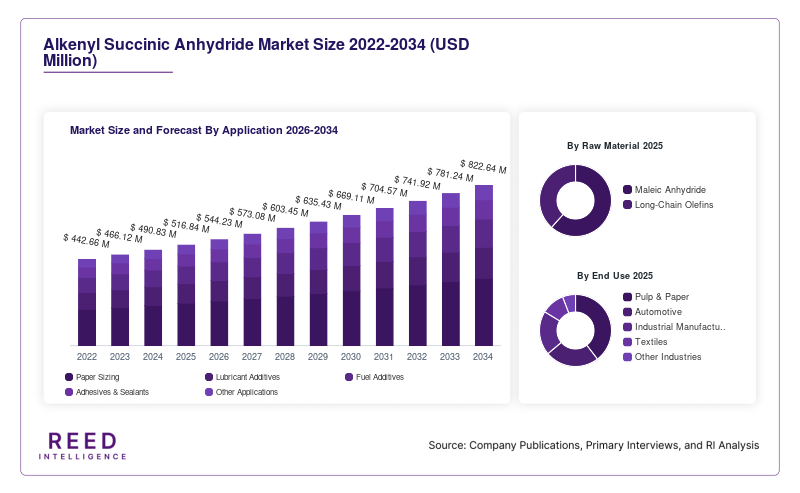
The global Alkenyl Succinic Anhydride Market was valued at USD 516.84 million in 2025 and is projected to grow from USD 544.23 million in 2026 to USD 822.64 million by 2034, registering a CAGR of 5.30% during 2026–2034.
The Alkenyl Succinic Anhydride market is primarily linked to paper and board manufacturing, where ASA functions as an internal sizing chemistry. The material is incorporated into the wet-end process to reduce liquid penetration into the finished sheet. Research identifies ASA as one of the established sizing chemistries used alongside AKD and rosin systems.
The commercial mechanism is particularly relevant to packaging board, linerboard, fine paper and other grades where controlled water absorption is required. Kemira's current sizing portfolio, for example, includes ASA solutions for fine paper, liner, sack paper, packaging board and gypsum board.
Alkenyl Succinic Anhydride Market Drivers
Packaging and Board Applications Sustain the Core ASA Demand Base
Paper and board remain the most direct commercial application for ASA because the chemistry provides hydrophobicity and controls liquid absorption during paper production. ASA is used across packaging board, containerboard, liner, fine paper and other grades where aqueous holdout affects downstream performance.
The mechanism is straightforward: mills need to control water absorption to meet product-performance requirements, including tests such as the Cobb water-absorption measurement. Solenis specifically positions ASA among its internal sizing chemistries for printing paper and packaging board.
This creates recurring chemical demand because sizing is incorporated into the manufacturing process rather than being a one-time treatment of finished paper. The counterbalance is that mills can change chemistry or optimize dosage when alternative sizing systems provide the required performance at lower operating complexity.
Asia-Pacific Capacity Expansion Strengthens the Supply Base
Supply-side investment is reinforcing ASA availability in Asia-Pacific. Kemira completed a multimillion-euro expansion of its Nanjing ASA production facility in September 2024, adding a third production line as well as storage and tank capacity. The company linked the investment directly to increased demand and supply reliability.
The mechanism is important because ASA is closely tied to paper-mill operating conditions and delivery reliability. Additional regional capacity can reduce supply constraints and improve manufacturers' ability to serve customers close to major paper-production centers.
Kemira's broader 2024 strategy also identified India as an important paper-market expansion area and included continued investment in its Asia-Pacific sizing capabilities.
The counterbalance is that new capacity can intensify competition among suppliers if demand growth does not absorb the additional output.
Process-Control Technologies Increase the Value of Higher-Performance ASA Systems
ASA demand is increasingly influenced by the ability to control dosage, retention, emulsion quality and sizing consistency, rather than simply increasing chemical consumption. Scientific research identifies emulsion stability and ASA retention as important variables affecting sizing efficiency.
This has created an opportunity for suppliers to combine ASA chemistry with application equipment, monitoring and digital process control. Solenis' OPTIX platform, for example, has been used to optimize ASA sizing chemistry using predictive analytics and autonomous process adjustments. The company reports reduced ASA use and lower sizing variation in a North American recycled-packaging application.
The commercial mechanism is therefore shifting toward performance per unit of ASA, allowing suppliers to compete through application know-how and process integration as well as chemical formulation.
Alkenyl Succinic Anhydride Market Restraints
ASA Hydrolysis and Emulsion Stability Complicate Mill Operations
ASA has a technical limitation that directly affects handling and application: the material is highly reactive and susceptible to hydrolysis. Scientific research notes that commercial ASA is normally emulsified before application and that the emulsion has limited stability, making process timing and formulation important.
This increases the importance of on-site emulsification, equipment configuration and process control. Poor emulsion stability or inadequate retention can reduce sizing efficiency and increase chemical consumption.
For suppliers, the implication is that selling ASA as a commodity chemical can be less effective than supplying an integrated sizing program. For paper mills, the additional operational requirements can encourage consideration of alternative sizing chemistries.
Alternative Sizing Chemistries Limit ASA's Addressable Market
ASA competes directly with other internal-sizing systems, particularly AKD and rosin-based sizing, while surface-sizing technologies can also reduce the quantity of ASA required in some applications. Solenis maintains portfolios covering ASA, AKD, rosin and other sizing technologies.
Solenis has also documented a packaging-mill application in which its imPress SB-798 surface-sizing technology reduced or eliminated surface ASA use while simplifying sizing control.
The commercial implication is that ASA suppliers must demonstrate a measurable performance advantage in water resistance, runnability, dosage efficiency or total process cost. Where an alternative chemistry achieves the required Cobb performance with fewer operational complications, ASA consumption can be reduced.
Alkenyl Succinic Anhydride Market Opportunities
Renewable and Lower-Impact ASA Chemistry Creates a Differentiation Route
Sustainability requirements in paper and packaging are creating opportunities for ASA formulations that reduce reliance on conventional fossil-derived feedstocks. Kemira's current FennoSize AS portfolio includes a renewable ASA sizing product manufactured from sunflower oil and positioned for paper and board applications.
The commercial opportunity is not simply replacing one chemical with another. Paper producers increasingly need sizing chemistry that can maintain water resistance while fitting within renewable-material and food-contact requirements.
A renewable ASA route therefore provides suppliers with a mechanism to differentiate through feedstock origin, regulatory compliance and application performance. Adoption will depend on whether mills can achieve comparable sizing performance and economics without compromising machine operation.
Packaging Paper and Molded Fiber Expand the Addressable Sizing Base
Packaging and molded-fiber applications provide an additional opportunity because these materials require controlled resistance to water and, in some applications, oils or other liquids. Kemira identifies liquid packaging board, containerboard and molded-fiber products among the applications requiring sizing chemistry.
Solenis similarly offers sizing and PFAS-free additives for molded-pulp applications requiring water and oil holdout.
This creates a commercial pathway for ASA suppliers to participate in the broader transition toward fiber-based packaging. The constraint is that some molded-fiber applications may require combinations of water, oil, grease and heat resistance that cannot be addressed by ASA alone.
Alkenyl Succinic Anhydride Market Application Segment Analysis
Paper Sizing Is the Largest Application Because ASA Directly Controls Liquid Absorption in Paper Manufacturing
Paper Sizing represents approximately 58% of the 2025 Alkenyl Succinic Anhydride market, corresponding to approximately USD 299.77 million, based on the internal market allocation. It is modeled to grow at approximately 5.0% CAGR from 2026 to 2034.
The segment dominates because ASA has a direct functional role in paper production: it reduces liquid penetration and provides hydrophobicity to paper and board. Scientific research identifies paper sizing as the established primary application of ASA, while commercial suppliers position ASA across packaging board, linerboard, fine paper and related grades.
Packaging applications are particularly relevant because liquid resistance affects the performance of paperboard used in demanding converting and packaging environments. Kemira's expansion of ASA production in Nanjing was explicitly connected to paper, packaging and board demand.
The segment's principal risk is substitution. Mills can use AKD, rosin and surface-sizing technologies depending on their process requirements, and improvements in digital control can reduce the amount of ASA needed per tonne of paper.
Lubricant Additives Represent the Fastest-Growing Application Because ASA Chemistry Extends Beyond Papermaking
Lubricant Additives account for approximately 18% of the 2025 market, equivalent to USD 93.03 million, and are internally modeled to grow at approximately 6.0% CAGR during 2026–2034.
ASA chemistry possesses reactive functional groups that allow derivatives to be incorporated into specialty formulations. Patent and technical literature documents uses of alkenyl succinic anhydrides beyond paper sizing, including lubricant-related applications.
The commercial mechanism differs from paper sizing: demand depends on formulation requirements for lubrication, corrosion control and surface activity rather than paper-machine throughput.
This creates diversification for ASA producers because demand is not entirely dependent on pulp and paper production. However, lubricant formulations are subject to performance specifications and competition from alternative additive chemistries, limiting the extent to which ASA can capture new formulations.
Alkenyl Succinic Anhydride Market Regional Analysis
Asia-Pacific Represents the Largest Regional Market Because Paper and Board Production Supports the Core ASA Demand Base
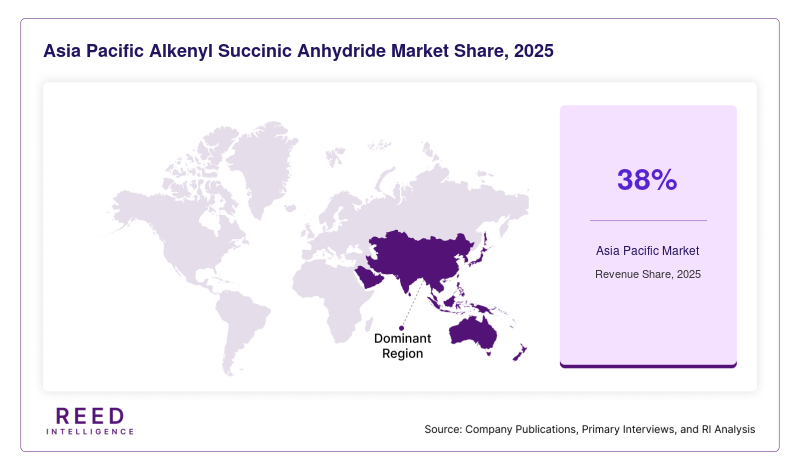
Asia-Pacific represents approximately 38% of the global Alkenyl Succinic Anhydride market in 2025, equivalent to USD 196.40 million, based on the internal allocation. It is modeled to expand at approximately 5.7% CAGR through 2034.
The region has a strong connection to ASA through its pulp, paper and packaging industries. Kemira identifies Nanjing as its largest ASA production site and has expanded the facility to improve regional supply capacity.
China is particularly important within the regional supply chain because it combines ASA manufacturing capacity with a large paper and board manufacturing base. India is another strategic market: Kemira's 2024 annual review identified India as a major paper-market expansion area and connected its Asia-Pacific strategy to packaging and sizing technologies.
The commercial mechanism is therefore both demand-led and supply-led: paper mills require sizing chemistry while local production capacity improves supplier responsiveness.
Constraints include competition among regional producers, alternative sizing technologies and volatility in petrochemical feedstocks used to produce conventional ASA.
North America Maintains an Established Market Through Packaging and Specialty Paper Applications
North America accounts for approximately 24% of global revenue in 2025, corresponding to USD 124.04 million, with an internally modeled CAGR of approximately 5.0% through 2034.
The region's demand is connected to packaging paper, board and specialty grades where controlled water absorption affects product performance. Solenis documents ASA use among North American packaging mills and has developed sizing technologies specifically for these operations.
The market is also characterized by greater emphasis on process optimization. Solenis' OPTIX technology has been applied to ASA sizing in a North American recycled-packaging operation, illustrating how chemical demand is increasingly connected with digital process control.
The future mechanism is therefore likely to involve higher-value sizing programs and chemical-efficiency improvements, rather than simply increased ASA consumption.
The main constraint is substitution by surface-sizing products and alternative internal sizing chemistries.
Europe Represents a Mature Market Where Performance and Sustainability Influence ASA Selection
Europe represents approximately 21% of the 2025 market, or USD 108.54 million, and is modeled to grow at approximately 4.9% CAGR through 2034.
The region's commercial environment favors sizing technologies that can meet performance requirements while addressing sustainability and food-contact considerations. Kemira's renewable ASA product is positioned for paper and board applications and is described as compliant with relevant food-contact requirements.
European demand therefore extends beyond conventional paper sizing toward packaging applications where renewable or lower-impact material choices can influence procurement.
The principal limitation is market maturity and the availability of alternative sizing chemistries. Suppliers must demonstrate measurable improvements in performance, sustainability or total process economics to gain share within established paper mills.
Latin America Develops Through Packaging and Pulp & Paper Applications
Latin America represents approximately 10% of the 2025 market, corresponding to USD 51.68 million, and is modeled to expand at approximately 5.2% CAGR during 2026–2034.
The regional opportunity is tied primarily to pulp, paper, packaging and board manufacturing. ASA demand increases when paper mills require controlled water absorption in packaging and other grades.
The commercial mechanism is therefore linked to mill production rather than consumer-level ASA demand. Suppliers with local distribution and technical-service capabilities can improve adoption by helping mills manage emulsification, retention and sizing performance.
The key limitations are differences in industrial infrastructure between countries, logistics costs and exposure to feedstock and energy-price movements.
Middle East and Africa Represent a Smaller Market With Specialty-Application Potential
Middle East and Africa account for approximately 7% of global revenue in 2025, or USD 36.18 million, and are modeled to grow at approximately 5.3% CAGR through 2034.
Demand is concentrated in paper, board and specialty chemical applications. Growth depends on expansion of regional paper-processing capacity and the availability of technically supported sizing systems.
Because ASA is a process chemical rather than a consumer product, distribution and technical support are particularly important. Mills need appropriate emulsification, dosing and process-control systems to obtain consistent sizing results.
The principal constraints are the smaller regional paper-production base, dependence on imported specialty chemicals in some markets and competition from alternative sizing technologies.
Alkenyl Succinic Anhydride Market Competitive Landscape
Competition in the ASA market is centered on chemical formulation, production capacity, feedstock access, technical service, application control and geographic proximity to paper mills.
Kemira has one of the most visible ASA-specific production footprints. The company completed an expansion of its Nanjing facility in 2024, adding a third production line and additional storage and tank capacity. The investment strengthens its ability to supply Asia-Pacific paper and board customers and improves delivery reliability.
Solenis competes through a combination of ASA chemistry, alternative sizing products, application expertise and digital process-control technologies. Its portfolio includes ASA, AKD and rosin sizing, allowing the company to compete across multiple chemistry platforms rather than relying exclusively on ASA.
Key Market Players
- Kemira Oyj
- Solenis LLC
- BASF SE
- Chevron Phillips Chemical Company LLC
- INEOS Group
- Vertellus Holdings LLC
- Mare Holding S.p.A.
- Tianyu Fine Chemical Co., Ltd.
- AnHui Sinograce Chemical Co., Ltd.
- Tokyo Chemical Industry Co., Ltd.
Recent Market Developments
- In September 2024, Kemira completed a multimillion-euro investment to expand ASA sizing-agent production at its Nanjing, China facility. The project included a third production line plus additional storage and tank capacity. The commercial implication is increased regional production capacity and improved supply reliability for paper and board customers.
- Kemira's 2024 annual review identified India as a strategic paper-market expansion area and linked the company's Asia-Pacific activities to packaging, hygiene papers and sizing technologies. The company also initiated a third ASA production line in China.
Alkenyl Succinic Anhydride Market Segments
By Application
- Paper Sizing
- Lubricant Additives
- Fuel Additives
- Adhesives & Sealants
- Other Applications
By Raw Material
- Maleic Anhydride
- Long-Chain Olefins
By End Use
- Pulp & Paper
- Automotive
- Industrial Manufacturing
- Textiles
- Other Industries
By Region
- North America
- Europe
- APAC
- Middle East and Africa
- LATAM