Allantoin Extract for Skincare Products Market Size, Share & Demand Report By Type (Synthetic Allantoin, Plant-Derived Allantoin), By Application (Moisturizers, Serums, Creams & Lotions, Cleansers, Masks), By End-Use (Personal Care, Dermatological Products), By Distribution Channel (Online Retail, Offline Retail) By Region & Segment Forecasts, 2025–2034
USD 3950
Market Overview
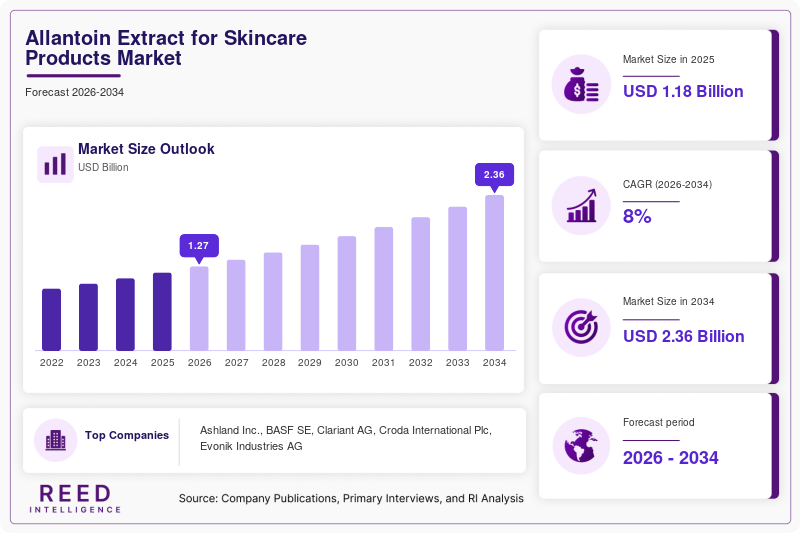
The global Allantoin Extract for Skincare Products Market size was valued at approximately USD 1.18 billion in 2025 and is projected to reach USD 2.36 billion by 2034, expanding at a CAGR of 8.0% during 2025–2034. The market size is witnessing steady expansion driven by increasing consumer awareness of skin health, coupled with the rising adoption of multifunctional cosmetic ingredients that offer soothing, healing, and moisturizing properties.
A key global factor supporting market growth is the rising demand for dermatologically safe and non-irritating skincare formulations. Consumers are increasingly shifting toward ingredients that enhance skin barrier repair while minimizing allergic reactions. Allantoin extract, known for its keratolytic and anti-inflammatory properties, has gained traction across moisturizers, serums, and medicated skincare products, particularly in sensitive skin formulations.
Key Highlights
- North America dominated the market with 34% share in 2025, while Asia Pacific is projected to grow fastest at a CAGR of 9.2%
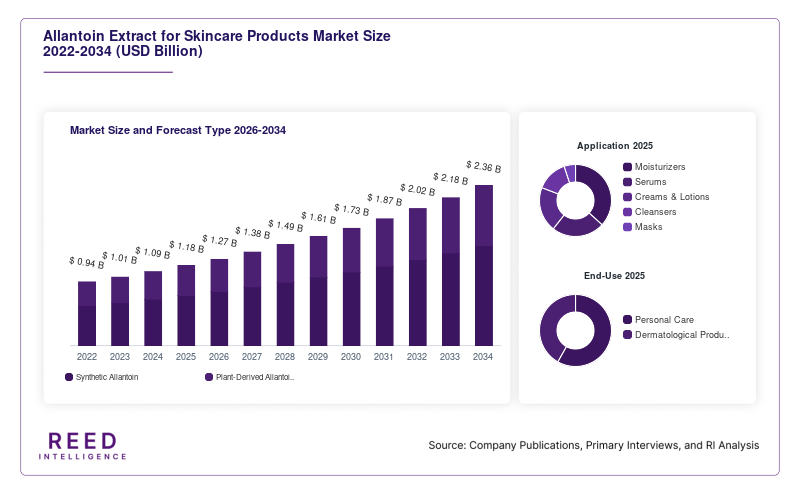
- Synthetic allantoin held the leading subsegment share of 62%, while plant-derived allantoin is expected to grow fastest at a CAGR of 9.8%
- Moisturizers accounted for the dominant application share of 38%, while serums are projected to grow fastest at 10.1% CAGR
- The United States market was valued at USD 310 million in 2025 and is expected to reach USD 335 million in 2026
Market Trends
Rising Preference for Clean and Transparent Ingredients
The Allantoin Extract for Skincare Products Market is witnessing a growing shift toward clean-label formulations. Consumers are prioritizing ingredient transparency, leading brands to highlight allantoin extract as a safe, non-toxic, and skin-compatible component. This trend is particularly evident in premium skincare segments where labels emphasize minimal ingredients and dermatological testing. Manufacturers are responding by incorporating allantoin into organic and vegan-certified product lines, enhancing its appeal among environmentally conscious consumers.
Expansion of Multi-Functional Skincare Formulations
Another significant trend shaping the market is the increasing demand for multifunctional skincare products. Consumers prefer formulations that combine hydration, soothing, and repair benefits in a single product. Allantoin extract plays a central role in this evolution due to its ability to improve skin texture while supporting regeneration. As a result, it is increasingly used in hybrid products such as BB creams, overnight repair masks, and post-procedure skincare solutions. This trend is expected to strengthen the overall market outlook and diversify product innovation pipelines.
Market Drivers
Increasing Demand for Sensitive Skin Solutions
The rising prevalence of skin sensitivity and irritation has significantly driven the demand for allantoin-based skincare products. Consumers are actively seeking ingredients that can soothe inflammation, reduce redness, and promote healing without causing adverse effects. Allantoin extract has emerged as a preferred choice due to its compatibility with a wide range of skin types, including acne-prone and sensitive skin. This growing consumer demand continues to expand the market size across both developed and emerging economies.
Growth of the Global Cosmetics and Personal Care Industry
The continuous expansion of the global cosmetics industry has been a key growth driver for the Allantoin Extract for Skincare Products Market. Rising disposable incomes, urbanization, and increasing beauty awareness are contributing to higher spending on skincare products. Additionally, the proliferation of digital marketing and influencer-driven promotions has accelerated product adoption. Manufacturers are leveraging allantoin extract to enhance product efficacy, thereby strengthening its integration into mainstream and niche skincare formulations.
Market Restraint
Availability of Alternative Active Ingredients
One of the primary restraints in the Allantoin Extract for Skincare Products Market is the availability of alternative skincare actives that offer similar benefits. Ingredients such as hyaluronic acid, aloe vera, and panthenol are widely used for hydration and soothing effects, often competing directly with allantoin extract. These alternatives may be preferred by manufacturers due to brand familiarity or consumer recognition, limiting the penetration of allantoin in certain product categories.
Additionally, fluctuations in raw material sourcing, particularly for natural allantoin, can affect production consistency and pricing. While synthetic allantoin remains widely available, the growing preference for natural ingredients creates challenges in supply chain stability. These factors collectively hinder the full-scale adoption of allantoin extract across all skincare segments, particularly in cost-sensitive markets.
Market Opportunities
Growth in Dermatological and Clinical Skincare
The increasing integration of dermatological science into skincare presents a significant opportunity for the Allantoin Extract for Skincare Products Market. Clinical-grade skincare products are gaining popularity among consumers seeking targeted solutions for conditions such as eczema, acne, and post-procedure healing. Allantoin extract’s proven efficacy in promoting skin regeneration positions it as a key ingredient in this segment. This trend is expected to drive innovation and expand its application scope.
Expansion in Emerging Markets
Emerging economies in Asia Pacific, Latin America, and the Middle East are offering substantial growth opportunities. Rising middle-class populations, increasing urbanization, and growing awareness of personal grooming are fueling demand for skincare products. Local manufacturers are increasingly incorporating allantoin extract into affordable formulations, enabling broader market penetration. As distribution networks improve and digital retail expands, these regions are expected to contribute significantly to market growth during the forecast period.
Segmental Analysis
By Type
Synthetic allantoin dominated the market with a 62% share in 2025 due to its cost-effectiveness and consistent quality. It is widely used in mass-market skincare products where large-scale production is required. Its stability and ease of formulation have made it a preferred choice among manufacturers.
Plant-derived allantoin is expected to grow at the fastest CAGR of 9.8% during the forecast period. This growth will be driven by increasing consumer preference for natural and organic ingredients. Brands focusing on clean beauty are expected to incorporate plant-based allantoin to enhance product appeal and meet regulatory standards.
By Application
Moisturizers held the dominant share of 38% in 2025, as allantoin extract is extensively used for its hydrating and skin-softening properties. It enhances moisture retention and improves skin texture, making it a key ingredient in daily skincare products.
Serums are projected to grow at a CAGR of 10.1%, driven by rising demand for concentrated formulations. Consumers are increasingly opting for targeted treatments, and allantoin-based serums offer enhanced absorption and efficacy, supporting rapid market growth.
By End-Use
Personal care products accounted for the largest share of 55% in 2025, reflecting widespread use in over-the-counter skincare formulations. These products include creams, lotions, and cleansers that incorporate allantoin for daily use.
Dermatological products are expected to grow at a CAGR of 9.5%, supported by increasing demand for clinically tested skincare solutions. Allantoin’s healing properties make it suitable for specialized treatments, driving its adoption in this segment.
By Distribution Channel
Offline retail dominated with a 60% share in 2025, as consumers often prefer physical stores for skincare purchases. Pharmacies and specialty stores play a significant role in product availability.
Online retail is anticipated to grow at a CAGR of 10.4%, fueled by the expansion of e-commerce platforms. Digital channels offer convenience, product variety, and competitive pricing, encouraging higher consumer engagement.
Regional Analysis
North America
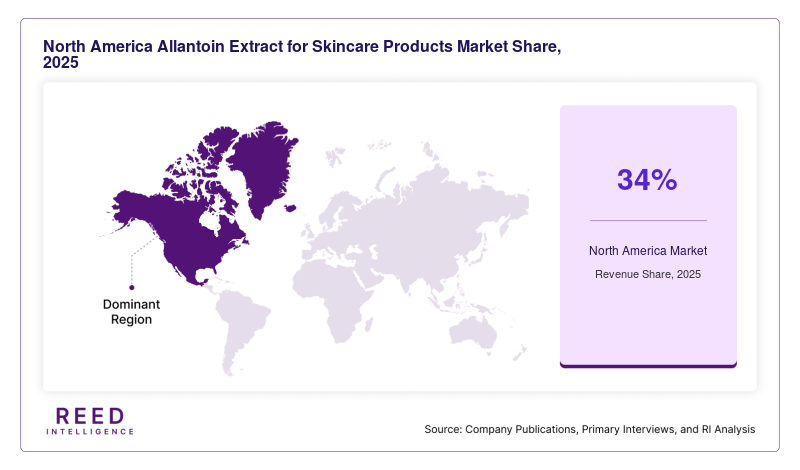
North America accounted for 34% of the Allantoin Extract for Skincare Products Market share in 2025 and is expected to grow at a CAGR of 7.5% through 2034. The region’s mature skincare industry and strong consumer awareness have supported steady demand for high-performance ingredients. Advanced product formulations and the presence of established cosmetic brands have further contributed to market stability.
The United States dominated the regional market due to its strong focus on dermatologically tested products. A key growth factor has been the increasing adoption of clinical skincare solutions, where allantoin extract is widely used for post-treatment care and sensitive skin applications. The presence of innovation-driven manufacturers continues to strengthen market expansion.
Europe
Europe held a 28% market share in 2025 and is projected to grow at a CAGR of 7.2% during the forecast period. The region’s strict regulatory framework has encouraged the use of safe and well-researched ingredients, supporting the adoption of allantoin extract in skincare formulations.
Germany emerged as the dominant country, driven by its strong pharmaceutical and cosmetic industries. A major growth factor has been the emphasis on sustainable and clean beauty products. European consumers prioritize eco-friendly ingredients, which has increased the demand for naturally derived allantoin extract.
Asia Pacific
Asia Pacific represented 22% of the market share in 2025 and is anticipated to grow at the fastest CAGR of 9.2%. Rapid urbanization, increasing disposable incomes, and the influence of beauty trends have significantly boosted skincare product consumption.
China dominated the region due to its large consumer base and expanding domestic cosmetic industry. A key growth factor has been the rising demand for multifunctional skincare products, where allantoin extract is used for hydration and skin repair. The growing popularity of K-beauty and J-beauty trends has further accelerated market growth.
Middle East & Africa
The Middle East & Africa accounted for 9% of the market share in 2025 and is expected to grow at a CAGR of 7.8%. Increasing awareness of personal care and rising demand for premium skincare products have supported market development.
The United Arab Emirates led the region due to its expanding retail sector and high consumer spending on beauty products. A notable growth factor has been the increasing demand for luxury skincare products that incorporate soothing and hydrating ingredients such as allantoin extract.
Latin America
Latin America held 7% of the market share in 2025 and is projected to grow at a CAGR of 8.1%. The region’s growing young population and rising interest in skincare routines have contributed to market expansion.
Brazil dominated the regional market, supported by its strong cosmetics industry. A key growth factor has been the increasing adoption of affordable skincare products that include functional ingredients like allantoin extract, enabling broader consumer reach.
Competitive Landscape
The Allantoin Extract for Skincare Products Market is moderately fragmented, with several global and regional players competing based on product quality, innovation, and pricing strategies. Leading companies are focusing on expanding their product portfolios and strengthening distribution networks to maintain market presence.
The market leader, Ashland Inc., has maintained a strong position through continuous innovation and strategic partnerships. A recent development includes the introduction of advanced allantoin-based formulations designed for sensitive skin applications, enhancing its competitive edge.
Other key players are investing in research and development to improve ingredient efficacy and sustainability. Collaborations with cosmetic brands and expansion into emerging markets remain key strategies among industry participants.
Key Players List
- Ashland Inc.
- BASF SE
- Clariant AG
- Croda International Plc
- Evonik Industries AG
- Lubrizol Corporation
- DSM-Firmenich
- Merck KGaA
- Solvay SA
- Galaxy Surfactants Ltd.
- Kao Corporation
- Seppic SA
- Lonza Group AG
- Givaudan Active Beauty
- Symrise AG
Recent Developments
- Introduction of plant-based allantoin formulations by leading cosmetic ingredient manufacturers
- Expansion of production facilities to meet rising global demand
- Strategic collaborations between ingredient suppliers and skincare brands
- Increased investment in sustainable sourcing and clean-label product development
- Launch of multifunctional skincare products incorporating allantoin extract
Allantoin Extract for Skincare Products Market Segments
Type
- Synthetic Allantoin
- Plant-Derived Allantoin
Application
- Moisturizers
- Serums
- Creams & Lotions
- Cleansers
- Masks
End-Use
- Personal Care
- Dermatological Products
Distribution Channel
- Online Retail
- Offline Retail
By Region
- North America
- Europe
- APAC
- Middle East and Africa
- LATAM