Allyl Alcohol Market Size, Share & Demand Report By Grade (Industrial Grade, Pharmaceutical Grade, Laboratory Grade), By Application (Chemical Intermediates, Pharmaceutical Manufacturing, Agrochemicals, Resins and Coatings, Plasticizers, Others), By End-Use Industry (Chemicals and Materials, Healthcare, Agriculture, Others), By Region & Segment Forecasts, 2026–2034
USD 3950
Market Overview
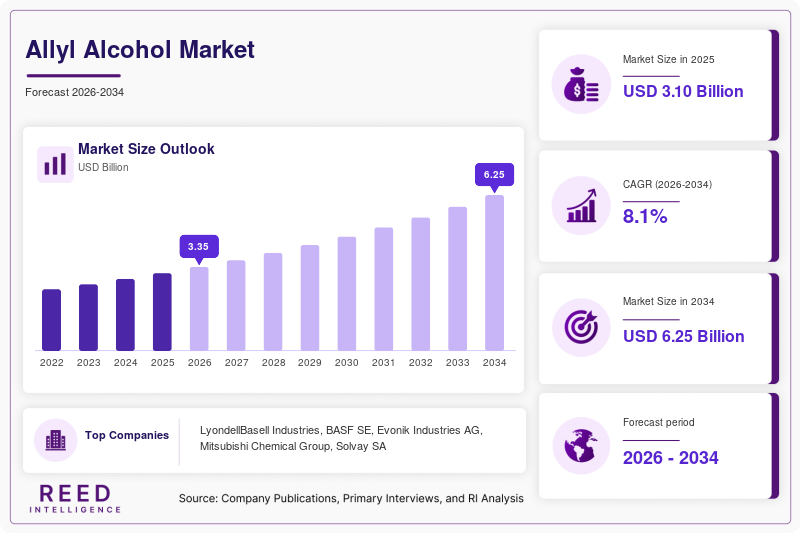
The global Allyl Alcohol Market size was valued at approximately USD 3.1 billion in 2026 and is projected to reach nearly USD 5.8 billion by 2034, expanding at a CAGR of 8.1% during the forecast period from 2026 to 2034. Allyl alcohol is an important intermediate chemical widely used in the production of glycerol, pharmaceuticals, agrochemicals, plasticizers, flame retardants, and specialty resins. The increasing demand for chemical intermediates in industrial manufacturing and pharmaceutical processing has contributed to steady market expansion across developed and emerging economies. Growing investments in specialty chemical production facilities and the rising need for high-performance compounds in automotive coatings and construction materials are also supporting market growth.
One of the major global factors driving the market is the rapid expansion of the specialty chemicals industry, particularly in Asia Pacific and North America. Manufacturers are increasingly focusing on high-value chemical formulations for industrial coatings, adhesives, and synthetic materials, which has increased the consumption of allyl alcohol derivatives. In addition, technological developments in catalytic oxidation and sustainable production processes are helping producers improve efficiency while reducing production costs. Governments in several countries are also encouraging domestic chemical manufacturing through policy incentives and industrial infrastructure investments, further strengthening supply chain capacity.
Key Highlights
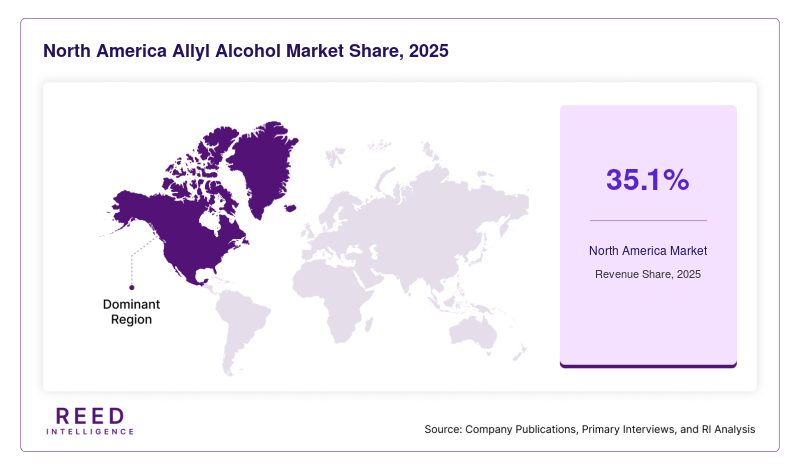
- North America dominated the market with a 35.1% share in 2025.
- Asia Pacific is expected to grow at the fastest CAGR of 9.4% during 2026–2034.
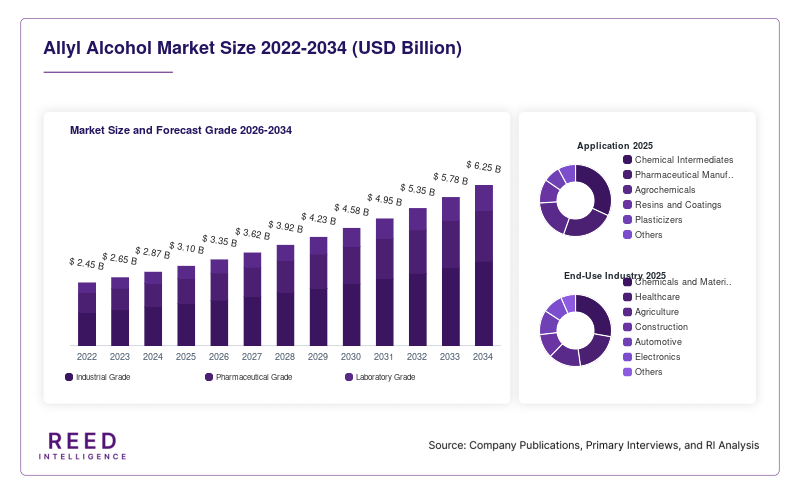
- By grade, industrial grade accounted for the largest share of 44.3%.
- while pharmaceutical grade is projected to grow at a CAGR of 9.8%.
- By application, chemical intermediates led with a 39.6% share.
- whereas pharmaceutical manufacturing is expected to expand at a CAGR of 10.2%.
- By end-use industry, chemicals and materials held the dominant share of 41.8%.
- while healthcare applications are projected to grow at a CAGR of 9.9%.
- The United States remained the dominant country, with market values of USD 620 million in 2024 and USD 680 million in 2025.
Market Trends
Rising Adoption of Sustainable Chemical Manufacturing Processes
The Allyl Alcohol Market is witnessing increasing adoption of sustainable and energy-efficient production technologies across the chemical industry. Manufacturers are focusing on catalytic oxidation methods and low-emission processing systems to reduce waste generation and improve operational efficiency. Environmental regulations in North America and Europe are encouraging companies to modernize production facilities and minimize volatile organic compound emissions during allyl alcohol manufacturing. This transition toward cleaner chemical production has also increased investments in process automation, advanced monitoring systems, and renewable energy integration within production plants.
The growing preference for sustainable specialty chemicals among downstream industries such as coatings, pharmaceuticals, and construction materials is further supporting this trend. Large-scale chemical producers are collaborating with research organizations to develop eco-friendly derivatives and optimize feedstock utilization. In addition, rising awareness regarding sustainable industrial practices among end users is encouraging procurement of environmentally responsible chemical intermediates. As industries continue to prioritize carbon reduction and compliance with environmental standards, demand for efficiently manufactured allyl alcohol products is expected to increase steadily throughout the forecast period.
Expansion of Pharmaceutical and Specialty Resin Applications
Another major trend shaping the Allyl Alcohol Market is the increasing utilization of allyl alcohol in pharmaceutical formulations and specialty resin manufacturing. Pharmaceutical companies are using allyl alcohol derivatives in active ingredient synthesis and advanced drug manufacturing processes due to their chemical reactivity and compatibility with complex formulations. The expansion of healthcare manufacturing capacities in countries such as India, China, and the United States is increasing consumption of specialty chemical intermediates, including allyl alcohol.
At the same time, the specialty resin industry is creating strong growth opportunities for allyl alcohol suppliers. Manufacturers of coatings, adhesives, insulation materials, and industrial composites are adopting advanced resin formulations that improve durability, thermal resistance, and flexibility. Allyl alcohol-based compounds are increasingly used in resin synthesis for automotive and construction applications. Rising infrastructure development projects and demand for durable industrial materials are further supporting this trend. The combination of healthcare expansion and specialty material innovation is expected to strengthen long-term demand across multiple industrial sectors.
Market Drivers
Increasing Demand from Chemical Intermediate Manufacturing
The expanding use of allyl alcohol as a chemical intermediate is one of the primary factors driving market growth. Allyl alcohol serves as a key raw material in the production of glycerol, allyl esters, flame retardants, plasticizers, and specialty polymers. Rapid industrialization and increasing manufacturing activity across Asia Pacific and North America are creating strong demand for these downstream products. Industries such as automotive, packaging, textiles, and electronics are increasingly using specialty chemicals that rely on allyl alcohol derivatives during production processes.
The growth of industrial coatings and advanced polymer manufacturing has also contributed to higher allyl alcohol consumption. Companies are investing in research and development activities to improve chemical formulations and produce high-performance materials for industrial use. In addition, rising infrastructure investments and urbanization are increasing demand for adhesives, sealants, and construction chemicals, which further supports the need for allyl alcohol-based compounds. The ability of allyl alcohol to function effectively in multiple chemical synthesis applications makes it a critical component in industrial manufacturing operations worldwide.
Growth of Pharmaceutical and Agrochemical Industries
The continued expansion of pharmaceutical and agrochemical industries is another major driver supporting the Allyl Alcohol Market. Pharmaceutical manufacturers use allyl alcohol derivatives in the production of active pharmaceutical ingredients, intermediates, and specialty compounds. The increasing prevalence of chronic diseases, growing healthcare expenditure, and rising pharmaceutical exports from emerging economies are contributing to higher demand for specialty chemical ingredients.
Similarly, the agrochemical industry is increasing the use of allyl alcohol in herbicide and pesticide formulations to improve crop productivity and agricultural efficiency. Growing global food demand and the need for higher agricultural output are encouraging farmers to adopt advanced crop protection chemicals. Countries with large agricultural sectors, including India, Brazil, and China, are witnessing significant investments in agrochemical manufacturing facilities. This trend is creating additional opportunities for allyl alcohol suppliers and distributors. As pharmaceutical and agricultural industries continue to expand production capacities, the requirement for reliable chemical intermediates is expected to rise steadily over the coming years.
Market Restraint
Stringent Environmental and Safety Regulations
Strict environmental and occupational safety regulations remain a major restraint for the Allyl Alcohol Market. Allyl alcohol is classified as a hazardous chemical due to its flammability and potential health risks associated with prolonged exposure. Regulatory authorities in North America and Europe have implemented rigorous handling, transportation, storage, and disposal standards for chemical manufacturers and distributors. Compliance with these regulations often requires companies to invest significantly in safety infrastructure, emission control systems, and employee training programs.
The high compliance costs associated with regulatory standards can create financial pressure for small and medium-sized manufacturers. In addition, environmental restrictions on chemical emissions and hazardous waste disposal may delay expansion projects or increase operational expenses. Some end-use industries are also shifting toward alternative bio-based chemicals to reduce environmental impact and regulatory risk. For example, certain coating and resin manufacturers are exploring low-toxicity substitutes that offer comparable performance characteristics. These challenges may limit market penetration in highly regulated regions and create pricing pressure for producers attempting to maintain profitability while meeting environmental compliance requirements.
Market Opportunities
Increasing Investment in Emerging Chemical Manufacturing Economies
Emerging economies are creating significant growth opportunities for the Allyl Alcohol Market due to rapid industrial expansion and increasing investment in chemical manufacturing infrastructure. Countries such as India, Vietnam, Indonesia, and Brazil are strengthening domestic specialty chemical production to reduce import dependence and support industrial growth. Government initiatives promoting local manufacturing and foreign direct investment are encouraging multinational chemical companies to establish production facilities and regional supply chains.
The availability of lower manufacturing costs, expanding industrial zones, and improving logistics infrastructure is attracting large-scale investments in chemical processing industries. These developments are increasing demand for allyl alcohol across applications such as coatings, agrochemicals, plastics, and industrial solvents. Rising urbanization and infrastructure development in emerging markets are also supporting consumption of construction materials and specialty polymers that require allyl alcohol derivatives. As industrial production capacity expands across developing economies, suppliers are expected to benefit from long-term growth opportunities and stronger regional demand.
Development of Advanced Specialty Materials and High-Performance Resins
The growing focus on advanced specialty materials is generating new opportunities for allyl alcohol manufacturers worldwide. Industries such as aerospace, automotive, electronics, and renewable energy are increasingly adopting high-performance resins and engineered materials with enhanced durability, thermal stability, and chemical resistance. Allyl alcohol-based compounds are widely used in resin synthesis and polymer modification processes, making them valuable components in advanced industrial materials.
The shift toward lightweight automotive components and durable industrial coatings is further supporting demand for specialty resins. Manufacturers are developing innovative material formulations to meet evolving performance requirements in electric vehicles, electronics insulation systems, and renewable energy equipment. In addition, increasing research activity in bio-based and multifunctional resin technologies is opening new avenues for allyl alcohol applications. As industrial sectors continue to prioritize material efficiency and product durability, demand for specialty chemicals used in advanced manufacturing is expected to create substantial growth potential for market participants.
Segmental Analysis
By Grade
Industrial grade allyl alcohol accounted for the largest share of the market in 2024, representing approximately 44.3% of total revenue. This segment continues to dominate due to its extensive use in chemical synthesis, coatings, adhesives, plasticizers, and specialty polymer production. Industrial grade allyl alcohol is widely preferred because of its cost efficiency and suitability for large-scale manufacturing applications. Industries such as automotive, construction, and packaging rely heavily on industrial-grade formulations for the production of durable materials and chemical intermediates. Growing infrastructure development and rising industrial manufacturing activities in Asia Pacific and North America are further supporting segment growth. In addition, the increasing use of industrial solvents and resin formulations in heavy manufacturing industries continues to strengthen demand for industrial-grade allyl alcohol products worldwide.
Pharmaceutical grade allyl alcohol is expected to register the fastest CAGR of 9.8% during the forecast period due to increasing pharmaceutical manufacturing and rising demand for specialty chemical intermediates. Pharmaceutical companies are expanding production capacities to meet the growing demand for active pharmaceutical ingredients and advanced drug formulations. Pharmaceutical grade allyl alcohol offers high purity levels and improved chemical consistency, making it suitable for sensitive healthcare applications. Rising healthcare expenditure, increasing prevalence of chronic diseases, and expanding pharmaceutical exports from emerging economies are contributing to segment expansion. In addition, growing investments in biotechnology and specialty chemical research are increasing the use of high-purity allyl alcohol compounds. The development of advanced therapeutic products and specialty formulations is expected to accelerate demand for pharmaceutical-grade materials over the coming years.
By Application
Chemical intermediates represented the dominant application segment in 2024 and accounted for nearly 39.6% of the global market share. Allyl alcohol plays a critical role in the synthesis of glycerol, allyl esters, plasticizers, flame retardants, and specialty resins used across multiple industries. The growing demand for high-performance materials in automotive manufacturing, construction, and electronics has increased the need for efficient chemical intermediates. Chemical manufacturers continue to invest in process optimization and advanced synthesis technologies to improve productivity and reduce operational costs. Rapid industrialization in developing economies and expanding specialty chemical production facilities are also contributing to segment growth. Furthermore, increasing demand for industrial coatings, adhesives, and synthetic materials has strengthened the importance of allyl alcohol in downstream chemical processing applications.
Pharmaceutical manufacturing is projected to witness the fastest CAGR of 10.2% during the forecast period due to increasing global healthcare demand and expanding drug production capabilities. Pharmaceutical manufacturers are using allyl alcohol derivatives in active ingredient synthesis and specialty formulations because of their chemical reactivity and process compatibility. Growing healthcare infrastructure investments and rising pharmaceutical exports from countries such as India and China are creating strong growth opportunities for the segment. In addition, advancements in drug delivery systems and biotechnology applications are increasing the use of specialty intermediates in pharmaceutical research and production. Regulatory emphasis on high-quality pharmaceutical manufacturing is also supporting the adoption of premium-grade chemical ingredients. These factors are expected to drive steady growth for pharmaceutical applications throughout the forecast period.
By End-Use Industry
The chemicals and materials industry held the largest share of the Allyl Alcohol Market in 2024, accounting for approximately 41.8% of global revenue. This dominance is attributed to the widespread use of allyl alcohol in specialty polymers, coatings, adhesives, and industrial chemical formulations. Manufacturers in the chemicals and materials sector rely on allyl alcohol derivatives to improve product performance, chemical stability, and durability across various industrial applications. Rising demand for advanced industrial materials in construction, automotive, and packaging sectors is further supporting segment growth. In addition, the expansion of manufacturing facilities and increasing investments in specialty chemical production are creating sustained demand for allyl alcohol-based compounds. Continuous innovation in resin technologies and industrial coatings is also strengthening the importance of allyl alcohol within the chemicals and materials industry.
Healthcare applications are anticipated to grow at the fastest CAGR of 9.9% during the forecast period due to increasing pharmaceutical production and expanding biotechnology research activities. The healthcare industry requires high-purity chemical intermediates for drug manufacturing, laboratory formulations, and specialty medical compounds. Rising healthcare expenditure in emerging economies and increasing global demand for pharmaceutical products are supporting segment expansion. In addition, the growing focus on advanced therapies and precision medicine is increasing the need for reliable specialty chemicals in research and development activities. Healthcare manufacturers are also investing in advanced processing technologies to improve production efficiency and meet stringent quality standards. These trends are expected to generate substantial demand for allyl alcohol across healthcare-related applications over the forecast timeline.
Regional Analysis
North America
North America accounted for approximately 35.1% of the global Allyl Alcohol Market share in 2025 and is expected to maintain steady growth during the forecast period with a CAGR of 7.4% through 2034. The region benefits from a highly developed chemical manufacturing sector and strong demand from pharmaceutical, coatings, and industrial material industries. Advanced industrial infrastructure and technological innovation continue to support production efficiency across the United States and Canada. In addition, rising investments in specialty chemicals and sustainable manufacturing technologies are strengthening regional market competitiveness.
The United States remains the dominant country in North America due to its extensive chemical processing industry and growing pharmaceutical manufacturing capacity. The country is also benefiting from increased demand for high-performance industrial coatings and specialty polymers in automotive and aerospace applications. Major chemical companies are investing in plant modernization and advanced catalyst technologies to improve production output and operational efficiency. Strong research and development capabilities and stable industrial demand continue to support long-term market expansion across the region.
Europe
Europe represented nearly 24.3% of the global Allyl Alcohol Market in 2025 and is projected to expand at a CAGR of 6.9% between 2026 and 2034. The region has a mature specialty chemical industry supported by stringent quality standards and strong industrial integration. Demand for allyl alcohol in Europe is driven by pharmaceutical manufacturing, construction chemicals, and advanced resin applications. Several European countries are focusing on sustainable chemical production methods and low-emission industrial operations, encouraging modernization within the market.
Germany remains the leading country within the European market due to its strong industrial manufacturing base and advanced chemical engineering sector. The country has a significant presence of automotive, coatings, and industrial material manufacturers that rely on specialty chemical intermediates. Germany is also investing in environmentally responsible production technologies and energy-efficient processing systems. The increasing focus on high-performance industrial materials and sustainable manufacturing practices is expected to support future market growth across the country and neighboring European economies.
Asia Pacific
Asia Pacific held approximately 28.7% of the global Allyl Alcohol Market share in 2025 and is anticipated to record the fastest CAGR of 9.4% during the forecast period. Rapid industrialization, expanding pharmaceutical production, and increasing investments in specialty chemical manufacturing are major factors supporting regional growth. Countries across Asia Pacific are witnessing strong demand for industrial coatings, adhesives, agrochemicals, and plasticizers, all of which contribute to increased allyl alcohol consumption. Growing export-oriented manufacturing activity is also strengthening regional supply chains.
China dominates the Asia Pacific market due to its large-scale chemical manufacturing capacity and strong domestic industrial demand. The country continues to invest heavily in specialty chemicals, industrial materials, and pharmaceutical production infrastructure. In addition, rising construction activity and increasing automotive manufacturing are generating strong demand for advanced coatings and resin products. Government support for domestic manufacturing and export competitiveness is further accelerating industrial expansion. These factors are expected to maintain China’s leadership position in the regional market over the forecast period.
Middle East & Africa
The Middle East & Africa region accounted for nearly 6.1% of the global Allyl Alcohol Market in 2025 and is projected to grow at a CAGR of 6.7% through 2034. Increasing industrial diversification and investments in petrochemical infrastructure are supporting market development across the region. Several countries are focusing on expanding downstream chemical processing industries to strengthen economic diversification strategies. Rising demand for industrial solvents, specialty coatings, and chemical intermediates is gradually increasing allyl alcohol consumption in manufacturing sectors.
Saudi Arabia represents the leading country in the regional market due to its strong petrochemical industry and large-scale industrial investment programs. The country is expanding its specialty chemical manufacturing capacity through strategic partnerships and industrial development projects. In addition, infrastructure construction and industrial modernization initiatives are increasing demand for coatings, adhesives, and advanced construction materials. The government’s long-term industrial diversification plans and growing investment in value-added chemical manufacturing are expected to create stable growth opportunities for allyl alcohol suppliers in the coming years.
Latin America
Latin America captured around 5.8% of the global Allyl Alcohol Market share in 2025 and is expected to expand at a CAGR of 6.5% during the forecast period. Growth in the region is supported by increasing agricultural activity, expanding industrial manufacturing, and rising demand for specialty chemicals. Countries across Latin America are investing in local chemical production facilities to support domestic industries and reduce import dependency. Demand from agrochemical applications and industrial coatings remains an important contributor to regional market expansion.
Brazil is the dominant country within the Latin American market due to its large agricultural sector and growing chemical manufacturing industry. The country is witnessing increased use of agrochemicals to improve crop productivity and agricultural efficiency, which is supporting demand for allyl alcohol derivatives. In addition, industrial development initiatives and rising construction activities are increasing the consumption of specialty coatings and polymer materials. Expanding domestic manufacturing capacity and favorable agricultural output trends are expected to sustain long-term market growth in Brazil.
Competitive Landscape
The Allyl Alcohol Market is moderately consolidated, with several global and regional chemical manufacturers competing through product quality, production efficiency, and strategic expansion initiatives. Leading companies are focusing on capacity expansion, research and development investments, and long-term supply agreements with downstream industries to strengthen market presence. Companies are also adopting sustainable manufacturing technologies and advanced catalyst systems to improve operational efficiency and comply with environmental standards.
LyondellBasell Industries remains one of the leading participants in the market due to its extensive specialty chemical portfolio and global manufacturing network. The company has focused on expanding its advanced chemical processing capabilities to support increasing industrial demand. Other major players including Evonik Industries, Mitsubishi Chemical Group, Solvay, and BASF SE are actively investing in specialty chemical innovation and regional production expansion. Several manufacturers are also entering strategic collaborations with pharmaceutical and resin producers to secure long-term supply contracts.
Recent market developments indicate increasing investments in sustainable production methods and high-purity allyl alcohol formulations. Market participants are prioritizing process optimization and digital manufacturing technologies to improve supply chain efficiency and reduce production costs. Competitive intensity is expected to increase further as emerging economies continue expanding specialty chemical manufacturing infrastructure.
Key Players
- LyondellBasell Industries
- BASF SE
- Evonik Industries AG
- Mitsubishi Chemical Group
- Solvay SA
- Dow Inc.
- Eastman Chemical Company
- Arkema SA
- Nippon Shokubai Co., Ltd.
- Shell Chemicals
- Tokyo Chemical Industry Co., Ltd.
- Merck KGaA
- Sasol Limited
- INEOS Group
- Sumitomo Chemical Co., Ltd.
Recent Developments
- In February 2026, BASF SE announced an expansion of its specialty chemical production facility to improve allyl alcohol derivative manufacturing capacity for industrial coatings applications.
- In September 2025, Evonik Industries AG introduced an advanced catalyst technology designed to improve efficiency and reduce emissions in allyl alcohol production processes.
- In June 2025, Mitsubishi Chemical Group entered a strategic partnership with a pharmaceutical manufacturer in Asia Pacific to strengthen the supply of high-purity allyl alcohol intermediates.
- In March 2026, LyondellBasell Industries invested in digital monitoring systems for specialty chemical facilities to improve production optimization and supply chain efficiency.
- In November 2025, Solvay SA expanded research activities focused on sustainable resin formulations using allyl alcohol-based compounds for industrial applications.
Allyl Alcohol Market Segments
Grade
- Industrial Grade
- Pharmaceutical Grade
- Laboratory Grade
Application
- Chemical Intermediates
- Pharmaceutical Manufacturing
- Agrochemicals
- Resins and Coatings
- Plasticizers
- Others
End-Use Industry
- Chemicals and Materials
- Healthcare
- Agriculture
- Construction
- Automotive
- Electronics
- Others
By Region
- North America
- Europe
- APAC
- Middle East and Africa
- LATAM