Alternative Dispute Resolution Services Market Size, Share & Trends Analysis Report By Service Type (Arbitration, Mediation, Negotiation, Conciliation and Others), By Mode of Delivery (Offline/In-Person and Online/Virtual), By Dispute Type (Commercial, Consumer, Employment, Family, Construction, Intellectual Property and Others) and By Region (North America, Europe, Asia Pacific, Latin America, Middle East & Africa) Forecasts, 2026–2034
USD 3950
Alternative Dispute Resolution Services Market Size
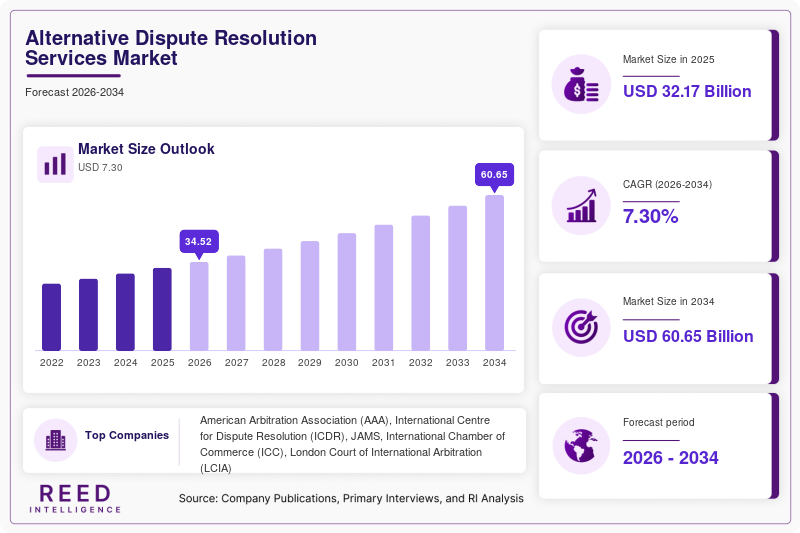
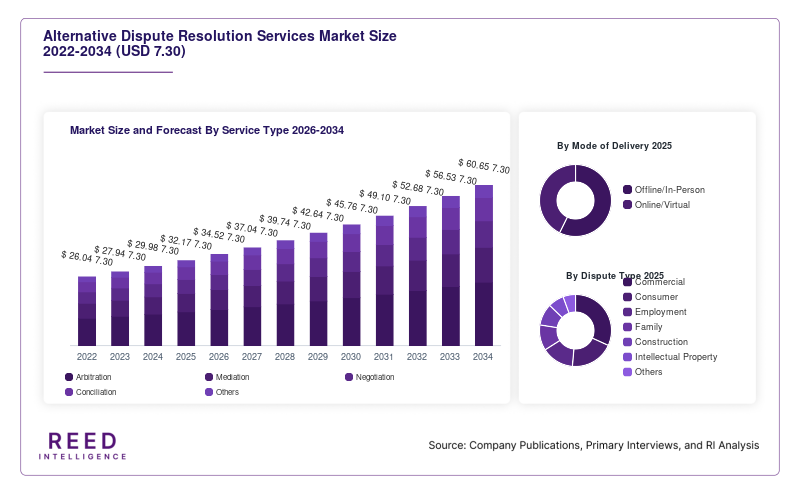
The global alternative dispute resolution services market was valued at USD 32.17 billion in 2025 and is projected to grow from USD 34.52 billion in 2026 to USD 60.65 billion by 2034, registering a CAGR of 7.30% during the forecast period from 2026 to 2034.
Alternative dispute resolution provides structured mechanisms for resolving conflicts outside conventional court litigation. Arbitration generally produces a decision from an appointed neutral, while mediation and negotiation focus on negotiated settlement. Conciliation, neutral evaluation, dispute boards and hybrid procedures provide additional mechanisms for disputes where parties require different levels of intervention.
The Alternative Dispute Resolution Market Growth is closely connected with the increasing complexity of commercial relationships. Cross-border supply contracts, construction projects, technology licensing, financial transactions, employment relationships and digital services can create disputes involving multiple jurisdictions and highly specialized evidence. ICC's 2025 caseload included construction and engineering, energy, healthcare, transportation, telecommunications, industrial equipment, finance and business services, illustrating the breadth of commercial demand.c
Alternative Dispute Resolution Services Market Drivers
Increasing Commercial and Cross-Border Disputes
International trade, infrastructure projects, technology agreements and multinational supply relationships create disputes that often involve several legal systems. Businesses therefore require mechanisms capable of handling cross-border evidence, contractual obligations, jurisdictional questions and enforcement considerations without relying exclusively on conventional litigation.
ICC's 2025 statistics illustrate the international nature of institutional arbitration: parties came from 147 jurisdictions and cases were seated across 70 countries or independent territories. Cross-border disputes accounted for 69.4% of ICC's 2025 arbitration caseload.
Greater Adoption of Mediation
Mediation is becoming a more prominent component of corporate dispute-management strategies because parties can seek negotiated settlements while retaining greater control over the outcome. It can also be incorporated before or during arbitration, allowing organizations to use different mechanisms at different stages of a dispute.
AAA's 2026 expansion of mediation services followed a 14% increase in its mediation caseload since 2022. The organization also reported strong 2025 increases in both commercial and consumer mediation filings, supporting broader institutional demand for mediation infrastructure and specialized mediator panels.
Digitalization of Dispute Resolution
Digital platforms are reducing procedural friction associated with filing, document exchange, hearings and case administration. Virtual hearings allow participants from different jurisdictions to participate without the travel and scheduling requirements associated with entirely physical proceedings.
ICC's Case Connect platform provides a centralized cloud environment for parties, tribunals and case administrators, while JAMS supports virtual ADR through online case management and remote and hybrid hearing capabilities. AAA has also introduced AI-enabled tools for preparing mediation agreements, indicating that technology is moving beyond videoconferencing into case preparation and administration.
Alternative Dispute Resolution Services Market Restraints
High Costs for Complex International Proceedings
Although ADR can reduce certain litigation burdens, complex institutional arbitration can involve substantial arbitrator fees, administrative charges, expert costs, legal fees and hearing expenses. Large infrastructure, energy and technology disputes can require extensive documentary production and specialized technical evidence.
Cost considerations therefore influence the choice between arbitration, mediation and negotiation. Smaller businesses and individuals may favor mediation or negotiated settlement when the economic value of a dispute does not justify a lengthy arbitral process.
Fragmented Rules and Jurisdictional Requirements
ADR procedures differ across jurisdictions, institutions and dispute categories. Parties must consider applicable procedural rules, seat of arbitration, enforcement frameworks, confidentiality provisions, arbitrator qualifications and local legal requirements.
International providers are responding by increasing multilingual accessibility and harmonizing digital processes. For example, LCIA expanded access to its Arbitration Rules in 11 language versions in July 2026, reflecting the practical requirements of users operating across different legal and linguistic environments.
Alternative Dispute Resolution Services Market Opportunities
AI and Technology-Enabled ADR
Artificial intelligence can support document organization, case intake, contract analysis, scheduling, procedural administration and agreement drafting. The technology opportunity is particularly relevant to disputes involving large document volumes and technically complex contractual relationships.
AAA launched an AI Agreement to Mediate Builder in May 2026, allowing parties, counsel and mediators to generate customized mediation agreements through structured inputs. JAMS has also developed technology-focused ADR capabilities covering AI, software, cybersecurity, cloud computing, blockchain and digital assets.
Specialized Industry Dispute Resolution
Technology, energy, construction, healthcare, financial services and intellectual property disputes require neutrals with sector-specific knowledge. Providers can differentiate through specialist panels, dedicated procedural rules and industry-specific case-management capabilities.
JAMS launched a Technology Industry Group in May 2026 covering AI, intellectual property, software and SaaS, cybersecurity, cloud computing, blockchain, digital assets, FinTech and HealthTech. This specialization reflects an opportunity for ADR providers to align services with increasingly technical commercial disputes.
Alternative Dispute Resolution Services Market Segmental Analysis
By Service Type
Arbitration is the dominant service category, accounting for approximately 43.0% share in 2026. Its position reflects extensive use in commercial contracts, infrastructure projects, energy agreements, international trade and technology transactions where parties require a structured process and a binding determination. ICC alone registered 881 arbitration cases in 2025, demonstrating substantial institutional activity across jurisdictions and industries.
Mediation is estimated to be the fastest-growing service category at approximately 8.4% CAGR during 2026–2034. Its expansion is supported by corporate interest in negotiated settlements, lower procedural complexity and the ability to preserve commercial relationships. AAA's reported increase in mediation activity provides evidence of rising institutional utilization.
By Mode of Delivery
Offline/In-Person ADR remains the dominant delivery mode, with approximately 62% share in 2026, particularly for complex arbitration hearings, high-value commercial disputes and proceedings involving extensive evidence or multiple witnesses.
Online/Virtual ADR is the fastest-growing mode, estimated at approximately 10.1% CAGR through 2034. Virtual hearings, electronic filing, cloud-based case management and digital evidence exchange allow participants in different jurisdictions to participate without physical travel. ICC and JAMS have expanded technology-enabled dispute-resolution infrastructure, supporting this transition.
By Dispute Type
Commercial disputes represent the dominant category, accounting for approximately 34% share in 2026. Commercial ADR encompasses contractual disagreements, supply-chain disputes, shareholder matters, financial claims and cross-border business conflicts. ICC's 2025 caseload demonstrates the breadth of commercial applications, with construction, energy, healthcare, transportation, technology and financial services among major sectors.
Intellectual Property disputes are estimated to register the fastest growth at approximately 9.2% CAGR during 2026–2034. Software licensing, AI development, digital assets, biotechnology and technology partnerships generate disputes requiring both legal and technical expertise. JAMS has expanded specialized capabilities for AI, software, cybersecurity, blockchain and digital-asset disputes.
By End User
Corporates represent the dominant end-user group, accounting for approximately 52% share in 2026. Businesses use ADR for commercial contracts, employment disputes, construction claims, intellectual property conflicts and cross-border transactions.
Government & Public Sector is estimated to be the fastest-growing end-user category at approximately 8.7% CAGR. Public infrastructure, procurement, concession agreements and international investment relationships can generate disputes requiring specialized neutral proceedings and structured settlement mechanisms.
Alternative Dispute Resolution Services Market Regional Analysis
North America Alternative Dispute Resolution Services Market
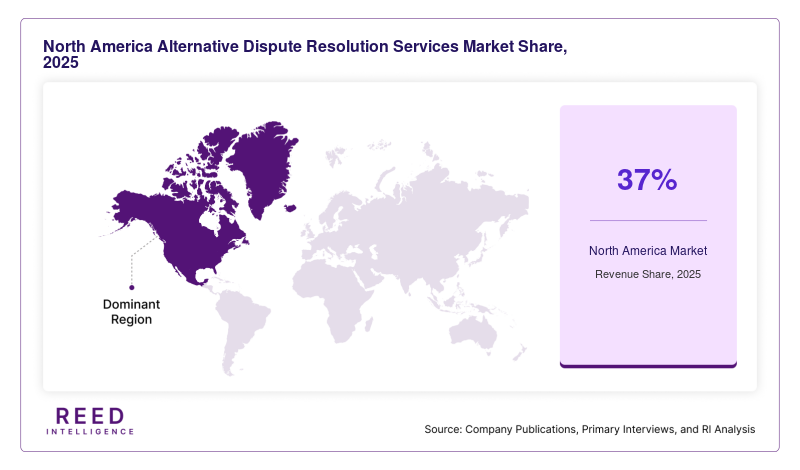
North America is the dominant regional market, accounting for approximately 37% share in 2026. The region benefits from established arbitration and mediation institutions, extensive corporate legal activity and strong adoption of institutional ADR. AAA reported 580,000 cases filed in 2025, while JAMS handled 21,939 new cases during the same year, illustrating the scale of domestic ADR activity in the United States.
The United States represents the principal regional demand center, supported by corporate disputes, employment matters, construction claims, consumer disputes and international arbitration. Canada also contributes through commercial and cross-border disputes, while U.S. institutions increasingly specialize in technology, AI and digital-asset matters.
Europe Alternative Dispute Resolution Services Market
Europe is estimated to expand at approximately 6.8% CAGR during 2026–2034. The region has a dense network of established arbitration and mediation institutions and remains an important location for international proceedings. ICC's 2025 top arbitration jurisdictions included France, the United Kingdom, Switzerland, Germany and Spain.
The United Kingdom, France, Switzerland, Germany and Spain remain important ADR centers. LCIA's international caseload and the expansion of its Arbitration Rules into 11 language versions demonstrate the region's role in serving parties operating across multiple jurisdictions.
Asia Pacific Alternative Dispute Resolution Services Market
Asia Pacific is projected to register the fastest regional growth at approximately 9.0% CAGR during 2026–2034. Increasing cross-border trade, infrastructure investment, technology transactions and regional headquarters activity are expanding the need for institutional arbitration and mediation.
Singapore, China, Hong Kong, India, Japan and Australia are important demand centers. ICC reported increased representation from East and South Asia and the Pacific in its 2025 caseload, while India returned to the top 10 party nationalities, reinforcing the region's growing role in international dispute resolution.
Latin America Alternative Dispute Resolution Services Market
Latin America is estimated to register approximately 7.5% CAGR during 2026–2034. Demand is supported by construction, energy, infrastructure, international trade and investment disputes. Cross-border commercial relationships increase the need for neutral forums that can operate across different national legal systems.
Brazil and Mexico represent major regional markets, while disputes involving energy, infrastructure, commodities and international commercial contracts create recurring requirements for arbitration and mediation. ICC's 2025 caseload included Brazil and Mexico among its top party nationalities and arbitration jurisdictions.
Middle East & Africa Alternative Dispute Resolution Services Market
Middle East & Africa is projected to expand at approximately 8.2% CAGR during 2026–2034. Infrastructure development, energy projects, construction contracts and international investment are creating demand for specialized dispute-resolution services. The UAE is particularly important because of its role as an international business and arbitration center.
The UAE, Saudi Arabia and other Gulf markets are expanding commercial and infrastructure activity, while African markets generate disputes across energy, construction, mining and trade. ICC reported the UAE among the top 10 party nationalities and arbitration jurisdictions in 2025, highlighting the region's participation in international ADR.
Alternative Dispute Resolution Services Market Competitive Landscape
The alternative dispute resolution services market contains institutional providers, specialized mediation firms, arbitration centers and professional networks of arbitrators and mediators. Competition is based on panel quality, procedural expertise, geographic coverage, sector specialization, technology infrastructure and institutional reputation.
American Arbitration Association (AAA/ICDR) maintains a broad domestic and international platform spanning arbitration, mediation and online dispute resolution. AAA reported 580,000 cases filed in 2025 and more than 4,900 panelists, while ICDR serves parties from more than 100 countries. Its 2026 initiatives include expanded mediation infrastructure and AI-supported agreement preparation.
Key Market Players
- American Arbitration Association (AAA)
- International Centre for Dispute Resolution (ICDR)
- JAMS
- International Chamber of Commerce (ICC)
- London Court of International Arbitration (LCIA)
- Singapore International Arbitration Centre (SIAC)
- CPR Dispute Resolution
- WIPO Arbitration and Mediation Center
- FINRA Dispute Resolution
- ADR Chambers
- Judicial Arbitration and Mediation Services
- Centre for Effective Dispute Resolution (CEDR)
- Hong Kong International Arbitration Centre (HKIAC)
- China International Economic and Trade Arbitration Commission (CIETAC)
- Permanent Court of Arbitration (PCA)
Alternative Dispute Resolution Services Market Recent Developments
-
September 2026 American Arbitration Association: AAA announced the addition of 103 experienced arbitrators and mediators across its commercial, construction, consumer, employment and labor panels, strengthening its neutral network.
-
May 2026 JAMS: JAMS launched its Technology Industry Group, bringing together mediation, arbitration and other ADR capabilities for disputes involving AI, software, SaaS, cybersecurity, cloud computing, blockchain, digital assets, FinTech and HealthTech.
Alternative Dispute Resolution Services Market Segments
By Service Type
- Arbitration
- Mediation
- Negotiation
- Conciliation
- Others
By Mode of Delivery
- Offline/In-Person
- Online/Virtual
By Dispute Type
- Commercial
- Consumer
- Employment
- Family
- Construction
- Intellectual Property
- Others
By End User
- Corporates
- Individuals
- Government & Public Sector
- Law Firms
- Insurance Companies
- Others
By Region
- North America
- Europe
- APAC
- Middle East and Africa
- LATAM