Alumina Polishing Slurry Market Size, Share & Trends Analysis Report By Slurry Type (Water-Based Slurries, Oil-Based Slurries, Alumina-Diamond Hybrid Slurries), By Particle Type (Alpha Alumina, Gamma Alumina), By Application (Semiconductor & CMP, Optics & Glass, Ceramics, Metals & Precision Components), By End Use (Semiconductor Manufacturing, Electronics & Photonics) and By Region (North America, Europe, APAC, Middle East and Africa, LATAM) Forecasts, 2026–2034
USD 3950
Alumina Polishing Slurry Market Size
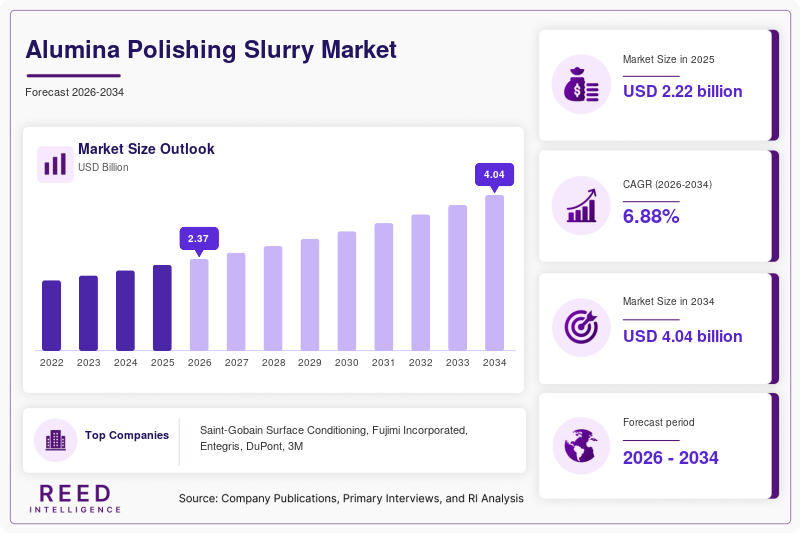
The global Alumina Polishing Slurry Market size was valued at USD 2.22 billion in 2025 and is projected to grow from USD 2.33 billion in 2026 to USD 4.04 billion by 2034, registering a CAGR of 6.88% during the forecast period from 2026 to 2034.
Alumina polishing slurry is a formulated suspension of alumina abrasive particles and liquid-phase additives used for controlled material removal, surface planarization and finishing. The technology is used across semiconductor wafers, advanced packaging, optics, ceramics, metals and other precision components. Saint-Gobain's current portfolio, for example, includes alumina slurries for CMP, lapping and polishing, with applications spanning copper, titanium, nickel-iron alloys, silicon nitride, sapphire, SiC, GaN and aluminum nitride.
The semiconductor industry is an increasingly important demand mechanism because advanced devices require extremely flat and clean surfaces. SEMI expects worldwide 300mm fab equipment spending to rise 18% to USD 133 billion in 2026 and another 14% to USD 151 billion in 2027, driven by AI, high-performance computing, advanced logic and memory demand.
At the same time, alumina slurry demand is broader than conventional silicon CMP. Suppliers are developing formulations for wide-bandgap materials such as SiC and GaN, advanced packaging metals, precision optics, ceramics and powdered-metal components. Saint-Gobain's current products include nano-alumina CMP systems for SiC and GaN and water-based alumina formulations for optics, glass and metal finishing.
The commercial value of the chemistry increasingly depends on removal rate, defectivity, particle-size control, surface roughness, dispersion stability and process compatibility, rather than abrasive hardness alone.
Alumina Polishing Slurry Market Drivers
Semiconductor Capacity Expansion Is Increasing Demand for Precision Polishing
The semiconductor manufacturing cycle is an important growth mechanism for alumina polishing slurries because wafer and device fabrication requires repeated surface preparation and planarization. Entegris describes CMP slurry as a critical process material that removes thin layers of metal or oxide through the interaction of abrasive particles and chemical additives. Its portfolio addresses logic, memory, foundry, wafer-substrate and rigid-disk applications.
The expansion is particularly relevant to advanced nodes and heterogeneous packaging, where copper, titanium, nickel-iron alloys, oxides, nitrides, glass and polymers can appear within the same process flow. Saint-Gobain specifically positions its alumina slurry systems for these mixed-material advanced-packaging applications.
SEMI expects global 300mm fab equipment spending to exceed USD 150 billion for the first time in 2027. AI and HPC are central drivers, while automotive and government-led semiconductor capacity diversification are also supporting new fabs.
The transmission mechanism is direct: more wafer starts and more complex process steps increase consumption of CMP and polishing materials. The counterbalance is that improvements in slurry efficiency and lower material consumption per wafer can moderate volume growth.
Wide-Bandgap Semiconductors Require Specialized Polishing
Silicon carbide, gallium nitride and other hard substrates are expanding in power electronics, high-frequency devices and other applications. These materials are significantly more difficult to process than conventional silicon because of their hardness and brittleness.
Saint-Gobain's current alumina CMP portfolio includes nano-scale alumina formulations for SiC, GaN, diamond and AlN. Its ClasSiC 2100 series is designed for SiC and diamond wafer polishing, while its GAiN series targets GaN applications. The company reports SiC removal rates above 10 µm/hour for its permanganate-based alumina formulation.
Fujimi similarly identifies SiC, GaN and III-V compound semiconductors among its polishing applications. Its COMPOL series is used for difficult substrate-finishing processes where a damage-free mirror surface is required.
The commercial effect is an increasing need for application-specific particle morphology, dispersion and chemistry. This favors suppliers capable of tuning abrasive systems to individual substrate characteristics rather than selling standardized abrasive powder alone.
Precision Surface Requirements Are Expanding Beyond Semiconductor Manufacturing
Alumina slurry is also used in optical glass, ceramics, metals, powdered-metal components and precision engineering. Saint-Gobain lists filter-glass polishing, precision optics, stainless steel and powdered-metal components among its alumina-slurry applications.
Fujimi's portfolio similarly covers glass and crystals, sapphire, ceramics, compound semiconductors, optical lenses, photomasks, electronic components and automotive applications. Its polishing materials are also used on alumina, SiC, GaN and other hard substrates.
This diversification creates a more resilient demand base because polishing requirements exist across several manufacturing industries. Automotive surface finishing is another example: Saint-Gobain's engineered alumina portfolio is designed for clear-coat and gel-coat polishing, with formulations targeting different balances between defect removal and final gloss.
Alumina Polishing Slurry Market Restraints
Abrasive Substitution Limits the Addressable Process Base
Alumina competes with diamond, ceria, silica and zirconia abrasives depending on the substrate and desired surface characteristics. Saint-Gobain's portfolio itself illustrates this competition, offering diamond, alumina, ceria, zirconia and abrasive-free CMP chemistries for different polishing requirements.
Ceria, for example, is used extensively for oxide and glass polishing because of its chemical interaction with oxide surfaces. Zirconia is used for selected oxide, nitride and glass processes, while diamond is favored for aggressive removal of extremely hard materials.
This means alumina suppliers must demonstrate a measurable process advantage in removal rate, surface quality, defect control, contamination or cost. A new formulation can therefore gain share within a specific process without necessarily expanding the total polishing-slurry market at the same rate.
Tight Particle and Contamination Control Raises Production Complexity
Polishing slurries must maintain stable particle distributions and avoid oversized particles that can create scratches or defects. Saint-Gobain emphasizes narrow particle-size distributions, controlled morphology and stable dispersion for its alumina formulations.
Entegris also highlights particle-size monitoring and filtration as important elements of CMP slurry defect control. Its April 2026 application work addressed detection of particle-distribution tails in CMP slurries.
The requirement creates higher manufacturing and quality-control costs. Semiconductor customers may require exceptionally tight specifications, extensive qualification and consistent lot-to-lot performance. These requirements create barriers to entry but also lengthen the qualification cycle for new suppliers.
Alumina Polishing Slurry Market Opportunities
Advanced Packaging and Mixed-Material CMP
Advanced packaging is creating new polishing requirements because packages can combine metals, dielectric layers, glass, polymers and other materials. Saint-Gobain identifies copper, titanium, nickel-iron alloys, oxides, nitrides, glass and polymer composites as relevant materials for advanced-packaging surface conditioning.
Alumina slurries can be tuned to provide controlled removal across difficult metal surfaces while limiting dishing, erosion and surface defects. This creates opportunities for specialized formulations that target particular packaging architectures rather than conventional wafer polishing alone.
SiC, GaN and Other Advanced Substrate Finishing
Wide-bandgap power electronics provide another high-value opportunity. SiC and GaN substrates require careful control of damage, flatness and surface roughness before device fabrication.
Fujimi identifies SiC and GaN as active polishing applications, while Saint-Gobain has dedicated GAiN and ClasSiC slurry families for these materials.
As electric vehicles, renewable-energy systems, high-voltage power conversion and high-frequency electronics increase semiconductor demand, polishing suppliers can capture additional value through specialized chemistry rather than higher-volume commodity abrasives.
High-Purity and Engineered Alumina Formulations
The move from conventional abrasive powder toward engineered particles creates opportunities for higher-value slurry products. Saint-Gobain offers precision-engineered alumina suspensions with controlled particle size and dispersion characteristics, while Fujimi emphasizes classification, filtration, purification, powder engineering and chemical technologies as core capabilities.
This creates a commercial pathway toward application-specific slurries where particle morphology, purity, concentration and chemical environment are optimized together. Such products can reduce process variability and support higher-throughput manufacturing.
Segmental Analysis
By Slurry Type
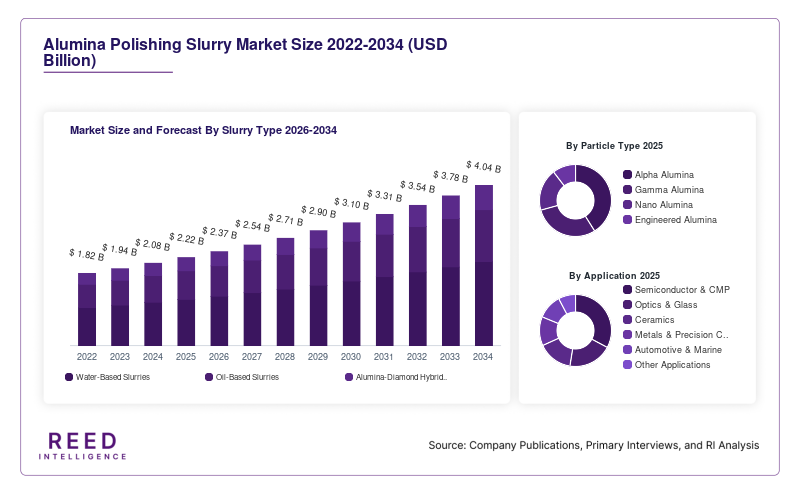
Water-Based Slurries represent approximately 61% of the global market in 2025, supported by semiconductor CMP, optical polishing, ceramics and precision metal finishing. Water-based systems offer compatibility with high-volume manufacturing and can be formulated with controlled particle dispersion and process chemistry. Saint-Gobain's portfolio includes water-based alumina CMP and lapping formulations across semiconductors, optics and metals.
Oil-Based Slurries account for approximately 25% and remain relevant for selected metals, ceramics and sapphire applications where lubrication and surface interaction are important.
Alumina-Diamond Hybrid Slurries represent approximately 14% and are the fastest-growing slurry type, with a CAGR of approximately 8.1%. These systems combine the aggressive removal capability of diamond with alumina's finishing characteristics and are used for advanced ceramics, crystals and hard materials.
By Particle Type
Alpha Alumina represents approximately 43% of the global market in 2025. Its hardness and controlled particle characteristics make it suitable for precision surface finishing across metals, ceramics, optics and semiconductor substrates.
Engineered Alumina accounts for approximately 29%, reflecting growing demand for tighter particle-size and morphology control. Saint-Gobain's engineered and precision-engineered alumina products emphasize controlled particle characteristics and dispersion behavior.
Nano Alumina represents approximately 20%, while Gamma Alumina accounts for approximately 8%.
Nano Alumina is the fastest-growing particle category, with approximately 9.0% CAGR, supported by advanced CMP applications requiring high removal rates while maintaining low defectivity and surface damage.
By Application
Semiconductor & CMP represents approximately 39% of the market in 2025. CMP requires controlled material removal and extremely low defectivity, making particle engineering and slurry chemistry critical process variables. Entegris describes slurry as one of the central components of the CMP process, while Fujimi supplies CMP products for oxide, tungsten, polysilicon, copper and barrier films.
Optics & Glass accounts for approximately 19%, Ceramics 16%, Metals & Precision Components 14%, Automotive & Marine 7%, and other applications 5%.
Semiconductor & CMP is also the fastest-growing application, with approximately 8.3% CAGR, supported by advanced logic, memory, advanced packaging and wide-bandgap semiconductor manufacturing.
By End Use
Semiconductor Manufacturing accounts for approximately 36% of the global market in 2025. The segment benefits from increasing wafer capacity, advanced-node complexity and the expansion of SiC and GaN processing.
Electronics & Photonics represents approximately 19%, while Industrial Manufacturing accounts for 17%.
Optical & Precision Engineering represents 13%, Automotive 9%, and other end uses 6%.
Electronics & Photonics is the fastest-growing end-use segment, with approximately 8.5% CAGR, supported by optical components, photonic substrates, LEDs, communication components and precision electronic materials. Fujimi's current portfolio includes polishing products for optical lenses, photomasks, crystal oscillators, SAW filters and LED substrates.
Regional Analysis
North America Alumina Polishing Slurry Market
North America represents approximately 30% of the global Alumina Polishing Slurry Market in 2025. The region benefits from a large semiconductor manufacturing base, advanced packaging investment, aerospace and defense production, optical manufacturing and precision industrial applications.
U.S. semiconductor capacity is expanding through investments in advanced logic, memory, power devices and packaging. SEMI expects global 300mm equipment spending to reach USD 133 billion in 2026, with North American capacity expansion supported by supply-chain diversification and government incentives.
The regional market also benefits from suppliers with established application-development infrastructure. Entegris maintains a broad CMP portfolio covering tungsten, copper, aluminum, silicon and dielectric polishing, while Saint-Gobain supports semiconductor, optics and advanced-material applications.
North America is projected to grow at approximately 6.2% CAGR through 2034. Advanced packaging, AI accelerators and wide-bandgap power electronics provide additional demand channels.
Europe Alumina Polishing Slurry Market
Europe accounts for approximately 22% of the global market in 2025. The region has a strong base in precision engineering, automotive manufacturing, optics, specialty glass, industrial ceramics and semiconductor equipment.
The semiconductor side is increasingly supported by capacity diversification and investment in advanced manufacturing. SEMI identifies government incentives and supply-chain diversification as important drivers of fab construction across Europe as well as Asia and North America.
Europe also has substantial demand outside semiconductors. Saint-Gobain's surface-conditioning operations cover optics, automotive, aerospace, ceramics, metalworking and electronics, while its alumina products serve optical glass, powdered metals and precision finishing.
Europe is expected to record approximately 5.8% CAGR. Automotive electrification, photonics, advanced ceramics and industrial precision manufacturing provide diversification, although energy costs and comparatively slower semiconductor capacity expansion can moderate growth.
APAC Alumina Polishing Slurry Market
APAC represents approximately 37% of the global market in 2025 and is the fastest-growing region, with a CAGR of approximately 8.2%.
The region's position is linked to its concentration of semiconductor fabs, electronics manufacturing, optical-component production and precision-material processing. SEMI tracks more than 400 300mm fabs and lines globally and identifies Asia as a major center of continued capacity expansion driven by AI, HPC, automotive and wireless applications.
Japan, Taiwan, South Korea and China are particularly important to the polishing-material supply chain. Fujimi maintains semiconductor development capabilities in Japan, the United States and Taiwan and has built regional technical infrastructure around major Asian semiconductor customers.
Fujimi's 2026 corporate information shows continued focus on semiconductor polishing, while its Taiwan operation provides local research, production and sales support.
The region is projected to remain the fastest-growing market because new fabs increase demand for CMP and wafer-finishing materials while SiC, GaN, sapphire and advanced packaging create additional polishing requirements.
Middle East and Africa Alumina Polishing Slurry Market
Middle East and Africa represents approximately 5% of the global market in 2025 and is projected to grow at approximately 6.0% CAGR.
Demand is concentrated in industrial manufacturing, metals, optics, automotive finishing and emerging electronics applications. The region has a smaller semiconductor fabrication base than APAC, North America and Europe, limiting direct CMP demand.
However, precision finishing applications are broader than semiconductor fabrication. Alumina slurries can be used for metals, ceramics, automotive finishes and optical materials, providing several industrial demand channels. Saint-Gobain's product portfolio illustrates the breadth of these applications.
The main constraint is limited local manufacturing of advanced slurry systems. Imported products and regional distributors therefore remain important, while demand can be sensitive to industrial investment cycles.
LATAM Alumina Polishing Slurry Market
LATAM accounts for approximately 6% of the global market in 2025 and is expected to grow at approximately 6.5% CAGR.
The regional demand base is concentrated in automotive manufacturing, industrial components, optics, electronics assembly and precision metal finishing. Brazil and Mexico provide important manufacturing centers, while the region's expanding automotive and industrial supply chains create requirements for surface finishing.
Automotive applications provide a particular opportunity because engineered alumina abrasives are used in clear-coat correction, component polishing and other finishing processes. Saint-Gobain's IDEAL alumina products are specifically positioned for automotive clear-coat and marine gel-coat polishing.
LATAM's semiconductor demand is smaller than that of APAC or North America, so regional growth depends more heavily on industrial and automotive applications. Imported slurry materials and dependence on global supply chains remain constraints.

Competitive Landscape
The Alumina Polishing Slurry Market combines specialist abrasive manufacturers with diversified materials and semiconductor-chemical suppliers. Competition is based on particle engineering, purity, dispersion stability, material-removal rate, defect control, technical support and qualification with downstream manufacturing processes.
Saint-Gobain Surface Conditioning has one of the broadest alumina portfolios. Its products cover CMP, lapping and polishing for semiconductor materials, optics, metals and ceramics, while its alumina-diamond systems address advanced ceramics and hard crystalline materials.
Fujimi competes through precision abrasive technology and deep semiconductor application expertise. Its PLANERLITE portfolio covers oxide, tungsten, polysilicon, copper and barrier-film CMP, while its broader polishing portfolio extends to SiC, GaN, sapphire, ceramics, optics and automotive surfaces.
Key Market Players
- Saint-Gobain Surface Conditioning
- Fujimi Incorporated
- Entegris
- DuPont
- 3M
- Kemet International
- MicroChemicals
- Ferro Corporation
- Engis Corporation
- Lapmaster Wolters
- Mipox Corporation
- BASF
- Merck KGaA
- Resonac
- Fujibo Holdings
Recent Market Developments
- August 2026 – Fujimi reported its FY2027 first-quarter results. The company continues to identify semiconductor abrasives and CMP materials as core businesses, while maintaining global semiconductor development and customer-support capabilities.
- April 2026 – Entegris published new technical work on CMP slurry monitoring. Its application notes covered particle-size characterization, filtration testing and detection of distribution tails in CMP slurries. The development reflects the increasing importance of particle control and defect prevention in advanced semiconductor polishing.
Alumina Polishing Slurry Market Segments
By Slurry Type
- Water-Based Slurries
- Oil-Based Slurries
- Alumina-Diamond Hybrid Slurries
By Particle Type
- Alpha Alumina
- Gamma Alumina
- Nano Alumina
- Engineered Alumina
By Application
- Semiconductor & CMP
- Optics & Glass
- Ceramics
- Metals & Precision Components
- Automotive & Marine
- Other Applications
By End Use
- Semiconductor Manufacturing
- Electronics & Photonics
- Automotive
- Industrial Manufacturing
- Optical & Precision Engineering
- Other End Uses
By Region
- North America
- Europe
- APAC
- Middle East and Africa
- LATAM