Aluminium Chloride Market Size, Share & Demand Report By Form (Anhydrous Aluminium Chloride, Hydrated Aluminium Chloride), By Application (Catalysts, Pharmaceutical Intermediates, Dyes and Pigments, Agrochemicals, Water Treatment, Others), By End-Use Industry (Chemicals and Petrochemicals, Pharmaceuticals, Water Treatment Industry, Textile Industry, Electronics, Others) By Region & Segment Forecasts, 2026–2034
USD 3950
Market Overview
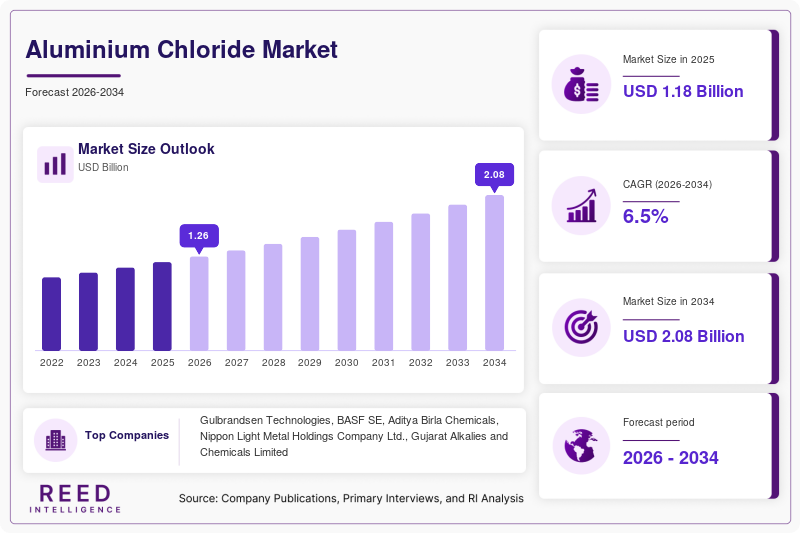
The global Aluminium Chloride Market size was valued at USD 1.18 billion in 2026 and is projected to reach USD 1.96 billion by 2034, expanding at a CAGR of 6.5% during the forecast period from 2026 to 2034. Aluminium chloride is widely used as a catalyst in chemical synthesis, pharmaceuticals, agrochemicals, dyes, pigments, and petroleum refining processes. The compound plays an important role in Friedel-Crafts reactions and other industrial chemical applications that require efficient catalytic activity. Rising demand for specialty chemicals and increasing production of pharmaceutical intermediates are supporting long-term market expansion across developed and emerging economies.
A major global factor supporting market growth is the continued expansion of the chemical manufacturing industry, particularly in Asia Pacific and the Middle East. Governments in several countries are investing in industrial infrastructure, petrochemical clusters, and downstream chemical production facilities to strengthen domestic manufacturing capabilities. Aluminium chloride is extensively consumed in these facilities due to its strong catalytic properties and cost efficiency. In addition, increasing demand for water treatment chemicals and high-purity chemical compounds from electronics and industrial sectors has improved product adoption across multiple end-use industries.
Key Highlights
- North America dominated the market with a 33.8% share in 2025.
- Asia Pacific is expected to grow at the fastest CAGR of 7.8% during 2026–2034. By form, anhydrous aluminium chloride accounted for the largest share of 61.4%, while hydrated
- aluminium chloride is projected to grow at a CAGR of 7.1%.
- By application, catalysts led with a 44.6% share, whereas pharmaceutical intermediates are expected to expand at a CAGR of 7.9%. By end-use industry, chemicals and petrochemicals held the dominant share of 39.2%, while pharmaceuticals are projected to grow at a CAGR of 8.1%. The United
- States remained the dominant country, with market values of USD 248 million in 2024 and USD 265 million in 2025.
Market Trends
Growing Adoption of High-Purity Aluminium Chloride in Pharmaceutical Manufacturing
The increasing demand for pharmaceutical intermediates and specialty active compounds is influencing the use of high-purity aluminium chloride across the global market. Pharmaceutical manufacturers require reliable catalytic compounds for organic synthesis and chemical reactions used in the production of antibiotics, analgesics, and specialty therapeutic products. Aluminium chloride is gaining traction because it improves reaction efficiency and supports higher production consistency. The expansion of generic drug manufacturing in Asia Pacific and Latin America has also strengthened demand for cost-effective catalyst materials. Several chemical manufacturers are investing in advanced purification technologies to improve product quality and meet strict pharmaceutical regulations. Growing research activities in fine chemical production and rising healthcare expenditure are further supporting the integration of high-purity aluminium chloride into pharmaceutical manufacturing operations.
Expansion of Petrochemical and Refining Activities Across Emerging Economies
The Aluminium Chloride Market is witnessing increasing demand from petrochemical and refining industries due to ongoing industrialization in emerging economies. Aluminium chloride is widely used in hydrocarbon processing and refining applications because of its catalytic performance in alkylation and polymerization processes. Countries such as China, India, Saudi Arabia, and Brazil are expanding petrochemical infrastructure to support domestic manufacturing and export activities. This development is increasing the consumption of catalyst materials across downstream chemical production facilities. In addition, growing investments in fuel processing modernization and specialty lubricant production are contributing to higher demand for aluminium chloride. Chemical companies are entering strategic partnerships with refinery operators to ensure long-term product supply and operational stability, which is expected to support steady market growth during the forecast period.
Market Drivers
Rising Demand from the Chemical and Agrochemical Industries
The growing consumption of specialty chemicals and agrochemical products is a major factor driving the Aluminium Chloride Market. Aluminium chloride is commonly used in the synthesis of dyes, pigments, pesticides, and herbicides because it enables efficient catalytic reactions and improves chemical processing performance. Agricultural production expansion in developing countries has increased the demand for crop protection chemicals, creating favorable conditions for aluminium chloride manufacturers. In addition, rising investments in industrial chemical manufacturing and increasing production capacity across Asia Pacific are supporting long-term demand growth. Chemical producers are focusing on high-efficiency catalyst systems to improve productivity and reduce operational costs, which is encouraging broader use of aluminium chloride in commercial-scale manufacturing facilities.
Increasing Use in Water Treatment and Industrial Processing Applications
The rising emphasis on industrial wastewater treatment and environmental management is contributing to the growth of the Aluminium Chloride Market. Aluminium chloride is used in water treatment applications to remove impurities, suspended particles, and organic contaminants from industrial and municipal wastewater systems. Rapid urbanization and stricter environmental regulations are increasing investments in advanced water treatment infrastructure across developed and emerging economies. Industries such as textiles, chemicals, food processing, and paper manufacturing are adopting efficient water purification technologies to comply with environmental standards. Aluminium chloride offers strong coagulation and purification performance, making it suitable for large-scale treatment operations. Growing awareness regarding water reuse and sustainable industrial practices is expected to support continued demand across treatment facilities and industrial processing sectors.
Market Restraint
Environmental and Handling Concerns Associated with Chemical Processing
Environmental regulations and handling challenges associated with aluminium chloride production and transportation are limiting market growth to some extent. Aluminium chloride is highly reactive and can release hydrogen chloride fumes when exposed to moisture, requiring specialized storage, transportation, and safety measures. Regulatory authorities in North America and Europe have implemented strict environmental compliance standards related to hazardous chemical handling and industrial emissions. These regulations increase operational costs for manufacturers and distributors. Small and medium-scale producers often face challenges in upgrading infrastructure and maintaining compliance with changing safety standards. In addition, accidental leakage or improper disposal of aluminium chloride may result in environmental contamination and workplace safety risks. Such concerns are encouraging certain end-use industries to explore alternative catalysts and treatment chemicals with lower handling complexity. Although demand remains stable across key sectors, compliance-related expenses and environmental scrutiny may affect profitability and production expansion for some market participants.
Market Opportunities
Development of Sustainable Production Technologies and Recycling Solutions
The growing focus on sustainable chemical manufacturing is creating new opportunities for companies operating in the Aluminium Chloride Market. Manufacturers are increasingly investing in cleaner production methods, emission reduction systems, and recycling technologies to improve environmental performance and operational efficiency. Sustainable production practices can help companies reduce raw material wastage, optimize energy consumption, and strengthen compliance with international environmental standards. Several chemical producers are exploring closed-loop processing systems and advanced purification techniques to improve product recovery rates. Demand for environmentally responsible chemical products is rising among pharmaceutical, petrochemical, and industrial processing companies, creating favorable conditions for sustainable aluminium chloride manufacturing solutions. Companies that adopt low-emission production technologies are expected to strengthen their market position and attract long-term industrial partnerships.
Expanding Demand from Electronics and Advanced Material Manufacturing
The increasing use of specialty chemicals in electronics manufacturing and advanced materials production is generating growth opportunities for the Aluminium Chloride Market. Aluminium chloride is used in the synthesis of high-performance materials, semiconductors, and specialty compounds required for electronic components and industrial coatings. The expansion of consumer electronics manufacturing in Asia Pacific and the growing adoption of electric vehicles are supporting demand for advanced chemical intermediates. In addition, rising investments in battery technology, conductive materials, and precision manufacturing processes are increasing the need for efficient catalytic compounds. Manufacturers are focusing on producing ultra-high-purity aluminium chloride grades suitable for advanced industrial applications. The development of electronics manufacturing hubs in countries such as China, South Korea, Taiwan, and India is expected to create new revenue opportunities for global market participants.
Segmental Analysis
By Form
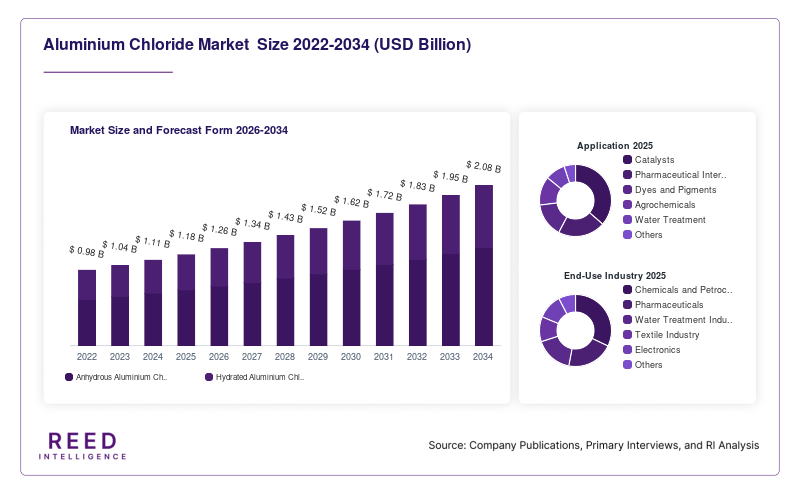
Anhydrous aluminium chloride represented the dominant subsegment in the Aluminium Chloride Market and accounted for 61.4% of the market share in 2024. The segment maintains a strong position because of its extensive use in catalytic reactions within chemical manufacturing, pharmaceuticals, and petrochemical processing. Anhydrous aluminium chloride offers high catalytic efficiency and supports complex organic synthesis applications, making it suitable for industrial-scale operations. The compound is widely used in Friedel-Crafts reactions for the production of dyes, perfumes, intermediates, and specialty chemicals. Strong demand from refining and hydrocarbon processing industries has further contributed to the segment’s dominance. Manufacturers continue to invest in high-purity production technologies to improve product consistency and meet industrial quality standards across global markets.
Hydrated aluminium chloride is expected to witness the fastest growth during the forecast period, expanding at a CAGR of 7.1% from 2026 to 2034. The growth of this segment is primarily supported by increasing demand from water treatment applications and municipal purification systems. Hydrated aluminium chloride is widely used as a coagulating agent for removing suspended particles and contaminants from wastewater. Rapid urbanization, rising industrial water reuse initiatives, and stricter environmental regulations are encouraging the adoption of efficient water treatment chemicals. In addition, the expansion of industrial purification systems in developing economies is contributing to higher demand for hydrated aluminium chloride. Companies are focusing on improving formulation stability and operational efficiency to strengthen their presence in this growing application segment.
By Application
Catalysts accounted for the largest share of the Aluminium Chloride Market in 2024, representing 44.6% of total revenue. Aluminium chloride is widely utilized as a catalyst in chemical reactions involving hydrocarbons, organic compounds, and specialty intermediates. The segment benefits from growing demand across petrochemical refining, pharmaceutical manufacturing, and specialty chemical synthesis industries. Catalytic applications require high reaction efficiency and process consistency, making aluminium chloride a preferred solution for several industrial processes. The increasing production of plastics, resins, dyes, and industrial additives is also contributing to sustained demand within this segment. In addition, chemical manufacturers are expanding production capacities and modernizing processing technologies to improve efficiency and strengthen supply chain resilience.
Pharmaceutical intermediates are projected to emerge as the fastest-growing application segment, registering a CAGR of 7.9% during the forecast period. Rising global demand for active pharmaceutical ingredients and specialty therapeutic compounds is supporting segment expansion. Aluminium chloride plays an important role in organic synthesis processes used in the production of antibiotics, anti-inflammatory drugs, and specialty formulations. Expanding generic drug manufacturing in Asia Pacific and increasing pharmaceutical outsourcing activities are further supporting market growth. Companies are investing in research and development to improve chemical synthesis efficiency and product purity. In addition, increasing healthcare expenditure and growing demand for advanced pharmaceutical formulations are expected to create favorable opportunities for aluminium chloride suppliers serving pharmaceutical manufacturers.
By End-Use Industry
Chemicals and petrochemicals held the dominant position in the Aluminium Chloride Market and accounted for 39.2% of total market revenue in 2024. The segment benefits from the widespread use of aluminium chloride in hydrocarbon processing, alkylation, polymerization, and specialty chemical production. Petrochemical companies require efficient catalytic compounds to optimize processing performance and improve production yields. Rising investments in refinery modernization and downstream chemical manufacturing are supporting sustained demand across developed and emerging economies. In addition, growing consumption of industrial chemicals, plastics, synthetic materials, and specialty compounds continues to strengthen market expansion within this end-use industry. Major chemical producers are focusing on integrated production facilities to improve operational efficiency and maintain stable raw material supply chains.
The pharmaceutical industry is anticipated to register the fastest CAGR of 8.1% during the forecast period due to increasing global drug production and rising demand for specialty therapeutic formulations. Aluminium chloride is extensively used in pharmaceutical intermediate synthesis because of its ability to improve reaction efficiency and support high-purity manufacturing processes. Expanding healthcare infrastructure and increasing investments in pharmaceutical research are creating favorable growth opportunities for chemical suppliers. Emerging economies are becoming important manufacturing hubs for generic medicines and specialty pharmaceutical products, further strengthening demand for aluminium chloride. In addition, the growing focus on advanced chemical synthesis techniques and regulatory compliance in pharmaceutical manufacturing is expected to support long-term growth within this segment.
Regional Analysis
North America
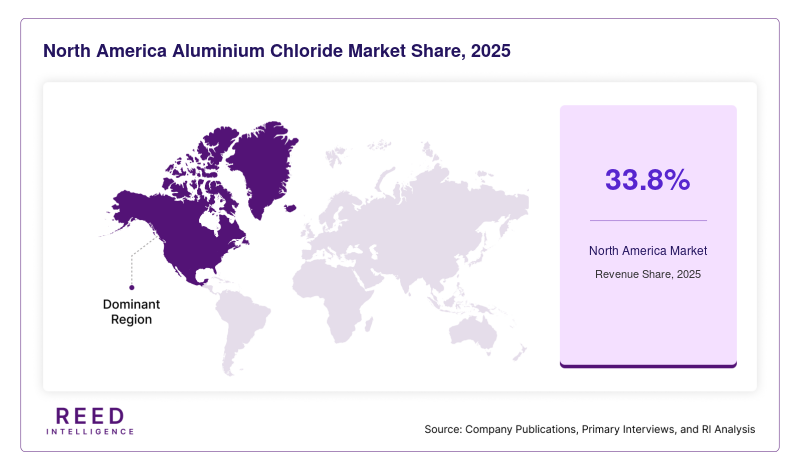
North America accounted for 33.8% of the global Aluminium Chloride Market share in 2025 and is expected to maintain stable growth at a CAGR of 5.9% during the forecast period. The region benefits from strong chemical manufacturing infrastructure, advanced pharmaceutical production, and consistent demand from petrochemical industries. The United States and Canada continue to invest in industrial process modernization and wastewater treatment facilities, supporting the consumption of aluminium chloride across multiple applications. Growing emphasis on sustainable chemical production and efficient catalyst technologies is further strengthening regional market expansion.
The United States remains the dominant country within North America due to its large-scale chemical processing industry and extensive pharmaceutical manufacturing activities. A key growth factor in the country is the increasing investment in specialty chemical production for healthcare and industrial applications. Major companies are expanding production capacity and improving supply chain integration to meet domestic demand. In addition, rising industrial water treatment requirements and growing refinery modernization projects are contributing to higher aluminium chloride consumption across the United States market.
Europe
Europe held a significant share of the Aluminium Chloride Market in 2025 and is projected to expand at a CAGR of 5.7% through 2034. The region benefits from advanced industrial manufacturing, strict environmental standards, and established pharmaceutical and specialty chemical sectors. Countries across Western Europe are increasing investments in sustainable chemical production technologies and emission control systems, which is encouraging the use of high-efficiency catalytic compounds. Demand for aluminium chloride in water treatment and industrial purification processes also remains stable due to growing environmental compliance requirements.
Germany represents the leading country within the European market because of its strong industrial chemical base and advanced research capabilities. One unique growth factor supporting the German market is the increasing use of aluminium chloride in high-value specialty chemical synthesis for automotive and engineering applications. Chemical companies in the country are focusing on advanced process optimization and sustainable manufacturing practices to maintain competitiveness. In addition, strong export activities in specialty chemicals continue to support stable demand for aluminium chloride across industrial production facilities.
Asia Pacific
Asia Pacific is expected to register the fastest growth in the Aluminium Chloride Market, with a forecast CAGR of 7.8% from 2026 to 2034. The region is experiencing rapid industrialization, expanding pharmaceutical manufacturing, and strong investments in petrochemical infrastructure. Countries such as China, India, Japan, and South Korea are increasing chemical production capacity to support domestic demand and export activities. Rising consumption of agrochemicals, dyes, pigments, and specialty compounds is also strengthening regional demand for aluminium chloride. Growing urbanization and industrial wastewater treatment investments are expected to further support market expansion.
China dominates the Asia Pacific market due to its extensive chemical manufacturing industry and large-scale industrial production network. A major growth factor in the country is the rapid expansion of downstream petrochemical and pharmaceutical facilities. Chinese manufacturers are increasing production efficiency and investing in high-purity chemical processing technologies to support specialty applications. In addition, favorable government policies supporting industrial development and export-oriented manufacturing are contributing to higher demand for aluminium chloride across multiple industrial sectors.
Middle East & Africa
The Middle East & Africa region is projected to witness moderate growth in the Aluminium Chloride Market during the forecast period, supported by rising petrochemical investments and expanding industrial infrastructure. The market is expected to grow at a CAGR of 5.4% between 2026 and 2034. Countries across the Gulf region are investing in downstream chemical manufacturing and refinery expansion projects to diversify economic activity beyond crude oil exports. Aluminium chloride demand is increasing in refining operations, industrial processing, and water treatment applications throughout the region.
Saudi Arabia remains the leading market within the Middle East & Africa region due to its strong petrochemical industry and ongoing industrial diversification initiatives. A unique growth factor supporting the country is the development of integrated chemical production clusters connected to refining and export infrastructure. Government-backed industrial investment programs are encouraging the establishment of new specialty chemical facilities and advanced manufacturing projects. In addition, rising investments in desalination and industrial water treatment systems are contributing to steady aluminium chloride consumption across Saudi Arabia.
Latin America
Latin America accounted for a moderate share of the global Aluminium Chloride Market in 2025 and is expected to grow at a CAGR of 5.8% during the forecast period. The region is benefiting from expanding agricultural production, increasing industrial manufacturing activities, and rising investments in water treatment infrastructure. Demand for aluminium chloride is growing across agrochemical, pharmaceutical, and chemical processing industries. Governments in several Latin American countries are focusing on improving industrial productivity and environmental management systems, which is creating opportunities for specialty chemical suppliers.
Brazil dominates the Latin American market because of its large agricultural sector and growing chemical manufacturing industry. One important growth factor in the country is the increasing production of crop protection chemicals and industrial treatment solutions. Brazilian manufacturers are investing in local chemical processing capabilities to reduce import dependency and improve supply chain stability. In addition, the expansion of municipal wastewater treatment projects and industrial purification facilities is expected to support higher aluminium chloride consumption across the country.
Competitive Landscape
The Aluminium Chloride Market is moderately consolidated, with several international and regional manufacturers competing based on product purity, production capacity, pricing strategies, and distribution networks. Companies are focusing on expanding manufacturing facilities, improving product quality, and strengthening long-term partnerships with chemical and pharmaceutical producers. Market participants are also investing in sustainable production technologies and advanced purification systems to address environmental regulations and improve operational efficiency.
Gulbrandsen Technologies remains one of the leading companies in the global market due to its extensive product portfolio and strong distribution capabilities across North America and Asia Pacific. The company recently expanded its specialty chemical production capacity to support rising demand from pharmaceutical and industrial processing applications. Other major companies are emphasizing acquisitions, joint ventures, and regional expansion strategies to strengthen market presence. Several manufacturers are also focusing on developing high-purity aluminium chloride grades for electronics, water treatment, and advanced material applications. Increasing competition is encouraging companies to improve supply chain integration and invest in research activities aimed at enhancing product performance and sustainability.
Key Players
- Gulbrandsen Technologies
- BASF SE
- Aditya Birla Chemicals
- Nippon Light Metal Holdings Company Ltd.
- Gujarat Alkalies and Chemicals Limited
- Kemira Oyj
- Honeywell International Inc.
- Lanxess AG
- Sumitomo Chemical Co., Ltd.
- Alfa Aesar
- Merck KGaA
- Tanfac Industries Limited
- Dongying Kunbao Chemical Co., Ltd.
- Aarti Industries Limited
- Gulshan Polyols Ltd.
Recent Developments
- In February 2026, Gulbrandsen Technologies announced the expansion of its aluminium chloride production facility in North America to support rising pharmaceutical and industrial demand.
- In August 2025, BASF SE introduced an upgraded catalyst-grade aluminium chloride portfolio focused on improving efficiency in petrochemical processing applications.
- In November 2025, Gujarat Alkalies and Chemicals Limited invested in process modernization initiatives aimed at reducing emissions and improving operational efficiency in specialty chemical manufacturing.
- In March 2026, Lanxess AG entered a strategic partnership with a regional water treatment solutions provider to strengthen its industrial chemical distribution network across Europe.
Aluminium Chloride Market Segments
Form
- Anhydrous Aluminium Chloride
- Hydrated Aluminium Chloride
Application
- Catalysts
- Pharmaceutical Intermediates
- Dyes and Pigments
- Agrochemicals
- Water Treatment
- Others
End-Use Industry
- Chemicals and Petrochemicals
- Pharmaceuticals
- Water Treatment Industry
- Textile Industry
- Electronics
- Others
By Region
- North America
- Europe
- APAC
- Middle East and Africa
- LATAM