Aluminium Nickel Catalyst Market Size, Share, Demand Report By Type (Raney Nickel Catalyst, Supported Aluminium Nickel Catalyst, Modified Alloy Catalyst), By Application (Hydrogenation Reactions, Petrochemical Processing, Renewable Fuel Production, Fine Chemical Synthesis), By End-Use Industry (Petrochemical, Pharmaceuticals, Food Processing, Chemical Manufacturing), By Form (Powder, Pellet, Granules) By Region & Segment Forecasts, 2026–2034
USD 3950
Market Overview
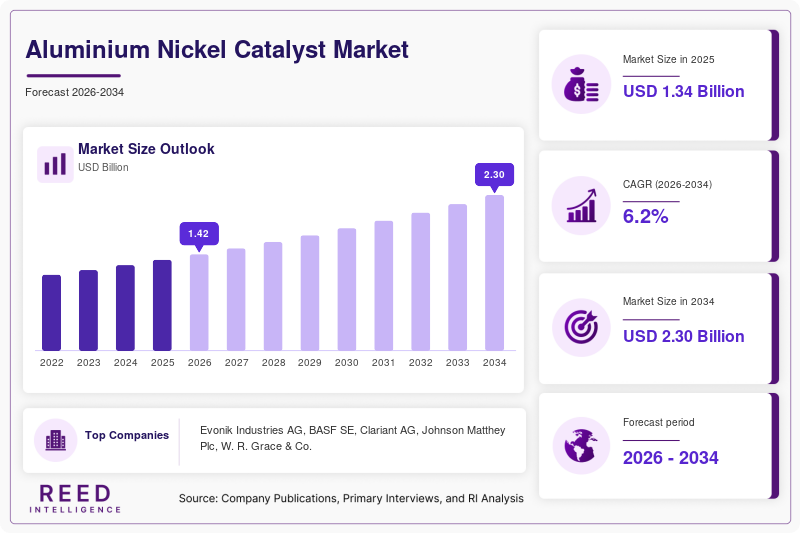
The global Aluminium Nickel Catalyst Market size is expected to reach a value of USD 1.42 billion in 2026 and is projected to attain USD 2.31 billion by 2034, expanding at a CAGR of 6.2% during 2026–2034. The market growth is primarily driven by increasing demand for efficient hydrogenation catalysts in petrochemical refining and fine chemical synthesis industries. Rising global emphasis on sustainable chemical processes and energy-efficient industrial catalysis has further strengthened adoption across manufacturing ecosystems.
A key global factor supporting the Aluminium Nickel Catalyst Market growth is the accelerated expansion of hydrogen-based chemical processing and renewable fuel production. As industries shift toward low-carbon hydrogenation processes, aluminium nickel catalysts are gaining traction due to their cost-effectiveness, high activity, and stability in large-scale industrial applications.
Key Highlights
- Dominant region (2025 share): Asia Pacific – 38.6%
- Fastest-growing region CAGR (2026–2034): Middle East & Africa – 7.1%
- Dominant subsegment (Type): Raney Nickel Catalyst – 2025 share 52.4%
- Fastest-growing subsegment CAGR (Application): Renewable Fuel Processing – 7.5%
- Dominant country market value: China – USD 0.29 billion (2024), USD 0.31 billion (2025)
Market Trends
Shift Toward Sustainable Hydrogenation Processes
The Aluminium Nickel Catalyst Market is witnessing increased adoption in green hydrogenation technologies. Industries are replacing precious metal catalysts with aluminium nickel-based alternatives to reduce operational costs and environmental impact. This shift is particularly evident in biodiesel production and bio-based chemical synthesis, where efficiency and sustainability are key performance metrics.
Technological Advancements in Catalyst Activation Techniques
Improved activation and formulation techniques are enhancing catalyst efficiency and lifespan. Innovations in alloy structuring and surface modification are enabling higher hydrogen absorption rates and improved reaction selectivity. These advancements are contributing significantly to the expansion of the Aluminium Nickel Catalyst Market in high-value chemical production sectors.
Market Drivers
Rising Demand in Petrochemical Refining
The increasing demand for refined fuels and petrochemical intermediates is a major driver of the Aluminium Nickel Catalyst Market. These catalysts play a crucial role in hydrogenation reactions used in refining processes such as desulfurization and saturation of hydrocarbons, supporting cleaner fuel production standards.
Growth of Fine and Specialty Chemicals Industry
Expanding production of fine chemicals, pharmaceuticals, and agrochemical intermediates is boosting catalyst consumption. Aluminium nickel catalysts offer high selectivity and cost efficiency, making them suitable for large-scale synthesis of complex organic compounds, thereby driving steady market expansion.
Market Restraint
Safety and Handling Limitations of Pyrophoric Nature
A key restraint affecting the Aluminium Nickel Catalyst Market is the pyrophoric nature of activated catalysts. Their high reactivity with air and moisture requires strict handling protocols and specialized storage conditions, increasing operational complexity and safety compliance costs for manufacturers.
Market Opportunities
Expansion in Green Hydrogen Economy
The growing global focus on hydrogen energy presents significant opportunities for the Aluminium Nickel Catalyst Market. These catalysts are increasingly used in hydrogenation and hydrogen storage applications, supporting the transition toward clean energy systems.
Rising Adoption in Emerging Economies
Rapid industrialization in developing regions is creating new demand for cost-effective catalytic solutions. The availability of affordable aluminium nickel catalysts is encouraging adoption in chemical manufacturing and refining industries across emerging markets.
Segmental Analysis
By Type
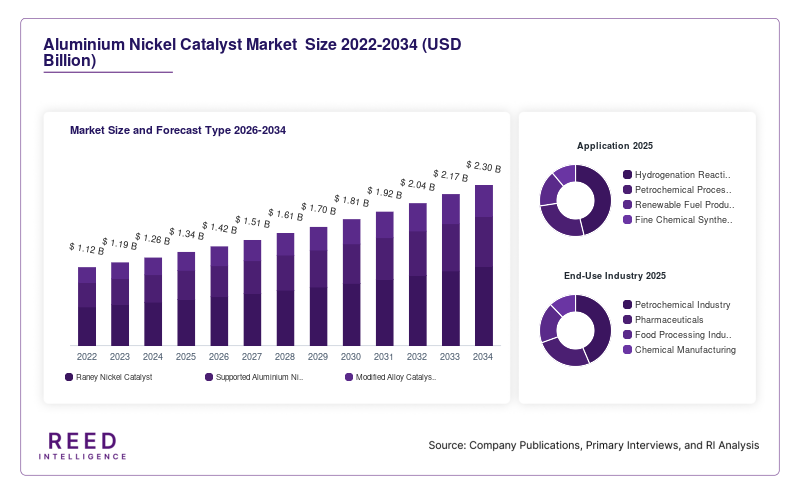
Raney Nickel Catalyst dominated the market with a 52.4% share in 2025, owing to its high catalytic activity in hydrogenation processes used in oil refining and organic synthesis. Its widespread industrial applicability makes it the preferred choice across multiple sectors.
The fastest-growing subsegment is Supported Aluminium Nickel Catalysts, projected to grow at a CAGR of 6.9% (2026–2034). This growth is driven by improved thermal stability and enhanced reaction control, making them suitable for advanced chemical processing applications.
By Application
Hydrogenation Reactions accounted for the dominant share of 46.8% in 2025, supported by extensive usage in petrochemical and edible oil industries. These processes rely heavily on aluminium nickel catalysts for efficient hydrogen transfer.
The fastest-growing application is Renewable Fuel Processing, expected to grow at a CAGR of 7.5% (2026–2034). Increasing investments in biofuels and green energy production are driving adoption in this segment.
By End-Use Industry
Petrochemical Industry held a dominant 41.2% share in 2025, driven by large-scale refining and chemical synthesis operations. Aluminium nickel catalysts are widely used in hydroprocessing and saturation reactions.
The fastest-growing end-use industry is Pharmaceuticals, projected to grow at a CAGR of 6.7% (2026–2034). Increasing demand for complex organic synthesis and API production is supporting catalyst utilization.
By Form
Powder Form dominated with a 58.1% share in 2025, due to its high surface area and reactivity in industrial hydrogenation processes.
The fastest-growing form is Pellet Form, expected to grow at a CAGR of 6.5% (2026–2034). Its improved handling safety and controlled reaction kinetics are driving adoption in large-scale industrial systems.
Regional Analysis
North America
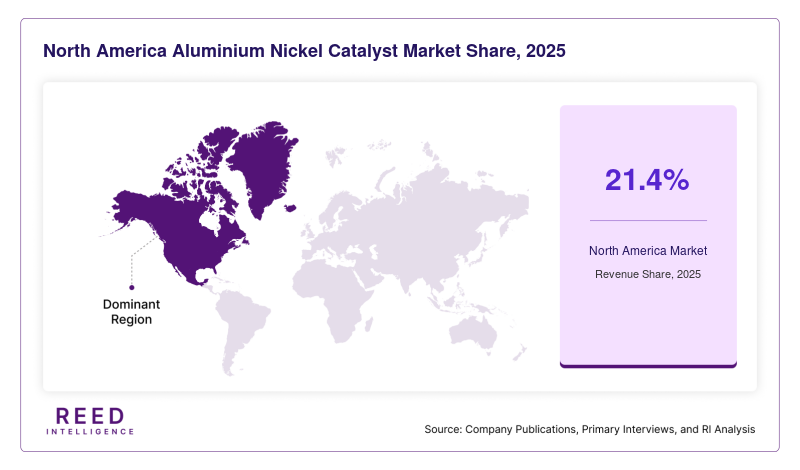
North America accounted for 21.4% market share in 2025 and is expected to grow at a CAGR of 5.8% (2026–2034). The region benefits from advanced petrochemical infrastructure and strong demand for hydrogenation catalysts in shale gas processing. The United States leads the regional Aluminium Nickel Catalyst Market due to robust refining capacity and continuous investment in chemical innovation.
Europe
Europe held a 24.7% share in 2025 and is projected to expand at a CAGR of 5.9% (2026–2034). Environmental regulations and the shift toward sustainable chemical manufacturing are driving catalyst adoption. Germany dominates the regional market, supported by strong industrial chemicals and automotive catalyst demand.
Asia Pacific
Asia Pacific dominated with a 38.6% share in 2025 and is forecasted to grow at a CAGR of 6.8% (2026–2034). Rapid industrialization, large-scale petrochemical production, and expanding pharmaceutical manufacturing are key growth drivers. China remains the leading country due to extensive refining capacity and government-backed industrial expansion.
Middle East & Africa
The region accounted for 8.9% share in 2025 and is expected to grow at a CAGR of 7.1% (2026–2034). Increasing investments in downstream oil refining and diversification into petrochemicals are supporting market growth. Saudi Arabia leads due to large refinery modernization projects and export-oriented chemical production.
Latin America
Latin America held a 6.4% share in 2025 and is projected to grow at a CAGR of 5.7% (2026–2034). Brazil is the key market, driven by expanding biodiesel production and chemical manufacturing industries. Rising demand for cost-efficient catalysts is strengthening regional adoption.
Competitive Landscape
The Aluminium Nickel Catalyst Market is moderately consolidated with key players focusing on product innovation, capacity expansion, and strategic collaborations. Major companies include Evonik Industries AG, BASF SE, Clariant AG, W. R. Grace & Co., and Johnson Matthey Plc. These players are actively investing in advanced catalyst formulations to enhance efficiency and environmental performance.
Evonik Industries AG holds a leading position due to its extensive catalyst portfolio and strong global distribution network. The company recently expanded its hydrogenation catalyst production capacity in Europe to meet growing industrial demand. BASF SE and Clariant AG are focusing on sustainable catalyst development aligned with green chemistry initiatives. Johnson Matthey continues to invest in advanced catalytic materials for energy transition applications. W. R. Grace & Co. emphasizes innovation in refining catalysts, strengthening its presence in petrochemical applications. Competitive intensity is driven by technological advancements and growing demand across emerging economies.
Key Players List
- Evonik Industries AG
- BASF SE
- Clariant AG
- Johnson Matthey Plc
- W. R. Grace & Co.
- Albemarle Corporation
- Arkema Group
- Umicore SA
- Haldor Topsoe A/S
- Sued-Chemie India Pvt. Ltd.
- Shanghai Petrochemical Catalyst Co.
- Ningbo Tenglong Catalytic Materials Co.
- Hangzhou Jiali Metal Technology Co.
- Shaanxi Kaida Chemical Engineering Co.
- Liaoning Haitai Sci-Tech Development Co.
Recent Developments
- In 2025, Evonik Industries AG expanded its catalyst production facility in Germany to support growing hydrogenation demand.
- BASF SE introduced an improved aluminium nickel catalyst formulation with enhanced selectivity for fine chemical applications.
- Johnson Matthey Plc announced R&D investments in sustainable catalyst technologies aligned with green hydrogen initiatives.
- Clariant AG strengthened its Asia Pacific supply chain to meet rising petrochemical demand.
- Umicore SA focused on recycling-based catalyst recovery systems to improve sustainability performance in industrial applications.
Aluminium Nickel Catalyst Market Segments
Type
- Raney Nickel Catalyst
- Supported Aluminium Nickel Catalyst
- Modified Alloy Catalyst
Application
- Hydrogenation Reactions
- Petrochemical Processing
- Renewable Fuel Production
- Fine Chemical Synthesis
End-Use Industry
- Petrochemical Industry
- Pharmaceuticals
- Food Processing Industry
- Chemical Manufacturing
Form
- Powder Form
- Pellet Form
- Granules Form
Distribution Channel
- Direct Sales
- Distributors
- Online Supply Platforms
By Region
- North America
- Europe
- APAC
- Middle East and Africa
- LATAM