Aluminum Die Casting Mold Release Agent Market Size, Share & Demand Report By Product Type (Solvent-Based Release Agents, Semi-Synthetic Release Agents, Synthetic Release Agents), By Application (Electric Vehicle Components, Industrial Machinery Parts, Consumer Electronics Components, Aerospace Components), By End-Use Industry (Industrial Manufacturing, Construction, Electronics) By Region & Segment Forecasts, 2026–2034
USD 3950
Market Overview
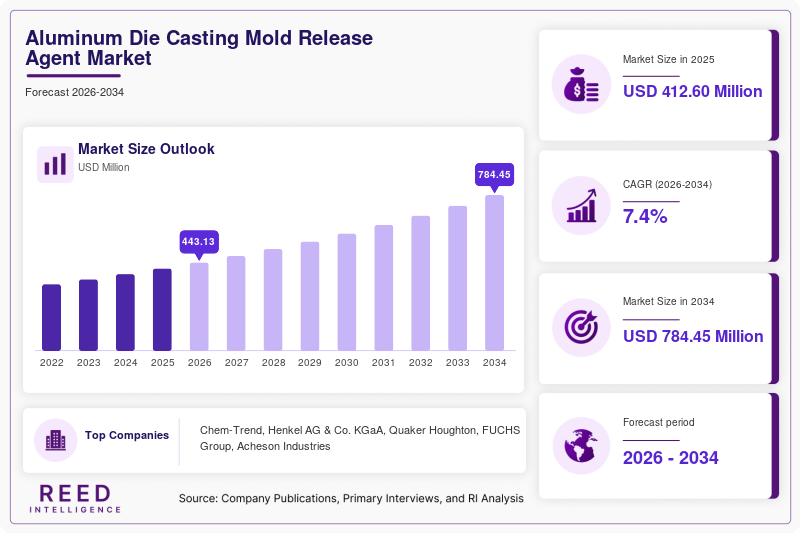
The global Aluminum Die Casting Mold Release Agent Market size was valued at USD 412.6 million in 2026 and is projected to reach USD 731.4 million by 2034, expanding at a CAGR of 7.4% during the forecast period from 2026 to 2034. The market continues to gain momentum due to the increasing use of aluminum die casting components across automotive, industrial machinery, consumer electronics, and construction applications. Mold release agents play a critical role in maintaining mold efficiency, reducing defects, improving surface quality, and extending die life in high-pressure die casting operations. Manufacturers are increasingly investing in advanced water-based and semi-synthetic formulations that reduce residue buildup and improve thermal stability during repetitive casting cycles.
One major global factor supporting market growth is the transition toward lightweight manufacturing in the automotive and transportation industries. Vehicle manufacturers are using aluminum die-cast components to reduce overall vehicle weight and improve fuel efficiency as well as electric vehicle battery performance. This trend has increased demand for high-performance mold release agents capable of operating under elevated temperatures and high production volumes. In addition, environmental regulations related to volatile organic compound emissions are encouraging the adoption of water-based release agents with lower environmental impact. The integration of automation in die casting plants has also increased the requirement for consistent spray performance and reduced downtime, further supporting market expansion across developed and emerging manufacturing economies.
Key Highlights
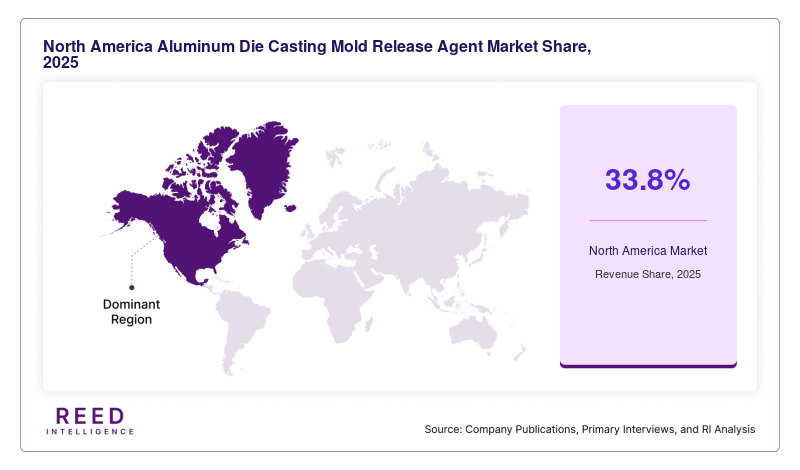
- North America dominated the market with a 33.8% share in 2025.
- while Asia Pacific is expected to grow at the fastest CAGR of 9.1% during 2026–2034.
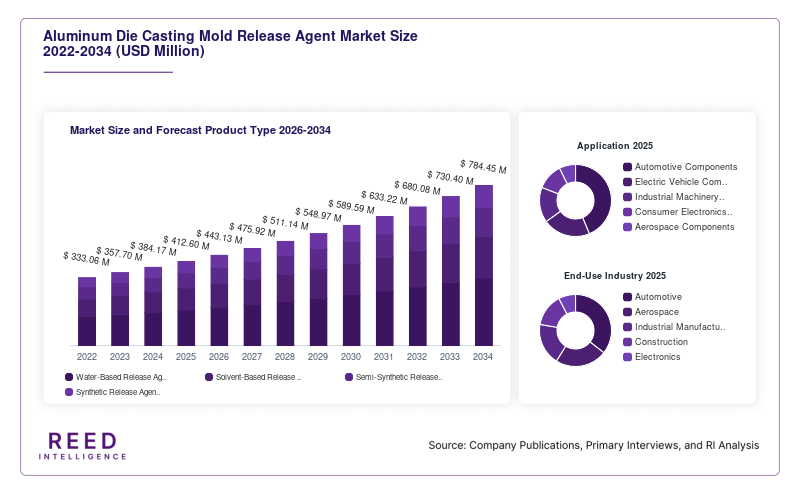
- By product type, water-based release agents accounted for the largest share of 46.3%.
- while semi-synthetic release agents are projected to grow at a CAGR of 9.6%.
- By application, automotive components led with a 48.7% share.
- whereas electric vehicle components are expected to expand at a CAGR of 10.2%.
- The United States remained the dominant country, with market values of USD 118 million in 2024 and USD 127 million in 2025.
Market Trends
Rising Adoption of Water-Based Formulations Across Industrial Casting Facilities
The market is witnessing a notable transition from solvent-based formulations toward water-based aluminum die casting mold release agents. Manufacturers are increasingly prioritizing low-emission production methods due to environmental regulations related to worker safety and industrial emissions. Water-based formulations offer lower smoke generation, reduced residue accumulation, and improved cooling characteristics during casting cycles. These benefits are particularly important for automotive and electronics manufacturers operating high-volume production lines where consistency and productivity remain essential. The shift is also supported by advancements in additive chemistry that improve lubricity and thermal resistance without compromising release efficiency.
Industrial facilities in North America and Europe are investing in automated spray systems designed specifically for water-based release agents. These systems reduce material waste and improve precision in die coverage, supporting long-term cost efficiency. Automotive component manufacturers are also using advanced formulations to reduce post-casting cleaning operations and improve final surface quality. The trend is expected to accelerate as sustainability goals become integrated into procurement strategies across the metal casting industry. Suppliers are therefore focusing on research activities aimed at improving dilution stability and extending die lubrication performance in demanding operational conditions.
Expansion of Electric Vehicle Manufacturing Supporting Specialized Release Agent Demand
The rapid expansion of electric vehicle production is reshaping demand patterns in the Aluminum Die Casting Mold Release Agent Market. Electric vehicles require lightweight structural components, battery housings, motor casings, and thermal management systems that increasingly rely on aluminum die casting technologies. These applications involve larger casting structures and more complex geometries, creating the need for advanced mold release agents capable of handling higher thermal loads and extended casting cycles. Manufacturers are responding by developing specialized products with enhanced anti-soldering and anti-porosity characteristics.
Large-scale giga-casting processes introduced by electric vehicle manufacturers are also influencing the market. These manufacturing methods require release agents that can maintain uniform performance across oversized molds while reducing cycle interruptions. Asia Pacific has emerged as a major production hub for electric vehicle components, increasing regional demand for high-performance release technologies. Suppliers are entering long-term partnerships with automotive OEMs and casting companies to provide customized chemical solutions optimized for automated casting lines. As electric vehicle production volumes continue to increase, demand for specialized release agents is expected to remain strong throughout the forecast period.
Market Drivers
Growing Demand for Lightweight Automotive Components
The increasing global demand for lightweight vehicles continues to drive the Aluminum Die Casting Mold Release Agent Market. Automotive manufacturers are reducing vehicle weight to improve fuel efficiency, reduce emissions, and enhance electric vehicle battery performance. Aluminum die casting has become a preferred manufacturing method for engine blocks, transmission housings, structural frames, and battery enclosures due to its strength-to-weight advantages. This growing use of aluminum components directly increases the consumption of mold release agents required to maintain casting precision and mold durability during high-pressure operations.
Modern automotive manufacturing environments require release agents capable of minimizing die buildup, improving component finish quality, and reducing rejection rates. High production speeds in automotive casting facilities have increased the need for reliable lubrication and thermal management solutions. Manufacturers are also seeking formulations that support automated spraying systems and reduce maintenance downtime. The expansion of electric vehicle production in China, Germany, and the United States is further supporting demand for advanced release agents tailored to large structural castings. These industry developments continue to create long-term growth opportunities for chemical suppliers operating within the die casting ecosystem.
Increasing Industrial Automation in Die Casting Operations
The growing adoption of automation technologies in metal casting facilities is another major factor driving market growth. Automated die casting systems require highly consistent release agent performance to ensure stable production cycles and reduced operational interruptions. Manufacturers are integrating robotic spraying systems, precision nozzles, and sensor-based monitoring technologies that depend on optimized release agent formulations. These advanced systems improve efficiency, reduce material wastage, and support higher production throughput in industrial manufacturing facilities.
Automation also places greater emphasis on release agent quality and formulation stability. Variations in spray distribution or residue formation can disrupt automated production environments and increase operational costs. As a result, manufacturers are investing in premium mold release products designed for uniform application and long-lasting thermal resistance. Industrial machinery, electronics, aerospace, and construction sectors are expanding the use of aluminum die casting for precision parts, further increasing demand for advanced release technologies. Emerging manufacturing economies are also modernizing casting infrastructure, creating additional demand for automated-compatible mold release solutions across regional markets.
Market Restraint
Fluctuating Raw Material Prices and Regulatory Compliance Challenges
The Aluminum Die Casting Mold Release Agent Market faces challenges associated with fluctuating raw material costs and increasingly strict environmental regulations. Mold release agents contain specialty chemicals, lubricants, surfactants, and additives whose prices are influenced by petroleum supply conditions, transportation costs, and global trade dynamics. Sudden changes in raw material pricing can affect profit margins for manufacturers and increase operational costs for end users. Small and medium-sized chemical suppliers often face difficulties maintaining pricing stability in competitive industrial markets where buyers prioritize cost efficiency.
Environmental compliance requirements also create operational pressure for manufacturers. Regulations related to volatile organic compound emissions, chemical disposal, and workplace safety are becoming stricter across North America and Europe. Compliance often requires additional investment in product reformulation, testing, and certification processes. Some solvent-based release agents are being phased out due to environmental concerns, forcing manufacturers to accelerate the transition toward water-based alternatives. Although sustainable products offer long-term benefits, the transition can involve higher initial production costs and equipment modifications for casting facilities. These factors may limit adoption among cost-sensitive manufacturers operating in developing industrial economies.
Market Opportunities
Rising Investment in Aerospace and Industrial Machinery Casting Applications
The increasing use of aluminum die casting in aerospace and industrial machinery applications is creating substantial opportunities for mold release agent manufacturers. Aerospace producers are using lightweight aluminum components to improve fuel efficiency and reduce aircraft operating costs. Structural brackets, housings, and engine-related components manufactured through die casting require specialized release agents capable of maintaining dimensional accuracy under extreme thermal conditions. This trend is encouraging suppliers to develop premium formulations with enhanced heat resistance and anti-soldering properties suitable for aerospace-grade casting operations.
Industrial machinery manufacturers are also increasing the adoption of aluminum die-cast components in pumps, compressors, robotics equipment, and automation systems. These applications require precision casting with minimal surface defects and consistent repeatability. Advanced release agents help improve mold longevity while reducing cleaning intervals and production interruptions. As industrial automation continues to expand globally, manufacturers are expected to increase investments in high-efficiency die casting technologies. This industrial transformation is likely to generate long-term demand for specialized release agent solutions designed for demanding engineering environments.
Emerging Manufacturing Expansion in Asia Pacific and Latin America
Rapid industrialization across Asia Pacific and Latin America presents a strong growth opportunity for the Aluminum Die Casting Mold Release Agent Market. Countries such as India, Vietnam, Mexico, and Brazil are attracting investments in automotive production, electronics assembly, and industrial manufacturing. These industries increasingly rely on aluminum die casting technologies to produce lightweight and cost-efficient components. As new casting facilities are established, demand for mold release agents is expected to rise significantly across regional markets.
Local manufacturers are also adopting automated and semi-automated die casting systems to improve productivity and meet export quality standards. This modernization trend supports demand for advanced release agents compatible with high-speed production environments. In addition, regional governments are promoting industrial infrastructure development and electric vehicle manufacturing through investment incentives and manufacturing policies. Global chemical suppliers are responding by expanding distribution networks and establishing localized production capabilities to strengthen market presence in emerging economies. These developments are expected to support sustained market growth throughout the forecast period.
Segmental Analysis
By Product Type
Water-based release agents dominated the Aluminum Die Casting Mold Release Agent Market with a 46.3% share in 2024. These products are widely used because they offer reduced smoke generation, improved cooling efficiency, and lower environmental impact compared to solvent-based alternatives. Automotive and industrial manufacturers increasingly prefer water-based formulations due to regulatory requirements related to worker safety and emission control. These agents also help reduce mold residue accumulation and improve the overall surface finish of aluminum cast components. Their compatibility with automated spraying systems further supports adoption in high-volume manufacturing facilities.
Semi-synthetic release agents are projected to grow at the fastest CAGR of 9.6% during the forecast period. These formulations combine the stability of synthetic compounds with the lubrication performance of traditional oils, making them suitable for complex casting operations. Manufacturers are increasingly adopting semi-synthetic products because they improve die lubrication, reduce soldering issues, and support longer production cycles. The expansion of electric vehicle manufacturing and large structural aluminum casting applications is expected to accelerate demand for advanced semi-synthetic release technologies.
By Application
Automotive components accounted for the largest market share of 48.7% in 2024 due to the extensive use of aluminum die casting in engines, transmissions, structural frames, and battery enclosures. Automotive manufacturers continue to increase aluminum usage to reduce vehicle weight and improve fuel efficiency. Mold release agents are essential in maintaining production speed, minimizing defects, and extending die lifespan in automotive casting operations. The growing transition toward electric vehicles has further increased demand for high-performance release agents optimized for large and complex cast structures.
Electric vehicle components are expected to witness the fastest CAGR of 10.2% through 2034. Manufacturers are increasingly adopting giga-casting processes to produce large aluminum structures for electric vehicles, creating new requirements for advanced mold release technologies. These applications demand superior thermal resistance, anti-porosity characteristics, and consistent spray performance during high-pressure operations. Growing investments in electric mobility infrastructure across China, Europe, and North America are expected to strengthen long-term demand for specialized release agent formulations designed for next-generation automotive manufacturing.
By End-Use Industry
The automotive industry remained the dominant end-use segment with a 51.2% market share in 2024. Aluminum die casting is widely used in vehicle production because it enables the manufacture of lightweight yet durable components at high production volumes. Mold release agents support operational efficiency by improving casting quality, reducing cycle times, and minimizing maintenance requirements. Automotive suppliers are also adopting environmentally compliant release formulations to align with sustainability objectives and regulatory standards across major manufacturing economies.
The aerospace industry is anticipated to register the fastest CAGR of 8.9% during the forecast period. Aerospace manufacturers increasingly rely on precision aluminum cast components to improve aircraft performance and fuel efficiency. These applications require advanced release agents capable of maintaining dimensional accuracy under extreme thermal conditions. Rising investments in commercial aviation, defense manufacturing, and lightweight aerospace materials are supporting demand for specialized mold release products tailored for high-precision industrial applications.
Regional Analysis
North America
North America accounted for 33.8% of the global Aluminum Die Casting Mold Release Agent Market in 2025 and continues to maintain a strong industrial manufacturing base. The region is projected to expand at a CAGR of 6.8% during the forecast period due to steady demand from automotive, aerospace, and industrial equipment sectors. Manufacturers across the United States and Canada are increasingly adopting automated die casting systems that require advanced mold release technologies. Water-based formulations are gaining popularity because of environmental regulations and workplace safety standards implemented across industrial production facilities.
The United States remains the dominant country in the regional market due to its extensive automotive and aerospace manufacturing infrastructure. Growing investments in electric vehicle production have increased demand for high-performance aluminum die-cast components and specialized release agents. Domestic manufacturers are also focusing on reducing production downtime and improving die life through advanced chemical formulations. The expansion of automated manufacturing plants and increasing research activities related to sustainable industrial lubricants continue to support market growth across the country.
Europe
Europe represented 27.4% of the global Aluminum Die Casting Mold Release Agent Market in 2025 and is expected to register a CAGR of 6.5% through 2034. The region benefits from strong automotive manufacturing activity, particularly in Germany, France, and Italy. European manufacturers are emphasizing sustainability and energy efficiency, which is increasing demand for environmentally compliant mold release agents. Water-based and low-emission formulations are widely adopted in industrial facilities seeking compliance with strict environmental regulations established by regional authorities.
Germany remains the leading country within the European market due to its advanced automotive engineering and industrial machinery sectors. The country's automotive manufacturers are increasing the use of aluminum die-cast components in electric and hybrid vehicles to reduce overall vehicle weight. This trend has increased demand for premium release agents capable of supporting high-volume and precision casting operations. German suppliers are also investing heavily in research and development focused on improving lubricant durability and reducing operational residue.
Asia Pacific
Asia Pacific held 24.9% of the global Aluminum Die Casting Mold Release Agent Market in 2025 and is projected to grow at the fastest CAGR of 9.1% during the forecast period. Rapid industrialization, expanding automotive production, and rising electronics manufacturing activities are major growth factors across the region. China, Japan, South Korea, and India continue to expand aluminum die casting operations to support domestic and export manufacturing demand. The increasing adoption of electric vehicles is also driving consumption of specialized mold release formulations.
China dominates the regional market due to its large-scale automotive and electronics manufacturing sectors. The country has become a major production hub for electric vehicle components, including battery housings and structural castings manufactured using aluminum die casting methods. This manufacturing expansion is increasing demand for high-performance release agents capable of supporting large casting structures and high production volumes. Government support for industrial modernization and electric mobility is further accelerating market growth.
Middle East & Africa
The Middle East & Africa accounted for 7.1% of the global Aluminum Die Casting Mold Release Agent Market in 2025 and is projected to grow at a CAGR of 5.8% during the forecast period. Industrial diversification initiatives in Gulf countries are supporting investments in automotive parts manufacturing, industrial equipment production, and infrastructure development. Aluminum availability in the region also supports the growth of local die casting activities. Manufacturers are increasingly adopting efficient casting technologies to improve production capabilities and reduce dependence on imported industrial components.
Saudi Arabia remains the leading country in the regional market due to its industrial diversification strategies and investments in manufacturing infrastructure. Government-backed industrial projects are encouraging the development of domestic metal processing and automotive component production facilities. These initiatives are increasing demand for mold release agents suitable for high-pressure die casting operations. The country's focus on industrial expansion and export-oriented manufacturing is expected to create long-term growth opportunities for chemical suppliers.
Latin America
Latin America captured 6.8% of the global Aluminum Die Casting Mold Release Agent Market in 2025 and is expected to expand at a CAGR of 6.1% through 2034. The regional market is supported by growing automotive production, industrial equipment manufacturing, and construction sector activity. Countries such as Brazil and Mexico are increasing investments in lightweight manufacturing technologies to improve industrial competitiveness and export capabilities. Demand for aluminum die casting components is rising steadily across transportation and machinery applications.
Brazil leads the regional market due to its strong automotive production base and expanding industrial manufacturing sector. Vehicle manufacturers are increasing the use of aluminum die-cast components to improve fuel efficiency and comply with environmental standards. This trend is supporting demand for advanced mold release agents capable of improving casting quality and extending die life. Brazilian manufacturers are also modernizing production facilities through automation investments and process optimization strategies.
Competitive Landscape
The Aluminum Die Casting Mold Release Agent Market is moderately consolidated, with global and regional chemical manufacturers competing through product innovation, strategic partnerships, and expansion initiatives. Leading companies are focusing on environmentally compliant formulations, automated spray compatibility, and enhanced thermal performance to strengthen market positioning. Competitive differentiation is increasingly based on product customization, technical support capabilities, and long-term partnerships with automotive and industrial casting companies.
Chem-Trend remains one of the leading companies in the market due to its extensive product portfolio and strong presence across automotive and industrial manufacturing sectors. The company recently expanded its sustainable water-based release agent solutions designed for high-pressure die casting applications. Other major players are investing in regional production facilities and research activities aimed at improving lubrication efficiency and reducing residue formation. Market participants are also strengthening distribution networks across emerging manufacturing economies to capture growing demand from electric vehicle and industrial automation sectors.
Key Players
- Chem-Trend
- Henkel AG & Co. KGaA
- Quaker Houghton
- FUCHS Group
- Acheson Industries
- Lusin Lubricants
- Rocol
- Münzing Chemie
- Petrofer Chemie
- Croda International
- Chemarrow
- ShinEtsu Chemical
- Lanxess
- Condat Group
- OKS Spezialschmierstoffe
Recent Developments
- In February 2025, Chem-Trend introduced a new low-residue water-based mold release agent designed for giga-casting applications in electric vehicle manufacturing facilities.
- In August 2024, FUCHS Group expanded its industrial lubricant production capacity in Asia Pacific to support rising demand from automotive and electronics die casting manufacturers.
- In November 2025, Henkel AG & Co. KGaA launched an advanced semi-synthetic release formulation with enhanced thermal resistance for high-pressure aluminum die casting operations.
Aluminum Die Casting Mold Release Agent Market Segments
Product Type
- Water-Based Release Agents
- Solvent-Based Release Agents
- Semi-Synthetic Release Agents
- Synthetic Release Agents
Application
- Automotive Components
- Electric Vehicle Components
- Industrial Machinery Parts
- Consumer Electronics Components
- Aerospace Components
End-Use Industry
- Automotive
- Aerospace
- Industrial Manufacturing
- Construction
- Electronics
By Region
- North America
- Europe
- APAC
- Middle East and Africa
- LATAM