Ambulatory Polysomnography System Market Size, Share & Demand Report By Product Type (Type II Ambulatory Polysomnography Systems, Type III Ambulatory Polysomnography Systems, Type IV Ambulatory Polysomnography Systems), By End-Use (Sleep Diagnostic Centers, Hospitals, Home Healthcare Settings), By Component (Hardware Devices, Sensors and Accessories, Software Platforms), By Region & Segment Forecasts, 2025–2034
USD 3950
Market Overview
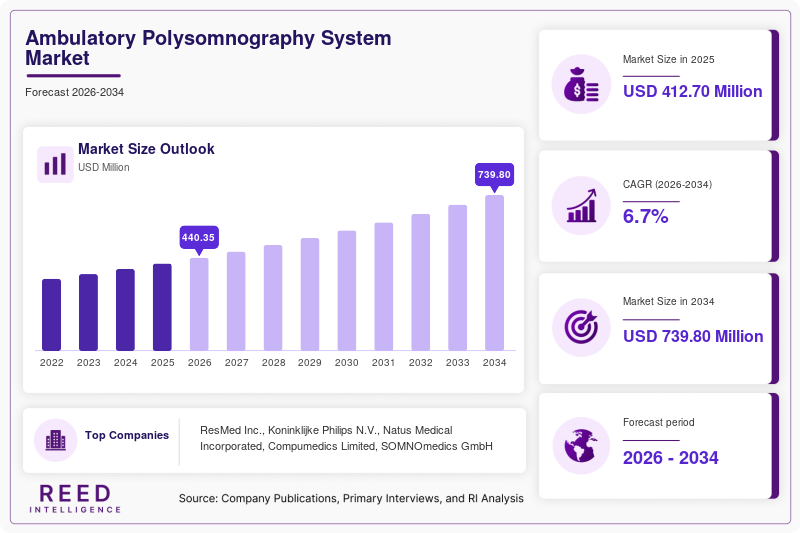
The global Ambulatory Polysomnography System Market size was valued at USD 412.7 million in 2025 and is projected to reach USD 739.5 million by 2033, expanding at a CAGR of 6.7% during the forecast period (2025–2034). Ambulatory polysomnography systems are portable diagnostic devices used to monitor sleep patterns and physiological parameters in patients outside traditional sleep laboratories. These systems measure variables such as brain activity, oxygen levels, heart rate, airflow, and breathing patterns to diagnose sleep-related disorders including sleep apnea, insomnia, and restless leg syndrome.
A significant global factor supporting the growth of the Ambulatory Polysomnography System Marketis the rising prevalence of sleep disorders worldwide. Increasing levels of stress, sedentary lifestyles, and growing obesity rates have contributed to a higher incidence of sleep apnea and related sleep conditions. Healthcare providers are increasingly adopting ambulatory diagnostic technologies to improve patient access to sleep monitoring while reducing the need for overnight hospital stays. Portable polysomnography systems allow patients to undergo sleep studies in their home environments, improving diagnostic convenience and reducing healthcare costs.
Key Highlights
- North America dominated the Ambulatory Polysomnography System Market with a 36.8% share in 2025, while Asia Pacific is projected to register the fastest CAGR of 7.4% during 2025–2034.
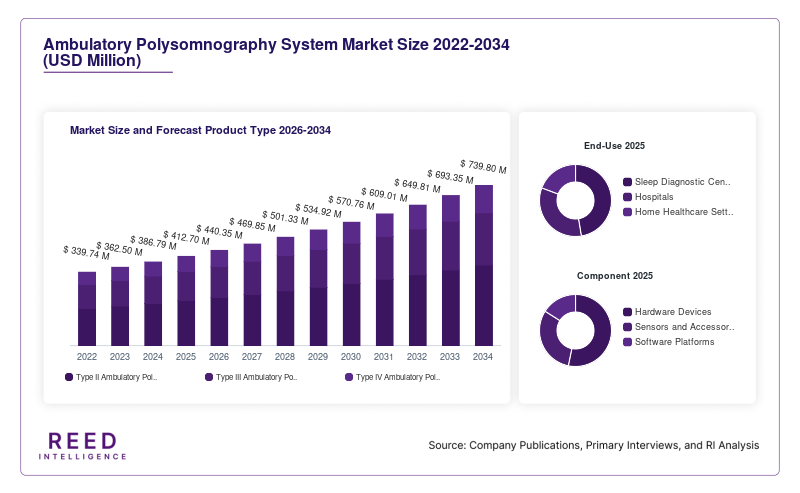
- By product type, Type II ambulatory polysomnography systems accounted for the largest share of 42.5% in 2025, while Type III systems are projected to grow fastest at a CAGR of 7.6%.
- By end-use, sleep diagnostic centers held the leading share of 46.9% in 2025, while home healthcare settings are expected to grow at a CAGR of 7.8%.
- The United States remained the dominant country, with the market valued at USD 123.6 million in 2025 and projected to reach USD 130.4 million in 2026.
Market Trends
Expansion of Home-Based Sleep Diagnostics
A notable trend shaping the Ambulatory Polysomnography System Marketis the increasing adoption of home-based sleep diagnostic solutions. Healthcare providers are gradually shifting toward decentralized diagnostic models that allow patients to undergo sleep studies in their homes. Ambulatory polysomnography systems provide portable monitoring capabilities that reduce the need for hospital-based sleep laboratories. This trend improves patient convenience while enabling healthcare providers to conduct sleep studies for a larger number of patients.
Integration of Wireless Monitoring and Data Analytics
Another trend influencing the Ambulatory Polysomnography System Marketis the integration of wireless data transmission and advanced analytics software. Modern ambulatory sleep monitoring devices are equipped with wireless sensors that transmit physiological data to cloud-based platforms. These technologies enable clinicians to analyze sleep patterns remotely and generate diagnostic reports more efficiently. The integration of advanced analytics tools also helps identify sleep disorder patterns with improved accuracy.
Market Drivers
Increasing Prevalence of Sleep Apnea
The rising incidence of sleep apnea has been a key driver of the Ambulatory Polysomnography System Market. Sleep apnea is a common disorder characterized by repeated interruptions in breathing during sleep. It is associated with obesity, cardiovascular diseases, and aging populations. Healthcare providers increasingly rely on polysomnography systems to diagnose this condition. Ambulatory devices provide a convenient alternative to laboratory-based testing, encouraging wider adoption among patients and clinicians.
Growing Demand for Cost-Effective Diagnostic Solutions
Another factor supporting market growth is the demand for cost-effective diagnostic technologies in healthcare systems. Traditional in-lab polysomnography studies require specialized facilities and overnight monitoring by trained personnel. Ambulatory polysomnography systems reduce these costs by allowing sleep monitoring to be conducted outside hospital settings. Healthcare institutions are increasingly adopting portable diagnostic devices to improve efficiency and reduce operational expenses.
Market Restraint
Technical Limitations Compared with Laboratory-Based Systems
One of the key restraints affecting the Ambulatory Polysomnography System Marketis the technical limitations associated with portable monitoring systems. Although ambulatory devices provide convenience and cost advantages, they may offer fewer monitoring channels compared with full laboratory polysomnography setups. Certain complex sleep disorders require comprehensive monitoring that includes additional physiological parameters. In such cases, sleep laboratories may still rely on advanced in-lab diagnostic systems. These limitations may restrict the use of ambulatory systems for certain clinical applications.
Market Opportunities
Development of AI-Enabled Sleep Diagnostic Platforms
The integration of artificial intelligence into sleep monitoring technologies presents a significant opportunity for the Ambulatory Polysomnography System Market. AI-based algorithms can analyze large volumes of sleep data and detect abnormalities in breathing patterns, sleep stages, and physiological signals. These technologies can support faster and more accurate diagnosis of sleep disorders. As AI tools become more integrated with portable monitoring devices, healthcare providers will gain improved diagnostic capabilities.
Expansion of Telehealth and Remote Patient Monitoring
Another opportunity for the Ambulatory Polysomnography System Marketlies in the rapid growth of telehealth services and remote patient monitoring systems. Healthcare providers increasingly utilize remote diagnostic technologies to monitor patients outside clinical environments. Ambulatory polysomnography systems can be integrated into telehealth platforms to support remote sleep monitoring and virtual consultations. This integration will enable clinicians to manage sleep disorder treatments more effectively.
Segmental Analysis
By Product Type
The Ambulatory Polysomnography System Marketis segmented by product type into Type II, Type III, and Type IV ambulatory polysomnography systems. Among these, Type II systems held the largest share of 42.5% in 2025. These systems provide multiple physiological monitoring channels similar to laboratory polysomnography systems. Healthcare providers frequently use Type II systems for comprehensive sleep studies conducted outside clinical laboratories. Their ability to capture detailed sleep data supports accurate diagnosis of various sleep disorders.
The Type III ambulatory polysomnography system segmentis expected to grow at the fastest CAGR of 7.6% during the forecast period. These devices provide a simplified monitoring setup that focuses on essential respiratory and oxygen saturation parameters. Their compact design and lower cost make them suitable for large-scale sleep disorder screening programs. As healthcare providers aim to expand sleep apnea screening services, the adoption of Type III monitoring systems will increase.
By End-Use
The Ambulatory Polysomnography System Marketis segmented into sleep diagnostic centers, hospitals, and home healthcare settings. Sleep diagnostic centers accounted for the largest share of 46.9% in 2025. These centers specialize in the diagnosis and treatment of sleep disorders and frequently use ambulatory polysomnography systems to conduct patient monitoring outside laboratory environments. Diagnostic centers often deploy portable systems for patients who require sleep monitoring at home.
The home healthcare segmentis expected to grow at the fastest CAGR of 7.8% during the forecast period. Portable monitoring devices allow patients to undergo sleep studies in familiar environments, improving comfort and compliance. Healthcare providers increasingly recommend home-based sleep monitoring to expand diagnostic capacity while reducing hospital resource utilization.
By Component
Based on component, the Ambulatory Polysomnography System Marketincludes hardware devices, sensors and accessories, and software platforms. Hardware devices accounted for the largest share of 44.6% in 2025. These devices serve as the core units responsible for recording physiological signals during sleep studies. Their reliability and measurement accuracy are essential for diagnostic applications.
The software platform segmentis projected to grow at the fastest CAGR of 7.9% during the forecast period. Sleep monitoring software enables clinicians to interpret complex physiological data collected during sleep studies. Advanced analytics tools help generate diagnostic reports and visualize sleep patterns more effectively. As healthcare providers increasingly adopt digital diagnostic platforms, demand for specialized software solutions will grow.
Regional Analysis
North America
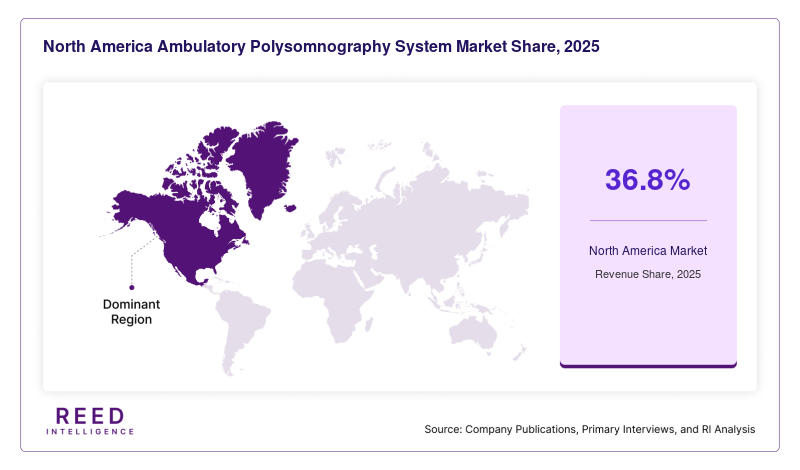
North America accounted for 36.8% of the global Ambulatory Polysomnography System Market share in 2025. The region benefited from well-developed healthcare infrastructure and widespread awareness of sleep disorders. During the forecast period from 2025 to 2034, the regional market is expected to grow at a CAGR of 6.5%. Healthcare providers across the region have increasingly adopted portable sleep monitoring technologies to improve patient access to diagnostic services.
The United Statesremained the dominant country within the region. The country has a large patient population suffering from sleep apnea and other sleep-related conditions. Healthcare institutions in the United States frequently utilize ambulatory polysomnography systems as part of sleep disorder screening programs. The presence of medical device manufacturers and advanced diagnostic laboratories supports the availability of sleep monitoring technologies.
Europe
Europe represented 27.1% of the global Ambulatory Polysomnography System Market share in 2025. The regional market will grow at a CAGR of 6.4% during the forecast period. Healthcare systems across Europe are increasingly adopting remote diagnostic technologies to manage growing patient populations. Portable sleep monitoring devices are becoming more common in clinical practice.
Germanyemerged as the leading country within the European market. The country has a well-established medical technology sector and advanced sleep diagnostic facilities. German healthcare providers frequently incorporate ambulatory polysomnography systems into diagnostic workflows for sleep apnea screening. The country’s strong medical device research ecosystem supports technological innovation in sleep monitoring systems.
Asia Pacific
Asia Pacific accounted for 23.9% of the global Ambulatory Polysomnography System Market share in 2025and is projected to register the fastest CAGR of 7.4% during the forecast period. Rapid urbanization and lifestyle changes have contributed to rising cases of sleep disorders across several Asian countries. Healthcare providers are increasingly investing in portable diagnostic technologies to improve access to sleep studies.
Chinadominated the regional market due to its large population and expanding healthcare infrastructure. Hospitals and diagnostic centers in China are gradually incorporating ambulatory sleep monitoring systems into their diagnostic capabilities. Increasing awareness of sleep health among urban populations has supported demand for sleep diagnostic devices.
Middle East & Africa
The Middle East & Africaaccounted for 6.2% of the global Ambulatory Polysomnography System Market share in 2025. The regional market will expand at a CAGR of 6.3% during the forecast period. Healthcare infrastructure development and increasing investment in medical technologies have supported the adoption of diagnostic devices in the region.
Saudi Arabiarepresented the dominant country within the regional market. The country has been expanding healthcare services and investing in advanced diagnostic technologies. Hospitals and medical centers are increasingly adopting portable sleep monitoring devices to support patient diagnostics.
Latin America
Latin America held 6.0% of the global Ambulatory Polysomnography System Market share in 2025and is projected to grow at a CAGR of 6.6% during 2025–2034. The demand for sleep disorder diagnostics has been gradually increasing across several countries in the region. Healthcare providers are incorporating portable monitoring technologies to improve patient access to diagnostic services.
Brazilremained the dominant country in the regional market. The country’s growing healthcare sector and increasing awareness of sleep health have supported demand for sleep diagnostic equipment. Hospitals and sleep diagnostic centers in Brazil have begun adopting ambulatory polysomnography systems for remote patient monitoring.
Competitive Landscape
The Ambulatory Polysomnography System Marketincludes several global medical device manufacturers that develop portable sleep monitoring technologies. Companies focus on improving device portability, data accuracy, and connectivity features to support remote diagnostics.
ResMed Inc.remains one of the notable participants in the market due to its expertise in sleep disorder management technologies. The company has expanded its sleep diagnostic portfolio with advanced ambulatory monitoring devices designed for home-based sleep studies. Recent developments include enhanced wireless connectivity features that allow clinicians to access sleep monitoring data remotely.
Key Players
- ResMed Inc.
- Koninklijke Philips N.V.
- Natus Medical Incorporated
- Compumedics Limited
- SOMNOmedics GmbH
- Nihon Kohden Corporation
- Cadwell Industries, Inc.
- BMC Medical Co., Ltd.
- Itamar Medical Ltd.
- Neurovirtual
- CleveMed
- Vyaire Medical, Inc.
- SleepMed Inc.
- Deymed Diagnostic
- Advanced Brain Monitoring, Inc.
Recent Developments
- In 2024, several medical device companies introduced portable polysomnography systems with enhanced wireless connectivity for remote patient monitoring.
- In 2023, sleep diagnostic device manufacturers launched cloud-based software platforms to support data analysis from ambulatory monitoring devices.
- In 2023, healthcare providers expanded home-based sleep testing programs using ambulatory polysomnography systems to improve patient access to diagnostics.
Ambulatory Polysomnography System Market Segments
Product Type
- Type II Ambulatory Polysomnography Systems
- Type III Ambulatory Polysomnography Systems
- Type IV Ambulatory Polysomnography Systems
End-Use
- Sleep Diagnostic Centers
- Hospitals
- Home Healthcare Settings
Component
- Hardware Devices
- Sensors and Accessories
- Software Platforms
By Region
- North America
- Europe
- APAC
- Middle East and Africa
- LATAM