Amla Extract Market Size, Share & Demand Report By Form (Powder Extract, Liquid Extract), By Application (Dietary Supplements, Food & Beverages, Cosmetics & Personal Care, Pharmaceuticals), By Distribution Channel (Online Retail, Pharmacies & Health Stores, Supermarkets/Hypermarkets, Specialty Herbal Stores), By Region & Segment Forecasts, 2025–2034
USD 3950
Market Overview
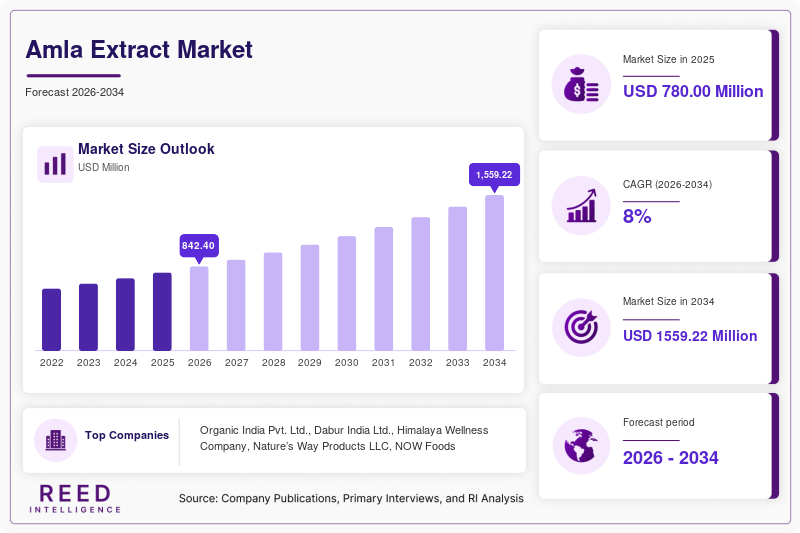
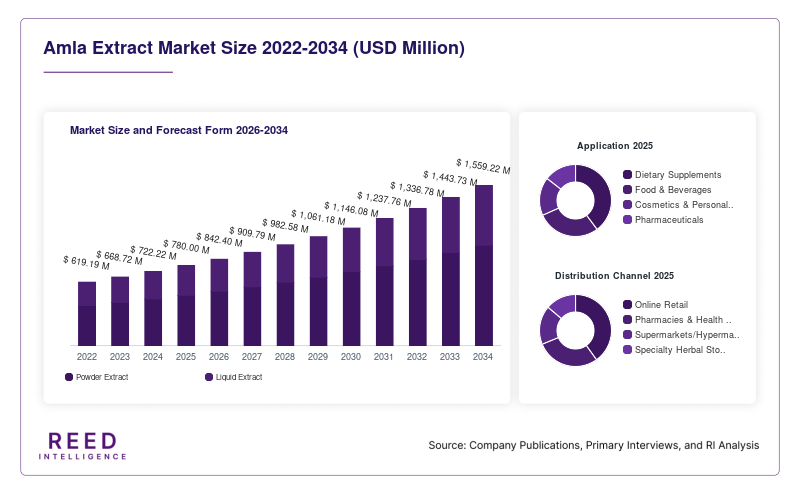
The global Amla Extract Market size was valued at approximately USD 780 million in 2025 and is projected to reach USD 1.56 billion by 2034, expanding at a CAGR of 8.0% during the forecast period (2025–2034). The market growth has been primarily supported by the increasing global shift toward plant-based nutraceuticals and herbal formulations, particularly in preventive healthcare and functional nutrition. Rising awareness about antioxidant-rich natural ingredients has positioned amla extract as a preferred component across dietary supplements, personal care products, and functional foods.
Amla extract, derived from Indian gooseberry, is widely recognized for its high vitamin C content and bioactive compounds, making it a critical ingredient in wellness-focused formulations. The growing demand for clean-label products and traditional botanical ingredients in Western markets has significantly boosted the market expansion. Additionally, increased R&D investments in herbal pharmacology and standardized extracts have enhanced product quality and broadened application scope.
Key Highlights:
- Asia Pacific dominated the market with a 41% share in 2025, while North America is expected to grow at the fastest CAGR of 8.9%.
- By form, powder extract led with a 56% share, while liquid extract is projected to grow at a CAGR of 9.2%.
- By application, dietary supplements dominated with a 38% share, while cosmetics & personal care is expected to grow at a CAGR of 8.7%.
- India remained the dominant country, with a market size of USD 210 million in 2024 and USD 225 million in 2025.
Market Trends
Expansion of Herbal Nutraceuticals
The increasing consumer inclination toward preventive healthcare has significantly influenced the Amla Extract Market. Manufacturers are integrating amla extract into capsules, powders, and gummies targeting immunity, digestion, and anti-aging benefits. This trend is further supported by regulatory acceptance of herbal supplements in key regions, enabling broader product commercialization. The shift toward personalized nutrition has also encouraged companies to develop targeted amla-based formulations.
Integration in Premium Personal Care Products
Amla extract is gaining traction in high-end cosmetics due to its antioxidant and hair-strengthening properties. It is widely incorporated in shampoos, serums, and anti-aging creams. The demand for sulfate-free and herbal beauty products has accelerated its adoption. Brands are increasingly marketing amla extract as a natural alternative to synthetic actives, enhancing product differentiation and consumer appeal.
Market Drivers
Rising Demand for Natural Ingredients in Functional Foods
The growing demand for functional foods enriched with natural ingredients is a major driver of the Amla Extract Market. Consumers are actively seeking products that offer health benefits beyond basic nutrition, such as immunity enhancement and detoxification. Amla extract’s compatibility with beverages, snacks, and fortified foods makes it a preferred ingredient for manufacturers.
Growth in Ayurvedic and Traditional Medicine Adoption
The increasing global recognition of Ayurveda and traditional medicine systems has fueled demand for amla extract. Governments and healthcare organizations are promoting herbal remedies, which has strengthened consumer trust. The export of Ayurvedic products has also contributed to market expansion, particularly in developed economies.
Market Restraint
Variability in Raw Material Quality and Supply Chain Challenges
One of the major challenges in the Amla Extract Market is the inconsistency in raw material quality. Amla cultivation is highly dependent on climatic conditions, which can affect yield and phytochemical composition. This variability leads to challenges in maintaining standardized extract quality, especially for pharmaceutical and nutraceutical applications.
Additionally, fragmented supply chains in major producing countries can lead to price fluctuations and supply disruptions. Limited mechanization in harvesting and processing further impacts efficiency. These factors collectively hinder the scalability of production and may affect profit margins for manufacturers.
Market Opportunities
Expansion into Functional Beverages
The growing popularity of functional beverages presents a significant opportunity for the Amla Extract Market. Amla extract is increasingly used in juices, herbal teas, and wellness drinks due to its nutritional profile. Beverage manufacturers are leveraging its health benefits to develop innovative products targeting urban consumers.
Technological Advancements in Extraction Processes
Advancements in extraction technologies such as supercritical fluid extraction and spray drying are improving the quality and shelf life of amla extract. These innovations enable higher retention of bioactive compounds and enhance product consistency. As a result, manufacturers can cater to high-value applications, including pharmaceuticals and premium cosmetics.
Segmental Analysis
By Form
The powder segment dominated the Amla Extract Market, accounting for 56% of the market share in 2024. Powdered amla extract is widely preferred due to its longer shelf life, ease of storage, and versatility in applications such as dietary supplements and food products. Its compatibility with capsules and tablets has further strengthened its demand.
The liquid extract segment is expected to grow at the fastest CAGR of 9.2% during the forecast period. This growth will be driven by increasing demand for ready-to-consume health products and functional beverages. Liquid extracts offer better absorption and convenience, making them suitable for modern consumption patterns.
By Application
Dietary supplements held the largest share of 38% in 2024. The segment’s dominance is attributed to the growing demand for immunity-boosting products and preventive healthcare solutions. Amla extract is widely used in capsules, tablets, and powders targeting various health benefits.
The cosmetics & personal care segment is projected to grow at a CAGR of 8.7%. This growth will be driven by increasing demand for herbal beauty products and natural formulations. Amla extract’s antioxidant properties make it a valuable ingredient in skincare and haircare products.
By Distribution Channel
Offline distribution dominated the market with a 62% share in 2024. Traditional retail channels, including pharmacies and health stores, have been the primary sales avenues for amla extract products. Consumer preference for physical product verification has supported this segment.
Online distribution is expected to grow at a CAGR of 9.5%. The expansion of e-commerce platforms and increasing digital adoption will drive this growth. Online channels provide convenience, wider product selection, and competitive pricing, attracting a larger consumer base.
Regional Analysis
North America
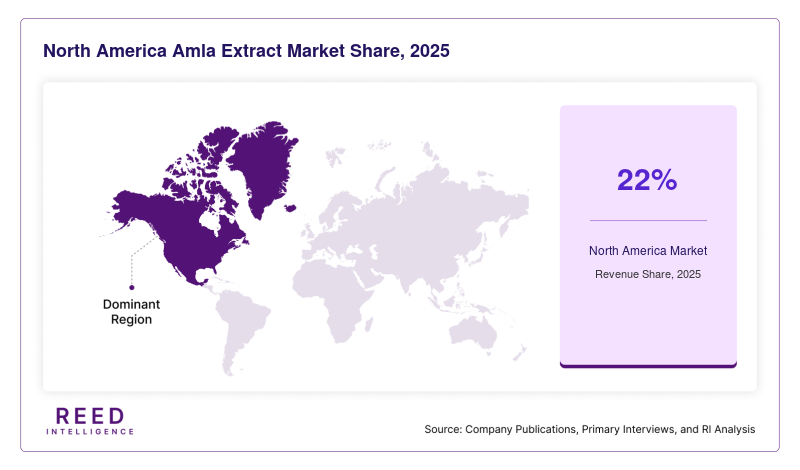
North America accounted for approximately 22% of the Amla Extract Market share in 2025 and is expected to grow at a CAGR of 8.9% during the forecast period. The region’s growth will be driven by increasing consumer demand for plant-based supplements and clean-label products. The rising popularity of herbal wellness solutions among millennials will further support market expansion.
The United States dominated the regional market due to strong demand for nutraceuticals and dietary supplements. The presence of established distribution channels and high consumer awareness regarding natural health products has contributed to market growth. Increasing product launches featuring amla extract in functional foods will further enhance adoption.
Europe
Europe held a 19% share of the Amla Extract Market in 2025 and is projected to grow at a CAGR of 7.6%. The region’s growth will be supported by stringent regulations promoting natural and organic ingredients in food and cosmetics. Consumers are increasingly shifting toward herbal formulations, driving demand for amla extract.
Germany emerged as the dominant country due to its strong herbal medicine industry. The country’s well-established pharmaceutical sector and preference for plant-based remedies have driven demand for standardized extracts. Growing interest in preventive healthcare will further boost market growth.
Asia Pacific
Asia Pacific dominated the Amla Extract Market with a 41% share in 2025 and is expected to grow at a CAGR of 8.2%. The region’s growth will be driven by abundant raw material availability and strong traditional medicine practices. Increasing urbanization and rising disposable income will further support market expansion.
India led the regional market due to its position as the largest producer of amla. The country’s extensive use of amla in Ayurvedic formulations and food products has significantly contributed to demand. Government initiatives supporting herbal product exports will enhance growth prospects.
Middle East & Africa
The Middle East & Africa accounted for 9% of the market share in 2025 and is projected to grow at a CAGR of 7.4%. The region’s growth will be supported by increasing awareness of herbal health products and expanding retail networks.
South Africa dominated the regional market due to rising demand for natural supplements. The growing middle-class population and increasing focus on wellness products have contributed to market growth. Expansion of e-commerce platforms will further drive product accessibility.
Latin America
Latin America held a 9% share of the Amla Extract Market in 2025 and is expected to grow at a CAGR of 7.8%. The region’s growth will be driven by increasing adoption of herbal ingredients in food and personal care products.
Brazil emerged as the dominant country due to its growing nutraceutical industry. The country’s expanding health-conscious population and increasing demand for natural ingredients have supported market growth. Local manufacturers are incorporating amla extract into functional food products, further boosting demand.
Competitive Landscape
The Amla Extract Market is moderately fragmented, with several regional and global players competing based on product quality, pricing, and innovation. Leading companies are focusing on expanding their product portfolios and improving extraction technologies to enhance efficiency.
A key market leader has maintained its position through continuous investment in research and development and strong distribution networks. The company recently introduced a standardized high-potency amla extract targeting premium nutraceutical applications, strengthening its competitive edge.
Other players are adopting strategies such as partnerships, acquisitions, and product launches to expand their market presence. Increasing focus on organic and sustainably sourced raw materials is also shaping the competitive landscape.
Key Players List
- Organic India Pvt. Ltd.
- Dabur India Ltd.
- Himalaya Wellness Company
- Nature’s Way Products LLC
- NOW Foods
- NutraMarks Inc.
- Arjuna Natural Pvt. Ltd.
- Avesthagen Limited
- Ambe Phytoextracts Pvt. Ltd.
- Herbal Hills
- Baidyanath Group
- Patanjali Ayurved Limited
- Martin Bauer Group
- Indfrag Biosciences Pvt. Ltd.
- Sydler Group
Recent Developments
- In 2025, a leading manufacturer launched a high-concentration amla extract designed for clinical nutrition applications.
- Several companies expanded their production capacities to meet rising global demand.
- New product launches in functional beverages incorporating amla extract gained traction in urban markets.
- Strategic collaborations between herbal extract manufacturers and cosmetic brands increased product innovation.
Amla Extract Market Segments
Form
- Powder Extract
- Liquid Extract
Application
- Dietary Supplements
- Food & Beverages
- Cosmetics & Personal Care
- Pharmaceuticals
Distribution Channel
- Online Retail
- Pharmacies & Health Stores
- Supermarkets/Hypermarkets
- Specialty Herbal Stores
By Region
- North America
- Europe
- APAC
- Middle East and Africa
- LATAM