Ammonia Market Size, Share, Demand Report By Production Method (Conventional Ammonia, Blue Ammonia, Green Ammonia), By Application (Fertilizers, Chemical Manufacturing, Refrigeration, Explosives, Energy & Fuel Applications, Others), By End-Use Industry (Agriculture, Chemical Industry, Mining, Energy, Pharmaceuticals, Others), By Region & Segment Forecasts, 2026–2034
USD 3950
Market Overview
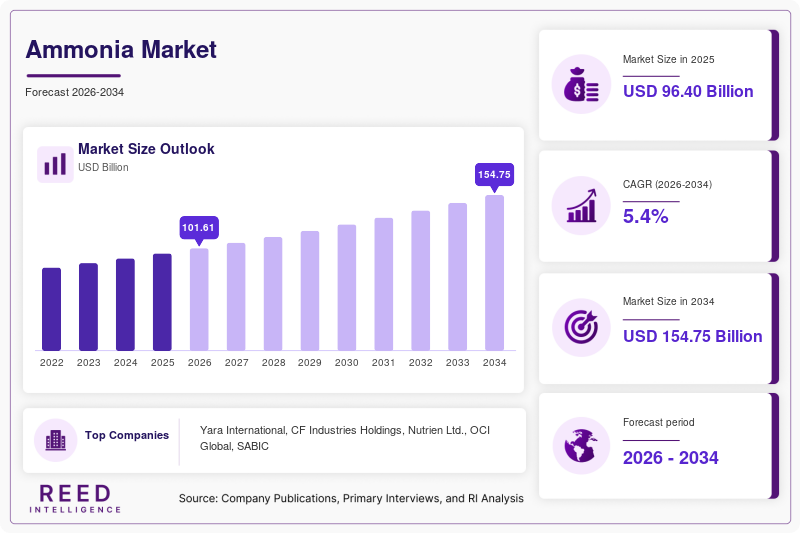
The global Ammonia Market size was valued at USD 96.4 billion in 2026 and is projected to reach USD 146.8 billion by 2034, expanding at a CAGR of 5.4% during 2026–2034. Ammonia remains one of the most important industrial chemicals worldwide, serving as a key feedstock for fertilizers, chemicals, refrigeration systems, explosives, pharmaceuticals, and emerging clean-energy applications. The market continues to benefit from rising agricultural productivity requirements, increasing food consumption, and expanding industrial manufacturing activities across both developed and developing economies.
A major global factor supporting market growth is the increasing demand for nitrogen-based fertilizers. Population growth, shrinking arable land availability, and the need for higher crop yields have encouraged fertilizer manufacturers to increase ammonia production capacities. In addition, governments are promoting sustainable agricultural practices and food security programs, creating stable demand for ammonia-derived products such as urea, ammonium nitrate, and ammonium sulfate.
Key Highlights
- North America dominated the market with a 35.4% share in 2025, while Asia Pacific is expected to grow at the fastest CAGR of 6.8% during 2026–2034.
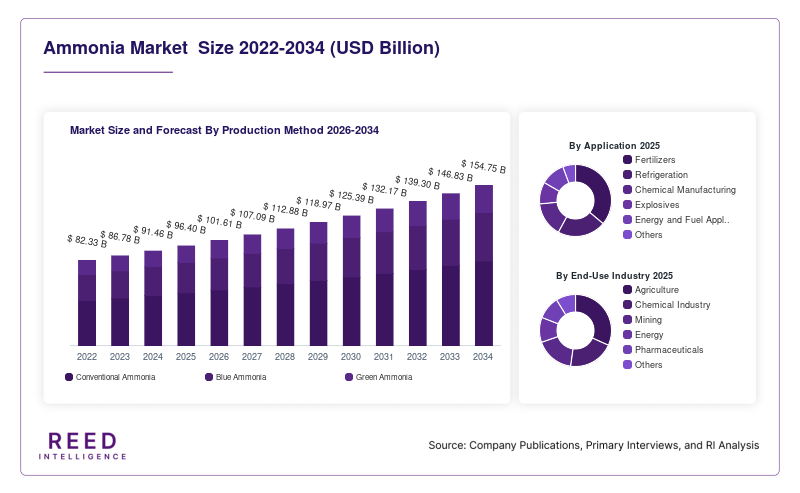
- By production method, conventional ammonia accounted for the largest share of 82.1%, while green ammonia is projected to grow at a CAGR of 14.6%.
- By application, fertilizers led with a 71.8% share, whereas energy and fuel applications are expected to expand at a CAGR of 15.2%.
- By end-use industry, agriculture held the largest share of 68.5%, while the energy sector is anticipated to grow at a CAGR of 13.9%.
- The United States remained the dominant country, with market values of USD 18.7 billion in 2024 and USD 19.8 billion in 2025.
Market Trends
Expansion of Green Ammonia Production Projects
The ammonia industry is undergoing a transition toward environmentally sustainable production methods. Traditional ammonia manufacturing relies heavily on natural gas and generates significant carbon emissions. As governments and corporations implement decarbonization strategies, investments in green ammonia facilities powered by renewable energy sources are increasing. Several producers are establishing pilot and commercial-scale projects that use electrolysis-generated hydrogen instead of fossil-fuel-derived hydrogen. These developments are attracting funding from energy companies, infrastructure investors, and public agencies seeking to accelerate low-carbon industrial transformation. Green ammonia is becoming an important component of long-term sustainability roadmaps across agriculture, transportation, and energy sectors, supporting future market growth and technological innovation.
Rising Adoption of Ammonia as a Hydrogen Carrier
Ammonia is increasingly being recognized as an efficient carrier for hydrogen storage and transportation. Hydrogen faces logistical challenges due to its low volumetric energy density and transportation costs. Ammonia offers a practical solution because it can be stored and transported using established infrastructure. Energy companies are evaluating ammonia for power generation, maritime fuel, and international hydrogen trade. Countries pursuing hydrogen economy strategies are investing in ammonia import terminals, storage facilities, and cracking technologies. This trend is expanding the market beyond traditional fertilizer applications and creating new commercial opportunities for producers. As hydrogen demand grows globally, ammonia is expected to become a strategic component of future energy supply chains.
Market Drivers
Growing Demand for Nitrogen Fertilizers Across Agricultural Economies
The increasing need to improve agricultural productivity remains a major driver of the ammonia market. Global population growth continues to place pressure on food production systems, requiring higher crop yields from limited agricultural land. Ammonia serves as the primary feedstock for nitrogen-based fertilizers, making it indispensable for modern farming operations. Governments in emerging economies are supporting fertilizer accessibility through subsidy programs and agricultural modernization initiatives. Farmers are increasingly adopting nutrient management practices that rely on ammonia-derived products to enhance soil fertility and crop performance. Rising demand for cereals, fruits, vegetables, and oilseeds is therefore contributing directly to sustained ammonia consumption across agricultural markets.
Industrial Expansion and Chemical Manufacturing Growth
The broad application of ammonia across industrial sectors continues to support market expansion. Ammonia is utilized in the production of plastics, fibers, explosives, cleaning agents, refrigerants, and numerous chemical intermediates. Rapid industrialization in Asia Pacific, Latin America, and parts of the Middle East is driving demand for these downstream products. Manufacturing facilities are increasing production capacities to meet growing consumer and industrial requirements. Infrastructure development projects also stimulate demand for explosives used in mining and construction activities. As industrial output expands and chemical value chains become more integrated, ammonia consumption is expected to maintain a steady growth trajectory throughout the forecast period.
Market Restraint
Volatility in Natural Gas Prices and Environmental Compliance Costs
The ammonia market faces significant challenges associated with fluctuations in natural gas prices and increasing environmental compliance requirements. Natural gas represents one of the largest input costs in conventional ammonia production. Sudden changes in energy prices can substantially affect operating margins and production economics, particularly in regions dependent on imported energy resources. Producers often face difficulties in maintaining stable pricing strategies during periods of energy market uncertainty.
Environmental regulations are creating additional financial pressure on manufacturers. Governments are implementing stricter emission standards and carbon reduction policies that require investments in cleaner technologies, carbon capture systems, and energy-efficient equipment. Smaller producers may encounter challenges in financing these upgrades, potentially affecting competitiveness. For example, facilities operating with older production technologies often experience higher compliance costs compared to newly constructed plants. These factors can delay capacity expansion projects and influence investment decisions, thereby limiting market growth potential in certain regions despite strong underlying demand.
Market Opportunities
Development of Ammonia-Fueled Maritime Transportation
The maritime industry is actively exploring low-carbon fuel alternatives to reduce greenhouse gas emissions. Ammonia has emerged as a promising marine fuel due to its carbon-free combustion characteristics and established global transportation infrastructure. Shipbuilders, engine manufacturers, and shipping companies are investing in ammonia-compatible technologies and vessel designs. Regulatory pressure from international maritime organizations is accelerating interest in cleaner fuel solutions. As commercial deployment increases, ammonia producers may benefit from substantial demand generated by shipping fleets transitioning toward sustainable energy sources. This opportunity could transform ammonia from a traditional industrial chemical into a strategic fuel commodity over the coming decade.
Emerging Demand from Power Generation and Energy Storage Applications
Power utilities and energy developers are evaluating ammonia as a fuel for electricity generation and long-duration energy storage. The ability to transport and store ammonia more easily than hydrogen makes it attractive for renewable energy integration. Countries investing in renewable power infrastructure are examining ammonia co-firing technologies for thermal power plants and dedicated ammonia-fueled generation facilities. These applications support grid stability while helping reduce carbon emissions. Growing investments in renewable energy projects and hydrogen infrastructure are expected to create new market segments for ammonia producers. The expansion of energy-related applications could significantly diversify revenue sources and strengthen long-term market prospects.
Segmental Analysis
By Production Method
Conventional ammonia represented the dominant subsegment and accounted for approximately 82.1% of the global market share in 2024. The segment maintains leadership due to its established production infrastructure, widespread commercial availability, and comparatively lower production costs. Most existing ammonia plants operate using natural gas-based steam methane reforming technologies, which remain economically viable in regions with abundant energy resources. Conventional ammonia continues to support fertilizer manufacturing, industrial chemical production, refrigeration applications, and mining activities. Despite increasing environmental concerns, the segment benefits from mature supply chains, extensive distribution networks, and proven operational reliability. Large-scale industrial users continue to depend on conventional production due to consistent supply volumes and established procurement systems.
Green ammonia is projected to be the fastest-growing production method, advancing at a CAGR of 14.6% during the forecast period. Growth is being supported by increasing investment in renewable energy infrastructure and decarbonization initiatives across major economies. Green ammonia production utilizes renewable hydrogen generated through electrolysis, significantly reducing carbon emissions compared with traditional methods. Governments are introducing incentives, funding programs, and regulatory frameworks that encourage adoption of low-carbon industrial technologies. Corporate sustainability commitments are also motivating manufacturers to secure cleaner feedstock sources. As production costs decline and technology deployment scales up, green ammonia is expected to gain a larger share of global output.
By Application
Fertilizers constituted the dominant application segment and held approximately 71.8% of market revenue in 2024. Ammonia serves as the foundational raw material for producing nitrogen fertilizers such as urea, ammonium nitrate, and ammonium sulfate. The segment benefits from increasing global food demand and the need to enhance agricultural productivity. Farmers across developed and developing economies continue to rely on nitrogen fertilizers to improve crop yields and maintain soil nutrient levels. Government support programs, agricultural modernization efforts, and expanding cultivation areas further strengthen fertilizer consumption. The essential role of fertilizers in global food production ensures consistent ammonia demand regardless of economic fluctuations in other industrial sectors.
Energy and fuel applications are anticipated to be the fastest-growing application segment, recording a CAGR of 15.2% through 2034. The increasing interest in ammonia as a hydrogen carrier and carbon-free fuel is driving market expansion. Power generation companies, shipping operators, and energy developers are exploring ammonia-based solutions to support decarbonization objectives. Research into ammonia combustion technologies and fuel-cell applications continues to advance commercial viability. Infrastructure investments involving storage facilities, transportation networks, and import-export terminals are further supporting adoption. As countries pursue cleaner energy systems and renewable fuel alternatives, ammonia's role within global energy markets is expected to expand substantially.
By End-Use Industry
Agriculture remained the dominant end-use industry and accounted for approximately 68.5% of global ammonia demand in 2024. The industry's dependence on nitrogen fertilizers makes agriculture the largest consumer of ammonia worldwide. Rising food consumption, changing dietary preferences, and population growth continue to increase pressure on agricultural production systems. Farmers utilize ammonia-derived fertilizers to improve crop productivity, optimize nutrient management, and achieve higher yields. Emerging economies are particularly important contributors due to expanding agricultural activities and government-backed food security initiatives. The critical importance of efficient crop production ensures agriculture maintains its leadership position within the ammonia market throughout the forecast period.
The energy sector is expected to emerge as the fastest-growing end-use industry, registering a CAGR of 13.9% between 2026 and 2034. Increasing interest in low-carbon energy solutions is encouraging investment in ammonia-based power generation, hydrogen transportation, and renewable energy storage. Utilities and energy developers are exploring ammonia co-firing strategies to reduce emissions from existing power assets. The development of hydrogen export markets is also creating new demand for ammonia infrastructure. Growing collaboration among energy companies, technology providers, and governments is accelerating commercialization efforts. These factors collectively position the energy sector as a significant future growth engine for ammonia consumption.
Regional Analysis
North America
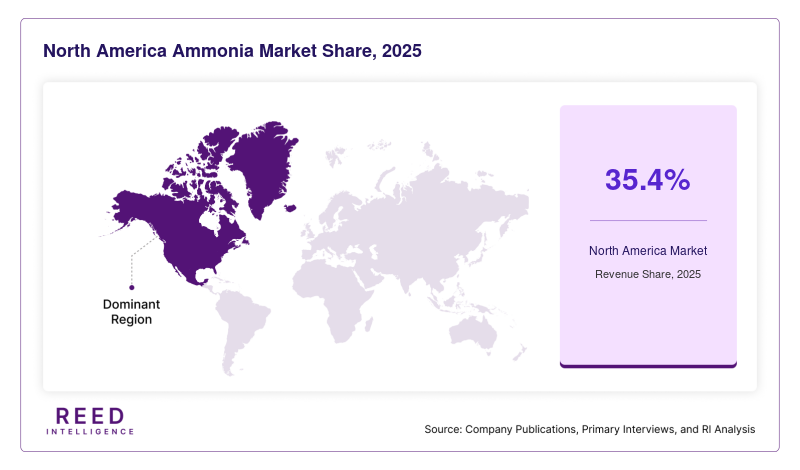
North America accounted for approximately 35.4% of the global ammonia market in 2025, making it the leading regional market. The region is projected to register a CAGR of 4.9% through 2034. Strong fertilizer demand, advanced production infrastructure, and abundant natural gas resources support market expansion. Investments in modern ammonia facilities and technological upgrades continue to improve production efficiency. The region also benefits from extensive distribution networks that facilitate reliable supply to agricultural and industrial customers.
The United States represents the dominant country within North America. A unique growth factor is the country's growing investment in clean hydrogen and low-carbon ammonia projects. Public and private sector funding has accelerated research into green ammonia technologies and carbon capture integration. Strong agricultural production, expanding energy initiatives, and robust industrial demand further contribute to the country's leading position in the regional market.
Europe
Europe captured approximately 24.6% of global market revenue in 2025 and is expected to expand at a CAGR of 5.2% during the forecast period. The region is characterized by stringent environmental regulations and a strong focus on sustainability. Manufacturers are increasingly investing in low-carbon production technologies to comply with emissions reduction targets. Demand from fertilizer producers and specialty chemical manufacturers continues to provide market stability across major European economies.
Germany remains the dominant country in the European ammonia market. A unique growth factor is the country's emphasis on industrial decarbonization and renewable energy integration. German companies are actively participating in green ammonia demonstration projects and hydrogen infrastructure development. Strong research capabilities and favorable policy support are encouraging innovation throughout the ammonia value chain, helping maintain market competitiveness.
Asia Pacific
Asia Pacific held around 22.8% of the ammonia market in 2025 and is forecast to grow at the fastest CAGR of 6.8% through 2034. Rising population levels, increasing food demand, and rapid industrialization are key contributors to regional growth. Fertilizer consumption remains particularly strong in agricultural economies where governments prioritize food security and farming productivity. Expanding manufacturing sectors are also supporting increased ammonia usage in chemical production.
China dominates the Asia Pacific market due to its large agricultural base and extensive chemical manufacturing sector. A unique growth factor is the country's ongoing modernization of fertilizer production facilities. Investments in efficient production technologies and environmental upgrades are enhancing capacity and operational performance. Continued industrial development and infrastructure expansion further strengthen ammonia demand across multiple application areas.
Middle East & Africa
The Middle East & Africa region accounted for approximately 9.1% of global market revenue in 2025 and is expected to grow at a CAGR of 5.8% over the forecast period. The region benefits from access to competitively priced natural gas resources, enabling cost-effective ammonia production. Several countries are expanding export-oriented production capacities to serve international fertilizer and industrial markets. These developments support increasing regional participation in global ammonia trade.
Saudi Arabia is the dominant country in the regional market. A unique growth factor is the country's strategic investment in large-scale green ammonia export projects. Energy diversification initiatives are encouraging collaboration between chemical producers and renewable energy developers. The growing focus on hydrogen exports and sustainable energy solutions is positioning Saudi Arabia as an emerging hub for future ammonia production and international supply.
Latin America
Latin America represented approximately 8.1% of the global ammonia market in 2025 and is anticipated to record a CAGR of 5.1% through 2034. Agricultural expansion remains the primary market driver across the region. Increasing cultivation of soybeans, corn, sugarcane, and other commercial crops continues to stimulate fertilizer demand. Governments and agribusiness organizations are investing in productivity improvement programs, creating favorable conditions for ammonia consumption growth.
Brazil leads the Latin American ammonia market. A unique growth factor is the country's expanding agribusiness sector and growing fertilizer requirements. Large-scale agricultural operations increasingly rely on nitrogen-based fertilizers to improve crop yields and export competitiveness. Continued investments in agricultural infrastructure, logistics networks, and farming technology are expected to support sustained ammonia demand over the forecast period.
Competitive Landscape
The ammonia market is moderately consolidated, with global participants competing through capacity expansion, operational efficiency improvements, sustainability initiatives, and strategic partnerships. Leading companies continue investing in production modernization and low-carbon ammonia technologies to strengthen market positioning. Increasing focus on renewable energy integration and carbon reduction targets is influencing competitive strategies across the industry.
Yara International remains a leading market participant due to its extensive global production footprint, fertilizer expertise, and investments in green ammonia projects. The company has continued expanding its low-carbon ammonia portfolio through collaborations involving renewable hydrogen and clean-energy infrastructure.
Other major participants including CF Industries, Nutrien, OCI Global, and SABIC are actively pursuing capacity upgrades and sustainability-focused investments. Competitive dynamics are increasingly shaped by access to affordable feedstocks, environmental compliance capabilities, and participation in emerging energy-related ammonia applications. Strategic alliances between chemical producers and energy developers are expected to become more common as the market evolves toward low-carbon production models.
Key Players
- Yara International
- CF Industries Holdings
- Nutrien Ltd.
- OCI Global
- SABIC
- BASF SE
- Koch Fertilizer
- Mitsubishi Chemical Group
- Qatar Fertiliser Company
- Togliattiazot
- EuroChem Group
- Acron Group
- Indian Farmers Fertiliser Cooperative Limited (IFFCO)
- Rashtriya Chemicals & Fertilizers Ltd.
- Saudi Arabian Mining Company
Recent Developments
- In 2025, leading ammonia producers expanded investments in green ammonia pilot plants powered by renewable hydrogen to accelerate low-carbon production capabilities and reduce dependency on fossil fuel-based feedstocks.
- In 2025, several global chemical companies announced strategic partnerships to develop large-scale ammonia cracking and hydrogen extraction facilities, supporting the growing ammonia-to-hydrogen energy value chain.
- In 2024, a major fertilizer manufacturer commissioned a new low-emission ammonia production unit integrated with carbon capture and utilization systems to reduce overall industrial carbon footprint.
- In 2024, multiple industry players increased R&D spending on advanced catalyst technologies aimed at improving ammonia synthesis efficiency and reducing energy consumption in production processes.
- In 2025, cross-border collaborations between energy firms and ammonia producers accelerated the development of ammonia-based fuel supply chains for maritime transportation and power generation applications.
Ammonia Market Segments
By Production Method
- Conventional Ammonia
- Blue Ammonia
- Green Ammonia
By Application
- Fertilizers
- Refrigeration
- Chemical Manufacturing
- Explosives
- Energy and Fuel Applications
- Others
By End-Use Industry
- Agriculture
- Chemical Industry
- Mining
- Energy
- Pharmaceuticals
- Others
By Region
- North America
- Europe
- APAC
- Middle East and Africa
- LATAM