Ammonium Bicarbonate Market Size, Share & Demand Report By Grade (Food Grade, Industrial Grade), By Application (Food Processing, Agriculture, Pharmaceuticals, Industrial Applications), By End-Use Industry (Food & Beverage, Agriculture, Chemicals, Pharmaceuticals) By Region & Segment Forecasts, 2026–2034
USD 3950
Market Overview
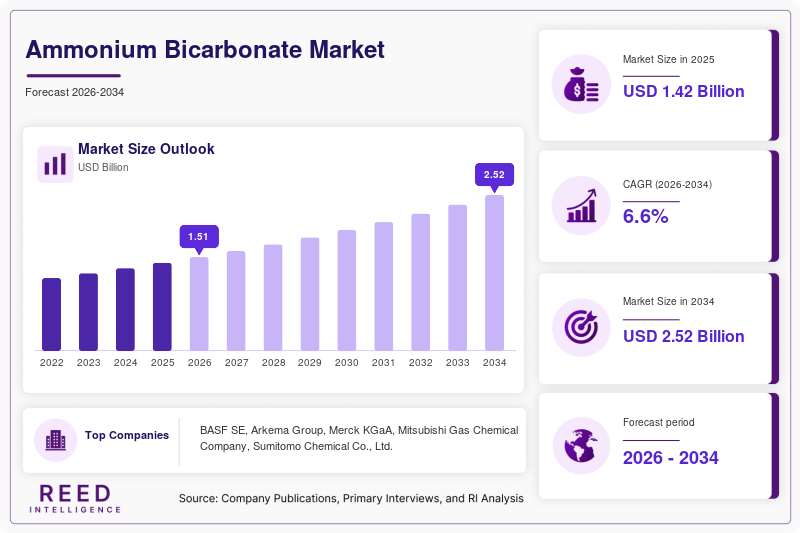
The Ammonium Bicarbonate Market was valued at approximately USD 1.42 billion in 2026 and is projected to reach USD 2.36 billion by 2034, expanding at a CAGR of 6.6% during 2026–2034. The market growth is largely supported by increasing demand from the food processing industry, particularly in bakery applications where ammonium bicarbonate is widely used as a leavening agent. Its cost-effectiveness and compatibility with low-moisture baked goods continue to sustain its global demand.
A key global factor driving the market is the steady expansion of the packaged and processed food sector. Rising urbanization, changing dietary habits, and growing consumption of ready-to-eat products have boosted the need for efficient and affordable food additives. Ammonium bicarbonate is preferred in certain formulations due to its ability to release carbon dioxide and ammonia during heating, making it suitable for biscuits, crackers, and cookies.
Key Highlights
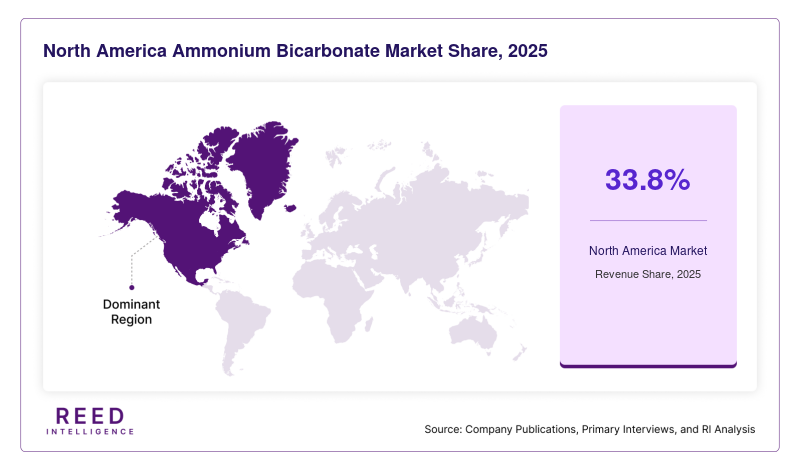
- North America dominated the market with a 33.8% share in 2025.
- Asia Pacific is expected to grow at the fastest CAGR of 7.4% during 2026–2034.
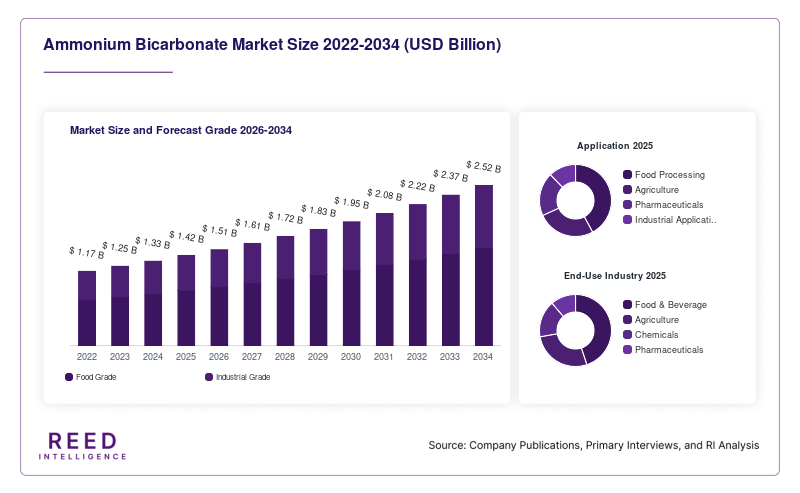
- By grade, food grade ammonium bicarbonate accounted for the largest share of 42.6%, while industrial grade is projected to grow at a CAGR of 7.1%.
- By application, food processing led with a 39.8% share, whereas agriculture is expected to expand at a CAGR of 7.3%.
- China remained the dominant country, with market values of USD 310 million in 2024 and USD 340 million in 2025.
Market Trends
Rising Demand for Clean-Label and Cost-Efficient Food Ingredients
The growing preference for clean-label and minimally processed food products is shaping the demand for ammonium bicarbonate in bakery and confectionery segments. Manufacturers are focusing on reducing complex chemical additives while maintaining product quality and cost efficiency. Ammonium bicarbonate fits this requirement due to its simple chemical composition and established use in traditional recipes. In developing regions, small and medium-scale food manufacturers prefer this compound due to its affordability compared to alternative leavening agents. Additionally, consumers are increasingly inclined toward products with familiar ingredients, encouraging producers to retain ammonium bicarbonate in formulations where it performs effectively without leaving residues in low-moisture products.
Expansion of Agricultural Applications in Emerging Markets
Another significant trend is the increasing use of ammonium bicarbonate as a nitrogen fertilizer in agriculture, especially in Asia Pacific and Latin America. Farmers are adopting cost-effective fertilizers to improve crop yields amid rising food demand. Ammonium bicarbonate offers a quick-release nitrogen source, making it suitable for certain crops and soil conditions. Governments in developing countries are promoting fertilizer accessibility and affordability, which supports the demand for such compounds. Furthermore, ongoing advancements in fertilizer formulations and blending techniques are enabling better efficiency and reduced environmental impact, thereby sustaining the role of ammonium bicarbonate in modern agricultural practices.
Market Drivers
Growth of the Global Bakery and Processed Food Industry
The expansion of the global bakery and processed food industry is a primary driver of the ammonium bicarbonate market. Increasing consumption of baked goods such as biscuits, crackers, and cookies has created consistent demand for effective leavening agents. Ammonium bicarbonate is particularly suitable for products that require a crisp texture and low moisture content. Rapid urbanization, rising disposable incomes, and changing lifestyles have led to higher consumption of convenience foods worldwide. Food manufacturers are also scaling production capacities to meet growing demand, further supporting the consumption of ammonium bicarbonate. Its cost advantage compared to alternative agents like baking powder enhances its attractiveness for large-scale production.
Increasing Use in Fertilizer and Agrochemical Applications
The rising need for improved agricultural productivity is another major growth driver. Ammonium bicarbonate serves as a nitrogen-rich fertilizer that can enhance soil fertility and crop yield. In regions with limited access to advanced fertilizers, it offers a cost-effective solution for farmers. Governments and agricultural organizations are promoting fertilizer usage to ensure food security, particularly in developing economies. Additionally, the integration of ammonium bicarbonate in compound fertilizers and its compatibility with various crops contribute to its growing demand. The increasing focus on sustainable farming practices is also encouraging the use of efficient nitrogen sources, further boosting market growth.
Market Restraint
Volatility in Raw Material Supply and Environmental Concerns
One of the key restraints affecting the ammonium bicarbonate market is the volatility in raw material supply and increasing environmental concerns. The production of ammonium bicarbonate relies on ammonia and carbon dioxide, both of which are subject to price fluctuations due to changes in energy markets and industrial demand. This volatility impacts production costs and profit margins for manufacturers. Additionally, environmental concerns related to ammonia emissions and nitrogen runoff are gaining attention globally. Improper use of ammonium bicarbonate in agriculture can lead to soil degradation and water pollution, prompting stricter regulations.
Regulatory bodies in several regions are implementing guidelines to control nitrogen-based fertilizers, which may limit market growth. For example, restrictions on excessive fertilizer use in Europe have led to a shift toward alternative solutions with lower environmental impact. These regulatory pressures increase compliance costs for manufacturers and may reduce demand in certain applications. Furthermore, the availability of substitute products such as urea and ammonium sulfate poses competition, particularly in agriculture. As a result, market participants must invest in sustainable production methods and improved formulations to mitigate environmental concerns and maintain competitiveness.
Market Opportunities
Expansion in Emerging Economies
Emerging economies present significant growth opportunities for the ammonium bicarbonate market. Rapid industrialization, population growth, and increasing food demand in regions such as Asia Pacific, Latin America, and Africa are driving the need for both food additives and fertilizers. Governments in these regions are investing in agricultural development and food processing infrastructure, creating a favorable environment for market expansion. Small-scale manufacturers and farmers often prefer cost-effective solutions, making ammonium bicarbonate an attractive option. Additionally, improvements in distribution networks and supply chains are enhancing product accessibility in rural areas, further boosting demand.
Technological Advancements in Production and Applications
Advancements in production technologies and application methods offer new opportunities for market growth. Manufacturers are focusing on improving process efficiency, reducing emissions, and enhancing product quality. Innovations in fertilizer formulations, such as controlled-release variants, are increasing the effectiveness of ammonium bicarbonate while minimizing environmental impact. In the food industry, research into optimized formulations is enabling better performance and broader application in various baked goods. These technological developments not only enhance product value but also help companies comply with regulatory standards. As a result, continuous innovation is expected to create new avenues for growth across multiple industries.
Segmental Analysis
By Grade
Food grade ammonium bicarbonate dominated the market, accounting for approximately 42.6% share in 2024. Its widespread use in bakery products such as biscuits, crackers, and cookies contributes to its leading position. The compound’s ability to produce a light and crisp texture without leaving residues makes it suitable for low-moisture applications. Additionally, the growing demand for processed and packaged foods supports the consumption of food-grade ammonium bicarbonate. Manufacturers prefer this grade due to its consistent performance and cost efficiency. The increasing popularity of convenience foods and snacks further strengthens its market position.
Industrial grade ammonium bicarbonate is expected to be the fastest-growing subsegment, with a CAGR of 7.1% during the forecast period. Its applications in industries such as textiles, chemicals, and pharmaceuticals are expanding. A key growth factor is the increasing use of ammonium bicarbonate in chemical synthesis and industrial processes. Additionally, the rising demand for cost-effective raw materials in manufacturing is driving its adoption. The development of advanced production techniques is also enhancing product quality and expanding its application scope.
By Application
The food processing segment held the largest share of approximately 39.8% in 2024, driven by the extensive use of ammonium bicarbonate as a leavening agent. The growing consumption of baked goods and convenience foods is a major factor supporting this segment. The compound’s ability to decompose completely during baking makes it suitable for specific applications where residue-free results are required. Additionally, the expansion of the global food industry and increasing product innovations contribute to segment growth.
The agriculture segment is projected to grow at the fastest CAGR of 7.3% during 2026–2034. The increasing demand for fertilizers to enhance crop yield is a key growth factor. Ammonium bicarbonate provides a cost-effective source of nitrogen, making it suitable for use in developing regions. Government initiatives aimed at improving agricultural productivity and food security are also driving demand. Furthermore, advancements in fertilizer formulations are improving efficiency and reducing environmental impact, supporting the growth of this segment.
By End-Use Industry
The food and beverage industry dominated the market, accounting for approximately 44.1% share in 2024. The extensive use of ammonium bicarbonate in bakery products and processed foods drives its demand in this segment. The growing preference for ready-to-eat products and snacks supports market growth. Additionally, the increasing number of food manufacturing facilities worldwide contributes to the rising consumption of ammonium bicarbonate. Its cost-effectiveness and functional properties make it a preferred choice for manufacturers.
The agriculture industry is expected to be the fastest-growing end-use segment, with a CAGR of 7.5% during the forecast period. The need to improve crop productivity and ensure food security is driving demand for fertilizers. Ammonium bicarbonate is widely used due to its affordability and effectiveness as a nitrogen source. The expansion of commercial farming and increasing adoption of modern agricultural practices are key growth factors. Additionally, government support and subsidies for fertilizers are encouraging their use, further boosting segment growth.
Regional Analysis
North America
North America accounted for approximately 33.8% of the global market share in 2025 and is expected to grow at a CAGR of 5.9% during the forecast period. The region benefits from a well-established food processing industry and advanced agricultural practices. The demand for ammonium bicarbonate remains stable due to its consistent use in bakery products and industrial applications. Additionally, the presence of major food manufacturers supports steady consumption.
The United States dominates the regional market, driven by its large-scale food production and advanced distribution networks. A key growth factor is the increasing demand for packaged and convenience foods, which continues to drive the use of leavening agents. Furthermore, ongoing investments in sustainable agricultural practices are supporting the adoption of efficient fertilizers, including ammonium bicarbonate.
Europe
Europe held a 27.4% market share in 2025 and is projected to grow at a CAGR of 5.6% during 2026–2034. The region’s mature food industry and strong regulatory framework influence market dynamics. While demand remains steady, environmental regulations are shaping the adoption of nitrogen-based fertilizers, leading to cautious growth.
Germany is the leading country in the region, supported by its strong food manufacturing sector. A unique growth factor is the emphasis on sustainable and eco-friendly production methods. Companies are investing in cleaner technologies and alternative formulations to comply with regulations, which is gradually transforming the market landscape.
Asia Pacific
Asia Pacific accounted for 24.6% of the market share in 2025 and is expected to grow at the fastest CAGR of 7.4% during the forecast period. The region’s rapid urbanization, population growth, and expanding food industry are key factors driving demand. Increasing agricultural activities also contribute significantly to market growth.
China dominates the Asia Pacific market, driven by its large-scale agricultural sector and food processing industry. A major growth factor is government support for agricultural productivity and food security. Subsidies and initiatives aimed at improving fertilizer usage are boosting the adoption of ammonium bicarbonate across the country.
Middle East & Africa
The Middle East & Africa region held a 7.2% market share in 2025 and is expected to grow at a CAGR of 6.3% during 2026–2034. The region’s growing population and increasing demand for food are driving the need for agricultural inputs and food additives. However, market growth is influenced by economic variability and infrastructure challenges.
Saudi Arabia is a key market in the region, supported by investments in agricultural development. A unique growth factor is the focus on improving food security through enhanced farming practices. Government initiatives aimed at boosting local food production are encouraging the use of fertilizers, including ammonium bicarbonate.
Latin America
Latin America accounted for 7.0% of the market share in 2025 and is projected to grow at a CAGR of 6.5% during the forecast period. The region’s agricultural sector plays a significant role in market demand. Increasing exports of agricultural products are driving the need for efficient fertilizers.
Brazil dominates the regional market, driven by its extensive agricultural activities. A key growth factor is the expansion of commercial farming and export-oriented agriculture. Farmers are adopting cost-effective fertilizers to enhance crop yield, which supports the demand for ammonium bicarbonate.
Competitive Landscape
The ammonium bicarbonate market is moderately fragmented, with several regional and global players competing based on pricing, product quality, and distribution networks. Key companies are focusing on expanding their production capacities and enhancing product offerings to strengthen their market position. Strategic collaborations and technological advancements are common approaches adopted by market participants.
A leading player in the market is BASF SE, which maintains a strong presence through its extensive product portfolio and global distribution network. The company focuses on innovation and sustainability to meet evolving industry requirements. A recent development includes the expansion of its chemical production facilities to improve supply chain efficiency and meet rising demand. Other companies are also investing in research and development to enhance product performance and reduce environmental impact. The competitive landscape is expected to remain dynamic, with companies adopting strategies such as mergers, acquisitions, and partnerships to gain a competitive edge.
Key Players
- BASF SE
- Arkema Group
- Merck KGaA
- Mitsubishi Gas Chemical Company
- Sumitomo Chemical Co., Ltd.
- Gujarat State Fertilizers & Chemicals Ltd.
- Yara International ASA
- Shanxi Jinfeng Coal Chemical Co., Ltd.
- Shandong Haihua Group Co., Ltd.
- Haohua Junhua Group Co., Ltd.
- Shijiazhuang Fengshan Chemical Co., Ltd.
- Shandong Lianmeng Chemical Group
- Jiangsu Huachang Chemical Co., Ltd.
- Anhui Jinhe Industrial Co., Ltd.
- Sichuan Golden Elephant Chemical Co., Ltd.
Recent Developments
- In 2025, BASF SE expanded its production capacity for ammonium-based chemicals to meet increasing demand from the food and agriculture sectors.
- In 2024, Yara International ASA introduced improved fertilizer blends incorporating ammonium bicarbonate to enhance nitrogen efficiency.
- In 2025, Gujarat State Fertilizers & Chemicals Ltd. invested in upgrading its manufacturing facilities to improve product quality and reduce environmental impact.
Ammonium Bicarbonate Market Segments
Grade
- Food Grade
- Industrial Grade
Application
- Food Processing
- Agriculture
- Pharmaceuticals
- Industrial Applications
End-Use Industry
- Food & Beverage
- Agriculture
- Chemicals
- Pharmaceuticals
By Region
- North America
- Europe
- APAC
- Middle East and Africa
- LATAM