Ammonium Lauryl Sulphate Market Size, Share & Demand Report By Product Type (Liquid, Powder), By Application (Personal Care Products, Household Cleaning, Industrial Cleaning, Textile Processing, Others), By End-Use Industry (Cosmetics and Toiletries, Household Care, Institutional Cleaning, Industrial Manufacturing, Others) By Region & Segment Forecasts, 2026–2034
USD 3950
Market Overview
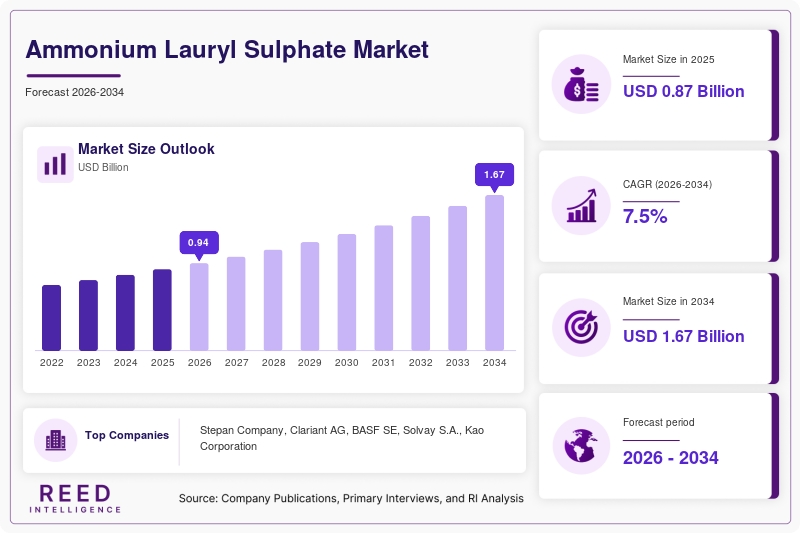
The global Ammonium Lauryl Sulphate Market size was valued at approximately USD 0.865 billion in 2026 and is projected to reach nearly USD 1.54 billion by 2034, expanding at a CAGR of 7.5% during the forecast period from 2026 to 2034. Rising demand for sulfate-based surfactants in personal care, industrial cleaning, and household formulations continues to support market expansion across developed and emerging economies. Ammonium lauryl sulphate is widely used as a foaming and cleansing agent in shampoos, liquid soaps, facial cleansers, and industrial detergents due to its cost efficiency and compatibility with multiple product formulations.
A major global factor supporting market growth is the rapid expansion of the personal hygiene and grooming industry. Increased consumer awareness regarding hygiene standards, growing urban populations, and rising spending on personal care products have accelerated the consumption of surfactants in daily-use formulations. Manufacturers are also investing in advanced sulfate processing technologies to improve product stability and reduce skin irritation concerns associated with cleansing agents. In addition, the growth of e-commerce platforms has improved the availability of personal care and cleaning products in both urban and semi-urban regions, positively influencing product demand.
Key Highlights
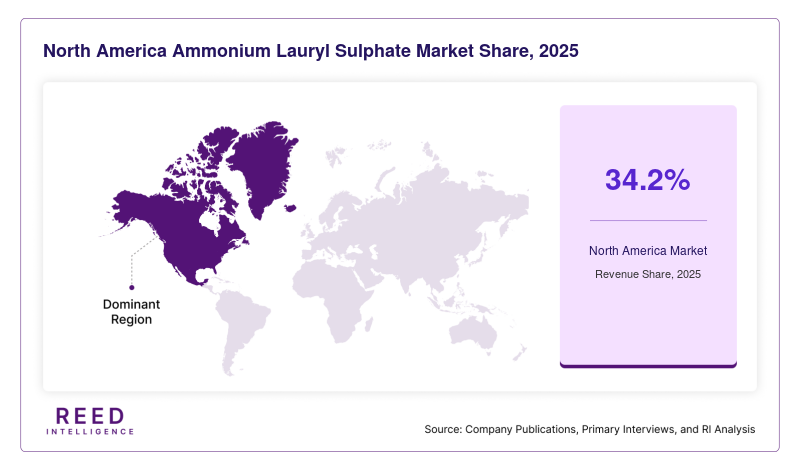
- North America dominated the market with a 34.2% share in 2025, while Asia Pacific is expected to grow at the fastest CAGR of 9.8% during 2026–2034.
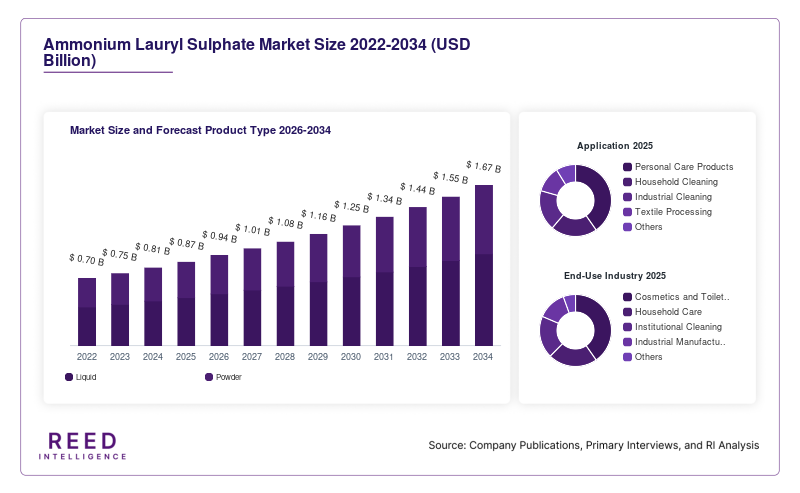
- By product type, liquid ammonium lauryl sulphate accounted for the largest share of 61.4%, while powder-based formulations are projected to grow at a CAGR of 8.7%.
- By application, personal care products led with a 46.8% share, whereas industrial cleaning applications are expected to expand at a CAGR of 8.9%.
- By end-use, cosmetics and toiletries accounted for the highest market share of 49.3%, while institutional cleaning is anticipated to witness a CAGR of 8.5% through 2034.
- The United States remained the dominant country, with market values of USD 238 million in 2024 and USD 256 million in 2025.
Market Trends
Expansion of Sulfate-Based Ingredients in Premium Personal Care Formulations
The use of ammonium lauryl sulphate in premium personal care products has increased steadily as manufacturers focus on creating formulations with improved cleansing efficiency and foam stability. Shampoos, facial cleansers, and body washes continue to incorporate ammonium lauryl sulphate due to its strong emulsifying properties and ability to produce dense foam textures preferred by consumers. Brands are increasingly blending sulfate compounds with conditioning ingredients and botanical extracts to reduce dryness while maintaining cleansing performance. This trend is particularly visible in urban consumer markets where buyers seek multifunctional grooming products with enhanced sensory appeal. Product innovation involving balanced sulfate concentrations and skin-compatible additives is expected to support long-term market growth.
Increasing Demand for High-Performance Industrial Cleaning Agents
Industrial and institutional cleaning applications are witnessing growing adoption of ammonium lauryl sulphate owing to stricter sanitation requirements across healthcare, hospitality, and manufacturing facilities. The ingredient is widely utilized in floor cleaners, degreasers, liquid detergents, and surface disinfectant formulations due to its strong surfactant behavior. Industrial cleaning product manufacturers are prioritizing cost-effective raw materials that provide stable foaming and dirt-removal efficiency under varying water conditions. Growth in food processing industries and commercial laundry services has also strengthened demand for effective cleansing ingredients. In addition, the increasing emphasis on workplace hygiene standards after recent global health concerns continues to support higher consumption of industrial-grade surfactants.
Market Drivers
Rising Consumption of Hair Care and Skin Cleansing Products
Growing demand for shampoos, body washes, and liquid cleansers is one of the major factors accelerating the expansion of the Ammonium Lauryl Sulphate Market. Consumers across both developed and developing economies are increasing spending on daily hygiene products due to changing lifestyles, urbanization, and rising disposable income levels. Ammonium lauryl sulphate remains a preferred surfactant because it delivers effective cleansing and foam generation at comparatively lower formulation costs. Cosmetic manufacturers are continuously launching new hair care and skincare products targeting different consumer groups, including children, men, and sensitive-skin users. The expansion of organized retail channels and online beauty platforms has further improved product accessibility, strengthening long-term demand for sulfate-based ingredients.
Growth in Household and Institutional Cleaning Applications
The expanding household cleaning sector is significantly contributing to market growth as consumers prioritize hygiene and sanitation in residential and commercial spaces. Ammonium lauryl sulphate is widely incorporated into dishwashing liquids, floor cleaners, laundry detergents, and multipurpose cleaning solutions because of its grease-removal and foaming capabilities. Commercial facilities such as hotels, hospitals, restaurants, and educational institutions are increasing purchases of cleaning formulations to comply with sanitation regulations. The growing number of healthcare establishments and food service outlets in emerging economies has also increased demand for industrial cleaning agents. Furthermore, manufacturers are developing concentrated liquid cleaning products that improve transportation efficiency and reduce packaging costs, thereby enhancing market adoption.
Market Restraint
Rising Preference for Sulfate-Free Formulations in Premium Consumer Segments
One of the key restraints affecting the Ammonium Lauryl Sulphate Market is the increasing consumer preference for sulfate-free personal care products. Many premium skincare and haircare brands are promoting sulfate-free formulations due to concerns regarding scalp dryness, skin irritation, and color fading in treated hair. This shift in consumer perception has encouraged cosmetic companies to explore alternative surfactants derived from amino acids, glucosides, and plant-based ingredients. As a result, several high-end beauty brands are gradually reducing dependence on conventional sulfate compounds in selected product categories.
The impact of this restraint is particularly visible in mature markets across North America and Europe, where consumers are highly aware of ingredient labels and product composition. Regulatory scrutiny regarding chemical ingredients in cosmetics has also encouraged manufacturers to invest in milder cleansing alternatives. For example, luxury shampoo brands increasingly market sulfate-free positioning as a value-added feature for sensitive skin users. Although ammonium lauryl sulphate remains cost-effective and highly functional, the growing popularity of naturally derived surfactants could limit market penetration in premium product categories over the forecast period.
Market Opportunities
Development of Mild and Biodegradable Sulfate Formulations
Manufacturers are increasingly focusing on the development of biodegradable and low-irritation sulfate formulations, creating significant opportunities for market expansion. Advancements in surfactant processing technologies are enabling companies to reduce impurities and improve the skin compatibility of ammonium lauryl sulphate-based products. Personal care companies are also integrating moisturizing agents and natural extracts into sulfate-containing formulations to improve product acceptance among health-conscious consumers. These innovations are expected to help manufacturers retain the performance benefits of sulfate surfactants while addressing concerns related to harsh cleansing effects. Growing regulatory support for environmentally safer chemical formulations is further expected to encourage investment in sustainable production technologies across the market.
Rapid Expansion of Emerging Consumer Markets
Emerging economies in Asia Pacific, Latin America, and the Middle East are presenting favorable growth opportunities for the Ammonium Lauryl Sulphate Market due to rising urban populations and increasing expenditure on personal hygiene products. Expanding middle-class demographics and improving retail infrastructure are encouraging multinational cosmetic and detergent companies to strengthen their regional presence. Demand for affordable cleansing products remains high in these markets, making ammonium lauryl sulphate an attractive ingredient because of its low formulation cost and broad application scope. In addition, local manufacturers are increasing production capacities to cater to growing domestic demand for shampoos, detergents, and industrial cleaning products, creating new revenue opportunities for raw material suppliers.
Segmental Analysis
By Product Type
Liquid ammonium lauryl sulphate represented the dominant subsegment in 2024, accounting for approximately 61.4% of the global market share. The widespread adoption of liquid formulations is primarily linked to their ease of handling, blending efficiency, and compatibility with personal care and detergent manufacturing processes. Liquid variants are extensively used in shampoos, body washes, dishwashing liquids, and industrial cleaning products because they provide stable viscosity and effective foaming characteristics. Manufacturers prefer liquid formulations due to lower processing complexity and improved storage efficiency in bulk production environments. In addition, the increasing use of automated liquid mixing systems in large-scale manufacturing facilities continues to strengthen the market position of liquid ammonium lauryl sulphate products across multiple end-use industries.
Powder-based ammonium lauryl sulphate formulations are expected to register the fastest CAGR of 8.7% during the forecast period. Rising adoption of powdered cleaning products and compact detergent solutions is supporting segment growth across commercial and industrial sectors. Powder formulations offer advantages such as longer shelf life, reduced transportation costs, and easier storage compared to liquid variants. Industrial cleaning manufacturers are increasingly utilizing powdered surfactants in institutional cleaning products designed for hospitality, healthcare, and food processing applications. Furthermore, growing interest in water-saving concentrated products is encouraging detergent manufacturers to explore dry surfactant technologies. Expanding demand for lightweight raw materials in export-oriented manufacturing operations is also expected to contribute significantly to the growth of the powder-based segment.
By Application
Personal care products emerged as the dominant application segment in 2024, accounting for nearly 46.8% of total market revenue. Ammonium lauryl sulphate is widely utilized in shampoos, face cleansers, body washes, bubble baths, and liquid hand soaps due to its strong cleansing and foaming properties. Consumer preference for richly foaming products continues to influence formulation strategies across global cosmetic brands. The expansion of skincare and haircare product lines targeting diverse consumer groups has also increased the use of sulfate-based surfactants in formulation development. In addition, rising demand for multifunctional personal care products with cleansing and conditioning benefits is encouraging manufacturers to incorporate balanced sulfate concentrations into premium and mass-market product portfolios.
Industrial cleaning applications are projected to witness the fastest growth, expanding at a CAGR of 8.9% during the forecast period. Growth in manufacturing, healthcare, hospitality, and food processing industries is increasing demand for effective industrial cleaning solutions. Ammonium lauryl sulphate is increasingly used in floor cleaners, degreasers, heavy-duty detergents, and sanitation products because of its grease-removal efficiency and stable foam performance. Industrial users are prioritizing high-performance cleaning formulations capable of operating effectively under varying temperature and water conditions. Furthermore, stricter workplace hygiene regulations and increased cleaning frequency in commercial facilities are accelerating the adoption of surfactant-based industrial cleaning products. This trend is expected to create sustained growth opportunities for suppliers of industrial-grade ammonium lauryl sulphate.
By End-Use Industry
Cosmetics and toiletries represented the leading end-use industry in 2024, holding approximately 49.3% of the global market share. The dominance of this segment is attributed to increasing consumer demand for personal grooming products and expanding product diversification strategies among cosmetic manufacturers. Ammonium lauryl sulphate continues to be a preferred ingredient in shampoos, facial cleansers, liquid soaps, and shower gels because it offers effective cleansing at relatively low production costs. Rapid urbanization, rising disposable incomes, and growing beauty awareness are encouraging higher spending on personal care products worldwide. In addition, international cosmetic companies are increasing investments in emerging markets to expand their consumer base, which is further strengthening demand for sulfate-based surfactants used in toiletries and skincare formulations.
Institutional cleaning is expected to emerge as the fastest-growing end-use segment, registering a CAGR of 8.5% during the forecast period. Hospitals, hotels, educational institutions, and commercial office spaces are increasing procurement of cleaning chemicals to maintain sanitation standards and improve operational safety. Ammonium lauryl sulphate is commonly incorporated into institutional cleaners because of its strong foaming, emulsifying, and grease-removal characteristics. The growing emphasis on public hygiene and infection prevention is accelerating the use of industrial cleaning agents in high-traffic facilities. Furthermore, expansion in commercial infrastructure projects across emerging economies is creating additional demand for professional cleaning products, supporting long-term growth opportunities for surfactant manufacturers operating in the institutional cleaning sector.
Regional Analysis
North America
North America accounted for approximately 34.2% of the global Ammonium Lauryl Sulphate Market share in 2025 and continues to maintain a strong industry position due to high consumption of personal care and institutional cleaning products. The region is projected to grow at a CAGR of 6.8% during the forecast period as established cosmetic and detergent manufacturers continue investing in product innovation and sustainable surfactant technologies. Rising demand for premium shampoos, liquid cleansers, and multifunctional hygiene products remains a major contributor to market stability across the United States and Canada.
The United States dominates the North American market owing to the strong presence of personal care product manufacturers and high consumer spending on hygiene products. One unique growth factor supporting regional expansion is the rapid adoption of concentrated liquid cleaning formulations in commercial and institutional sectors. Companies operating in healthcare and hospitality industries are increasingly purchasing high-performance cleaning products that utilize ammonium lauryl sulphate due to its strong emulsifying and foaming capabilities, thereby supporting long-term demand across industrial applications.
Europe
Europe held a significant share of the Ammonium Lauryl Sulphate Market in 2025 due to strong demand for cosmetic formulations and household cleaning agents. The regional market is expected to expand at a CAGR of 6.5% through 2034, supported by stable consumption patterns and rising demand for sustainable surfactant ingredients. Consumers across Germany, France, Italy, and the United Kingdom continue to purchase premium personal care products with advanced cleansing properties. In addition, the region benefits from established chemical manufacturing infrastructure and high investments in product quality enhancement.
Germany represents the dominant country within the European market because of its strong industrial chemical sector and advanced cosmetic manufacturing capabilities. A unique growth factor influencing the regional market is the increasing integration of eco-friendly packaging and biodegradable formulations in personal care products. European cosmetic brands are investing in environmentally responsible product development to align with regional sustainability regulations. This transition is encouraging manufacturers to improve the environmental profile of ammonium lauryl sulphate-based ingredients while maintaining cleansing efficiency and formulation stability.
Asia Pacific
Asia Pacific is projected to witness the fastest growth in the Ammonium Lauryl Sulphate Market, expanding at a CAGR of 9.8% during 2026–2034. The region accounted for nearly 28.5% of global market revenue in 2025 and continues to experience strong expansion due to rapid urbanization and increasing demand for affordable hygiene products. Rising disposable income levels and expanding middle-class populations in countries such as China, India, Indonesia, and Vietnam are significantly contributing to the growth of personal care and detergent industries. Growing e-commerce penetration is also improving product availability across urban and rural markets.
China dominates the Asia Pacific market due to its large-scale chemical manufacturing base and strong domestic demand for cleaning and cosmetic products. One unique factor driving market expansion is the rapid growth of regional private-label personal care brands offering cost-effective products to mass consumers. Local manufacturers are increasing production capacities for shampoos, facial cleansers, and household detergents to meet rising domestic and export demand. Government support for industrial development and improving retail infrastructure further support sustained regional market growth.
Middle East & Africa
The Middle East & Africa region is experiencing moderate but steady growth in the Ammonium Lauryl Sulphate Market, supported by expanding urban populations and rising awareness regarding hygiene products. The region accounted for approximately 7.4% of global market revenue in 2025 and is expected to grow at a CAGR of 7.1% over the forecast period. Demand for household cleaning products and liquid detergents is increasing steadily in major urban centers. Growth in hospitality, healthcare, and commercial infrastructure projects is also contributing to higher consumption of industrial cleaning formulations across the region.
Saudi Arabia remains the dominant country in the regional market due to its expanding retail sector and increasing consumption of imported and locally manufactured personal care products. A unique growth factor supporting the market is the rising investment in tourism and hospitality infrastructure, which has increased demand for institutional cleaning solutions. Hotels, shopping malls, and healthcare facilities are increasing procurement of surface cleaners and liquid detergents containing sulfate-based surfactants to maintain sanitation standards and operational efficiency.
Latin America
Latin America accounted for a moderate share of the global Ammonium Lauryl Sulphate Market in 2025 and is expected to grow at a CAGR of 7.3% during the forecast period. Increasing consumer awareness regarding personal hygiene and growing adoption of liquid cleaning products are supporting market expansion across the region. Countries including Brazil, Mexico, and Argentina are witnessing higher demand for shampoos, liquid soaps, and household detergents. Regional manufacturers are also expanding product portfolios to meet changing consumer preferences for affordable and effective cleansing formulations.
Brazil dominates the Latin American market because of its large cosmetics industry and expanding household cleaning sector. A unique factor contributing to regional growth is the increasing penetration of direct-to-consumer beauty and hygiene brands through online retail channels. Local companies are leveraging digital platforms to introduce affordable personal care products targeting younger consumers. This trend is increasing production demand for sulfate-based surfactants used in mass-market shampoos, facial cleansers, and liquid soaps throughout the region.
Competitive Landscape
The Ammonium Lauryl Sulphate Market is moderately fragmented, with multinational chemical companies and regional surfactant manufacturers competing through pricing strategies, product innovation, and supply chain expansion. Leading market participants are investing in advanced production technologies to improve formulation quality and enhance environmental compliance. Companies are also focusing on developing mild sulfate solutions and biodegradable surfactant blends to address changing consumer preferences in personal care applications.
Stepan Company remains one of the leading players in the market due to its extensive surfactant product portfolio and global manufacturing presence. The company recently expanded its specialty surfactant production capacity to support growing demand from personal care and industrial cleaning sectors. Other major companies are strengthening partnerships with cosmetic manufacturers and detergent producers to secure long-term supply agreements. Strategic investments in Asia Pacific and Latin America are becoming increasingly common as companies target high-growth consumer markets. Product customization, improved raw material sourcing, and regulatory compliance remain important competitive factors influencing industry dynamics.
Key Players
- Stepan Company
- Clariant AG
- BASF SE
- Solvay S.A.
- Kao Corporation
- Galaxy Surfactants Ltd.
- Evonik Industries AG
- Huntsman Corporation
- Croda International Plc
- Pilot Chemical Company
- Oxiteno S.A.
- Taiwan NJC Corporation
- Innospec Inc.
- Godrej Industries Limited
- Lubrizol Corporation
Recent Developments
- Stepan Company announced an expansion of its surfactant manufacturing facility in North America to support increasing demand from personal care product manufacturers.
- Galaxy Surfactants Ltd. introduced a new mild sulfate formulation designed for sensitive skin and baby care applications in Asia Pacific markets.
- BASF SE expanded its sustainable surfactant portfolio by integrating biodegradable processing technologies into selected sulfate production operations for cosmetic applications.
Ammonium Lauryl Sulphate Market Segments
Product Type
- Liquid
- Powder
Application
- Personal Care Products
- Household Cleaning
- Industrial Cleaning
- Textile Processing
- Others
End-Use Industry
- Cosmetics and Toiletries
- Household Care
- Institutional Cleaning
- Industrial Manufacturing
- Others
By Region
- North America
- Europe
- APAC
- Middle East and Africa
- LATAM