Ammonium Phosphatide Market Size, Share Demand Report By Type (Liquid Ammonium Phosphatide), By Application (Food Processing, Animal Feed), By Source (Soy-Based, Sunflower-Based, Other Plant Sources), By End-Use Industry (Food & Beverage, Agriculture & Feed), By Distribution Channel (Direct Sales, Distributors & Wholesalers), By Region & Segment Forecasts, 2025–2034
USD 3950
Market Overview
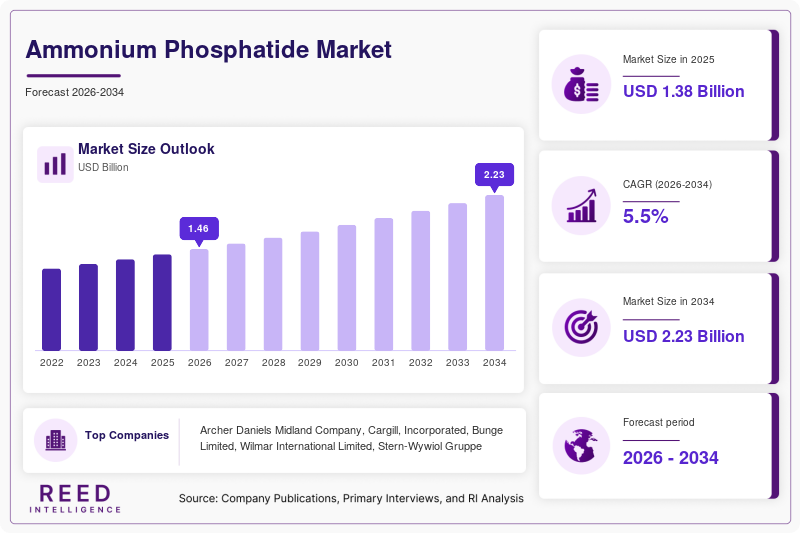
The global Ammonium Phosphatide Market size was valued at approximately USD 1.38 billion in 2025 and is projected to reach USD 2.24 billion by 2034, expanding at a CAGR of 5.5% during the forecast period (2025–2034). The market has experienced steady growth due to increasing demand for food-grade emulsifiers and stabilizing agents across processed food, animal feed, and industrial applications. Ammonium phosphatide, commonly derived from lecithin, is widely utilized for its superior emulsification, dispersion, and moisture-retention properties.
One of the key global factors supporting market growth is the rapid expansion of the processed food industry, driven by changing dietary patterns and rising urbanization. Food manufacturers are increasingly incorporating functional additives such as ammonium phosphatide to enhance product texture, shelf life, and consistency. Additionally, the growing emphasis on cost-effective emulsifiers compared to traditional alternatives has strengthened its adoption across multiple industries.
Key Highlights:
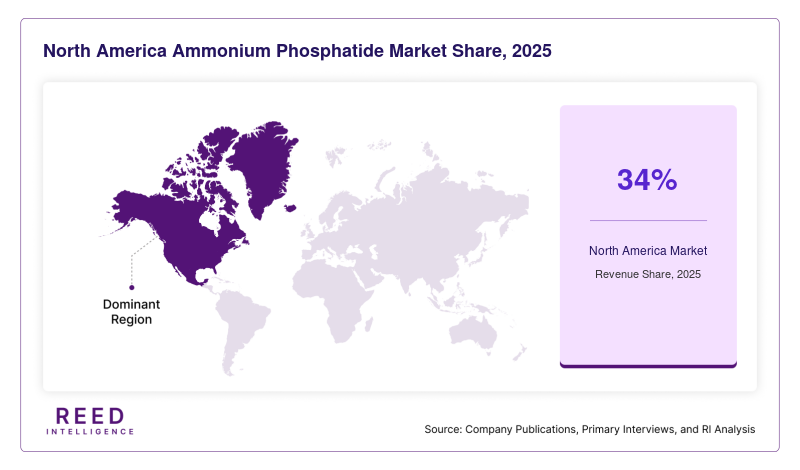
- North America dominated the market with a 34% share in 2025, while Asia Pacific is expected to register the fastest CAGR of 6.8% through 2034.
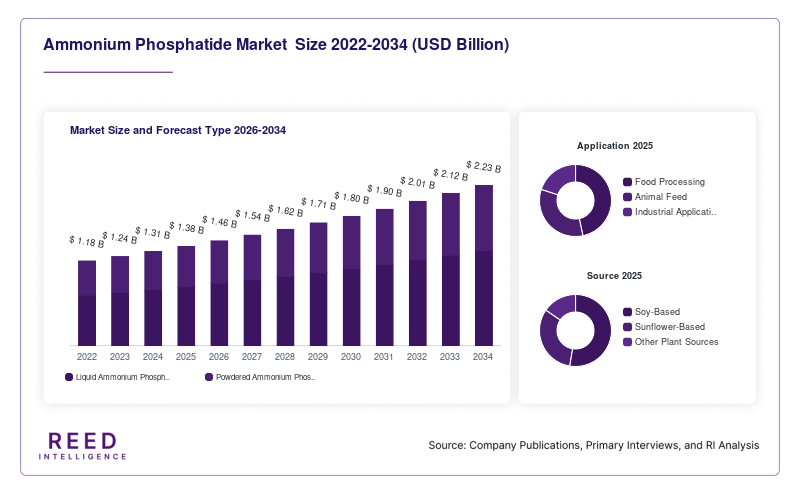
- By type, liquid ammonium phosphatide held the largest share, while powdered variants are projected to grow at a CAGR of 6.3%.
- By application, food processing was the leading segment, whereas animal feed is anticipated to grow at a CAGR of 6.6%.
- The United States remained the dominant country, with market values of USD 360 million in 2024 and USD 378 million in 2025.
Market Trends
Rising Adoption in Clean-Label Formulations
Manufacturers are increasingly focusing on clean-label products that use naturally derived ingredients. Ammonium phosphatide, being derived from plant-based lecithin sources, is gaining traction as a preferred emulsifier in bakery, confectionery, and dairy products. This trend is reshaping product formulations, encouraging manufacturers to replace synthetic emulsifiers with naturally sourced alternatives while maintaining product stability.
Expansion of Functional Feed Additives
The use of ammonium phosphatide in animal nutrition is expanding due to its ability to improve feed digestibility and nutrient absorption. Livestock producers are increasingly adopting advanced feed formulations to enhance productivity and animal health. As a result, ammonium phosphatide is being integrated into compound feed and premix formulations, particularly in poultry and aquaculture sectors. This trend is further supported by growing demand for high-quality protein sources and efficient feed conversion ratios.
Market Drivers
Growth of Processed and Convenience Food Industry
The global surge in demand for processed and ready-to-eat food products has significantly driven the Ammonium Phosphatide Market. Consumers are increasingly seeking convenient food options with longer shelf life and consistent quality. Ammonium phosphatide plays a critical role in maintaining texture, improving emulsification, and preventing ingredient separation. Its compatibility with a wide range of food formulations makes it a preferred additive for manufacturers aiming to optimize production efficiency and product quality.
Cost Efficiency Compared to Alternative Emulsifiers
Ammonium phosphatide offers a cost-effective solution compared to traditional emulsifiers such as mono- and diglycerides. Its lower production cost and efficient performance enable manufacturers to reduce overall formulation expenses without compromising functionality. This economic advantage is particularly important for large-scale food and feed producers operating under tight cost constraints. The increasing focus on optimizing production costs is expected to continue driving adoption across various industries.
Market Restraint
Regulatory and Quality Compliance Challenges
The Ammonium Phosphatide Market faces challenges related to stringent regulatory standards and quality compliance requirements across different regions. Food safety authorities impose strict guidelines regarding the use of additives, including purity levels, labeling requirements, and permissible limits. These regulations can vary significantly across countries, creating complexities for manufacturers operating in multiple markets.
Additionally, concerns related to the sourcing and processing of raw materials can impact product acceptance, particularly in regions emphasizing organic and non-GMO ingredients. Manufacturers are required to invest in quality assurance, certification, and compliance processes, which can increase operational costs. Smaller players may find it difficult to meet these requirements, limiting their market participation.
Market Opportunities
Growing Demand in Emerging Economies
Emerging economies present significant growth opportunities for the Ammonium Phosphatide Market due to rising disposable incomes, urbanization, and expanding food processing industries. Countries in Asia Pacific and Latin America are witnessing increased consumption of packaged foods, driving demand for functional additives. Manufacturers can capitalize on this trend by expanding production capacities and establishing regional distribution networks.
Innovation in Industrial Applications
Beyond food and feed, ammonium phosphatide is gaining attention in industrial applications such as coatings, lubricants, and agrochemicals. Its emulsifying and dispersing properties make it suitable for improving product stability and performance in these sectors. Ongoing research and development efforts are expected to unlock new applications, providing additional revenue streams for market participants. This diversification into non-food applications is likely to strengthen the long-term growth outlook.
Segmental Analysis
By Type
Liquid ammonium phosphatide accounted for the largest share of 62% in 2024, driven by its ease of handling and superior dispersion properties. It has been widely used in food processing applications where uniform mixing and consistency are essential.
Powdered ammonium phosphatide is expected to grow at a CAGR of 6.3% through 2034. Its longer shelf life and convenience in storage and transportation will drive its adoption, particularly in regions with limited cold storage infrastructure. The ability to maintain stability in dry formulations will further support its growth.
By Application
Food processing dominated the market with a 48% share in 2024, supported by widespread use in bakery, confectionery, and dairy products. Ammonium phosphatide has been essential in improving texture and extending shelf life.
Animal feed is projected to grow at a CAGR of 6.6% during the forecast period. Increasing focus on improving feed efficiency and livestock productivity will drive demand. Its role in enhancing nutrient absorption will be a key growth factor.
By Source
Soy-based ammonium phosphatide held the largest share of 55% in 2024 due to its widespread availability and cost-effectiveness. It has been extensively used in both food and feed applications.
Sunflower-based variants are expected to grow at a CAGR of 6.1% through 2034. Rising demand for non-GMO and allergen-free ingredients will support this segment’s expansion, particularly in premium food products.
By End-Use Industry
The food and beverage industry accounted for the largest share of 52% in 2024, driven by consistent demand for emulsifiers and stabilizers. Manufacturers have relied on ammonium phosphatide to improve product quality and processing efficiency.
The industrial sector is expected to grow at a CAGR of 5.9% through 2034. Expanding applications in coatings, lubricants, and agrochemicals will contribute to this growth. Its functional properties in enhancing product stability will be a key driver.
Regional Analysis
North America
North America accounted for 34% of the Ammonium Phosphatide Market share in 2025 and is expected to grow at a CAGR of 4.8% through 2034. The region has been characterized by a mature food processing industry and high adoption of functional food ingredients. Demand has remained stable due to consistent consumption patterns and advanced manufacturing capabilities.
The United States dominated the regional market, supported by strong demand for processed food products and well-established supply chains. The country’s focus on product innovation and efficient manufacturing practices has contributed to sustained growth. Additionally, the presence of large-scale food manufacturers has ensured steady demand for emulsifiers.
Europe
Europe held a 27% market share in 2025 and is projected to grow at a CAGR of 4.6% during the forecast period. The region has demonstrated steady demand for food additives, driven by established food industries and evolving consumer preferences.
Germany emerged as the dominant country, driven by its strong industrial base and advanced food processing sector. The country’s emphasis on quality standards and technological innovation has supported the adoption of ammonium phosphatide in various applications. Additionally, increasing demand for sustainable and efficient ingredients has influenced market growth.
Asia Pacific
Asia Pacific represented 22% of the market share in 2025 and is expected to register the fastest CAGR of 6.8% through 2034. The region has experienced rapid industrialization and urbanization, leading to increased demand for processed food and feed products.
China dominated the regional market due to its large population and expanding food manufacturing sector. The country’s growing middle class and changing dietary habits have driven demand for convenience foods, boosting the adoption of emulsifiers. Additionally, the expansion of the livestock industry has supported demand in feed applications.
Middle East & Africa
The Middle East & Africa accounted for 9% of the market share in 2025 and is anticipated to grow at a CAGR of 5.2% during the forecast period. The region has shown gradual growth due to increasing investments in food processing and agricultural sectors.
Saudi Arabia emerged as the dominant country, supported by government initiatives to enhance food security and develop local manufacturing capabilities. The country’s focus on diversifying its economy has led to increased investments in food production and processing, driving demand for functional additives.
Latin America
Latin America held an 8% share in 2025 and is expected to grow at a CAGR of 5.6% through 2034. The region has witnessed rising demand for processed food products, supported by urbanization and changing consumer lifestyles.
Brazil dominated the market due to its large agricultural base and growing food processing industry. The country’s strong export-oriented food sector has driven the adoption of emulsifiers to maintain product quality and consistency. Additionally, increasing investments in food manufacturing have supported market expansion.
Competitive Landscape
The Ammonium Phosphatide Market is moderately fragmented, with several global and regional players competing based on product quality, pricing, and distribution networks. Leading companies are focusing on expanding their product portfolios and investing in research and development to enhance functionality and application scope.
Archer Daniels Midland Company has emerged as a market leader, leveraging its strong raw material sourcing capabilities and extensive global presence. The company recently introduced improved emulsifier formulations aimed at enhancing performance in food applications.
Other key players are actively pursuing strategic partnerships, capacity expansions, and product innovations to strengthen their market position. The competitive environment is characterized by continuous innovation and efforts to meet evolving customer requirements.
Key Players
- Archer Daniels Midland Company
- Cargill, Incorporated
- Bunge Limited
- Wilmar International Limited
- Stern-Wywiol Gruppe
- Lipoid GmbH
- Lecico GmbH
- Avril Group
- AAK AB
- Lasenor Emul
Recent Developments
- In 2025, major manufacturers expanded production capacities to meet rising demand from the food processing sector.
- New product formulations focusing on enhanced emulsification efficiency were introduced across key markets.
- Strategic collaborations between ingredient suppliers and food manufacturers increased to improve supply chain efficiency.
- Investments in sustainable sourcing of raw materials gained traction among leading players.
- Expansion into emerging markets remained a key focus area for global companies.
Ammonium Phosphatide Market Segments
Type
- Liquid Ammonium Phosphatide
- Powdered Ammonium Phosphatide
Application
- Food Processing
- Animal Feed
- Industrial Applications
Source
- Soy-Based
- Sunflower-Based
- Other Plant Sources
End-Use Industry
- Food & Beverage
- Agriculture & Feed
- Industrial Sector
Distribution Channel
- Direct Sales (B2B)
- Distributors & Wholesalers
- Online Sales
By Region
- North America
- Europe
- APAC
- Middle East and Africa
- LATAM