Ammonium Thiosulfate Market Size, Share & Demand Report By Application (Fertilizer, Industrial Processing, Photographic Chemicals), By End-Use Industry (Agriculture, Mining, Chemical Manufacturing), By Form (Liquid Ammonium Thiosulfate, Solid Ammonium Thiosulfate) By Region & Segment Forecasts, 2022–2034
USD 3950
Market Overview
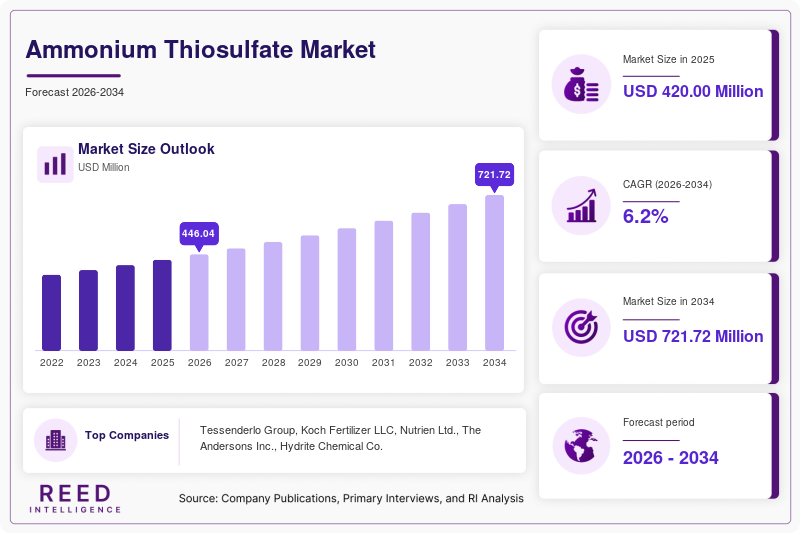
The Ammonium Thiosulfate Market size was valued at USD 420 million in 2024 and is projected to reach USD 725 million by 2033, registering a CAGR of 6.2% from 2025 to 2033. Ammonium thiosulfate is widely used as a liquid fertilizer and nitrogen-sulfur nutrient source in modern agriculture. The compound enhances nutrient absorption in crops and improves soil fertility, making it an essential input for crop yield optimization. Its compatibility with liquid fertilizer blends and fertigation systems has strengthened its adoption across commercial farming operations.
One global factor that supported the expansion of the Ammonium Thiosulfate Market is the increasing shift toward high-efficiency fertilizer formulations. Farmers and agricultural cooperatives are adopting sulfur-containing fertilizers to address soil nutrient deficiencies and maintain crop productivity. This trend has increased the integration of ammonium thiosulfate in nutrient management programs across several agricultural economies.
Key Highlights
- North America accounted for 34% of the global market share in 2025, while Asia Pacific is projected to record the fastest growth with a CAGR of 7.1% through 2033.
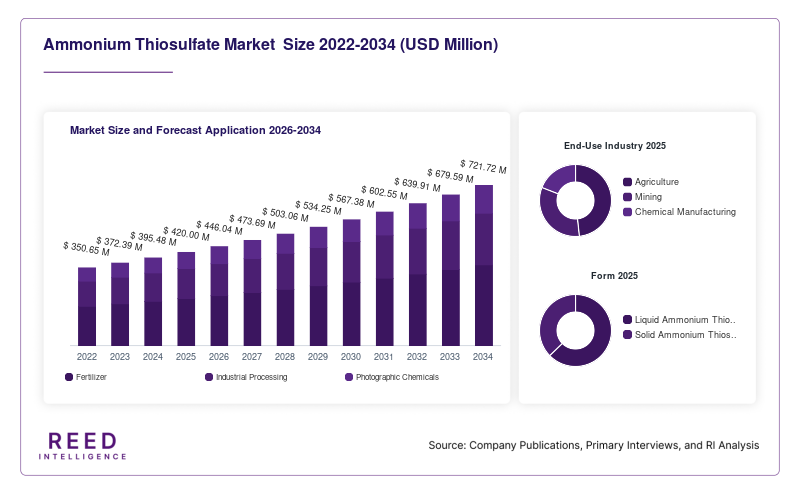
- By Application, the fertilizer segment held the largest share in 2024 at 68%, while the industrial processing segment is expected to grow at 6.8% CAGR.
- By End-Use, agriculture dominated the market with 70% share in 2024, while mining and industrial processing will expand at 6.5% CAGR.
- United States remained the dominant country with USD 120 million in 2024, reaching approximately USD 128 million in 2025.
Market Trends
Increasing Adoption of Liquid Fertilizer Blends
The adoption of liquid fertilizer blends is a key trend shaping the Ammonium Thiosulfate Market. Agricultural distributors are increasingly offering multi-nutrient liquid fertilizer solutions that combine nitrogen, sulfur, and micronutrients to simplify field application. Ammonium thiosulfate functions as a stabilizing agent and nutrient source within these blends, improving nutrient availability in soil systems.
Liquid fertilizer programs are gaining traction among commercial farms because they allow precise nutrient application through irrigation systems. As fertigation technologies expand in developed and emerging agricultural economies, ammonium thiosulfate is being integrated into nutrient management programs to enhance crop performance. The growing acceptance of advanced liquid fertilizer distribution networks is therefore supporting sustained demand.
Integration in Crop Nutrient Management Programs
Another trend influencing the Ammonium Thiosulfate Market is the integration of sulfur-based nutrients into crop nutrient management strategies. Sulfur deficiencies are becoming increasingly common due to changes in fertilizer composition and soil nutrient depletion. Ammonium thiosulfate is being incorporated into crop nutrition programs to maintain sulfur balance and support plant growth.
Agronomists and fertilizer manufacturers are emphasizing balanced nutrient applications that combine nitrogen with secondary nutrients. This trend is encouraging the adoption of ammonium thiosulfate across multiple crop segments, including cereals, oilseeds, and specialty crops.
Market Drivers
Expansion of Commercial Agriculture
The growth of commercial agriculture is a major driver of the Ammonium Thiosulfate Market. Large-scale farms rely on efficient nutrient delivery systems to maintain consistent crop productivity. Ammonium thiosulfate provides both nitrogen and sulfur, two nutrients that play a role in plant metabolism and protein synthesis.
As global food production requirements increase, agricultural producers are adopting fertilizers that support higher yields while maintaining soil health. Ammonium thiosulfate is commonly applied during planting or through irrigation systems to improve nutrient uptake efficiency. This functional advantage is supporting its use across modern agricultural operations.
Rising Demand for Sulfur-Based Fertilizers
Sulfur deficiency in agricultural soils has become more evident in several crop-producing regions. The decline of atmospheric sulfur deposition has reduced natural sulfur inputs into soil systems, making sulfur-based fertilizers increasingly important.
Ammonium thiosulfate is considered a reliable sulfur source due to its solubility and compatibility with liquid fertilizer programs. Fertilizer distributors and agricultural service providers are promoting sulfur nutrient supplementation to maintain crop quality and productivity. This growing awareness among farmers is supporting long-term demand growth in the Ammonium Thiosulfate Market.
Market Restraint
Price Volatility of Raw Materials
One restraint affecting the Ammonium Thiosulfate Market is the volatility in raw material prices used in its production. Ammonium thiosulfate manufacturing relies on ammonia and sulfur-based chemical inputs, which are influenced by fluctuations in global energy markets and industrial supply chains.
Variations in raw material prices can impact production costs for manufacturers and create pricing uncertainty for fertilizer distributors. Agricultural buyers are often sensitive to fertilizer price changes, especially in regions where input costs represent a large portion of total farming expenses. This sensitivity may reduce short-term purchasing volumes during periods of elevated fertilizer prices.
Additionally, transportation and storage requirements for liquid fertilizers can increase logistics costs compared to certain solid fertilizer alternatives. These factors may limit adoption in regions with limited fertilizer infrastructure. As a result, pricing pressures and supply chain variability remain notable constraints within the Ammonium Thiosulfate Market.
Market Opportunities
Expansion of Precision Agriculture
Precision agriculture technologies are creating opportunities for the Ammonium Thiosulfate Market. Farmers are increasingly using digital tools and field sensors to monitor soil nutrient levels and crop conditions. These systems support variable-rate fertilizer application, enabling producers to deliver nutrients exactly where they are needed.
Ammonium thiosulfate fits well within precision farming systems due to its compatibility with liquid fertilizer equipment and irrigation networks. As adoption of precision agriculture technologies expands globally, demand for liquid nutrient solutions containing ammonium thiosulfate is expected to grow.
Growth of Specialty Crop Production
The expansion of specialty crop cultivation is another opportunity for the Ammonium Thiosulfate Market. Fruits, vegetables, and horticultural crops often require balanced nutrient programs that include secondary nutrients such as sulfur.
Ammonium thiosulfate can be applied through irrigation systems or combined with other fertilizers to support plant development in high-value crops. As demand for specialty crops increases in both developed and emerging economies, fertilizer suppliers are introducing nutrient solutions designed for these crop categories. This trend will likely support new product development and broaden the application scope of ammonium thiosulfate.
Segmental Analysis
By Application
The fertilizer application segment dominated the Ammonium Thiosulfate Market in 2024 with a 68% share. Ammonium thiosulfate is widely used as a nitrogen-sulfur fertilizer in liquid nutrient blends applied to crops such as corn, wheat, and oilseeds. Its high solubility and compatibility with irrigation systems make it a preferred component in liquid fertilizer formulations.
The industrial processing segment is projected to grow at a CAGR of 6.8% from 2025 to 2033. Ammonium thiosulfate is used in certain industrial processes including metal extraction and photographic chemical applications. Industrial operators are increasingly adopting specialized chemical solutions that support operational efficiency, which is expected to drive growth in this segment.
By End-Use
The agriculture end-use segment accounted for 70% of the Ammonium Thiosulfate Market share in 2024. Farmers utilize ammonium thiosulfate as part of nutrient management programs designed to maintain balanced soil fertility. The compound delivers sulfur nutrients that support protein synthesis and plant growth, making it widely used across crop cultivation systems.
The mining and industrial processing segment is anticipated to grow at a CAGR of 6.5% during the forecast period. Ammonium thiosulfate is utilized in certain gold leaching processes as an alternative to traditional chemical reagents. Mining companies are exploring chemical solutions that offer operational efficiency and environmental compatibility, which will contribute to demand growth in this segment.
By Form
The liquid form segment dominated the Ammonium Thiosulfate Market in 2024 with a 76% share. Liquid ammonium thiosulfate products are commonly used in fertilizer solutions and irrigation systems due to their ease of handling and application.
The solid form segment is expected to grow at a CAGR of 6.0% through 2033. Solid formulations are being developed for specialized industrial applications where precise chemical composition and storage stability are required. Advances in chemical processing techniques are expected to support product innovation in this segment.
Regional Analysis
North America
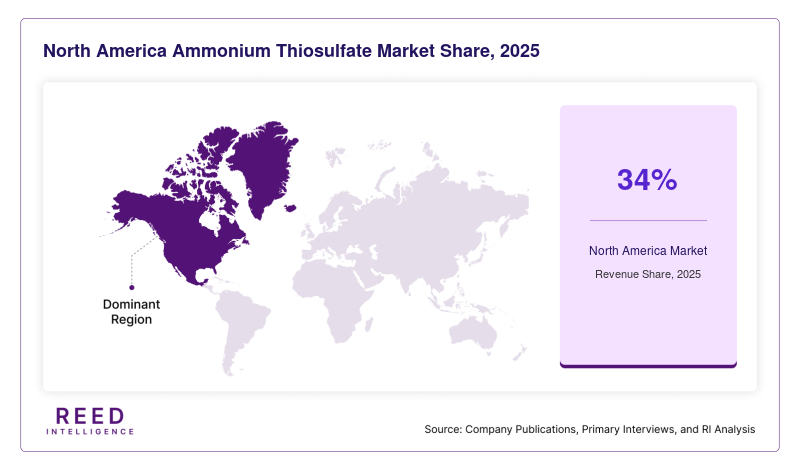
North America accounted for 34% of the Ammonium Thiosulfate Market share in 2025. The region had established a strong market presence due to its advanced agricultural infrastructure and widespread use of liquid fertilizer programs. The regional market is projected to grow at a CAGR of 5.9% from 2025 to 2033.
The United States represented the dominant country in this region. Large-scale corn and soybean cultivation creates demand for nutrient solutions containing nitrogen and sulfur. Agricultural service providers in the country operate extensive fertilizer distribution networks, enabling consistent availability of ammonium thiosulfate for farmers. The presence of large fertilizer manufacturers and integrated supply chains further supported the adoption of ammonium thiosulfate products.
Europe
Europe held 22% of the global Ammonium Thiosulfate Market share in 2025. The regional market is expected to expand at a CAGR of 5.6% through 2033. Agricultural producers in Europe increasingly use balanced nutrient fertilizers to maintain soil productivity and comply with sustainable farming guidelines.
Germany emerged as the dominant country within the European market. The country has a strong agricultural research ecosystem and promotes advanced nutrient management strategies. Farmers are adopting fertilizer formulations that improve crop productivity while supporting soil health. Ammonium thiosulfate has been integrated into several fertilizer blending programs to address sulfur nutrient requirements in crops.
Asia Pacific
Asia Pacific accounted for 28% of the Ammonium Thiosulfate Market share in 2025 and is projected to grow at the fastest CAGR of 7.1% between 2025 and 2033. The region’s growth outlook is supported by the expansion of commercial farming and increasing fertilizer consumption.
China dominated the regional market due to its extensive agricultural production and large fertilizer manufacturing sector. The country has implemented initiatives to improve crop yields and soil nutrient balance. Fertilizer manufacturers are expanding liquid fertilizer production capacities, which is contributing to higher usage of ammonium thiosulfate in nutrient formulations.
Middle East & Africa
The Middle East & Africa accounted for 9% of the global Ammonium Thiosulfate Market share in 2025. The market in this region is expected to grow at a CAGR of 6.0% during the forecast period.
Saudi Arabia was identified as the leading country in the region. The country is investing in agricultural development programs aimed at improving domestic food production. Modern irrigation systems and fertilizer distribution channels are gradually expanding, enabling farmers to access liquid nutrient products such as ammonium thiosulfate.
Latin America
Latin America held 7% of the global Ammonium Thiosulfate Market share in 2025. The regional market is forecast to grow at a CAGR of 6.4% through 2033.
Brazil represented the dominant market within the region. The country’s large soybean and corn production sector drives demand for fertilizers containing sulfur nutrients. Agricultural input suppliers are increasing the availability of liquid fertilizer blends designed for tropical soil conditions. This factor is supporting the adoption of ammonium thiosulfate across several crop segments.
Competitive Landscape
The Ammonium Thiosulfate Market is moderately consolidated, with several chemical manufacturers and fertilizer suppliers operating across global markets. Companies focus on expanding fertilizer distribution networks and introducing liquid nutrient solutions that include ammonium thiosulfate.
One of the leading companies in the market is Tessenderlo Group, which has established a strong presence in sulfur-based fertilizer products. The company has invested in expanding its liquid fertilizer portfolio to meet increasing demand from commercial agriculture operations.
Other companies in the market are emphasizing regional distribution partnerships and production capacity expansions to strengthen their market position. Strategic collaborations with agricultural cooperatives and fertilizer distributors are also supporting market penetration across emerging agricultural regions.
Key Players
- Tessenderlo Group
- Koch Fertilizer LLC
- Nutrien Ltd.
- The Andersons Inc.
- Hydrite Chemical Co.
- Martin Midstream Partners L.P.
- Mears Fertilizer Inc.
- Kugler Company
- Poole Chemical Company
- TIB Chemicals AG
- Plant Food Company Inc.
- Rentech Nitrogen Partners
- Hawkins Inc.
- H.J. Baker & Bro.
- Tessenderlo Kerley Inc.
Recent Developments
- In 2024, Tessenderlo Group expanded production capacity for liquid sulfur fertilizers to meet increasing agricultural demand.
- In 2023, Nutrien Ltd. introduced a liquid fertilizer formulation containing ammonium thiosulfate for improved sulfur nutrient delivery.
- In 2024, Koch Fertilizer expanded its fertilizer distribution network in North America.
- In 2023, The Andersons Inc. strengthened its liquid fertilizer blending capabilities in the U.S. Midwest.
- In 2024, Kugler Company launched new liquid crop nutrition products designed for fertigation systems.
Ammonium Thiosulfate Market Segments
Application
- Fertilizer
- Industrial Processing
- Photographic Chemicals
End-Use Industry
- Agriculture
- Mining
- Chemical Manufacturing
Form
- Liquid Ammonium Thiosulfate
- Solid Ammonium Thiosulfate
Region
- North America
- Europe
- Asia Pacific
- Middle East & Africa
- Latin America
By Region
- North America
- Europe
- APAC
- Middle East and Africa
- LATAM