Amorphous Alloy Band Market Size, Share & Demand Report By Type (Iron-Based Amorphous Alloy Bands, Cobalt-Based Amorphous Alloy Bands, Nickel-Based Amorphous Alloy Bands), By Application (Transformer Cores, Electric Motor Components, Inductors, Sensors), By End-Use Industry (Power Generation & Distribution, Automotive, Electronics, Industrial Equipment), By Region & Segment Forecasts, 2025–2033
USD 3950
Market Overview
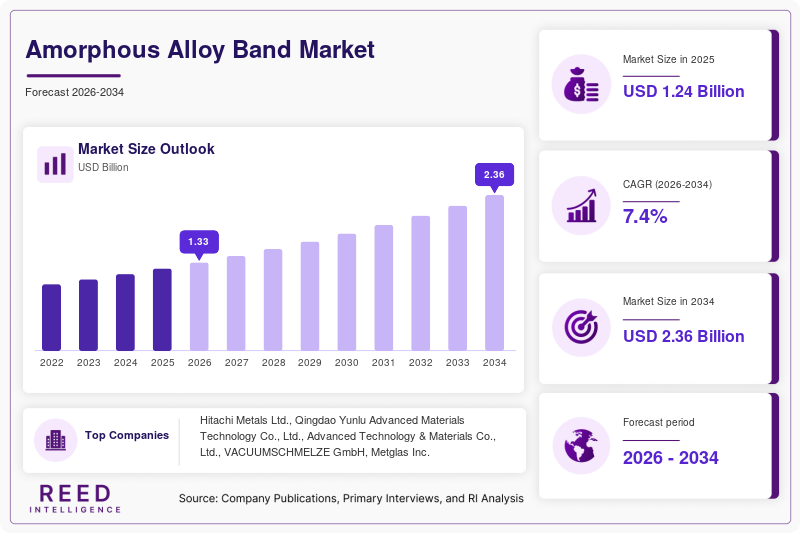
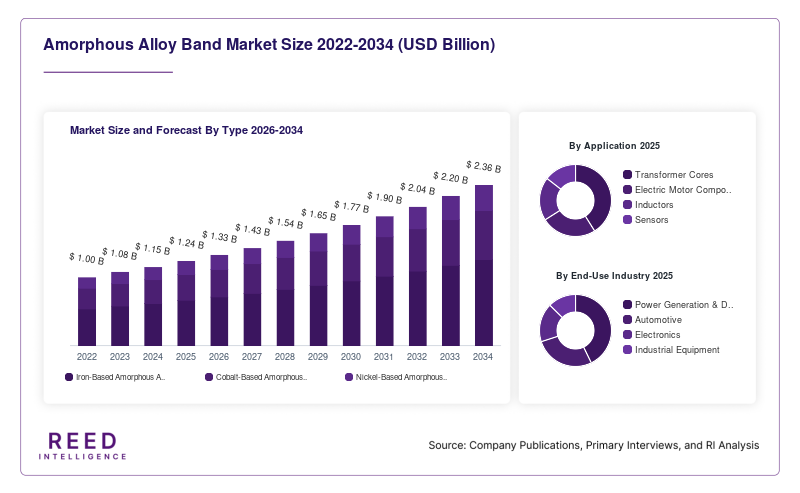
The Amorphous Alloy Band Market size was valued at USD 1.24 billion in 2024 and is projected to reach USD 2.35 billion by 2033, expanding at a CAGR of 7.4% from 2025 to 2033. Amorphous alloy bands, commonly produced through rapid solidification techniques, exhibit unique magnetic, electrical, and mechanical properties due to their non-crystalline structure. These bands are widely utilized in transformer cores, electric motors, sensors, and energy-efficient electrical equipment across industrial and power distribution sectors.
A significant factor supporting the expansion of the Amorphous Alloy Band Market is the global emphasis on energy efficiency and power transmission optimization. Governments and utilities across several economies are focusing on reducing transmission losses in power grids, which has accelerated the adoption of amorphous alloy materials in transformer manufacturing. Compared with conventional silicon steel cores, amorphous alloy bands offer lower core losses and improved energy efficiency, enabling utilities to reduce electricity wastage and operating costs.
Key Highlights
- Asia Pacific dominated the Amorphous Alloy Band Market with 46.3% share in 2025, while Latin America is projected to grow at the fastest CAGR of 8.6% through 2033.
- By Type, Iron-Based Amorphous Alloy Bands accounted for 62.5% share in 2024, while Cobalt-Based Bands will grow at a CAGR of 8.2%.
- By Application, Transformer Cores held 55.4% share in 2024, while Electric Motor Components are expected to expand at 8.8% CAGR.
- China led the market with USD 315 million in 2024 and approximately USD 338 million in 2025.
Market Trends
Rising Adoption in Energy-Efficient Transformers
One of the key trends shaping the Amorphous Alloy Band Market is the growing deployment of high-efficiency amorphous metal transformers in electricity distribution networks. Power utilities are adopting these transformers to reduce core losses during electricity transmission and distribution. Amorphous alloy bands possess significantly lower magnetic hysteresis losses compared with conventional electrical steels. As electricity consumption rises globally, utilities are prioritizing technologies that reduce operational losses and improve energy efficiency. This shift is encouraging transformer manufacturers to integrate amorphous alloy bands into next-generation transformer designs.
Expansion of Electric Mobility Components
The rapid development of electric mobility is influencing the Amorphous Alloy Band Market. Electric vehicles require efficient magnetic materials in motors, inductors, and power electronics systems. Amorphous alloy bands offer improved magnetic permeability and reduced eddy current losses, which makes them suitable for compact and high-efficiency electric motor components. As electric vehicle production expands across major automotive markets, manufacturers are evaluating advanced magnetic materials that improve energy efficiency and thermal performance. This trend is expected to gradually increase the use of amorphous alloy bands in automotive powertrain systems, supporting long-term market growth.
Market Drivers
Increasing Grid Modernization Projects
The modernization of electricity transmission and distribution networks is a major driver of the Amorphous Alloy Band Market. Several countries are investing in upgrading aging power infrastructure to enhance reliability and reduce transmission losses. Amorphous alloy bands enable the production of transformer cores with lower energy losses, making them suitable for modern distribution transformers. Utilities adopting advanced transformer technologies are encouraging the demand for amorphous alloy band materials.
Expanding Renewable Energy Infrastructure
The expansion of renewable power capacity is also supporting the Amorphous Alloy Band Market growth. Renewable energy facilities such as solar and wind farms require efficient transformers, inductors, and magnetic components to manage fluctuating electricity loads. Amorphous alloy bands provide high magnetic efficiency and improved performance in variable power conditions. As renewable energy projects continue to increase globally, the demand for energy-efficient electrical materials will rise, contributing to market expansion.
Market Restraint
High Manufacturing Cost and Processing Complexity
A major restraint affecting the Amorphous Alloy Band Market is the relatively high cost associated with manufacturing amorphous alloys. Producing these materials requires specialized melt spinning equipment, precise temperature control, and high-speed quenching processes to maintain the amorphous structure. These advanced manufacturing processes increase capital expenditure and operational costs for producers.
Additionally, amorphous alloy bands can exhibit mechanical brittleness, which requires careful handling during processing and transformer core fabrication. The need for specialized processing technologies limits the number of manufacturers capable of producing high-quality amorphous alloy bands at scale. As a result, production capacity remains relatively concentrated among a limited number of suppliers.
The higher cost of amorphous alloy materials compared with traditional electrical steels also slows adoption among cost-sensitive transformer manufacturers. Although long-term energy savings may offset the higher initial material cost, budget limitations in certain power infrastructure projects continue to limit widespread adoption. Addressing manufacturing cost challenges will remain an important factor for the future expansion of the Amorphous Alloy Band Market.
Market Opportunities
Development of Advanced Magnetic Materials
Continuous research in magnetic material engineering presents opportunities for the Amorphous Alloy Band Market. Manufacturers are focusing on improving alloy compositions to enhance magnetic permeability, reduce core losses, and improve mechanical flexibility. New material innovations could expand the use of amorphous alloy bands in applications such as sensors, inductors, and power electronics systems.
Growth of Smart Grid Technologies
The global transition toward smart grid infrastructure is creating opportunities for the Amorphous Alloy Band Market. Smart grids require efficient power distribution systems with advanced transformers capable of managing dynamic electricity loads. Amorphous alloy band-based transformer cores provide improved energy efficiency and reduced heat generation, which makes them suitable for modern power networks.
As countries deploy intelligent grid systems to improve power monitoring and distribution efficiency, demand for high-performance transformer materials will increase. This trend is expected to support long-term market growth for amorphous alloy bands.
Segmental Analysis
By Type
Iron-Based Amorphous Alloy Bands dominated the Amorphous Alloy Band Market and accounted for 62.5% share in 2024. These materials are widely used in transformer core manufacturing due to their high magnetic permeability and low core loss characteristics. Iron-based alloys are also relatively more cost-effective compared with cobalt-based alternatives. Their ability to reduce energy losses in electrical equipment contributed to strong demand from transformer manufacturers and power distribution equipment suppliers.
Cobalt-Based Amorphous Alloy Bands are projected to expand at the fastest CAGR of 8.2% during the forecast period. These materials offer superior magnetic performance and higher thermal stability compared with iron-based alloys. Their improved magnetic saturation characteristics will likely support their adoption in advanced electronic devices, aerospace components, and high-performance magnetic systems. Increasing research into specialized magnetic applications will contribute to the growth of this segment.
By Application
The Transformer Cores segment held the largest share of the Amorphous Alloy Band Market, accounting for 55.4% in 2024. Transformer manufacturers widely utilize amorphous alloy bands due to their low hysteresis loss and improved magnetic efficiency. These properties enable transformer cores to operate with reduced energy losses, which helps utilities improve the efficiency of electricity distribution networks.
The Electric Motor Components segment will likely grow at the highest CAGR of 8.8% between 2025 and 2033. Electric motors used in industrial machinery and transportation systems require efficient magnetic materials to improve operational performance. Amorphous alloy bands will increasingly be incorporated into motor designs that prioritize reduced energy consumption and improved efficiency.
By End-Use Industry
The Power Generation and Distribution segment accounted for 48.6% share in 2024, making it the dominant end-use sector in the Amorphous Alloy Band Market. The sector relies heavily on efficient transformer technologies to manage electricity transmission and distribution. The ability of amorphous alloy bands to minimize energy loss in transformer cores contributed to their widespread use across power infrastructure.
The Automotive Industry will likely register the fastest CAGR of 8.5% through 2033. As vehicle electrification expands globally, automotive manufacturers will increasingly require advanced magnetic materials for electric motors and power electronics. Amorphous alloy bands will support improved efficiency in electric propulsion systems, which will contribute to the growth of this segment.
Regional Analysis
North America
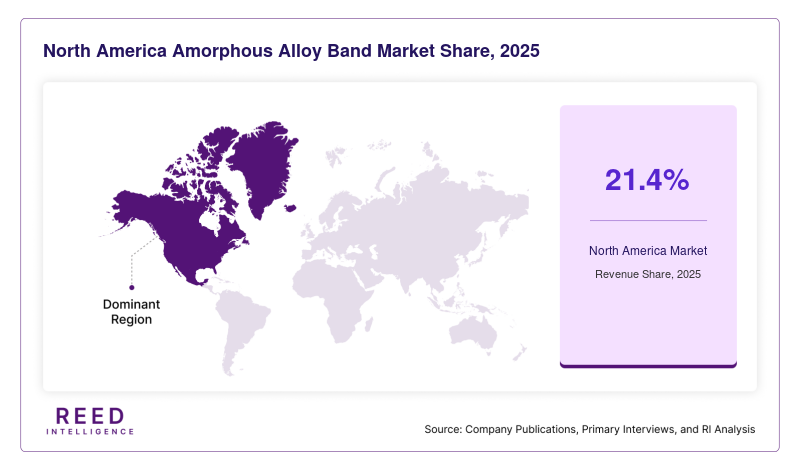
North America accounted for 21.4% of the Amorphous Alloy Band Market share in 2025, reflecting steady adoption of energy-efficient electrical materials. The region will likely expand at a CAGR of 6.9% between 2025 and 2033. Demand for advanced transformer materials across power distribution networks has supported market expansion. Utilities across the region have been gradually replacing older transformer units with modern equipment that improves energy efficiency and operational reliability.
The United States represented the dominant country in the regional market. Expansion of electricity infrastructure upgrades and investments in resilient power grids contributed to material demand. Several power distribution companies implemented programs focused on reducing electricity losses in local distribution systems. These initiatives increased the deployment of transformers that utilize amorphous alloy band cores. Additionally, manufacturers within the country have expanded research efforts focused on improving magnetic materials for industrial and electronic applications.
Europe
Europe held approximately 18.7% share of the Amorphous Alloy Band Market in 2025 and will likely grow at a CAGR of 6.7% through 2033. The region’s market expansion has been supported by regulatory frameworks encouraging energy efficiency and modernization of power distribution infrastructure. Many countries have implemented standards that promote the use of energy-efficient transformers in electricity networks.
Germany emerged as the dominant country within the regional market. The country’s strong industrial base and focus on high-efficiency electrical equipment supported material demand. Transformer manufacturers in Germany have adopted advanced magnetic materials to comply with regional efficiency standards. Additionally, research institutions and industrial companies have collaborated on improving magnetic alloy technologies, which contributed to the development of advanced amorphous alloy band applications.
Asia Pacific
Asia Pacific represented the largest regional market with 46.3% share in 2025 and will expand at a CAGR of 7.9% from 2025 to 2033. Rapid industrialization, urbanization, and electricity demand growth have supported transformer installations across several countries. Expansion of electricity transmission infrastructure and large-scale power grid upgrades contributed to the strong demand for amorphous alloy bands.
China dominated the regional market due to its extensive transformer manufacturing industry and large electricity distribution network. The country has invested significantly in high-efficiency transformer technologies to reduce energy losses in the national power grid. Domestic manufacturers have increased production capacity for amorphous alloy bands to support transformer manufacturers. Additionally, expanding renewable energy installations and industrial electrification projects have further contributed to material demand within the country.
Middle East & Africa
The Middle East & Africa accounted for 7.6% share of the Amorphous Alloy Band Market in 2025 and will grow at a CAGR of 7.1% during the forecast period. Electricity infrastructure development across emerging economies has supported demand for advanced transformer materials. Several countries in the region are expanding power generation capacity and upgrading distribution systems to support growing electricity consumption.
Saudi Arabia emerged as a leading country within the regional market. Expansion of electricity networks and infrastructure development projects have increased the installation of new transformers across the country. Energy efficiency initiatives implemented in the power sector have encouraged utilities to adopt advanced transformer technologies. These developments supported the adoption of amorphous alloy bands used in transformer cores.
Latin America
Latin America held 6.0% share of the Amorphous Alloy Band Market in 2025 and is projected to grow at the fastest CAGR of 8.6% through 2033. The region’s electricity demand has been rising steadily due to industrial expansion and urban population growth. Several countries have initiated programs to improve the efficiency and reliability of electricity distribution networks.
Brazil represented the dominant country in the regional market. Investments in electricity transmission infrastructure and expansion of power distribution networks supported transformer installations across the country. Utilities and industrial companies have adopted energy-efficient transformer technologies to improve electricity distribution efficiency. These initiatives have gradually increased the demand for amorphous alloy band materials within the region.
Competitive Landscape
The Amorphous Alloy Band Market remains moderately concentrated with a limited number of manufacturers possessing advanced material production capabilities. Companies are focusing on improving alloy compositions, expanding production capacity, and strengthening partnerships with transformer manufacturers.
Hitachi Metals Ltd. emerged as a leading player in the market due to its extensive experience in advanced magnetic materials. The company has continued to expand its amorphous metal production capacity to support the growing demand from transformer manufacturers.
Other prominent companies are focusing on research and development initiatives to enhance material performance and manufacturing efficiency. Strategic collaborations with power equipment manufacturers are also supporting market expansion.
Key Players List
- Hitachi Metals Ltd.
- Qingdao Yunlu Advanced Materials Technology Co., Ltd.
- Advanced Technology & Materials Co., Ltd.
- Henan Zhongyue Amorphous New Materials Co., Ltd.
- Foshan Huaxin Microlite Metal Co., Ltd.
- VACUUMSCHMELZE GmbH
- Metglas Inc.
- China Amorphous Technology Co., Ltd.
- Londerful New Material Technology Co., Ltd.
- Jiangsu Guoneng Alloy Technology Co., Ltd.
- Shenzhen Amorphous Technology Co., Ltd.
- Hebei Zhaojian Technology Co., Ltd.
- Orient Group
- Bomatec AG
- MK Magnetics Inc.
Recent Developments
-
Several transformer manufacturers expanded partnerships with amorphous alloy band producers to increase the production of energy-efficient transformers.
-
Material manufacturers introduced improved melt-spinning technologies to enhance the uniformity and mechanical properties of amorphous alloy bands.
-
Companies increased investment in research programs aimed at developing new magnetic alloy compositions for advanced electronic applications.
Amorphous Alloy Band Market Segments
By Type
- Iron-Based Amorphous Alloy Bands
- Cobalt-Based Amorphous Alloy Bands
- Nickel-Based Amorphous Alloy Bands
By Application
- Transformer Cores
- Electric Motor Components
- Inductors
- Sensors
By End-Use Industry
- Power Generation & Distribution
- Automotive
- Electronics
- Industrial Equipment
By Region
- North America
- Europe
- APAC
- Middle East and Africa
- LATAM