Amphoteric Starch Market Size, Share & Demand Report By Type (Cationic Dominant Amphoteric Starch, Anionic Dominant Amphoteric Starch, Balanced Ionic Amphoteric Starch), By Application (Paper Manufacturing, Textile Processing, Personal Care Formulations, Food Processing, Wastewater Treatment, Pharmaceutical Applications), By End-Use Industry (Packaging and Paper Processing, Cosmetics and Personal Care, Food and Beverage, Textile Industry, Water Treatment Industry, Pharmaceutical Industry), By Re
USD 3950
Market Overview
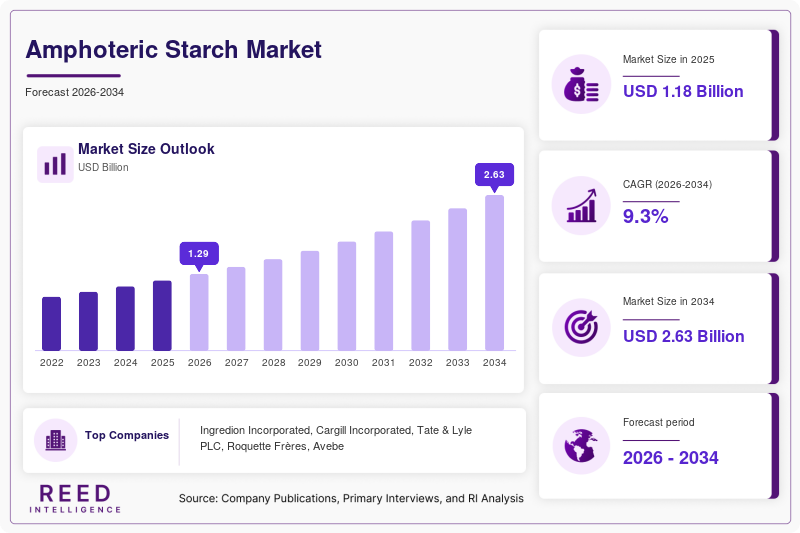
The global Amphoteric Starch Market size was valued at USD 1.18 billion in 2026 and is projected to reach USD 2.41 billion by 2034, expanding at a CAGR of 9.3% during the forecast period from 2026 to 2034. Amphoteric starch has gained strong commercial attention across paper processing, textile finishing, personal care formulations, and wastewater treatment applications because of its dual ionic functionality. The material combines both cationic and anionic properties, enabling enhanced adhesion, retention, thickening, and stabilization performance in industrial formulations. Growing industrial demand for multifunctional bio-based additives has contributed significantly to market expansion across developed and emerging economies.
One of the major global factors supporting market growth is the rising transition toward sustainable and biodegradable specialty chemicals. Manufacturers in paper, packaging, cosmetics, and food processing industries are increasingly replacing synthetic polymers with starch-derived alternatives to meet environmental regulations and sustainability targets. Amphoteric starch offers high compatibility with eco-friendly manufacturing systems while improving product efficiency and process optimization. In addition, rising investments in advanced starch modification technologies have improved product stability, viscosity control, and moisture resistance, allowing manufacturers to broaden the commercial use of amphoteric starch across multiple industries.
Key Highlights
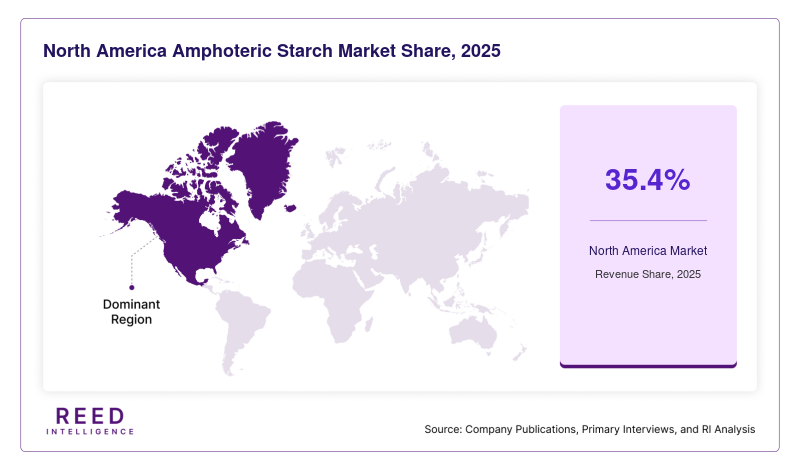
- North America dominated the market with a 35.4% share in 2025, while Asia Pacific is expected to grow at the fastest CAGR of 10.8% during 2026–2034.
- By type, cationic dominant amphoteric starch accounted for the largest share of 42.7%, while balanced ionic amphoteric starch is projected to grow at a CAGR of 11.4%.
- By application, paper manufacturing led with a 39.1% share, whereas personal care formulations are expected to expand at a CAGR of 11.7%.
- By end-use industry, packaging and paper processing held the leading share of 36.8%, while wastewater treatment is forecast to grow at a CAGR of 12.1%.
- The United States remained the dominant country, with market values of USD 318 million in 2024 and USD 352 million in 2025.
Market Trends
Rising Integration of Bio-Based Additives in Packaging Applications
The growing emphasis on sustainable packaging materials has become a significant trend influencing the Amphoteric Starch Market. Packaging manufacturers are increasingly incorporating amphoteric starch into coated paper, corrugated board, and molded fiber products to improve printability, tensile strength, and moisture resistance. Governments across North America and Europe have strengthened regulations associated with plastic waste reduction, encouraging packaging companies to adopt biodegradable additives and renewable raw materials. Amphoteric starch has emerged as a practical solution because of its compatibility with paper recycling systems and low environmental impact. The rapid growth of e-commerce and food delivery services has also increased demand for durable yet sustainable packaging products, further supporting market expansion.
Increasing Use in Personal Care and Cosmetic Formulations
Another major trend shaping the market is the increasing use of amphoteric starch in cosmetic and personal care applications. Manufacturers of skincare, haircare, and hygiene products are using modified starch ingredients to improve texture stabilization, moisture retention, and formulation consistency. Consumers are actively seeking products formulated with naturally derived ingredients, leading cosmetic producers to reduce reliance on synthetic thickeners and stabilizers. Amphoteric starch offers multifunctional performance while supporting clean-label and sustainable product positioning. Growth in premium beauty products across Asia Pacific and Europe has accelerated the use of starch-based additives in creams, lotions, shampoos, and emulsions. Continuous innovation in bio-compatible cosmetic ingredients is expected to strengthen this trend throughout the forecast period.
Market Drivers
Expanding Demand from the Paper and Packaging Industry
The rapid expansion of the global paper and packaging industry continues to drive demand for amphoteric starch products. Paper manufacturers increasingly require additives that improve sheet strength, retention efficiency, ink absorption, and coating performance. Amphoteric starch provides balanced ionic functionality, allowing better interaction with pulp fibers and fillers during the papermaking process. The rising demand for recyclable packaging, tissue products, and specialty paper grades has significantly increased consumption across commercial paper mills. In addition, governments promoting sustainable packaging alternatives have encouraged producers to shift toward biodegradable starch-based chemicals. Emerging economies in Asia Pacific and Latin America are witnessing substantial investments in paper production capacity, creating favorable long-term growth opportunities for amphoteric starch suppliers.
Growth in Industrial Wastewater Treatment Applications
The increasing need for efficient wastewater treatment solutions has become another important growth driver for the Amphoteric Starch Market. Industries such as textile processing, mining, chemicals, and food manufacturing are investing heavily in water purification technologies to comply with environmental standards. Amphoteric starch is widely used as a flocculating and stabilizing agent because of its ability to interact with both positively and negatively charged contaminants. The material improves sedimentation efficiency while reducing chemical residue generation in water treatment systems. Rapid industrialization in emerging countries has intensified concerns regarding wastewater discharge and water scarcity, resulting in stronger investments in treatment infrastructure. The adoption of bio-based treatment additives is expected to expand steadily as industries prioritize sustainability and operational efficiency.
Market Restraint
Volatility in Raw Material Prices and Supply Chain Constraints
Fluctuations in raw material prices remain a major restraint affecting the Amphoteric Starch Market. Corn, potato, cassava, and wheat are primary feedstocks used for starch extraction and modification, and their pricing is heavily influenced by climate conditions, agricultural yields, transportation costs, and global trade policies. Sudden changes in crop availability can directly affect manufacturing costs and profit margins for starch producers. Supply chain disruptions associated with transportation bottlenecks and export restrictions have also created uncertainty in raw material procurement across several regions.
The impact of raw material volatility is particularly significant for small and medium-sized manufacturers operating with limited procurement flexibility. Rising agricultural commodity prices can increase production costs for amphoteric starch formulations, forcing manufacturers to revise pricing strategies or reduce operating margins. In some instances, industrial end users may shift toward lower-cost synthetic alternatives when starch prices rise sharply. Additionally, dependence on agricultural raw materials exposes the industry to seasonal production risks and geopolitical trade disruptions. These factors can slow market expansion in price-sensitive regions and limit adoption among smaller industrial users with restricted budgets.
Market Opportunities
Expansion of Sustainable Textile Processing Technologies
The growing transition toward sustainable textile manufacturing presents substantial opportunities for amphoteric starch producers. Textile manufacturers are increasingly replacing petroleum-derived chemicals with biodegradable and environmentally compatible additives to reduce wastewater pollution and chemical residue generation. Amphoteric starch is being adopted in textile sizing, finishing, and coating applications because of its strong film-forming capability and compatibility with natural fibers. Global apparel brands are also pressuring suppliers to adopt cleaner production practices and sustainable raw materials throughout the supply chain.
The expansion of textile production in countries such as India, Vietnam, Bangladesh, and Indonesia is expected to create strong future demand for starch-based processing agents. Technological improvements in starch modification processes are further enhancing product stability, flexibility, and performance under varying textile processing conditions. Manufacturers that invest in high-performance formulations designed for modern textile operations may benefit from long-term commercial opportunities. Increasing consumer preference for environmentally responsible fashion products is likely to strengthen demand for bio-based textile chemicals during the forecast period.
Development of Advanced Functional Food and Pharmaceutical Ingredients
Another important opportunity lies in the growing use of amphoteric starch in food processing and pharmaceutical applications. Functional starch ingredients are gaining attention because of their ability to improve texture stability, controlled release properties, and formulation consistency in processed foods and medicinal products. Amphoteric starch can enhance emulsification, moisture retention, and viscosity management, making it suitable for specialized applications in nutritional supplements, tablet coatings, and processed food systems.
The expansion of convenience food consumption and rising pharmaceutical manufacturing activities in Asia Pacific and North America are expected to support future product demand. Research institutions and ingredient manufacturers are actively developing modified starch products tailored for high-value functional applications. Increasing focus on clean-label ingredients and plant-derived pharmaceutical excipients may further strengthen market potential. Companies investing in research and development for specialty food-grade and pharmaceutical-grade amphoteric starch products are expected to gain competitive advantages as industrial demand diversifies.
Segmental Analysis
By Type
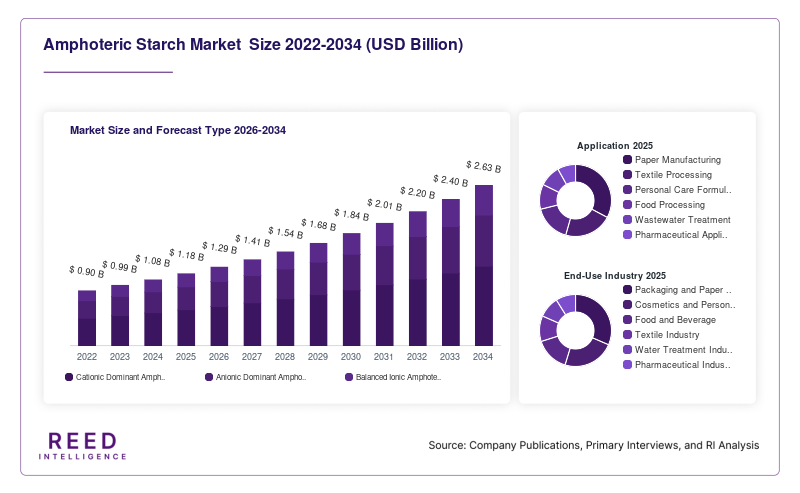
Cationic dominant amphoteric starch accounted for the largest market share of 42.7% in 2024 due to its broad commercial adoption across paper manufacturing and wastewater treatment industries. The segment is widely preferred because of its strong retention performance, fiber bonding capability, and compatibility with industrial pulp systems. Paper manufacturers utilize cationic dominant formulations to improve paper strength, coating adhesion, and printing quality while reducing filler loss during processing. In wastewater treatment applications, the product helps improve flocculation efficiency and contaminant separation performance. Growing demand for high-efficiency industrial additives and sustainable chemical formulations has further strengthened segment growth across developed and emerging economies. In addition, ongoing advancements in starch modification technology have improved the operational stability and multifunctional performance of cationic dominant products in industrial manufacturing systems.
Balanced ionic amphoteric starch is projected to register the fastest CAGR of 11.4% during the forecast period because of its expanding use in multifunctional industrial applications. These formulations offer improved compatibility with varying pH conditions and diverse processing environments, making them suitable for cosmetics, textile finishing, specialty coatings, and pharmaceutical formulations. Manufacturers are increasingly investing in balanced ionic products to achieve better formulation flexibility and process optimization. The segment is also benefiting from growing demand for sustainable ingredients capable of delivering both stabilization and emulsification functions simultaneously. Rising research activities focused on advanced bio-based additives are expected to accelerate innovation within the segment. Expanding adoption in premium personal care and high-performance industrial formulations is likely to create additional commercial opportunities for balanced ionic amphoteric starch products.
By Application
Paper manufacturing represented the leading application segment with a market share of 39.1% in 2024. Amphoteric starch is extensively used in paper processing because it enhances sheet formation, printability, tensile strength, and coating stability. Rising global demand for recyclable packaging materials and specialty paper products has significantly increased consumption across commercial paper mills. The growth of e-commerce and food delivery services has also strengthened demand for durable corrugated packaging, further supporting segment expansion. Manufacturers continue to adopt starch-based additives to reduce dependence on synthetic chemicals and improve sustainability performance. In addition, technological improvements in papermaking operations have increased the need for advanced retention and coating agents capable of improving production efficiency and reducing material waste during high-speed industrial processing.
Personal care formulations are expected to expand at the fastest CAGR of 11.7% during the forecast period due to rising demand for naturally derived cosmetic ingredients. Amphoteric starch is increasingly incorporated into skincare creams, lotions, shampoos, and emulsions because of its stabilizing, thickening, and moisture retention capabilities. Consumers are actively seeking clean-label beauty products formulated with biodegradable and plant-derived ingredients, encouraging cosmetic manufacturers to adopt starch-based alternatives. Growth in premium skincare consumption across Asia Pacific and Europe has further accelerated demand for multifunctional bio-compatible additives. Product innovation in natural cosmetics and increasing awareness regarding environmentally responsible formulations continue to support segment expansion. Companies developing high-purity starch ingredients for sensitive skin and specialized cosmetic applications are expected to gain strong commercial advantages in the coming years.
By End-Use Industry
Packaging and paper processing emerged as the dominant end-use industry segment with a 36.8% market share in 2024. The segment benefits from rising demand for sustainable packaging materials, recyclable paper products, and high-performance industrial coatings. Amphoteric starch is widely used in packaging production to improve structural durability, print quality, and resistance to moisture exposure. Rapid expansion of e-commerce distribution networks has increased the need for lightweight yet durable packaging solutions, encouraging broader adoption of starch-based additives. Governments across multiple regions are implementing stricter restrictions on plastic packaging, prompting manufacturers to invest in biodegradable alternatives. The growing transition toward renewable industrial materials and environmentally responsible manufacturing systems continues to support long-term demand growth within the packaging and paper processing segment.
Wastewater treatment is forecast to record the fastest CAGR of 12.1% from 2026 to 2034 due to increasing industrial focus on environmental compliance and water conservation. Amphoteric starch products are gaining popularity as eco-friendly flocculants and stabilizers capable of improving sedimentation and contaminant removal efficiency. Industries including textiles, chemicals, food processing, and mining are investing heavily in advanced water treatment infrastructure to comply with stricter environmental regulations. Rapid urbanization and industrial expansion in emerging economies have intensified concerns regarding water scarcity and wastewater discharge management. The adoption of bio-based treatment chemicals is expected to increase steadily as governments encourage sustainable industrial practices. Manufacturers developing high-performance amphoteric starch solutions tailored for industrial water treatment systems are likely to experience substantial growth opportunities during the forecast period.
Regional Analysis
North America
North America accounted for 35.4% of the global Amphoteric Starch Market share in 2025 and is projected to maintain steady growth at a CAGR of 8.4% during the forecast period. The region benefits from strong industrial infrastructure, advanced paper manufacturing operations, and increasing demand for sustainable specialty chemicals. Packaging companies across the United States and Canada continue to adopt bio-based additives to comply with environmental regulations and reduce synthetic polymer usage. The region also has a mature wastewater treatment industry, which supports stable consumption of amphoteric starch in industrial processing and water purification systems.
The United States remained the dominant country in North America due to its large paper packaging sector and extensive industrial manufacturing activities. One unique growth factor driving the U.S. market is the rapid expansion of sustainable e-commerce packaging production. Online retail companies are increasingly demanding recyclable and durable packaging materials that support environmental objectives. This trend has encouraged paper manufacturers to invest in advanced starch-based additives that improve product durability, print quality, and operational efficiency. Increasing investments in specialty chemicals research also continue to support product innovation across the country.
Europe
Europe represented 27.1% of the global market share in 2025 and is forecast to expand at a CAGR of 8.7% from 2026 to 2034. The region has established strong regulatory frameworks focused on sustainability, biodegradable materials, and waste reduction, encouraging widespread use of starch-derived specialty additives. Demand for amphoteric starch is growing steadily in paper coating, cosmetic formulations, and textile processing applications across several European economies. The presence of advanced research institutions and chemical manufacturers has also accelerated innovation in high-performance starch modification technologies.
Germany remained the leading country within the European market because of its strong industrial manufacturing base and advanced packaging sector. A major growth factor supporting the German market is the increasing investment in circular economy initiatives across packaging and industrial processing industries. Manufacturers are actively integrating recyclable and renewable materials into production systems to achieve sustainability targets. This transition has strengthened demand for bio-based additives such as amphoteric starch. The country's focus on technological advancement and sustainable manufacturing continues to create favorable conditions for long-term market development.
Asia Pacific
Asia Pacific held 24.3% of the global Amphoteric Starch Market share in 2025 and is expected to register the fastest CAGR of 10.8% during the forecast period. Rapid industrialization, population growth, and expanding manufacturing activities are contributing significantly to regional market expansion. Countries across the region are witnessing strong demand for paper packaging, textile processing chemicals, and water treatment solutions. Rising environmental awareness and government initiatives promoting sustainable industrial practices are also encouraging adoption of starch-based specialty chemicals in several manufacturing industries.
China emerged as the dominant country in Asia Pacific due to its large-scale paper production capacity and expanding industrial base. One unique growth factor driving the Chinese market is the rapid development of domestic biodegradable packaging production. The government has implemented stricter controls on single-use plastics, encouraging manufacturers to shift toward recyclable and renewable materials. This transition has increased demand for amphoteric starch in paper coatings, corrugated packaging, and industrial adhesives. Growing investments in chemical processing infrastructure and export-oriented manufacturing are further supporting market expansion across the country.
Middle East & Africa
The Middle East & Africa region accounted for 7.2% of the global market share in 2025 and is projected to grow at a CAGR of 7.9% through 2034. Demand for amphoteric starch in the region is supported by increasing investments in wastewater treatment facilities, food processing industries, and textile manufacturing operations. Governments across several countries are implementing industrial diversification strategies that encourage development of sustainable manufacturing industries. Rising awareness regarding water conservation and environmental management has also strengthened demand for bio-based treatment chemicals and industrial additives.
Saudi Arabia remained the dominant country in the regional market because of its growing industrial infrastructure and expanding water treatment sector. A unique growth factor supporting the Saudi Arabian market is the significant investment in advanced desalination and industrial water recycling projects. The country continues to invest heavily in water sustainability initiatives to address long-term resource challenges. These projects require efficient flocculating and stabilizing agents, creating demand for amphoteric starch products. Expanding industrial manufacturing activities and diversification policies are expected to support continued market growth.
Latin America
Latin America captured 6.0% of the global Amphoteric Starch Market share in 2025 and is anticipated to expand at a CAGR of 8.1% during the forecast period. Growing paper production, agricultural processing activities, and textile manufacturing are contributing to regional demand for specialty starch products. Countries across the region are increasingly adopting sustainable manufacturing practices to strengthen export competitiveness and comply with international environmental standards. Demand for bio-based additives in packaging and industrial processing applications continues to increase steadily.
Brazil dominated the Latin American market due to its strong agricultural base and established starch processing industry. One unique growth factor driving the Brazilian market is the abundant availability of cassava and corn feedstocks used in starch production. Domestic raw material availability supports cost-effective manufacturing and reduces dependency on imported specialty chemicals. In addition, Brazil's expanding paper packaging industry and increasing focus on sustainable industrial solutions continue to create favorable conditions for amphoteric starch consumption. Investments in agro-industrial processing are expected to support long-term regional market development.
Competitive Landscape
The global Amphoteric Starch Market remains moderately fragmented, with several international and regional manufacturers competing through product innovation, strategic partnerships, and expansion of production capacity. Companies are increasingly investing in advanced starch modification technologies to improve product functionality, processing stability, and environmental performance. The competitive environment is strongly influenced by growing demand for biodegradable industrial additives and rising adoption of sustainable specialty chemicals across paper, packaging, cosmetics, and wastewater treatment industries.
Ingredion Incorporated remains one of the leading market participants because of its diversified specialty starch portfolio and strong global manufacturing presence. The company has focused on expanding its sustainable ingredient offerings to strengthen its position in paper processing and industrial applications. Other major players including Cargill, Tate & Lyle, Roquette Frères, and Avebe continue to invest in research and development activities aimed at enhancing starch functionality and expanding application areas.
Recent market developments have included capacity expansions, strategic acquisitions, and collaborations with industrial packaging manufacturers. Several companies are also introducing customized amphoteric starch solutions tailored for cosmetics, textile processing, and water treatment applications. Increasing competition is encouraging manufacturers to focus on operational efficiency, product differentiation, and regional market expansion strategies.
Key Players
- Ingredion Incorporated
- Cargill Incorporated
- Tate & Lyle PLC
- Roquette Frères
- Avebe
- ADM
- Grain Processing Corporation
- Emsland Group
- AGRANA Beteiligungs-AG
- Global Bio-Chem Technology Group
- Angel Starch & Food Pvt. Ltd.
- SPAC Starch Products India Ltd.
- Universal Starch-Chem Allied Ltd.
- China Essence Group Ltd.
- Tereos Group
Recent Developments
- Ingredion Incorporated announced the expansion of its specialty starch production capacity in North America in 2025 to support rising demand from sustainable packaging manufacturers.
- Roquette Frères introduced a new amphoteric starch formulation for cosmetic and personal care applications in 2024, focusing on improved texture stability and biodegradable performance.
- Cargill Incorporated partnered with a packaging solutions provider in 2025 to develop recyclable paper coating technologies using starch-derived industrial additives.
- Tate & Lyle PLC increased investment in research programs focused on high-performance modified starch products for wastewater treatment applications during 2024.
- Avebe launched an advanced potato-based amphoteric starch ingredient in 2025 designed for multifunctional industrial processing and specialty paper applications.
Amphoteric Starch Market Segments
Type
- Cationic Dominant Amphoteric Starch
- Anionic Dominant Amphoteric Starch
- Balanced Ionic Amphoteric Starch
Application
- Paper Manufacturing
- Textile Processing
- Personal Care Formulations
- Food Processing
- Wastewater Treatment
- Pharmaceutical Applications
End-Use Industry
- Packaging and Paper Processing
- Cosmetics and Personal Care
- Food and Beverage
- Textile Industry
- Water Treatment Industry
- Pharmaceutical Industry
By Region
- North America
- Europe
- APAC
- Middle East and Africa
- LATAM