Amylase Market Size, Share & Demand Report By Type (Fungal Amylase, Bacterial Amylase, Microbial Amylase, Plant-Based Amylase), By Application (Food & Beverages, Pharmaceuticals, Detergents, Textile Processing, Biofuel Production, Animal Feed), By End-Use Industry (Food Processing, Industrial Manufacturing, Bioenergy Industry, Pharmaceutical Industry, Consumer Goods Industry), By Region & Segment Forecasts, 2026–2034
USD 3950
Market Overview
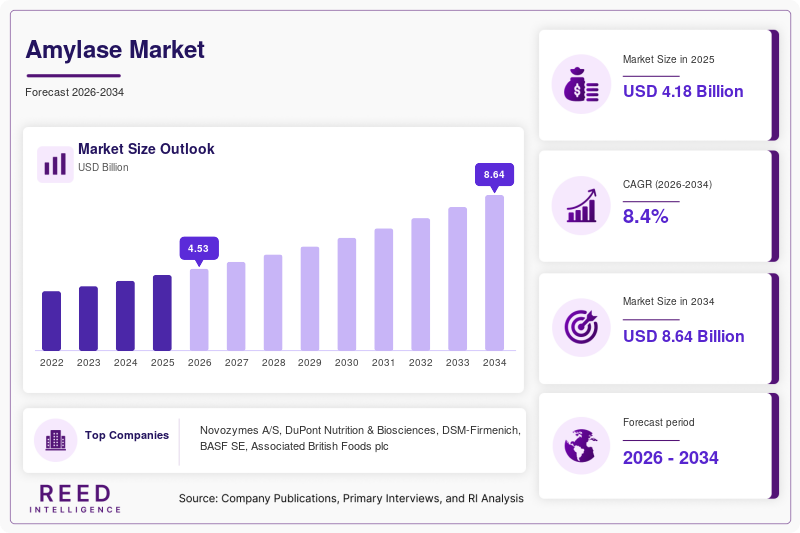
The global Biotechnology Amylase Market size was valued at USD 4.18 billion in 2026 and is projected to reach USD 7.96 billion by 2034, expanding at a CAGR of 8.4% during the forecast period from 2026 to 2034. The market continues to experience stable expansion due to the increasing utilization of enzyme-based processing solutions across food and beverage manufacturing, pharmaceuticals, textile processing, detergents, and biofuel production. Growing preference for sustainable industrial processing technologies has encouraged manufacturers to adopt enzyme-based formulations that reduce chemical dependency and improve production efficiency. Amylase enzymes are widely used for starch hydrolysis, sugar conversion, and fermentation enhancement, making them essential in several industrial applications.
The increasing demand for processed and convenience food products across developing economies has contributed significantly to market growth. Food manufacturers are using amylase enzymes to improve texture, extend shelf life, and optimize baking processes. In addition, rising investments in industrial biotechnology and enzyme engineering have improved product stability and operational efficiency, creating broader adoption opportunities across commercial manufacturing sectors. The expansion of bioethanol production and growing emphasis on environmentally friendly detergents have also supported the deployment of microbial amylase products in large-scale industrial operations.
Key Highlights
- North America dominated the market with a 35.1% share in 2025.
- Asia Pacific is expected to grow at the fastest CAGR of 10.8% during 2026–2034.
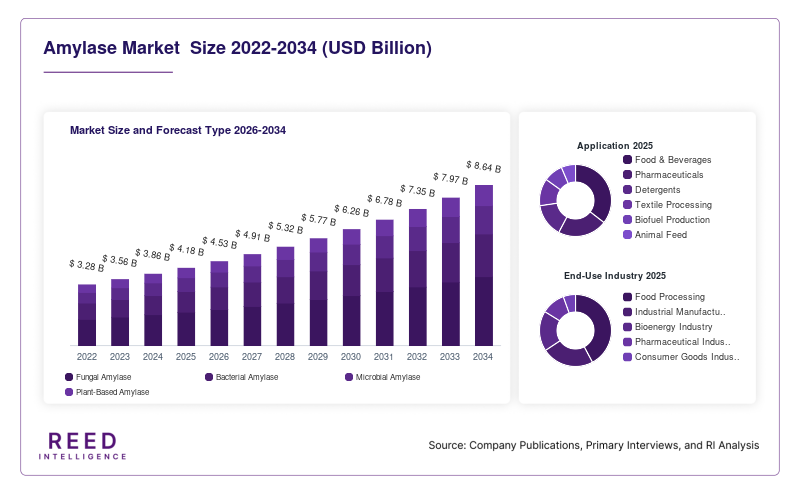
- By type, fungal amylase accounted for the largest share of 42.6%.
- while microbial amylase is projected to grow at a CAGR of 11.4%.
- By application, food & beverages led with a 39.8% share, whereas biofuel production is expected to expand at a CAGR of 10.9%.
- The United States remained the dominant country, with market values of USD 720 million in 2024 and USD 785 million in 2025.
Market Trends
Rising Integration of Enzymes in Functional Food Manufacturing
The food processing industry is increasingly integrating amylase enzymes into functional and fortified food production processes. Manufacturers are focusing on improving product consistency, texture stability, and nutritional value while reducing production time and ingredient waste. Amylase enzymes help optimize starch conversion and improve dough conditioning in bakery products, which has increased their use in commercial baking facilities. Demand for clean-label ingredients and reduced chemical additives is also influencing enzyme adoption among packaged food manufacturers. As consumer preference shifts toward healthier processed foods, companies are investing in enzyme-assisted manufacturing technologies to support efficient and scalable production systems. Emerging economies are witnessing higher consumption of ready-to-eat meals and packaged snacks, which continues to strengthen long-term demand for industrial amylase applications.
Expansion of Industrial Biotechnology and Sustainable Processing
Industrial biotechnology continues to create strong momentum for the Amylase Market as companies prioritize sustainable manufacturing processes. Enzyme-assisted processing reduces water consumption, minimizes harsh chemical use, and improves production efficiency across several industries. Textile manufacturers are increasingly adopting amylase-based desizing solutions to enhance fabric processing while lowering environmental impact. Similarly, detergent manufacturers are incorporating enzyme blends into formulations to improve stain removal performance at lower washing temperatures. Biofuel producers are also utilizing high-performance amylase enzymes to optimize starch breakdown during ethanol production. Continuous advancements in microbial fermentation technology and protein engineering are helping manufacturers develop more stable and heat-resistant enzyme products, expanding their application scope across industrial sectors with demanding operational conditions.
Market Drivers
Increasing Demand from the Food and Beverage Industry
The growing global consumption of processed foods and bakery products is one of the primary drivers supporting the Amylase Market. Food manufacturers rely on amylase enzymes to improve product quality, maintain texture consistency, and enhance fermentation efficiency. In bakery applications, amylase supports dough conditioning and extends shelf life by slowing starch retrogradation. Beverage manufacturers also use the enzyme in brewing and alcohol production to facilitate starch conversion into fermentable sugars. Rising urbanization and changing dietary habits are increasing demand for packaged and convenience foods, particularly across Asia Pacific and Latin America. This trend has encouraged food processing companies to expand production capacities and invest in enzyme-assisted manufacturing technologies that improve productivity and reduce ingredient waste across commercial operations.
Growing Use of Enzymes in Biofuel and Detergent Applications
The increasing focus on renewable energy production and environmentally responsible cleaning products is driving demand for industrial enzymes, including amylase. Bioethanol manufacturers use amylase enzymes during starch liquefaction and saccharification processes to improve ethanol yield and reduce operational costs. Government initiatives supporting biofuel adoption in several countries are encouraging industrial-scale enzyme utilization. In the detergent sector, manufacturers are integrating amylase into enzyme-based formulations to improve stain removal performance and energy efficiency during low-temperature washing cycles. Consumers are increasingly preferring eco-friendly detergent products that reduce water and energy consumption. These factors are contributing to long-term growth opportunities for enzyme manufacturers developing specialized amylase formulations for industrial cleaning and renewable energy applications.
Market Restraint
High Production Costs and Stability Challenges in Industrial Applications
Despite increasing adoption across multiple industries, the Amylase Market faces challenges related to production costs and enzyme stability under varying industrial conditions. Commercial enzyme manufacturing requires advanced fermentation infrastructure, microbial strain optimization, and controlled purification processes, which can increase operational expenses for producers. Smaller manufacturers often face difficulties in maintaining cost competitiveness due to high investment requirements and complex quality control procedures. In addition, enzyme activity can be affected by temperature fluctuations, pH variations, and harsh chemical exposure during industrial processing. These stability limitations may reduce efficiency in applications such as textile manufacturing and detergent formulation. Companies are therefore required to invest heavily in research and development to create heat-resistant and chemically stable enzyme products. The need for continuous product optimization and regulatory compliance also adds pressure on manufacturing costs, particularly in highly regulated food and pharmaceutical industries where product consistency and safety standards remain critical for commercial acceptance.
Market Opportunities
Development of Advanced Microbial Enzyme Technologies
Advancements in microbial engineering and industrial fermentation technologies are creating substantial opportunities for the Amylase Market. Manufacturers are increasingly investing in genetically optimized microbial strains that improve enzyme yield, thermal stability, and production efficiency. Enhanced microbial production methods help reduce manufacturing costs while supporting large-scale commercial deployment across industries. These developments are especially important for food processing, pharmaceuticals, and biofuel applications that require highly stable enzyme performance under demanding operational conditions. Research institutions and biotechnology companies are collaborating to develop next-generation enzyme solutions tailored for industry-specific requirements. The growing use of synthetic biology and protein engineering is expected to support the introduction of customized amylase products with broader application potential and improved process compatibility across industrial manufacturing sectors.
Increasing Adoption in Emerging Economies and Industrial Processing
Emerging economies are presenting significant growth opportunities for enzyme manufacturers due to expanding industrialization and rising demand for processed products. Countries across Asia Pacific, Latin America, and the Middle East are witnessing increasing investments in food processing facilities, textile manufacturing plants, and bioethanol production infrastructure. Growing urban populations and changing consumer lifestyles are contributing to higher demand for packaged food products and industrial cleaning solutions. In addition, supportive government policies promoting sustainable industrial practices are encouraging the adoption of enzyme-based manufacturing technologies. Several multinational companies are expanding regional production facilities and distribution networks to strengthen market penetration in developing economies. These investments are expected to create favorable conditions for long-term market expansion while increasing awareness regarding the operational and environmental advantages of enzyme-assisted industrial processing.
Segmental Analysis
By Type
Fungal amylase accounted for the largest share of the global Amylase Market in 2024 due to its extensive utilization across food processing and brewing industries. Fungal enzymes offer high efficiency in starch hydrolysis and are widely preferred for bakery applications because they improve dough texture and product shelf life. Food manufacturers increasingly rely on fungal amylase formulations to enhance fermentation processes and maintain consistency in large-scale commercial production. The segment also benefits from growing demand for processed foods and beverages across developing economies. In addition, fungal amylase demonstrates effective performance under moderate processing conditions, making it suitable for several industrial applications. Strong adoption across the food and beverage sector has therefore maintained the dominant market position of fungal amylase products in global industrial enzyme manufacturing.
Microbial amylase is projected to register the fastest CAGR of 11.4% during the forecast period due to increasing advancements in microbial fermentation technologies and enzyme engineering. Manufacturers are increasingly adopting microbial enzyme production methods because they support higher yield efficiency and cost-effective commercial manufacturing. Microbial amylase products also demonstrate improved thermal stability and adaptability across industrial applications such as detergents, textiles, and biofuel production. Growing investment in industrial biotechnology research is supporting the development of genetically optimized microbial strains capable of delivering enhanced process performance. In addition, rising emphasis on sustainable industrial practices is encouraging industries to replace traditional chemical processing methods with enzyme-assisted technologies. These factors are expected to strengthen long-term demand for microbial amylase solutions across commercial manufacturing operations.
By Application
Food and beverages represented the dominant application segment in the global Amylase Market in 2024, accounting for a substantial market share due to rising demand for processed and packaged food products. Amylase enzymes are extensively used in bakery products, brewing, dairy processing, and sweetener production because they improve starch conversion efficiency and product quality. Commercial food manufacturers increasingly rely on enzyme-assisted processing technologies to improve operational efficiency while reducing production waste. The growing popularity of convenience foods and ready-to-eat meals has also strengthened demand for industrial enzymes across large-scale food manufacturing operations. Furthermore, increasing consumer preference for clean-label food ingredients is encouraging producers to adopt enzyme-based processing systems that reduce dependency on synthetic additives and harsh chemical treatments.
Biofuel production is expected to emerge as the fastest-growing application segment, expanding at a CAGR of 10.9% during the forecast period. The increasing global focus on renewable energy generation and reduced carbon emissions is driving investment in bioethanol manufacturing infrastructure. Amylase enzymes play a critical role in starch liquefaction and saccharification processes required for ethanol production. Government policies supporting renewable fuel adoption across several countries are encouraging industrial-scale deployment of enzyme-assisted biofuel processing technologies. In addition, technological improvements in enzyme stability and production efficiency are helping manufacturers reduce operational costs associated with bioethanol production. The growing use of agricultural feedstocks for renewable fuel manufacturing is therefore expected to create substantial long-term opportunities for amylase enzyme suppliers operating within the industrial biotechnology sector.
By End-Use Industry
The food processing industry held the largest share of the global Amylase Market in 2024 due to increasing industrial production of bakery products, beverages, confectionery items, and processed meals. Amylase enzymes are essential for improving starch conversion, fermentation efficiency, and product texture within commercial food manufacturing operations. Rising urbanization and changing dietary habits have increased consumption of convenience foods globally, encouraging manufacturers to expand production capacities and optimize operational efficiency through enzyme-assisted processing technologies. In addition, the growing focus on reducing food waste and improving ingredient utilization has strengthened the adoption of industrial enzyme solutions across food production facilities. The segment also benefits from increasing investments in automated food processing systems designed to support high-volume commercial manufacturing activities.
The bioenergy industry is anticipated to witness the fastest CAGR during the forecast period due to rising investments in renewable energy production and sustainable fuel technologies. Industrial enzyme manufacturers are increasingly developing specialized amylase formulations designed for high-efficiency ethanol production processes. Growing concerns regarding fossil fuel dependency and greenhouse gas emissions are encouraging governments and private organizations to expand biofuel manufacturing infrastructure. Amylase enzymes improve starch breakdown efficiency and contribute to higher ethanol yield during fermentation processes, making them essential for commercial bioenergy production. Furthermore, advancements in industrial biotechnology and enzyme engineering are supporting the development of heat-resistant enzyme formulations capable of operating under demanding industrial conditions. These technological developments are expected to strengthen demand for amylase products across renewable energy applications worldwide.
Regional Analysis
North America
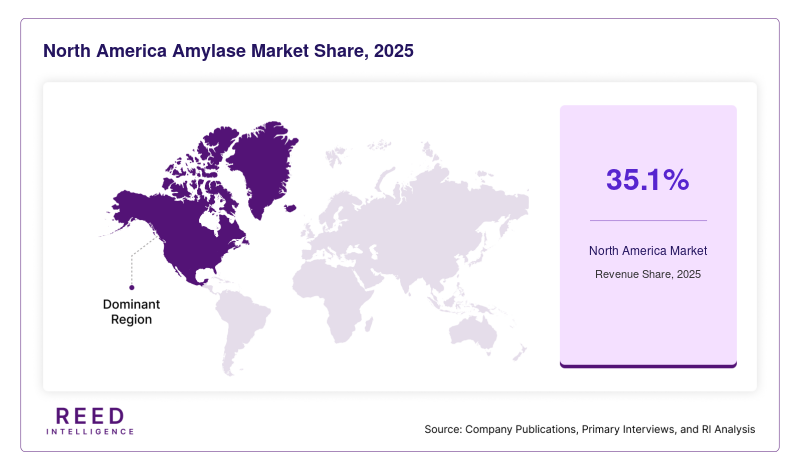
North America accounted for 35.1% of the global Amylase Market share in 2025 and continues to maintain a strong position due to advanced biotechnology infrastructure and high industrial enzyme adoption. The region is expected to expand at a CAGR of 7.8% during the forecast period as food processing, detergents, and pharmaceutical industries continue integrating enzyme-based technologies into commercial production systems. Strong demand for processed foods and sustainable industrial solutions has supported stable enzyme consumption across the United States and Canada. Manufacturers are also investing in research programs focused on improving enzyme stability and production efficiency to strengthen competitive positioning in industrial applications.
Europe
Europe represented a significant share of the global Amylase Market in 2025 and is projected to grow at a CAGR of 7.5% through 2034. The regional market benefits from stringent environmental regulations encouraging industries to adopt sustainable processing technologies. Enzyme-assisted manufacturing solutions are increasingly preferred across food processing, textile manufacturing, and detergents industries due to their lower environmental impact and improved operational efficiency. European manufacturers continue investing in enzyme innovation to improve product performance and reduce chemical dependency across industrial applications. Rising consumer preference for clean-label food products is also contributing to increased demand for enzyme-based food processing technologies across the region.
Asia Pacific
Asia Pacific is expected to register the fastest CAGR of 10.8% during the forecast period due to rapid industrialization and expanding food processing industries. Rising disposable incomes and urbanization across developing countries are increasing consumption of packaged foods, bakery products, and convenience beverages. This trend is supporting higher demand for amylase enzymes in food manufacturing operations. In addition, growing investments in industrial biotechnology and biofuel production infrastructure are contributing to strong regional market growth. Manufacturers are increasingly establishing local production facilities to meet rising demand and improve supply chain efficiency across emerging economies within the region.
Middle East & Africa
The Middle East & Africa region is gradually expanding within the global Amylase Market and is projected to grow at a CAGR of 8.1% over the forecast period. Growth is primarily supported by rising investments in food processing facilities and industrial manufacturing operations across Gulf countries and selected African economies. Increasing urbanization and changing dietary habits are encouraging demand for packaged foods and bakery products, leading to greater adoption of enzyme-assisted production technologies. Regional governments are also promoting industrial diversification strategies that encourage biotechnology investments and sustainable manufacturing practices. These developments are creating new opportunities for industrial enzyme suppliers across the region.
Latin America
Latin America continues to demonstrate steady growth in the Amylase Market and is forecast to expand at a CAGR of 8.4% during 2026–2034. Rising investments in food processing, bioethanol production, and textile manufacturing are supporting broader enzyme adoption across the region. Countries such as Brazil and Mexico are witnessing increasing consumption of processed foods and industrial cleaning products, which is encouraging manufacturers to implement enzyme-assisted production technologies. Growing awareness regarding environmentally sustainable industrial practices has also contributed to higher demand for enzyme-based manufacturing solutions that reduce chemical usage and improve production efficiency in commercial operations.
Competitive Landscape
The global Amylase Market remains moderately consolidated with several multinational biotechnology and industrial enzyme manufacturers competing through product innovation, strategic partnerships, and regional expansion initiatives. Companies are increasingly investing in microbial strain development, fermentation optimization, and customized enzyme solutions to strengthen their industrial application portfolios. Market participants are also expanding production facilities to meet rising demand from food processing, biofuel, and detergent industries.
Novozymes A/S continues to maintain a leading market position due to its extensive enzyme portfolio and strong biotechnology research capabilities. The company recently expanded its industrial enzyme manufacturing operations to improve supply efficiency across Asia Pacific and North America. DuPont Nutrition & Biosciences, DSM-Firmenich, Associated British Foods plc, and BASF SE are also focusing on strategic collaborations and enzyme innovation programs to strengthen their competitive positioning. Increasing investment in sustainable manufacturing technologies and customized enzyme development is expected to intensify competition across industrial application segments during the forecast period.
Key Players
- Novozymes A/S
- DuPont Nutrition & Biosciences
- DSM-Firmenich
- BASF SE
- Associated British Foods plc
- Amano Enzyme Inc.
- Advanced Enzyme Technologies
- Chr. Hansen Holding A/S
- Kerry Group plc
- Bio-Cat Inc.
- Enzyme Development Corporation
- AB Enzymes GmbH
- Adisseo
- Sunson Industry Group
- Specialty Enzymes & Probiotics
Recent Developments
- Novozymes A/S introduced an advanced heat-stable amylase enzyme formulation designed for high-temperature industrial starch processing applications in 2025.
- Advanced Enzyme Technologies expanded its fermentation production facility in Asia Pacific to support rising demand from food processing and biofuel industries in 2024.
- DSM-Firmenich launched a customized enzyme solution portfolio targeting sustainable bakery and brewing applications in 2025.
Amylase Market Segments
Type
- Fungal Amylase
- Bacterial Amylase
- Microbial Amylase
- Plant-Based Amylase
Application
- Food & Beverages
- Pharmaceuticals
- Detergents
- Textile Processing
- Biofuel Production
- Animal Feed
End-Use Industry
- Food Processing
- Industrial Manufacturing
- Bioenergy Industry
- Pharmaceutical Industry
- Consumer Goods Industry
By Region
- North America
- Europe
- APAC
- Middle East and Africa
- LATAM