Android TV Box Market Size, Share, Demand Report By Type (4K, Full HD, Others), By Application (Home, Commercial, Hospitality), By Region & Segment Forecasts, 2026–2034
USD 3950
Android TV Box Market Size
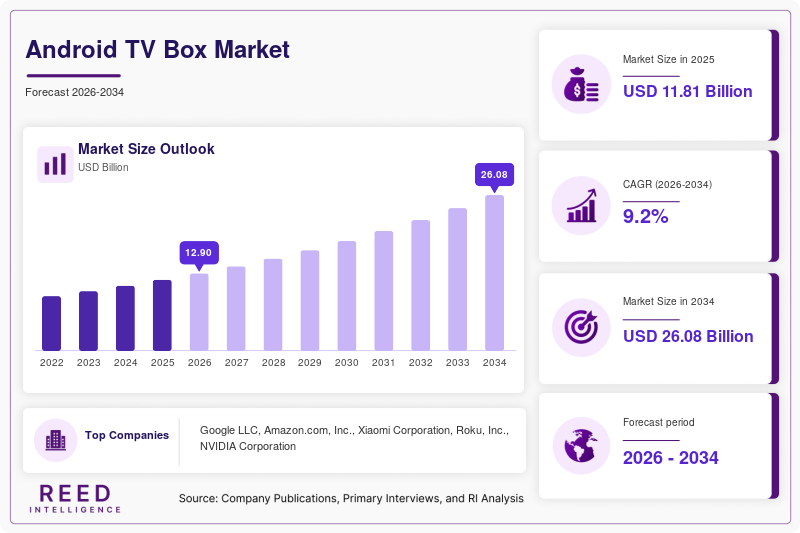
The global Android TV Box market size is projected at USD 12.9 billion in 2026 and is expected to hit USD 26.08 billion by 2034 with a CAGR of 9.2%. The market is being shaped by rising OTT consumption, broadband expansion, 4K content availability, and demand for affordable smart entertainment hardware. Detailed segmentation, production volumes, regional penetration, technology trends, and competitive positioning are increasingly important for manufacturers, operators, distributors, and investors evaluating growth opportunities.
Key Takeaways
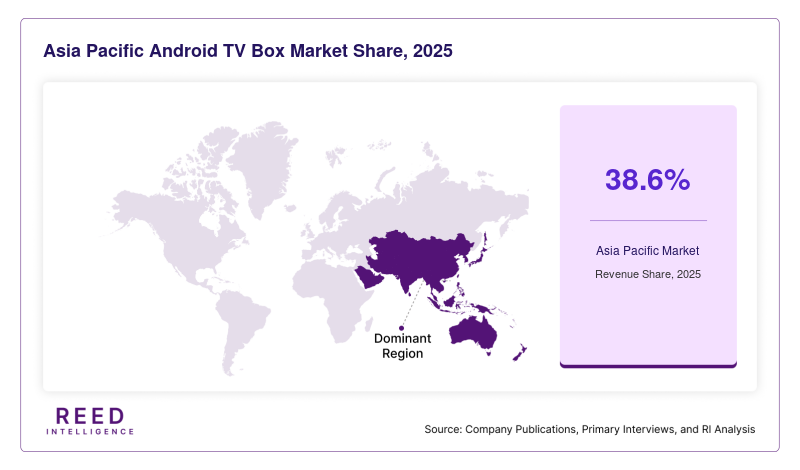
- Asia Pacific dominated the global market with approximately 38.6% share in 2025, while the region is expected to remain the leading market through 2034. India is among the fastest-growing country markets, supported by broadband expansion and increasing OTT adoption.
- 4K Android TV Boxes represented approximately 45.2% of market revenue in 2025 and are expected to remain the dominant type as 4K televisions and UHD streaming become mainstream.
- Home applications accounted for an estimated 68% of global unit demand in 2025, while hospitality and commercial applications are expected to register comparatively faster adoption as managed entertainment platforms expand.
- India is projected to be one of the fastest-growing country markets, with an estimated CAGR of more than 11% through 2034, supported by affordable broadband, OTT platforms, and digital entertainment adoption.
- The global market is estimated to have generated approximately 185 million units of Android TV Box shipments in 2025, with volume expected to increase steadily as replacement demand and emerging-market penetration strengthen.
Android TV Boxes are compact connected-TV devices that use Android-based television software to convert conventional displays into connected entertainment platforms. They provide access to streaming applications, app stores, games, cloud services, voice assistants, casting, and digital content through HDMI-connected hardware. The market includes consumer retail boxes as well as operator-deployed devices used by telecom, IPTV, broadband, and hospitality providers. Production is concentrated across Asian electronics manufacturing hubs, particularly China and other East Asian manufacturing centers, while adoption is expanding rapidly across emerging markets. In 2025, 4K products contributed approximately 45.2% of market revenue, while home applications accounted for roughly 68% of unit demand.
Android TV Box Market Trends
AI-enabled entertainment and advanced connectivity
The Android TV Box industry is moving from basic streaming hardware toward intelligent entertainment hubs. Manufacturers are incorporating faster quad-core processors, Wi-Fi 6 connectivity, improved graphics processing, HDR10+, Dolby Vision, Dolby Atmos, DTS:X, voice search, personalized recommendations, and AI-supported content discovery. Google TV interfaces are increasingly appearing alongside traditional Android TV deployments, while AI assistants are becoming an important differentiating feature in premium devices.
Sector-specific demand is also expanding beyond household entertainment. Telecom operators are deploying Android-based boxes for IPTV and broadband bundles, while hotels, serviced apartments, healthcare facilities, educational institutions, and retail locations use managed Android TV platforms for customized content delivery. Demand is particularly strong for 4K-capable hardware with centralized device management, secure DRM, remote software updates, and integrated advertising or content-management capabilities.
Android TV Box Market Drivers
Rapid expansion of OTT and streaming consumption
The proliferation of subscription video-on-demand, free ad-supported television, live streaming, gaming, and regional OTT platforms is a primary growth driver. Android TV Boxes offer consumers an economical alternative to replacing an existing television, while operators can use certified devices to deliver broadband, IPTV, and streaming services through a unified interface. Falling component prices and wider availability of 4K televisions further support replacement and upgrade cycles.
Android TV Box Market Restraints
Increasing penetration of integrated smart televisions
Growing availability of affordable smart televisions reduces the need for standalone streaming hardware, particularly in developed markets. Consumers increasingly purchase televisions with integrated Google TV, Android TV, Roku, or proprietary platforms, limiting replacement demand for entry-level boxes. Product fragmentation, certification costs, software-support requirements, and competition from streaming sticks also create pricing pressure for standalone Android TV Box manufacturers.
Android TV Box Market Opportunities
Expansion across emerging markets and managed entertainment
Emerging economies provide significant opportunities because many households continue to use conventional televisions and seek inexpensive pathways to online entertainment. India, Southeast Asia, Latin America, the Middle East, and Africa offer opportunities for low-cost 4K devices, operator bundles, and localized OTT ecosystems. Hospitality is another promising opportunity, as hotels increasingly seek centralized Android-based entertainment platforms with guest personalization, casting, streaming access, and remote management.
Challenges in Android TV Box Market
Price competition, platform dependency, and cybersecurity
Manufacturers face intense competition from established streaming ecosystems, low-cost unbranded devices, smart televisions, and streaming sticks. Dependence on operating-system certification and third-party content ecosystems can increase development costs and restrict product flexibility. Cybersecurity, DRM compliance, software fragmentation, counterfeit devices, privacy requirements, and long-term firmware support are additional challenges that can influence purchasing decisions and brand reputation.
Android TV Box Market Segmentation Analysis
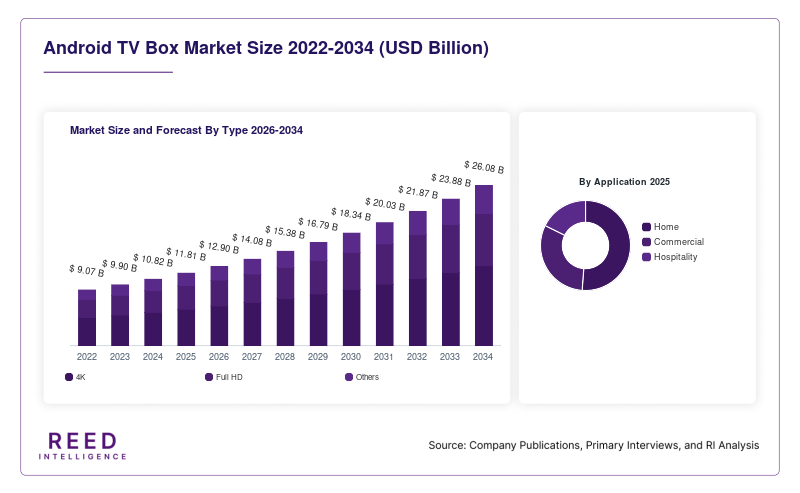
The market is primarily segmented by product type and application. The 4K segment held the largest share at approximately 45.2% of 2025 market revenue, while home applications represented the largest demand pool at an estimated 68% of total unit shipments. Commercial and hospitality applications are expected to grow faster as operators and businesses adopt centralized connected-TV infrastructure.
By Type
4K: The 4K segment accounted for approximately 45.2% share in 2025, representing an estimated 83.6 million units. These devices typically support 3840 × 2160 resolution, HDR formats, dual-band Wi-Fi, Bluetooth connectivity, HDMI output, and increasingly Wi-Fi 6. Demand is supported by falling 4K television prices and wider availability of UHD streaming content. Premium products commonly combine 2–4 GB RAM with 8–32 GB storage and enhanced audio/video codecs.
Full HD: Full HD products represented approximately 30.4% share, corresponding to around 56.2 million units in 2025. Supporting 1920 × 1080 resolution, these devices remain popular in price-sensitive markets where existing televisions have not transitioned to 4K. Typical specifications include quad-core processors, 1–2 GB RAM, 8–16 GB storage, Wi-Fi connectivity, Bluetooth, HDMI, and USB interfaces. The segment is expected to grow at a slower rate as 4K products become more affordable.
Others: Other products, including entry-level HD and emerging higher-resolution devices, accounted for approximately 24.4% share, or about 45.1 million units. The category includes specialized devices used in commercial deployments and premium configurations supporting enhanced processing, higher storage, advanced HDR, and gaming capabilities. Demand is supported by niche applications and continuing product experimentation.
By Application
Home: Home applications dominated with an estimated 68% share of 2025 unit demand, equivalent to approximately 125.8 million units. Consumers use Android TV Boxes for OTT streaming, live television, gaming, casting, music, and smart-home integration. Affordable 1080p and 4K devices remain especially important in developing markets, while premium households increasingly prefer high-performance hardware with 4K HDR, Wi-Fi 6, voice control, and expanded storage.
Commercial: Commercial applications represented approximately 22% of units, or about 40.7 million devices. Retail stores, offices, healthcare facilities, education providers, restaurants, and entertainment venues use Android-based boxes for digital signage, informational displays, IPTV, training content, and managed video services. Commercial demand increasingly favors secure hardware, centralized management, reliable connectivity, remote updates, and extended operating lifecycles.
Hospitality: Hospitality applications represented approximately 10% of shipments, equivalent to around 18.5 million units. Hotels and serviced accommodation providers deploy Android TV hardware to provide guest streaming, personalized welcome screens, hotel information, casting, room-service interfaces, and managed entertainment. This segment is expected to record strong growth as hospitality operators replace proprietary IPTV systems with flexible Android-based platforms.
Android TV Box Market Regional Analysis
Asia Pacific Android TV Box Market
Asia Pacific held approximately 38.6% of global revenue in 2025 and remains the largest regional market. China contributes substantially through electronics manufacturing and domestic consumption, while India is among the fastest-growing markets. Southeast Asian countries are also adopting affordable Android TV Boxes as broadband access and OTT consumption increase. Residential demand dominates, followed by telecom operator deployments, hospitality, and commercial applications.
North America Android TV Box Market
North America represents a mature but technologically advanced market, supported by high OTT penetration, premium streaming subscriptions, gaming, and replacement demand. The United States accounts for the majority of regional consumption, while Canada contributes through broadband and streaming-device adoption. Demand is concentrated in premium 4K products, operator devices, and advanced home entertainment systems.
Europe Android TV Box Market
Europe maintains strong demand for Android-based connected-TV equipment because of extensive broadband coverage, IPTV adoption, and growing streaming consumption. Germany, the U.K., France, Italy, and Spain are important markets. Residential use remains dominant, while telecom operators and hospitality providers increasingly deploy centrally managed Android TV platforms.
Latin America Android TV Box Market
Latin America is experiencing increasing adoption as households migrate from traditional television toward streaming services. Brazil and Mexico represent major contributors, while Argentina, Colombia, and Chile provide additional growth opportunities. Affordable Full HD and 4K products dominate residential demand, with operator and hospitality deployments supporting commercial growth.
Middle East & Africa Android TV Box Market
The Middle East & Africa market is developing rapidly from a comparatively smaller base. Gulf countries demonstrate strong premium-device demand, while African markets favor affordable Android TV Boxes that provide access to OTT services on existing televisions. South Africa, Saudi Arabia, the UAE, and other connected urban markets contribute significantly to regional demand.
Top Players in the Android TV Box Market
- Google LLC
- Amazon.com, Inc.
- Xiaomi Corporation
- Roku, Inc.
- NVIDIA Corporation
- Skyworth Digital Holdings Limited
- TCL Technology
- Hisense Group
- Sony Corporation
- Vantiva
- KAON Media Co., Ltd.
- ZTE Corporation
- Huawei Technologies Co., Ltd.
- Shenzhen Coship Electronics Co., Ltd.
Recent Developments in Android TV Box Market
- September 2026: New Android TV devices continued entering operator and retail markets, including STRONG LEAP-S4, Elisa Viihde Plus 2, and other Amlogic S905X5-powered platforms, highlighting the transition toward faster next-generation chipsets.
- August 2026: Multiple operator Android TV platforms were introduced across Europe, Latin America, the Middle East, and India, reflecting continued expansion of managed IPTV and OTT deployments.
- May 2026: Major television manufacturers accelerated AI-enabled connected-TV strategies, increasing competition between integrated smart televisions and standalone Android TV streaming hardware.
- July 2025: Xiaomi introduced its second-generation TV Stick 4K with Google TV, 4K output, Dolby Vision, HDR10+, Wi-Fi 6, and upgraded processing, reinforcing the shift toward higher-performance streaming devices.
- September 2025: Google expanded Gemini capabilities to Google TV, introducing conversational AI-assisted content discovery and signaling a broader move toward AI-powered television experiences.
Android TV Box Market Segments
By Type
- 4K
- Full HD
- Others
By Application
- Home
- Commercial
- Hospitality
By Region
- North America
- Europe
- APAC
- Middle East and Africa
- LATAM