Anemia And Vitamin Test Market Size, Share & Demand Report By Test Type (Complete Blood Count Tests, Ferritin Tests, Vitamin B12 Tests, Vitamin D Tests, Folate Tests, Iron Profile Tests), By Technology (Immunoassay Systems, Molecular Diagnostics, Chromatography-Based Testing, Point-of-Care Testing, Automated Hematology Analyzers), By End Use (Hospitals, Diagnostic Laboratories, Homecare Settings, Research Institutes, Specialty Clinics), By Region & Segment Forecasts, 2026–2034
USD 3950
Market Overview
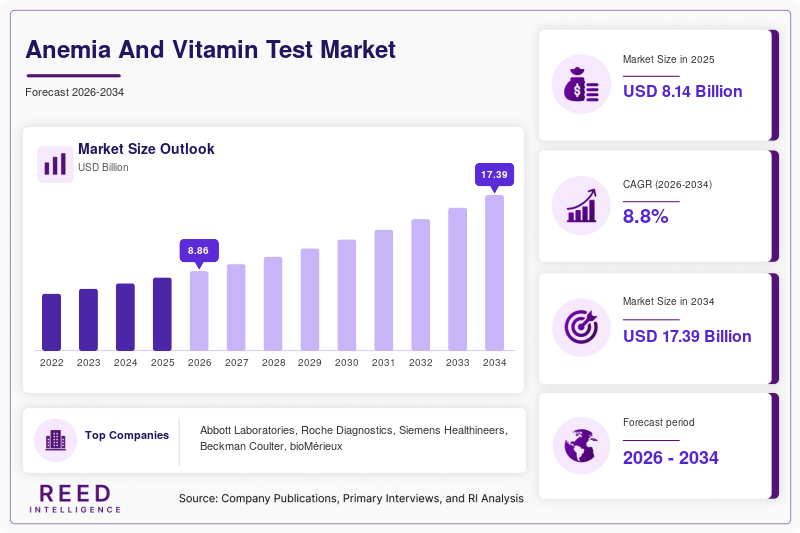
The global Anemia And Vitamin Test Market size was valued at USD 8.14 billion in 2026 and is projected to reach USD 15.92 billion by 2034, expanding at a CAGR of 8.8% during the forecast period from 2026 to 2034. The market is experiencing consistent growth due to the increasing prevalence of nutritional deficiencies, rising awareness regarding preventive healthcare, and growing adoption of routine diagnostic screening across hospitals and homecare settings. Governments and healthcare organizations are also expanding anemia detection initiatives among women, children, and geriatric populations, which continues to support testing demand across developed and developing economies.
The increasing burden of iron deficiency anemia and vitamin B12 deficiency remains one of the major public health concerns globally. Healthcare providers are emphasizing early-stage diagnosis to reduce long-term complications associated with chronic fatigue, neurological disorders, and weakened immunity. In addition, the expansion of point-of-care testing technologies and digital diagnostic platforms has improved access to affordable and rapid blood testing services. Diagnostic laboratories are increasingly integrating automated analyzers and AI-assisted reporting systems to improve operational efficiency and reduce turnaround time.
Key Highlights
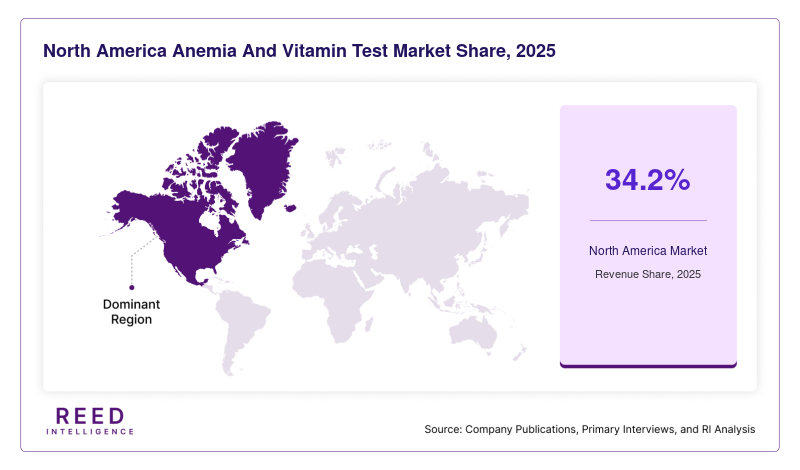
- North America dominated the Anemia And Vitamin Test Market with a 34.2% share in 2025, while Asia Pacific is expected to grow at the fastest CAGR of 11.2% during 2026–2034.
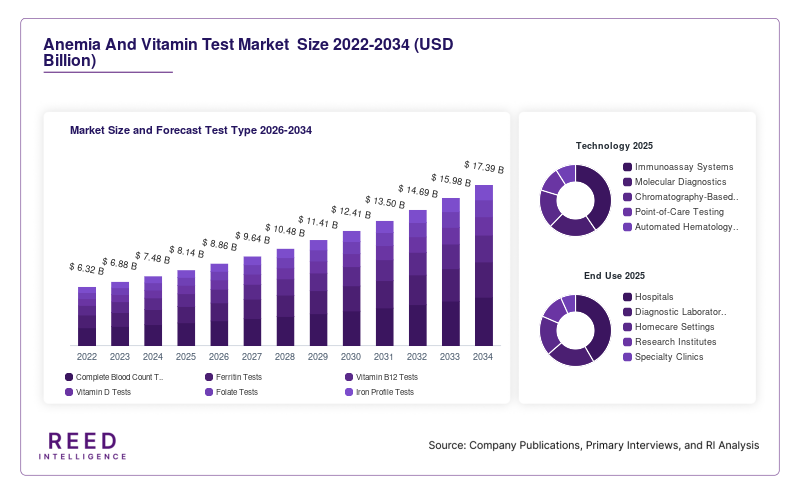
- By test type, complete blood count tests accounted for the largest share of 39.1%, while vitamin D testing is projected to grow at a CAGR of 12.1%.
- By technology, immunoassay systems led with a 36.8% share, whereas molecular diagnostic platforms are expected to expand at a CAGR of 11.5%.
- By end use, hospitals represented the dominant share of 44.7%, while homecare diagnostics are projected to grow at a CAGR of 12.4%.
- The United States remained the dominant country, with market values of USD 1.86 billion in 2024 and USD 2.01 billion in 2025.
Market Trends
Expansion of At-Home Diagnostic Testing Services
The increasing adoption of home-based healthcare services is shaping the growth trajectory of the Anemia And Vitamin Test Market. Consumers are showing greater preference for convenient diagnostic solutions that minimize hospital visits and reduce waiting times. Home sample collection services and self-testing kits are gaining traction among working professionals, elderly individuals, and patients requiring regular nutritional monitoring. Companies are introducing user-friendly testing kits integrated with mobile health applications that provide digital reports and physician consultation support.
The demand for vitamin D, vitamin B12, and ferritin self-testing products has increased substantially in urban healthcare markets. Diagnostic service providers are also collaborating with e-commerce healthcare platforms to improve product visibility and delivery efficiency. The trend is particularly strong in Asia Pacific and North America, where telehealth adoption continues to rise. Increasing smartphone penetration and digital healthcare awareness are expected to further strengthen the long-term adoption of at-home anemia and vitamin testing solutions.
Rising Integration of Automation and AI in Diagnostic Laboratories
Clinical laboratories are increasingly integrating automation and artificial intelligence technologies into diagnostic workflows to improve testing accuracy and efficiency. Automated analyzers capable of processing large sample volumes with minimal human intervention are becoming standard in hospitals and reference laboratories. AI-assisted reporting platforms are helping healthcare professionals identify abnormal nutritional markers and anemia-related complications more effectively.
The growing need to reduce operational costs and laboratory turnaround times is accelerating investment in smart diagnostic infrastructure. Automated systems are also improving standardization in vitamin and hematology testing procedures, reducing the possibility of manual errors. In addition, cloud-connected diagnostic systems are enabling remote monitoring and centralized data management across healthcare networks. These advancements are encouraging laboratories to expand testing capacity while improving patient outcomes, thereby contributing significantly to the growth of the Anemia And Vitamin Test Market.
Market Drivers
Increasing Prevalence of Nutritional Deficiencies Worldwide
The growing incidence of iron deficiency anemia, vitamin D deficiency, and vitamin B12 disorders is one of the major factors driving the Anemia And Vitamin Test Market. Sedentary lifestyles, changing dietary habits, and rising consumption of processed foods have contributed to nutritional imbalances among both adults and children. Pregnant women, elderly populations, and individuals with chronic illnesses remain highly vulnerable to anemia and vitamin deficiencies, increasing the need for regular diagnostic monitoring.
Healthcare organizations are also promoting nutritional screening programs to identify deficiencies at an early stage. Schools, corporate wellness initiatives, and maternal healthcare campaigns are increasingly incorporating vitamin and hemoglobin testing into preventive healthcare strategies. Developing economies are witnessing a sharp increase in awareness regarding micronutrient deficiencies, particularly among middle-income populations. As healthcare expenditure rises globally, diagnostic testing is becoming more accessible, further strengthening market demand across hospitals, laboratories, and homecare environments.
Growth in Preventive Healthcare and Routine Health Screening
Preventive healthcare practices are becoming increasingly important across global healthcare systems, creating substantial demand for anemia and vitamin testing services. Consumers are prioritizing early disease detection and wellness monitoring to avoid long-term medical complications. Routine blood screening packages offered by hospitals and diagnostic laboratories commonly include iron profile tests, complete blood count panels, and vitamin deficiency assessments.
Corporate healthcare programs and insurance-supported annual health checkups are further encouraging frequent testing adoption. In developed countries, healthcare providers are recommending regular vitamin D and vitamin B12 screening among aging populations due to the rising burden of bone disorders and neurological conditions. Moreover, increasing health awareness through digital media and wellness campaigns is influencing younger populations to undergo nutritional health assessments. The growing emphasis on personalized healthcare and preventive diagnostics is expected to remain a major growth contributor for the Anemia And Vitamin Test Market over the forecast period.
Market Restraint
High Cost of Advanced Diagnostic Technologies in Emerging Economies
Despite the growing adoption of nutritional diagnostic testing, the high cost associated with advanced testing systems remains a significant challenge for market expansion. Automated analyzers, molecular diagnostic platforms, and AI-enabled laboratory systems require substantial capital investment, making them less accessible for small healthcare facilities and rural diagnostic centers. Many low-income and developing regions continue to depend on conventional laboratory infrastructure with limited testing capabilities.
The affordability gap also affects patient access to specialized vitamin and mineral deficiency testing. Comprehensive nutritional panels involving multiple biomarkers are often expensive for uninsured populations, reducing testing frequency in price-sensitive markets. In several developing countries, inadequate reimbursement structures and limited public healthcare funding further restrict widespread adoption of advanced diagnostic technologies. Additionally, a shortage of trained laboratory professionals in underserved regions creates operational challenges for sophisticated diagnostic systems. These factors collectively limit market penetration, particularly across remote healthcare settings and economically constrained regions.
Market Opportunities
Expansion of Digital Health Platforms and Telemedicine Services
The rapid expansion of digital healthcare ecosystems is creating new growth opportunities for the Anemia And Vitamin Test Market. Telemedicine platforms are increasingly integrating diagnostic testing services into virtual healthcare consultations, allowing patients to access nutritional assessments from home. Digital prescription systems and app-based health monitoring solutions are making it easier for healthcare providers to recommend vitamin and anemia screening programs.
Healthcare startups are also developing integrated wellness platforms that combine diagnostic testing, nutritional counseling, and personalized supplementation recommendations. The increasing use of wearable health technologies and connected devices may further support real-time nutritional monitoring in the future. Emerging economies are witnessing strong investment in digital healthcare infrastructure, particularly in urban centers with growing internet penetration. These developments are expected to improve accessibility to anemia and vitamin testing services while supporting long-term market expansion.
Increasing Demand for Personalized Nutrition and Wellness Programs
The growing consumer focus on personalized nutrition is opening significant opportunities for diagnostic companies operating in the Anemia And Vitamin Test Market. Consumers are becoming more aware of the relationship between nutritional balance and long-term health outcomes. As a result, personalized wellness plans based on individual vitamin and mineral profiles are gaining popularity across fitness, preventive healthcare, and lifestyle management sectors.
Healthcare providers and wellness clinics are increasingly offering customized supplementation programs based on blood test results. Fitness centers, sports organizations, and nutrition consultants are also incorporating vitamin deficiency testing into performance optimization programs. The increasing adoption of precision healthcare strategies is expected to strengthen demand for comprehensive nutritional diagnostic solutions. In addition, rising disposable income and expanding middle-class populations in developing economies are encouraging consumers to spend more on preventive wellness services, creating favorable growth conditions for the market.
Segmental Analysis
By Test Type
Complete blood count tests accounted for the largest share of the Anemia And Vitamin Test Market in 2024 due to their widespread use in routine diagnostic screening and anemia detection. These tests are commonly performed in hospitals, diagnostic laboratories, and primary healthcare centers to evaluate hemoglobin levels, red blood cell count, and hematocrit values. Healthcare providers rely heavily on complete blood count testing because it provides rapid and cost-effective insights into various hematological disorders. The growing prevalence of iron deficiency anemia among women, children, and elderly populations continues to support high testing volumes globally. In addition, increasing integration of automated hematology analyzers in laboratories has improved testing efficiency and expanded accessibility across both developed and emerging healthcare markets.
Vitamin D testing is projected to register the fastest CAGR of 12.1% during the forecast period due to rising awareness regarding bone health, immune function, and chronic disease prevention. Increasing sedentary lifestyles and reduced outdoor exposure have contributed significantly to vitamin D deficiency across urban populations. Healthcare professionals are increasingly recommending vitamin D testing for elderly individuals, pregnant women, and patients with osteoporosis or autoimmune disorders. The growing popularity of preventive wellness programs and personalized nutrition plans is also accelerating demand for vitamin D screening. Moreover, direct-to-consumer health testing services and digital wellness platforms are making vitamin deficiency testing more accessible to broader consumer groups across multiple regions.
By Technology
Immunoassay systems held the dominant share of the market in 2024 due to their high sensitivity, accuracy, and broad application range in vitamin and mineral deficiency testing. These systems are extensively used for detecting biomarkers associated with vitamin B12, ferritin, folate, and vitamin D deficiencies. Clinical laboratories prefer immunoassay technologies because they provide reliable results with faster turnaround times compared to traditional manual testing methods. The increasing automation of immunoassay analyzers has further improved operational efficiency and reduced laboratory workload. Growing demand for high-throughput diagnostic solutions among hospitals and reference laboratories continues to strengthen adoption of immunoassay-based testing platforms across global healthcare systems.
Molecular diagnostic platforms are expected to grow at the fastest CAGR of 11.5% during 2026–2034 due to rising interest in precision medicine and advanced nutritional diagnostics. These technologies allow healthcare professionals to identify genetic and metabolic factors associated with nutrient absorption disorders and chronic anemia conditions. The increasing use of genomic analysis in personalized healthcare strategies is contributing to market expansion. Research institutions and advanced diagnostic laboratories are investing in molecular diagnostic capabilities to support targeted nutritional treatment approaches. Furthermore, technological advancements in PCR-based systems and next-generation sequencing platforms are improving testing accuracy and expanding the application scope of molecular diagnostics in nutritional healthcare.
By End Use
Hospitals represented the largest share of the Anemia And Vitamin Test Market in 2024 because they serve as primary centers for diagnostic testing and chronic disease management. Hospitals conduct a large volume of anemia and vitamin deficiency tests for inpatient, outpatient, and emergency care settings. The availability of advanced laboratory infrastructure and skilled healthcare professionals enables hospitals to manage complex nutritional diagnostic procedures effectively. Increasing patient admissions associated with chronic illnesses, pregnancy-related complications, and geriatric care are contributing to higher testing demand. In addition, hospitals are increasingly integrating automated diagnostic technologies to improve workflow efficiency and support faster clinical decision-making processes.
Homecare diagnostics are projected to expand at the fastest CAGR of 12.4% during the forecast period due to increasing consumer preference for convenient and remote healthcare services. Patients are increasingly adopting home-based blood testing kits and digital health platforms for regular nutritional monitoring. The rise of telemedicine and app-based healthcare consultation services has significantly improved awareness regarding home diagnostic solutions. Elderly individuals and patients with mobility limitations particularly benefit from at-home testing convenience. Furthermore, growing investment in user-friendly self-testing technologies and rapid sample collection methods is expected to accelerate adoption across developed and emerging markets. Expanding e-commerce healthcare distribution channels are also supporting wider accessibility of homecare diagnostic products.
Regional Analysis
North America
North America accounted for 34.2% of the global Anemia And Vitamin Test Market share in 2025 and continues to maintain a leading position due to strong healthcare infrastructure and high preventive healthcare adoption. The region is projected to expand at a CAGR of 8.1% during the forecast period. The presence of advanced diagnostic laboratories, rising demand for routine wellness screening, and increasing healthcare spending are supporting market expansion. Growing awareness regarding vitamin D deficiency and iron deficiency anemia among aging populations also contributes to testing demand across the United States and Canada.
The United States remains the dominant country in the region due to the widespread availability of advanced diagnostic services and high consumer awareness regarding nutritional health. The country is also witnessing increasing adoption of home-based blood testing kits and telehealth-integrated diagnostic solutions. Employer-sponsored wellness programs and insurance-supported annual screening packages continue to encourage regular vitamin and anemia testing. Additionally, strong investments in laboratory automation technologies are improving diagnostic efficiency and supporting market growth across the country.
Europe
Europe represented a substantial share of the Anemia And Vitamin Test Market in 2025 and is expected to grow at a CAGR of 7.9% during 2026–2034. The regional market benefits from established healthcare systems, rising geriatric populations, and increasing awareness regarding nutritional deficiencies. Governments across several European countries are promoting preventive healthcare strategies to reduce the long-term burden of chronic diseases associated with vitamin deficiencies and anemia-related disorders.
Germany remains the dominant country in the European market due to strong diagnostic infrastructure and high healthcare expenditure. The country has witnessed increasing adoption of preventive blood screening programs among elderly populations and pregnant women. Rising focus on personalized nutrition and wellness monitoring is also contributing to testing demand. Furthermore, the expansion of private diagnostic laboratories and technological advancements in automated testing systems continue to strengthen the regional market outlook.
Asia Pacific
Asia Pacific is projected to register the fastest CAGR of 11.2% during the forecast period due to rapid healthcare infrastructure development and increasing awareness regarding nutritional deficiencies. The region is experiencing growing demand for affordable diagnostic testing services, particularly in densely populated countries. Rising urbanization, changing dietary patterns, and increasing prevalence of vitamin deficiencies are supporting market growth across both developed and emerging economies.
China remains the dominant country in the region due to its large patient population and expanding healthcare investments. Government-supported public health programs focused on maternal nutrition and anemia prevention are significantly increasing diagnostic testing volumes. The country is also witnessing strong growth in online healthcare platforms offering home sample collection and digital reporting services. Rapid expansion of private diagnostic chains and growing middle-class healthcare spending are expected to further accelerate market growth in China.
Middle East & Africa
The Middle East & Africa region is experiencing steady growth in the Anemia And Vitamin Test Market and is forecast to expand at a CAGR of 7.4% during 2026–2034. Increasing healthcare awareness, rising prevalence of vitamin D deficiency, and gradual improvements in diagnostic infrastructure are supporting market development. Governments across Gulf countries are investing in healthcare modernization programs, including laboratory expansion and preventive screening initiatives.
Saudi Arabia represents the leading country within the regional market due to increasing healthcare expenditure and growing awareness regarding lifestyle-related nutritional disorders. The country has a high prevalence of vitamin D deficiency caused by limited sun exposure and changing lifestyle patterns. Public health campaigns promoting early diagnosis and preventive care are encouraging regular testing among adults and children. In addition, expansion of private healthcare facilities and laboratory networks is improving diagnostic accessibility across urban areas.
Latin America
Latin America is expected to witness moderate growth in the Anemia And Vitamin Test Market with increasing demand for affordable preventive healthcare services. The region is projected to grow at a CAGR of 7.6% during the forecast period. Rising awareness regarding nutritional deficiencies among women and children is contributing to greater adoption of anemia and vitamin testing services. Healthcare reforms and improvements in laboratory infrastructure are also supporting market expansion.
Brazil dominates the Latin American market due to its large healthcare network and increasing focus on public nutrition programs. The country has implemented several initiatives aimed at reducing iron deficiency anemia among children and pregnant women. Growing investments in private diagnostic laboratories and telehealth services are improving patient access to testing facilities. Additionally, increasing urban healthcare awareness and expanding middle-income populations are expected to sustain long-term market growth across Brazil.
Competitive Landscape
The Anemia And Vitamin Test Market is moderately fragmented with the presence of multinational diagnostic companies, regional laboratory service providers, and emerging digital healthcare firms. Market participants are focusing on product innovation, automation technologies, strategic partnerships, and geographic expansion to strengthen their competitive position. Companies are increasingly investing in AI-enabled diagnostic platforms and advanced biomarker testing solutions to improve testing accuracy and workflow efficiency.
Abbott Laboratories remains one of the leading players in the market due to its extensive portfolio of diagnostic analyzers and nutritional testing solutions. The company continues to expand its automated laboratory systems across hospital and diagnostic laboratory networks globally. Roche Diagnostics, Siemens Healthineers, Beckman Coulter, and bioMérieux also maintain strong market positions through continuous investment in advanced immunoassay technologies and digital laboratory platforms.
Recent competitive activity includes the launch of integrated vitamin testing panels, expansion of home-based diagnostic services, and collaboration between telehealth providers and laboratory networks. Several companies are also focusing on emerging economies where preventive healthcare awareness and diagnostic accessibility are improving steadily.
Key Players
- Abbott Laboratories
- Roche Diagnostics
- Siemens Healthineers
- Beckman Coulter
- bioMérieux
- Thermo Fisher Scientific
- Quest Diagnostics
- Laboratory Corporation of America Holdings
- Sysmex Corporation
- Bio-Rad Laboratories
- Randox Laboratories
- Ortho Clinical Diagnostics
- DiaSorin S.p.A.
- Mindray Medical International
- ARUP Laboratories
Recent Developments
- In March 2026, Roche Diagnostics introduced an advanced automated vitamin deficiency testing panel designed for high-throughput clinical laboratories.
- In November 2025, Abbott Laboratories expanded its point-of-care hematology testing portfolio for rapid anemia screening in primary healthcare facilities.
- In January 2026, Siemens Healthineers partnered with digital health providers to integrate AI-assisted nutritional diagnostic reporting into telehealth platforms.
- In August 2025, Sysmex Corporation launched a compact hematology analyzer targeting small and mid-sized diagnostic laboratories across Asia Pacific.
- In February 2026, Beckman Coulter announced the expansion of its immunoassay testing capabilities for vitamin B12 and ferritin biomarker analysis.
Anemia And Vitamin Test Market Segments
Test Type
- Complete Blood Count Tests
- Ferritin Tests
- Vitamin B12 Tests
- Vitamin D Tests
- Folate Tests
- Iron Profile Tests
Technology
- Immunoassay Systems
- Molecular Diagnostics
- Chromatography-Based Testing
- Point-of-Care Testing
- Automated Hematology Analyzers
End Use
- Hospitals
- Diagnostic Laboratories
- Homecare Settings
- Research Institutes
- Specialty Clinics
By Region
- North America
- Europe
- APAC
- Middle East and Africa
- LATAM