Anesthesia Gas Blender Market Size, Share & Demand Report By Product Type (Electronic Anesthesia Gas Blenders, Mechanical Anesthesia Gas Blenders, Portable Anesthesia Gas Blenders), By Application (Hospital Operating Rooms, Ambulatory Surgical Centers, Intensive Care Units, Emergency Care Facilities), By End Use (Hospitals, Specialty Clinics, Ambulatory Surgical Centers, Academic and Research Institutions), By Region & Segment Forecasts, 2026–2034
USD 3950
Market Overview
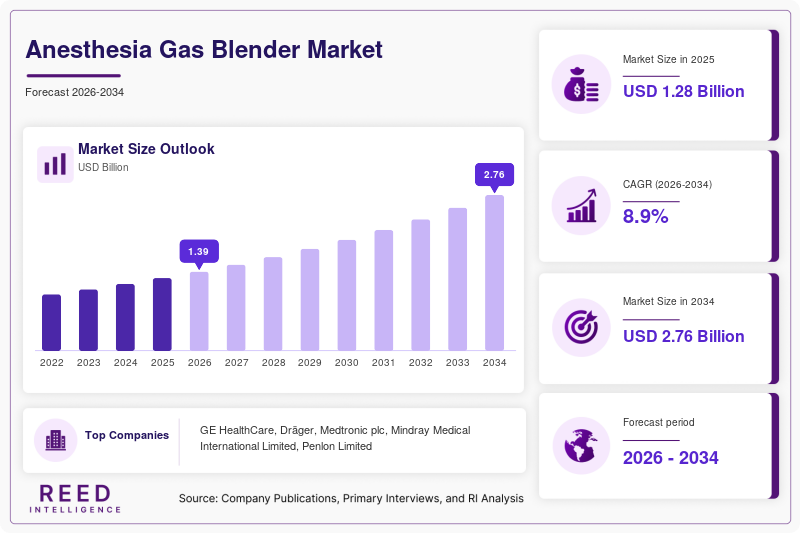
The global Anesthesia Gas Blender Market size was valued at approximately USD 1.28 billion in 2026 and is projected to reach USD 2.54 billion by 2034, expanding at a CAGR of 8.9% during 2026–2034. The market is witnessing steady expansion due to the growing volume of surgical procedures worldwide, increasing healthcare infrastructure investments, and rising demand for precise gas delivery systems in operating rooms and critical care environments. Anesthesia gas blenders play a crucial role in controlling oxygen and medical gas mixtures, helping clinicians maintain patient safety and optimize anesthesia administration.
A significant global factor supporting market growth is the continuous increase in surgical interventions associated with aging populations and the growing prevalence of chronic diseases. Healthcare systems across developed and emerging economies are investing in advanced anesthesia delivery technologies to improve procedural efficiency and reduce complications. Modern anesthesia gas blenders equipped with digital controls, automated monitoring functions, and integrated alarm systems are gaining wider acceptance among hospitals and ambulatory surgical centers.
Key Highlights
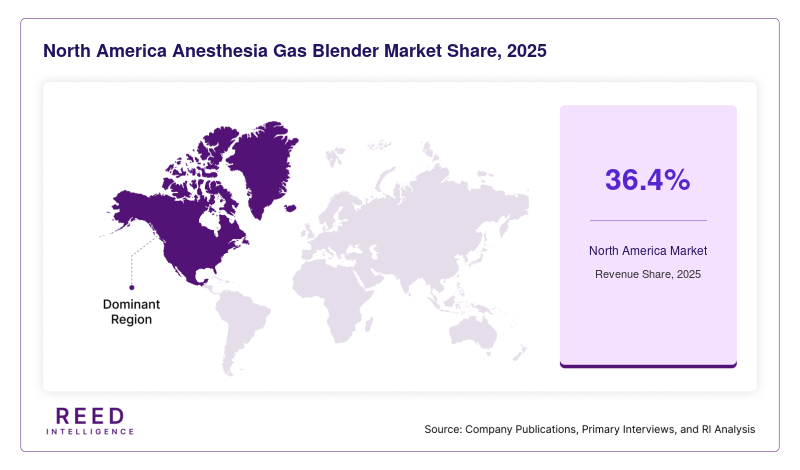
- North America dominated the market with a 36.4% share in 2025, while Asia Pacific is expected to grow at the fastest CAGR of 10.8% during 2026–2034.
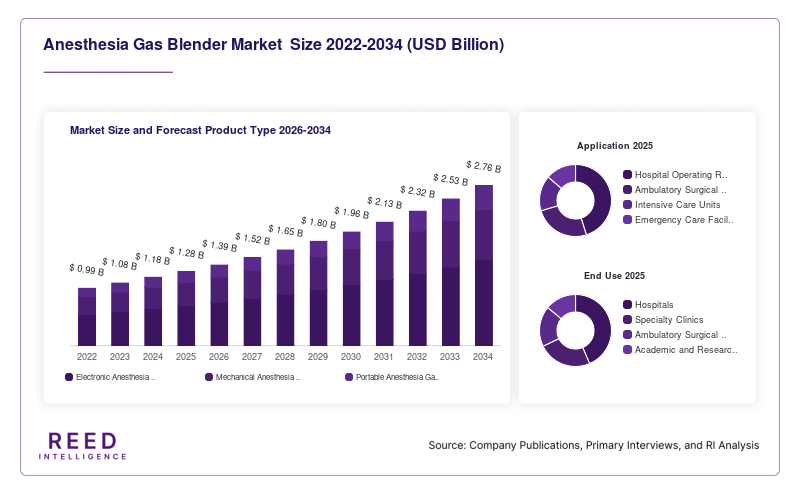
- By product type, electronic anesthesia gas blenders accounted for the largest share of 61.2%, while portable anesthesia gas blenders are projected to grow at a CAGR of 11.4%.
- By application, hospital operating rooms led with a 57.8% share, whereas ambulatory surgical centers are expected to expand at a CAGR of 10.9%.
- By end use, hospitals held the largest share of 64.5%, while specialty clinics are projected to grow at a CAGR of 10.2%.
- The United States remained the dominant country, with market values of USD 398 million in 2024 and USD 431 million in 2025.
Market Trends
Increasing Integration of Digital Monitoring Technologies
The anesthesia gas blender market is experiencing a notable shift toward digitalization and intelligent monitoring capabilities. Healthcare facilities are increasingly adopting advanced gas blending systems equipped with touchscreen interfaces, automated calibration functions, real-time monitoring displays, and alarm management features. These innovations help clinicians maintain precise oxygen and anesthetic gas concentrations throughout surgical procedures. Digital technologies also support enhanced documentation and connectivity with hospital information systems, improving workflow efficiency and regulatory compliance.
The growing demand for data-driven healthcare environments has encouraged manufacturers to develop smart anesthesia gas blenders capable of continuous performance monitoring and predictive maintenance. Such systems reduce equipment downtime and improve patient safety. Hospitals seeking to modernize operating rooms are prioritizing integrated anesthesia solutions that combine accuracy, reliability, and connectivity. As healthcare providers focus on improving clinical outcomes and operational efficiency, digitally enabled anesthesia gas blenders are expected to become standard equipment across major healthcare facilities worldwide.
Rising Demand for Portable and Compact Systems
Portability has become an important purchasing criterion in the anesthesia gas blender market. Healthcare providers increasingly require flexible equipment that can be deployed across multiple clinical settings, including ambulatory surgical centers, emergency care units, mobile healthcare facilities, and remote treatment environments. Compact anesthesia gas blenders offer convenience without compromising blending accuracy, making them suitable for facilities with space limitations.
Manufacturers are responding by introducing lightweight designs, battery-supported systems, and modular configurations that improve mobility and ease of installation. The expansion of outpatient surgical procedures has further accelerated demand for portable devices. As healthcare delivery models continue to shift toward decentralized and cost-efficient care, portable anesthesia gas blenders are expected to gain broader acceptance. This trend is particularly evident in emerging economies where healthcare providers seek versatile equipment solutions that can support expanding patient volumes while maintaining operational flexibility.
Market Drivers
Growth in Global Surgical Procedure Volumes
The increasing number of surgical procedures performed worldwide remains a primary growth driver for the anesthesia gas blender market. Rising prevalence of cardiovascular disorders, orthopedic conditions, cancer, neurological diseases, and other chronic health issues has significantly increased surgical demand. Aging populations in many countries are also contributing to higher rates of elective and emergency surgeries.
Every surgical procedure requiring anesthesia depends on accurate gas delivery and concentration control, making anesthesia gas blenders an essential component of operating room infrastructure. Healthcare systems are expanding surgical capacities to address growing patient needs, resulting in increased procurement of anesthesia equipment. Emerging economies are witnessing particularly strong growth as access to healthcare services improves and surgical capabilities expand. The continued rise in procedural volumes creates sustained demand for reliable and technologically advanced anesthesia gas blending systems across hospitals and surgical facilities.
Expanding Investments in Healthcare Infrastructure
Governments and private healthcare organizations are making substantial investments in healthcare infrastructure development. New hospital construction projects, operating room modernization initiatives, and expansion of critical care facilities are generating significant demand for advanced anesthesia equipment. Many healthcare providers are replacing aging systems with modern devices that offer improved accuracy, safety, and operational efficiency.
Healthcare infrastructure expansion is especially prominent in developing countries where growing populations and rising healthcare expenditures are driving facility upgrades. The establishment of specialty hospitals and advanced surgical centers has increased demand for sophisticated anesthesia technologies. Additionally, regulatory emphasis on patient safety and equipment performance standards is encouraging healthcare providers to invest in newer gas blending systems. These infrastructure investments are expected to remain a strong contributor to market growth throughout the forecast period.
Market Restraint
High Equipment Costs and Maintenance Requirements
The relatively high acquisition cost of advanced anesthesia gas blenders presents a significant challenge for market expansion, particularly in resource-constrained healthcare environments. Modern electronic systems equipped with digital monitoring features, automated controls, and integrated safety mechanisms require substantial capital investment. Small hospitals, rural healthcare facilities, and budget-sensitive providers may delay equipment upgrades due to financial limitations.
In addition to initial purchase costs, ongoing maintenance expenses can create operational challenges. Regular calibration, technical servicing, software updates, and component replacement are necessary to ensure performance accuracy and regulatory compliance. Healthcare facilities must also invest in staff training programs to support proper equipment utilization. These financial considerations can slow adoption rates in certain regions and limit purchasing decisions among smaller healthcare providers. Although technological advancements continue to improve performance and reliability, cost-related barriers remain a notable factor influencing market penetration and procurement strategies across the global anesthesia gas blender industry.
Market Opportunities
Expansion of Ambulatory Surgical Centers
The rapid growth of ambulatory surgical centers presents a significant opportunity for the anesthesia gas blender market. These facilities are becoming increasingly popular due to their ability to deliver cost-effective surgical care while reducing hospital burden. As outpatient procedures continue to rise, demand for reliable and compact anesthesia delivery equipment is expanding accordingly.
Ambulatory surgical centers require efficient gas blending systems that support diverse procedures while maintaining high safety standards. Manufacturers are developing specialized products designed to meet the operational needs of these facilities, including portable units and integrated monitoring solutions. The ongoing transition toward outpatient care models in both developed and emerging markets is expected to create sustained demand for advanced anesthesia gas blenders. This trend offers substantial growth potential for equipment manufacturers seeking to diversify product portfolios and expand market presence.
Growing Healthcare Modernization in Emerging Economies
Emerging economies represent a major growth opportunity for the anesthesia gas blender market. Countries across Asia Pacific, Latin America, the Middle East, and parts of Africa are investing heavily in healthcare modernization programs aimed at improving access to quality medical services. Expansion of hospital networks, increasing healthcare budgets, and rising adoption of advanced medical technologies are creating favorable market conditions.
As healthcare facilities upgrade operating rooms and critical care departments, demand for sophisticated anesthesia equipment continues to increase. Government initiatives focused on improving surgical care capabilities further support market development. International manufacturers are expanding distribution networks and establishing local partnerships to capitalize on these opportunities. The combination of growing patient populations, rising healthcare awareness, and infrastructure development is expected to accelerate anesthesia gas blender adoption throughout emerging healthcare markets during the forecast period.
Segmental Analysis
By Product Type
Electronic anesthesia gas blenders represented the dominant product category, accounting for approximately 61.2% of total market revenue in 2024. Their leadership position is attributed to superior accuracy, automated control capabilities, and integration with modern anesthesia workstations. Hospitals increasingly prefer electronic systems because they provide precise gas concentration management, real-time monitoring, and advanced safety functions. These devices help clinicians maintain optimal anesthesia delivery during complex surgical procedures while minimizing human error. Growing demand for digitally connected healthcare equipment has further strengthened adoption. As healthcare facilities continue to modernize operating rooms and prioritize patient safety, electronic anesthesia gas blenders remain the preferred choice across developed and emerging healthcare markets.
Portable anesthesia gas blenders are expected to register the fastest CAGR of 11.4% during the forecast period. Growth is primarily driven by increasing demand for flexible and mobile anesthesia delivery solutions. Ambulatory surgical centers, emergency care facilities, and temporary healthcare settings require compact equipment capable of maintaining blending accuracy without extensive installation requirements. Manufacturers are introducing lightweight designs with enhanced durability and user-friendly interfaces to address evolving clinical needs. The expansion of outpatient care services and decentralized healthcare delivery models further supports adoption. As healthcare providers seek operational flexibility and cost-efficient equipment solutions, portable anesthesia gas blenders are positioned to experience strong growth across multiple healthcare environments.
By Application
Hospital operating rooms accounted for the largest application segment, holding approximately 57.8% of market revenue in 2024. The dominance of this segment is linked to the high concentration of surgical procedures performed in hospital settings. Operating rooms require reliable anesthesia gas delivery systems that ensure precise control of oxygen and anesthetic mixtures throughout surgical interventions. Increasing numbers of complex surgeries and growing emphasis on patient safety continue to support demand. Hospitals also possess the financial resources necessary to invest in advanced anesthesia technologies featuring digital monitoring, automated controls, and integrated alarm systems. These factors collectively reinforce the leading position of hospital operating rooms within the anesthesia gas blender market.
Ambulatory surgical centers are projected to expand at the fastest CAGR of 10.9% during the forecast period. The shift toward outpatient surgical procedures has accelerated demand for specialized anesthesia equipment tailored to efficient and cost-effective healthcare delivery. These facilities prioritize compact, reliable, and easy-to-operate gas blending systems capable of supporting diverse surgical applications. Technological advancements have enabled manufacturers to develop solutions specifically designed for ambulatory settings. Rising patient preference for shorter recovery times and lower treatment costs continues to drive outpatient procedure volumes. Consequently, ambulatory surgical centers are emerging as a key growth area within the global anesthesia gas blender market.
By End Use
Hospitals dominated the end-use segment with a market share of approximately 64.5% in 2024. Their leading position reflects extensive utilization of anesthesia gas blending systems across operating rooms, intensive care units, and emergency departments. Hospitals perform a large volume of surgical procedures requiring accurate gas management and advanced patient monitoring capabilities. Continuous investment in infrastructure modernization and equipment replacement programs further supports demand. Many hospitals are integrating anesthesia gas blenders into broader digital healthcare ecosystems, enhancing operational efficiency and clinical oversight. Strong procurement capabilities and ongoing focus on patient safety continue to sustain hospital leadership within the market.
Specialty clinics are anticipated to record the fastest CAGR of 10.2% during 2026–2034. Growth is supported by increasing numbers of specialized treatment centers performing targeted surgical and diagnostic procedures. These facilities are adopting advanced anesthesia technologies to improve care quality and accommodate growing patient demand. Specialty clinics often require compact and cost-efficient equipment that can deliver reliable performance in focused clinical environments. Expanding healthcare access, rising procedural volumes, and increasing investment in specialized medical services are creating favorable market conditions. As healthcare delivery becomes more diversified, specialty clinics are expected to contribute significantly to future market growth.
Regional Analysis
North America
North America accounted for approximately 36.4% of the global anesthesia gas blender market in 2025 and is expected to maintain a strong position throughout the forecast period. The region is projected to expand at a CAGR of 7.8% between 2026 and 2034. Market growth is supported by advanced healthcare infrastructure, high surgical procedure volumes, and widespread adoption of technologically advanced anesthesia equipment. Continuous investment in operating room modernization further strengthens regional demand.
The United States remains the dominant country within the region. A major growth factor is the strong focus on patient safety and regulatory compliance across healthcare facilities. Hospitals consistently invest in advanced gas blending technologies to improve anesthesia precision and reduce procedural risks. Growing demand for integrated operating room solutions continues to support equipment upgrades across healthcare institutions.
Europe
Europe represented approximately 28.6% of the global anesthesia gas blender market in 2025 and is projected to register a CAGR of 8.1% during the forecast period. Demand is supported by strong healthcare systems, increasing surgical volumes, and ongoing adoption of advanced anesthesia technologies. Many European countries continue to invest in hospital modernization projects aimed at improving clinical outcomes and operational efficiency.
Germany remains the leading country within the European market. A key growth factor is the region's commitment to technological innovation in healthcare equipment. Healthcare providers increasingly seek advanced anesthesia systems capable of improving procedural accuracy and supporting stringent safety requirements. This trend continues to stimulate demand for modern gas blending devices across hospitals and specialty surgical centers.
Asia Pacific
Asia Pacific accounted for approximately 22.4% of global market revenue in 2025 and is anticipated to register the fastest CAGR of 10.8% through 2034. Rapid healthcare infrastructure development, growing surgical procedure volumes, and increasing healthcare expenditure are key factors supporting market growth. Countries across the region are actively investing in advanced medical technologies to address expanding healthcare needs.
China remains the dominant country in the regional market. One major growth factor is the extensive expansion of hospital infrastructure and surgical capabilities. Public and private healthcare investments continue to increase, enabling broader adoption of advanced anesthesia equipment. Rising healthcare awareness and improving access to medical services further contribute to market development. The growing middle-class population and increasing healthcare affordability are supporting greater utilization of surgical procedures. Healthcare providers are investing in modern operating room equipment to improve service quality and accommodate rising patient volumes. These developments are creating favorable conditions for anesthesia gas blender manufacturers seeking regional expansion opportunities.
Middle East & Africa
The Middle East & Africa held approximately 6.4% of the global anesthesia gas blender market in 2025 and is expected to grow at a CAGR of 8.6% during the forecast period. Market expansion is supported by increasing healthcare investments, hospital construction projects, and efforts to improve access to advanced medical services. Several countries are prioritizing healthcare modernization as part of broader economic development initiatives.
Saudi Arabia remains the leading market within the region. A significant growth factor is the government's focus on healthcare infrastructure transformation and technology adoption. Large-scale investments in hospitals, specialty medical centers, and surgical facilities are driving demand for advanced anesthesia equipment, including sophisticated gas blending systems. Private sector participation in healthcare development is also increasing across the region. New healthcare facilities often prioritize modern medical technologies to attract patients and improve service quality. This trend is creating opportunities for equipment manufacturers offering innovative and reliable anesthesia solutions.
Latin America
Latin America represented approximately 6.2% of the global anesthesia gas blender market in 2025 and is projected to grow at a CAGR of 8.4% through 2034. The market is supported by healthcare infrastructure improvements, rising surgical procedure rates, and increasing awareness of advanced patient care technologies. Governments and private healthcare organizations continue to invest in facility upgrades and equipment modernization.
Brazil remains the dominant country in the regional market. A key growth factor is the expansion of private healthcare networks and specialty surgical centers. These facilities are increasingly investing in advanced anesthesia systems to enhance patient safety and improve clinical outcomes. Rising healthcare spending further supports procurement of modern medical equipment.
Competitive Landscape
The anesthesia gas blender market is moderately consolidated, with several international medical device manufacturers competing through technological innovation, product quality, and geographic expansion strategies. Companies focus on developing advanced gas blending systems that improve accuracy, enhance patient safety, and integrate seamlessly with modern anesthesia workstations.
GE HealthCare remains a leading participant due to its broad anesthesia equipment portfolio and extensive global distribution network. The company recently expanded its anesthesia technology offerings through enhanced digital monitoring capabilities designed to improve operating room efficiency and clinical decision-making.
Key Players
- GE HealthCare
- Dräger
- Medtronic
- Mindray Medical International
- Penlon Limited
- Fisher & Paykel Healthcare
- Ohio Medical
- Precision Medical Inc.
- Air Liquide Healthcare
- Smiths Medical
- Allied Healthcare Products
- BeaconMedaes
- Heyer Medical AG
- Dameca A/S
- Spacelabs Healthcare
Recent Developments
- In 2025, a leading anesthesia equipment manufacturer launched a next-generation electronic anesthesia gas blender featuring real-time gas concentration monitoring, automated calibration functions, and enhanced safety alarm systems for operating room applications.
- In 2025, a major medical device company expanded its anesthesia technology production facility to increase manufacturing capacity and address growing demand from hospitals and ambulatory surgical centers across emerging markets.
- In 2024, several healthcare institutions adopted integrated anesthesia workstations equipped with advanced gas blending systems to improve procedural accuracy, patient safety, and operating room efficiency.
- In 2024, a global anesthesia solutions provider introduced a compact portable anesthesia gas blender designed for outpatient surgical centers, emergency care units, and mobile healthcare environments.
- In 2025, a prominent medical technology firm invested in digital connectivity enhancements for anesthesia gas blenders, enabling seamless integration with hospital information systems and real-time performance monitoring platforms.
Anesthesia Gas Blender Market Segments
Product Type
- Electronic Anesthesia Gas Blenders
- Mechanical Anesthesia Gas Blenders
- Portable Anesthesia Gas Blenders
Application
- Hospital Operating Rooms
- Ambulatory Surgical Centers
- Intensive Care Units
- Emergency Care Facilities
End Use
- Hospitals
- Specialty Clinics
- Ambulatory Surgical Centers
- Academic and Research Institutions
By Region
- North America
- Europe
- APAC
- Middle East and Africa
- LATAM