Animal Feed Organic Trace Minerals Market Size, Share & Demand Report By Mineral Type (Zinc, Copper, Iron, Manganese, Selenium, Others), By Livestock (Poultry, Swine, Ruminants, Aquaculture, Equine, Others), By Form (Chelated Minerals, Proteinates, Amino Acid Complexes, Polysaccharide Complexes, Others), By Region & Segment Forecasts, 2026–2034
USD 3950
Market Overview
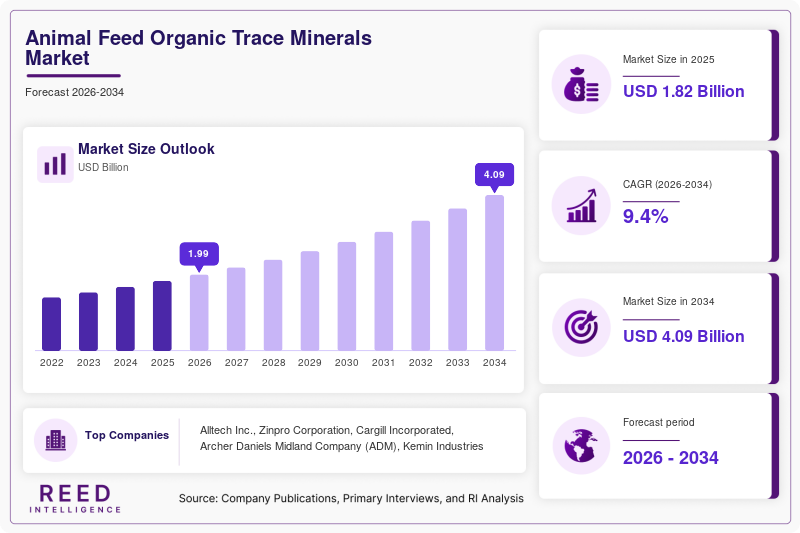
The global Animal Feed Organic Trace Minerals Market size was valued at approximately USD 1.82 billion in 2026 and is projected to reach USD 3.74 billion by 2034, expanding at a CAGR of 9.4% during 2026–2034. Organic trace minerals have become an essential component of modern animal nutrition due to their superior bioavailability, improved absorption efficiency, and ability to support livestock productivity. These minerals, including zinc, copper, manganese, iron, and selenium complexes, are increasingly utilized across poultry, swine, ruminant, and aquaculture feed formulations to enhance growth performance, reproductive health, immunity, and feed conversion rates.
One of the major global factors supporting market expansion is the increasing emphasis on sustainable livestock production. Producers across developed and developing economies are seeking nutritional solutions that improve animal health while reducing mineral excretion into the environment. Organic trace minerals help optimize nutrient utilization, allowing feed manufacturers and livestock producers to achieve productivity targets while addressing environmental concerns. Growing demand for high-quality animal protein, expanding commercial farming operations, and advancements in feed formulation technologies are also contributing to market growth.
Key Highlights
- North America dominated the market with a 35.1% share in 2025.
- Asia Pacific is expected to grow at the fastest CAGR of 10.8% during 2026–2034.
- By mineral type, zinc-based organic trace minerals accounted for the largest share of 31.8%.
- while selenium-based organic trace minerals are projected to grow at a CAGR of 11.5%.
- By livestock, poultry held the largest share of 39.6%.
- whereas aquaculture is expected to expand at a CAGR of 11.7%.
- By form, chelated minerals led with a 57.4% share.
- while proteinates are anticipated to grow at a CAGR of 10.9%.
- The United States remained the dominant country, with market values of USD 412 million in 2024 and USD 448 million in 2025.
Market Trends
Increasing Adoption of Precision Animal Nutrition
Precision nutrition continues to influence the Animal Feed Organic Trace Minerals Market as livestock producers seek measurable improvements in productivity and feed efficiency. Modern farming operations increasingly use data-driven feeding programs that account for species, age, genetics, and environmental conditions. Organic trace minerals fit well within these strategies because they provide higher absorption rates than conventional inorganic alternatives. Feed manufacturers are responding by developing customized mineral blends designed to maximize nutrient utilization and reduce wastage. This trend is particularly evident in poultry and swine production, where performance optimization directly affects profitability. The growing integration of digital livestock management systems is further encouraging the adoption of advanced nutritional solutions that include organic trace mineral supplementation.
Rising Demand for Sustainable Feed Ingredients
Sustainability objectives are becoming an important purchasing criterion across the livestock value chain. Producers are under pressure to reduce environmental impacts while maintaining production efficiency. Organic trace minerals support these goals by lowering mineral excretion and improving nutrient utilization within animals. As regulatory authorities introduce stricter environmental standards, feed manufacturers are increasingly incorporating organic mineral solutions into commercial formulations. The trend is also supported by consumer demand for responsibly produced meat, dairy, and seafood products. Investment in environmentally efficient feed ingredients continues to increase, creating favorable conditions for broader adoption of organic trace minerals across both mature and emerging livestock markets.
Market Drivers
Growing Demand for High-Quality Animal Protein
The increasing consumption of meat, dairy products, eggs, and seafood worldwide remains a significant driver for the Animal Feed Organic Trace Minerals Market. Rising urbanization, population growth, and income expansion are encouraging greater demand for animal protein products. To meet these requirements, livestock producers are focusing on improving productivity, feed conversion efficiency, and overall herd health. Organic trace minerals contribute directly to these objectives by supporting metabolism, immunity, growth, and reproductive performance. Their enhanced bioavailability allows animals to utilize nutrients more effectively, resulting in better production outcomes. As commercial farming systems expand globally, the need for advanced nutritional inputs is expected to continue supporting market growth.
Focus on Animal Health and Disease Prevention
Animal health management has become a priority for producers aiming to reduce losses and improve operational efficiency. Organic trace minerals play a critical role in strengthening immune function and supporting physiological processes that influence animal performance. Feed manufacturers increasingly promote these ingredients as part of preventive nutrition programs designed to reduce disease risks and improve resilience against environmental stressors. This trend is especially relevant in intensive farming systems where disease outbreaks can have significant economic consequences. Growing awareness among farmers regarding the long-term benefits of balanced mineral supplementation continues to drive product adoption across multiple livestock categories.
Market Restraint
Higher Cost Compared with Conventional Mineral Sources
Despite strong growth prospects, the Animal Feed Organic Trace Minerals Market faces challenges associated with the relatively high cost of organic mineral products. Chelated and proteinated trace minerals require specialized manufacturing processes and advanced raw materials, resulting in higher prices compared with traditional inorganic alternatives. For small and medium-scale livestock producers, particularly in cost-sensitive markets, the price difference can limit adoption. Feed manufacturers may also face difficulties in balancing nutritional performance with affordability when formulating commercial feed products. In developing economies where feed costs represent a significant portion of production expenses, purchasing decisions often prioritize short-term cost savings over long-term efficiency gains. This pricing challenge may slow market penetration in certain regions despite demonstrated performance benefits. Continued innovation, economies of scale, and increased production capacity will be important factors in improving affordability and expanding market access over the forecast period.
Market Opportunities
Expansion of Aquaculture Nutrition Programs
Aquaculture represents a significant opportunity for the Animal Feed Organic Trace Minerals Market. Global seafood demand continues to increase, encouraging investment in intensive fish and shrimp farming operations. Producers are focusing on feed formulations that improve growth rates, disease resistance, and feed utilization efficiency. Organic trace minerals help address these requirements by supporting physiological development and immune health in aquatic species. As aquaculture production becomes increasingly sophisticated, demand for specialized nutritional ingredients is expected to rise. Emerging aquaculture industries across Asia Pacific, Latin America, and the Middle East are creating new growth avenues for manufacturers offering species-specific mineral solutions.
Development of Advanced Chelated Mineral Technologies
Technological innovation is creating opportunities for product differentiation and value creation within the market. Manufacturers are investing in advanced chelation technologies that improve mineral stability, absorption, and performance outcomes. New formulations are designed to function effectively under diverse feeding conditions while minimizing nutrient interactions. These developments enable feed producers to offer premium nutritional products targeted at commercial livestock operations. Increasing research into species-specific mineral requirements is also encouraging the introduction of customized solutions. As producers seek measurable returns on nutritional investments, demand for technologically advanced organic trace mineral products is expected to strengthen throughout the forecast period.
Segmental Analysis
By Mineral Type
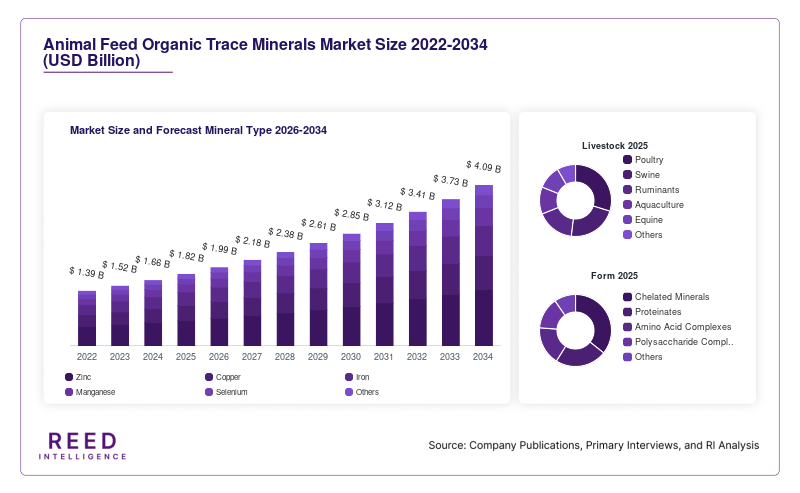
Zinc-based organic trace minerals represented the dominant subsegment, accounting for approximately 31.8% of the market share in 2024. Zinc plays a critical role in enzyme activity, immune function, tissue development, and reproductive performance across multiple livestock species. Its broad applicability has made it one of the most commonly utilized organic minerals in commercial feed formulations. Feed manufacturers continue to prioritize zinc supplementation due to its established benefits in improving growth performance and maintaining animal health. Demand remains particularly strong in poultry and swine production, where efficient nutrient utilization directly influences production economics. The widespread recognition of zinc’s nutritional importance supports its leading position across global markets.
Selenium-based organic trace minerals are projected to register the fastest CAGR of 11.5% during the forecast period. Growing awareness regarding the role of selenium in antioxidant defense systems and immune health is driving increased adoption. Livestock producers are seeking nutritional solutions that enhance disease resistance and improve reproductive outcomes, particularly in high-performance production environments. Organic selenium products offer improved bioavailability compared with inorganic alternatives, contributing to stronger market acceptance. Rising emphasis on animal welfare and preventive nutrition strategies further supports demand for selenium-based supplements. Continued product innovation and expanding research into selenium’s physiological benefits are expected to reinforce growth opportunities throughout the forecast period.
By Livestock
Poultry emerged as the dominant livestock subsegment, holding approximately 39.6% of the market share in 2024. The poultry industry requires nutritionally balanced feed formulations to support rapid growth cycles, egg production, and overall flock health. Organic trace minerals are increasingly integrated into poultry diets because of their ability to improve feed conversion efficiency and support immune function. Growing global consumption of chicken meat and eggs has encouraged producers to adopt advanced nutritional inputs that maximize productivity. Commercial poultry operations often prioritize feed efficiency, making organic mineral supplementation an attractive option for enhancing production performance while maintaining animal health standards.
Aquaculture is expected to be the fastest-growing livestock subsegment, expanding at a CAGR of 11.7% through 2034. Rising seafood consumption and increasing investments in intensive fish and shrimp farming are creating substantial demand for specialized feed ingredients. Organic trace minerals contribute to improved growth rates, disease resistance, and nutrient utilization in aquatic species. Producers are increasingly adopting premium feed formulations designed to support sustainable aquaculture production. Expansion of aquaculture industries across Asia Pacific and Latin America is further strengthening demand. As feed manufacturers continue to develop species-specific nutritional solutions, the role of organic trace minerals in aquaculture diets is expected to become increasingly significant.
By Form
Chelated minerals accounted for the largest share of approximately 57.4% in 2024. These products are widely preferred because they protect mineral ions from adverse interactions within the digestive tract, improving absorption and utilization. Chelated mineral technologies have gained strong acceptance among feed manufacturers seeking consistent performance outcomes. Their effectiveness across various livestock species has contributed to broad adoption in commercial feed formulations. The ability to enhance nutrient availability while reducing excretion supports both productivity and sustainability objectives. Growing awareness regarding feed efficiency and animal health benefits continues to strengthen demand for chelated mineral products across developed and emerging markets.
Proteinates are anticipated to register the fastest CAGR of 10.9% during the forecast period. These products combine minerals with amino acids or proteins, facilitating efficient transport and absorption within the animal body. Livestock producers are increasingly recognizing the benefits of proteinates in supporting growth performance, immunity, and reproductive health. Demand is particularly strong in premium feed applications where nutritional precision is a priority. Continued advancements in feed science and growing interest in high-performance nutrition programs are encouraging wider adoption. As producers seek improved production efficiency and measurable returns on feed investments, proteinates are expected to experience robust growth across multiple livestock categories.
Regional Analysis
North America
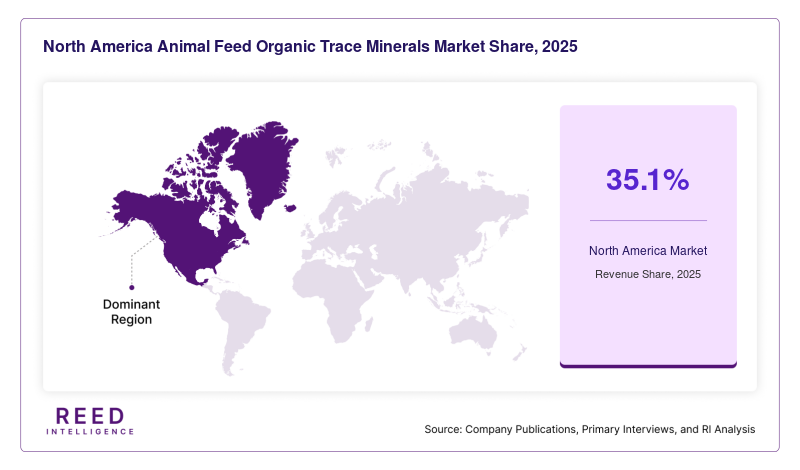
North America accounted for approximately 35.1% of the global Animal Feed Organic Trace Minerals Market in 2025 and is projected to maintain a steady growth trajectory with a CAGR of 8.7% through 2034. The region benefits from a highly developed livestock industry, advanced feed manufacturing infrastructure, and widespread awareness regarding animal nutrition. Feed producers continue to incorporate organic trace minerals into premium feed formulations to improve production efficiency and animal health outcomes.
The United States remains the dominant country within the region due to its large commercial poultry, swine, and cattle industries. A unique growth factor supporting market expansion is the increasing adoption of precision livestock farming technologies. Producers are utilizing nutritional monitoring systems and performance analytics to optimize feed programs, which encourages greater inclusion of highly bioavailable organic mineral ingredients.
Europe
Europe represented approximately 27.8% of the global market in 2025 and is expected to expand at a CAGR of 8.9% during the forecast period. Regulatory emphasis on environmental sustainability and responsible livestock production continues to support market demand. Feed manufacturers across the region are increasingly replacing traditional mineral sources with organic alternatives to improve nutrient utilization and reduce environmental impacts.
Germany serves as the leading national market due to its strong livestock sector and advanced feed production capabilities. A unique growth factor is the region’s focus on reducing mineral excretion and improving environmental compliance. This has encouraged wider adoption of organic trace minerals among producers seeking to meet sustainability targets while maintaining productivity levels.
Asia Pacific
Asia Pacific held a market share of approximately 24.4% in 2025 and is anticipated to record the fastest CAGR of 10.8% through 2034. Rapid expansion of commercial livestock production, rising protein consumption, and increasing investments in feed manufacturing are supporting regional growth. Countries across the region are focusing on improving animal productivity to meet growing food demand, creating favorable conditions for organic trace mineral adoption.
China dominates the regional market owing to its extensive livestock and aquaculture industries. A unique growth factor is the modernization of animal feeding practices. Producers are increasingly transitioning from conventional feed formulations to scientifically balanced nutritional programs that emphasize efficiency, health management, and production performance, driving sustained demand for organic mineral products.
Middle East & Africa
The Middle East & Africa accounted for approximately 6.5% of the global market in 2025 and is forecast to grow at a CAGR of 8.3% during the study period. Growth is supported by increasing investments in food security initiatives and expanding commercial livestock operations. Governments and private sector participants are focusing on improving domestic animal production to reduce dependence on imports.
Saudi Arabia represents the dominant market within the region due to substantial investments in modern livestock production facilities. A unique growth factor is the growing adoption of climate-adapted feeding programs. Producers are utilizing nutritional solutions that help animals withstand heat stress and environmental challenges, increasing demand for organic trace minerals that support immunity and overall health.
Latin America
Latin America captured approximately 6.2% of the global Animal Feed Organic Trace Minerals Market in 2025 and is projected to grow at a CAGR of 8.6% through 2034. The region’s strong agricultural base and expanding livestock exports are encouraging greater use of advanced feed ingredients. Poultry and cattle production remain important contributors to regional demand for organic trace minerals.
Brazil leads the Latin American market due to its extensive livestock industry and export-oriented meat production sector. A unique growth factor is the increasing emphasis on export quality standards. Producers are adopting advanced nutritional strategies to improve productivity and product consistency, creating favorable conditions for the broader use of organic trace mineral feed additives.
Competitive Landscape
The Animal Feed Organic Trace Minerals Market is characterized by the presence of multinational feed additive manufacturers and specialized mineral nutrition companies. Market participants compete through product innovation, strategic partnerships, capacity expansion, and investments in research and development. Companies are focusing on developing advanced chelated and proteinated mineral formulations that offer enhanced bioavailability and measurable performance benefits.
Among leading participants, Alltech Inc. maintains a strong market position through its extensive portfolio of organic trace mineral solutions and broad global distribution network. The company continues to invest in nutritional research and precision feeding technologies. Recent developments across the industry include new product launches targeting poultry and aquaculture nutrition, expansion of manufacturing facilities, and collaborations with feed producers to develop customized mineral programs. Other major companies are strengthening their presence through acquisitions, technical support services, and sustainability-focused product strategies. Increasing demand for efficient livestock nutrition is expected to encourage further innovation and competitive activity throughout the forecast period.
Key Players
- Alltech Inc.
- Zinpro Corporation
- Archer Daniels Midland Company
- Cargill Incorporated
- Kemin Industries
- Novus International
- Nutreco N.V.
- Trouw Nutrition
- Balchem Corporation
- Biochem Zusatzstoffe
- Phibro Animal Health Corporation
- Orffa International Holding B.V.
- Pancosma SA
- Bluestar Adisseo Company
- BASF SE
Recent Developments
- Alltech Inc. expanded production capacity for organic trace mineral solutions to support growing demand from poultry and dairy producers.
- Zinpro Corporation introduced a next-generation chelated mineral formulation designed to improve nutrient utilization and reproductive performance in livestock.
- Kemin Industries launched a new organic selenium product targeting aquaculture feed applications and disease resistance enhancement.
- Nutreco expanded its animal nutrition research initiatives focused on sustainable mineral supplementation strategies.
- Novus International strengthened its regional distribution network across Asia Pacific to support increasing demand for advanced feed additives.
Animal Feed Organic Trace Minerals Market Segments
Mineral Type
- Zinc
- Copper
- Iron
- Manganese
- Selenium
- Others
Livestock
- Poultry
- Swine
- Ruminants
- Aquaculture
- Equine
- Others
Form
- Chelated Minerals
- Proteinates
- Amino Acid Complexes
- Polysaccharide Complexes
- Others
By Region
- North America
- Europe
- APAC
- Middle East and Africa
- LATAM