Animal Feed Safety Testing Equipment Market Size, Share & Demand Report By Equipment Type (Rapid Testing Kits, Immunoassay Analyzers, PCR-Based Systems, Sensors and Biosensors, Software Solutions), By Application (Mycotoxin Testing, Pathogen Detection, Pesticide Residue Analysis, Heavy Metal Testing), By End Use (Veterinary Diagnostic Laboratories, Government Testing Agencies, Research Institutions, Livestock Farms), By Region & Segment Forecasts, 2026–2034
USD 3950
Market Overview
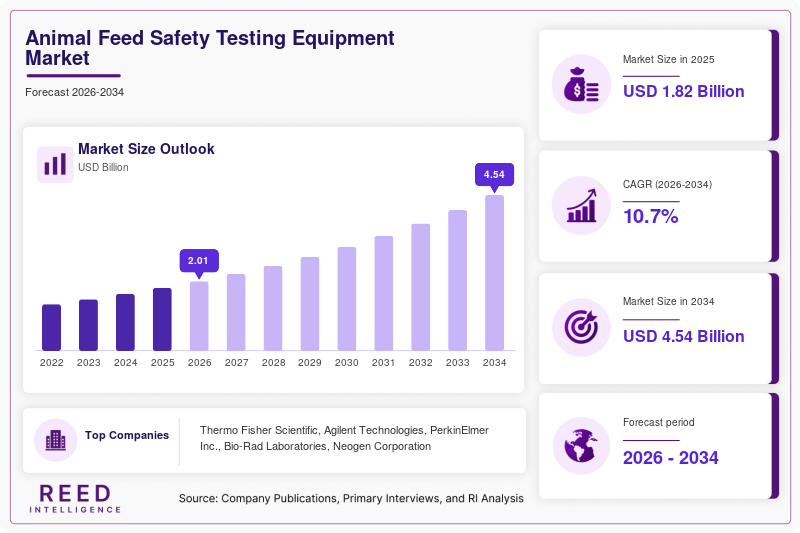
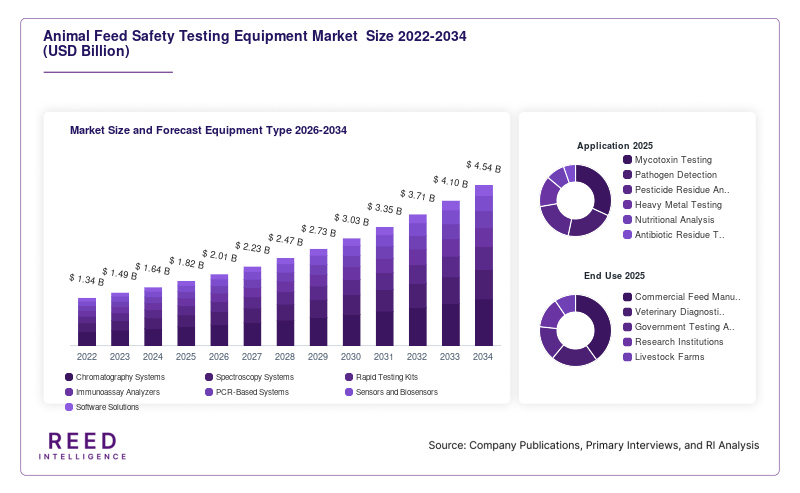
The global Animal Feed Safety Testing Equipment Market size was valued at USD 1.82 billion in 2026 and is projected to reach USD 4.11 billion by 2034, expanding at a CAGR of 10.7% during the forecast period from 2026 to 2034. The market is experiencing steady expansion due to increasing regulatory scrutiny related to livestock nutrition, contamination control, and food chain transparency across developed and emerging economies. Rising consumption of poultry, dairy, aquaculture, and processed meat products has encouraged feed manufacturers to adopt advanced safety testing systems that can identify pathogens, toxins, heavy metals, pesticide residues, and nutritional imbalances in feed materials.
A major global factor supporting market growth is the increasing implementation of feed quality regulations and traceability frameworks by food safety authorities. Governments and industry associations are focusing on reducing contamination risks associated with animal-derived food products. This has accelerated the adoption of rapid testing instruments, automated analyzers, biosensors, chromatography systems, and laboratory software solutions within feed production facilities and veterinary laboratories. Increasing outbreaks of feed contamination incidents involving mycotoxins and antibiotic residues have further increased investments in testing infrastructure among feed manufacturers and livestock producers.
Key Highlights
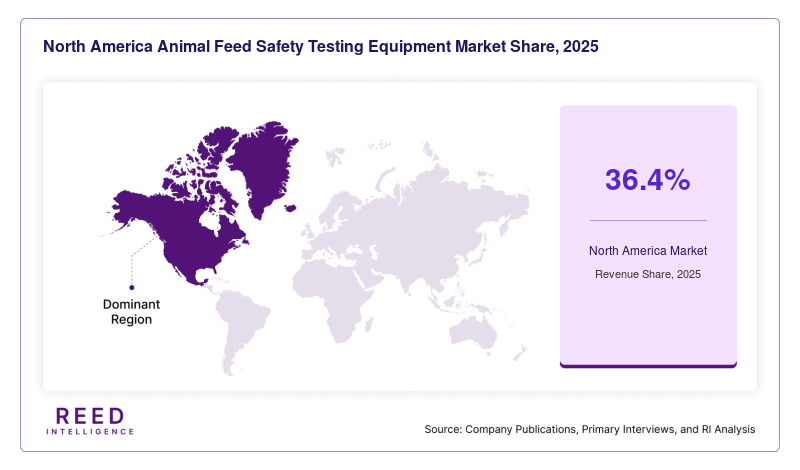
- North America dominated the market with a 36.4% share in 2025.
- Asia Pacific is expected to grow at the fastest CAGR of 11.8% during 2026–2034.
- By equipment type, chromatography systems accounted for the largest share of 39.1%.
- while rapid testing kits are projected to grow at a CAGR of 12.6%.
- By application, mycotoxin testing led with a 42.8% share.
- whereas pathogen detection is expected to expand at a CAGR of 12.1%.
- The United States remained the dominant country, with market values of USD 590 million in 2024 and USD 648 million in 2025.
Market Trends
Automation and Digital Integration Across Feed Testing Laboratories
The Animal Feed Safety Testing Equipment Market is witnessing growing adoption of automated laboratory systems integrated with digital monitoring platforms. Feed manufacturers are increasingly deploying automated sample preparation systems, robotic analyzers, and cloud-connected testing equipment to improve operational efficiency and reduce manual errors. These systems support faster turnaround time for feed quality analysis while improving consistency in contamination detection. Laboratories handling large testing volumes are investing in integrated software platforms capable of storing analytical records, generating compliance reports, and enabling remote monitoring. This trend is particularly visible among multinational feed producers operating across several geographic regions where regulatory compliance and traceability standards continue to evolve.
Digital transformation is also enabling predictive quality management in feed manufacturing. Advanced software linked with testing instruments can analyze historical contamination data and identify recurring quality risks. Equipment manufacturers are introducing smart sensors and AI-supported analytical platforms that deliver rapid results with minimal operator involvement. The integration of Internet of Things technologies into feed testing equipment is helping producers monitor moisture levels, bacterial contamination, and nutrient consistency in real time. These developments are expected to support higher equipment replacement rates and encourage investment in technologically advanced safety testing infrastructure during the forecast period.
Rising Preference for Rapid and Portable Testing Solutions
The market is also experiencing increased demand for rapid and portable testing equipment that can perform on-site feed analysis. Feed manufacturers, livestock farms, and veterinary inspection agencies are seeking compact devices capable of delivering accurate results within shorter timeframes. Portable analyzers and rapid diagnostic kits are becoming popular for detecting mycotoxins, pathogens, and antibiotic residues in feed ingredients. These solutions reduce dependency on centralized laboratories and support faster quality decisions during production and storage operations. As supply chains become more globalized, the need for immediate contamination detection has become more significant for exporters and commercial livestock producers.
Portable feed testing equipment is gaining traction in emerging economies where laboratory infrastructure remains limited. Small and medium-scale feed producers are adopting cost-effective handheld systems to comply with food safety regulations without investing heavily in large laboratory facilities. Technological improvements in biosensors and miniaturized analytical systems are improving detection sensitivity and reducing testing complexity. Market participants are increasingly focusing on user-friendly interfaces and wireless connectivity features to improve adoption rates among non-specialized operators. This trend is expected to strengthen market penetration in agricultural regions with expanding livestock production activities.
Market Drivers
Expansion of Livestock Production and Commercial Feed Manufacturing
The continuous growth of the livestock industry is a major factor driving the Animal Feed Safety Testing Equipment Market. Rising consumption of poultry meat, dairy products, eggs, and aquaculture products has increased the need for high-quality commercial feed. Feed manufacturers are under pressure to maintain nutritional consistency and eliminate contamination risks that can affect animal health and food safety outcomes. As livestock operations become increasingly industrialized, producers are adopting advanced testing equipment to monitor raw materials, additives, and final feed products throughout the manufacturing cycle.
Commercial feed production facilities are expanding rapidly across Asia Pacific, Latin America, and parts of the Middle East due to increasing urbanization and rising protein consumption. This expansion has increased demand for analytical systems capable of testing feed ingredients for toxins, pesticides, bacterial contamination, and heavy metals. Large poultry and dairy companies are integrating sophisticated testing laboratories into their production facilities to improve quality assurance and export competitiveness. Increasing awareness regarding animal nutrition and disease prevention is also encouraging investments in feed testing technologies that can support long-term livestock productivity.
Stringent Food Safety Regulations and Export Compliance Standards
Government regulations related to feed quality and food chain safety are significantly contributing to market growth. Regulatory agencies across North America and Europe have established strict guidelines for contamination control, antibiotic usage, and nutritional labeling in animal feed products. Feed manufacturers are required to conduct routine testing to ensure compliance with legal standards and avoid penalties, recalls, or export restrictions. This regulatory environment is increasing demand for advanced laboratory equipment capable of delivering accurate and repeatable analytical results.
International trade activities are further strengthening the importance of feed safety testing. Export-oriented feed producers and meat processing companies must comply with varying regional quality standards to access global markets. Countries importing livestock products are implementing strict inspection protocols related to mycotoxins, pathogens, and chemical residues in feed. As a result, producers are investing in modern chromatography systems, immunoassay analyzers, and rapid testing instruments that can support certification requirements. The growing emphasis on food traceability and consumer safety is expected to sustain long-term demand for advanced feed testing technologies.
Market Restraint
High Equipment Costs and Limited Technical Expertise in Emerging Markets
The high initial cost associated with advanced analytical instruments remains a major challenge for the Animal Feed Safety Testing Equipment Market. Sophisticated chromatography systems, automated analyzers, and molecular testing equipment require significant capital investment, which limits adoption among small and medium-sized feed manufacturers. In many developing economies, feed producers continue to rely on conventional testing methods due to financial constraints and limited laboratory infrastructure. Maintenance costs, calibration requirements, and recurring expenses associated with consumables further increase the operational burden for companies operating with restricted budgets.
Another challenge involves the shortage of skilled laboratory professionals capable of operating advanced testing systems efficiently. Emerging markets often face difficulties in maintaining trained technicians and quality assurance specialists familiar with modern analytical procedures. Incorrect handling of testing equipment can lead to inconsistent results and compliance risks, reducing confidence in advanced technologies among smaller producers. For example, regional feed mills in parts of Africa and Southeast Asia frequently outsource testing activities to third-party laboratories because of limited technical capabilities. This dependence increases testing turnaround time and restricts widespread equipment adoption, particularly in rural agricultural regions where infrastructure development remains uneven.
Market Opportunities
Growing Demand for Feed Testing in Aquaculture and Pet Food Industries
The increasing expansion of aquaculture and premium pet food production is creating substantial opportunities for the Animal Feed Safety Testing Equipment Market. Aquaculture producers are focusing on feed quality optimization to improve fish health, growth performance, and export compliance. This has increased demand for specialized testing equipment capable of detecting contaminants such as heavy metals, fungal toxins, and bacterial pathogens in aquatic feed products. Countries with large seafood export industries are investing in advanced feed monitoring systems to maintain international quality standards and strengthen global trade competitiveness.
The premium pet food sector is also contributing to equipment demand due to growing consumer awareness regarding pet nutrition and ingredient safety. Pet food manufacturers are adopting sophisticated analytical systems to verify protein content, detect contaminants, and ensure formulation consistency. Increasing preference for organic and specialized pet diets has created additional testing requirements related to ingredient traceability and allergen detection. Equipment manufacturers have opportunities to introduce customized testing platforms designed specifically for aquaculture and pet nutrition applications, supporting market diversification and long-term revenue growth.
Expansion of Portable and AI-Enabled Testing Technologies
The development of portable and AI-enabled analytical systems presents a major opportunity for market participants. Feed manufacturers are increasingly seeking compact equipment that can deliver rapid and accurate testing results directly at production sites, storage facilities, and transportation centers. Portable devices reduce testing delays and support immediate quality decisions, helping companies minimize contamination-related losses. Equipment providers focusing on user-friendly handheld analyzers and wireless connectivity features are expected to benefit from rising adoption among small and medium-scale feed producers.
Artificial intelligence integration is also creating new growth prospects in predictive feed quality analysis. AI-supported testing systems can process large volumes of analytical data and identify contamination trends more efficiently than conventional systems. These technologies improve decision-making capabilities by predicting feed safety risks before contamination levels become critical. Manufacturers introducing cloud-based monitoring software, automated reporting systems, and machine learning algorithms are likely to gain competitive advantages in the evolving market landscape. The growing interest in digital agriculture and smart livestock management is expected to further strengthen opportunities for technologically advanced feed safety testing solutions.
Segmental Analysis
By Equipment Type
Chromatography systems accounted for the largest share of the Animal Feed Safety Testing Equipment Market in 2024, representing approximately 39.1% of total revenue. These systems are widely used for detecting mycotoxins, pesticide residues, antibiotics, and chemical contaminants in feed materials with high analytical precision. Feed manufacturers and veterinary laboratories prefer chromatography technologies because they support comprehensive analysis across multiple contaminants within a single testing process. Increasing regulatory pressure regarding residue monitoring and export compliance has strengthened demand for high-performance liquid chromatography and gas chromatography systems across developed economies.
Rapid testing kits are projected to register the fastest CAGR of 12.6% during the forecast period due to their portability, lower operational complexity, and quick result generation capabilities. Feed producers are increasingly adopting these kits to conduct on-site contamination analysis without depending on centralized laboratory infrastructure. The growing need for real-time monitoring of pathogens and toxins during feed production and transportation is accelerating demand for rapid diagnostic solutions. Improvements in biosensor sensitivity and user-friendly interfaces are also encouraging adoption among smaller feed mills and agricultural cooperatives operating in emerging economies.
By Application
Mycotoxin testing represented the dominant application segment in 2024 with a market share of 42.8%. The widespread occurrence of fungal contamination in grains and feed ingredients has made mycotoxin monitoring a critical quality assurance requirement for livestock producers. Contaminated feed can negatively affect animal health, productivity, and food safety outcomes, increasing the need for reliable detection systems. Feed manufacturers are investing heavily in analytical technologies capable of identifying aflatoxins, fumonisins, and ochratoxins at low concentration levels. Increasing climate variability and storage-related contamination risks are further strengthening demand for advanced mycotoxin testing equipment.
Pathogen detection is expected to expand at the fastest CAGR of 12.1% throughout the forecast period. Rising concerns regarding bacterial contamination in feed supply chains are encouraging producers to adopt rapid pathogen monitoring systems. Salmonella and E. coli outbreaks associated with contaminated feed have increased pressure on manufacturers to implement routine microbial testing procedures. Technological advancements in molecular diagnostics and automated immunoassay systems are improving testing efficiency and reducing analysis time. Growing awareness regarding foodborne disease prevention and international trade compliance is expected to support sustained demand for pathogen detection technologies.
By End Use
Commercial feed manufacturers held the largest share of the Animal Feed Safety Testing Equipment Market in 2024, accounting for nearly 46.3% of total revenue. Large-scale feed production facilities require continuous quality monitoring to ensure ingredient consistency, contamination control, and compliance with regulatory standards. These manufacturers operate integrated testing laboratories equipped with advanced analytical systems capable of conducting high-volume testing activities. Increasing demand for nutritionally balanced feed products and rising export requirements are encouraging feed companies to modernize laboratory infrastructure and automate quality control operations.
Veterinary diagnostic laboratories are anticipated to witness the fastest CAGR of 11.9% during the forecast period. Growing livestock disease monitoring activities and rising focus on preventive animal healthcare are increasing testing volumes within veterinary laboratories. These facilities are adopting sophisticated analytical equipment to provide accurate feed contamination analysis and nutritional evaluation services for livestock producers. Government-backed disease surveillance programs and growing collaboration between veterinary institutions and feed manufacturers are supporting investment in modern laboratory technologies. Increasing demand for independent third-party testing services among small-scale feed producers is also contributing to segment growth.
Regional Analysis
North America
North America accounted for 36.4% of the global Animal Feed Safety Testing Equipment Market in 2025 and is projected to maintain stable growth at a CAGR of 9.4% during the forecast period. The region benefits from advanced laboratory infrastructure, strict feed quality regulations, and strong adoption of automated analytical technologies. Large commercial livestock operations across the United States and Canada continue to invest in sophisticated testing equipment to comply with food safety requirements and maintain export competitiveness. Growing emphasis on traceability and contamination prevention is also supporting continuous demand for advanced feed testing systems.
The United States remains the dominant country in the regional market due to its extensive livestock production and established feed manufacturing industry. One unique growth factor in the country is the strong collaboration between government agencies, veterinary research institutes, and feed manufacturers focused on improving food chain transparency. These partnerships support ongoing investments in rapid pathogen detection systems and AI-enabled analytical platforms. Increasing demand for premium animal protein products and export-oriented meat production is further encouraging modernization of feed quality laboratories throughout the country.
Europe
Europe represented 28.1% of the global Animal Feed Safety Testing Equipment Market in 2025 and is expected to grow at a CAGR of 9.1% through 2034. The region has implemented comprehensive food safety regulations governing feed ingredient quality, contamination monitoring, and antibiotic usage. Feed manufacturers across Germany, France, Italy, and the Netherlands are increasingly adopting automated chromatography systems and molecular testing equipment to comply with evolving regulatory standards. Growing consumer preference for sustainable and traceable livestock products is also supporting investments in advanced feed quality management systems.
Germany dominates the European market due to its technologically advanced agricultural and food processing sectors. A major growth factor supporting the country’s market expansion is the increasing use of precision farming and digital livestock management systems integrated with feed quality testing platforms. German feed producers are adopting connected laboratory technologies capable of real-time monitoring and automated reporting. The country’s strong export presence in dairy and processed meat products has further accelerated investments in analytical infrastructure designed to ensure compliance with international safety standards.
Asia Pacific
Asia Pacific held 22.7% of the global Animal Feed Safety Testing Equipment Market in 2025 and is forecast to register the fastest CAGR of 11.8% during the study period. Rapid expansion of commercial livestock farming and rising meat consumption are increasing the need for advanced feed safety solutions throughout the region. Countries such as China, India, Vietnam, and Thailand are witnessing strong growth in poultry and aquaculture production, encouraging investments in feed testing laboratories and rapid analytical equipment. Regulatory reforms related to food quality and export safety are also contributing to market expansion.
China remains the leading country within Asia Pacific due to its large-scale feed manufacturing industry and growing emphasis on food safety modernization. One distinctive growth factor is the country’s increasing investment in domestic analytical technology production aimed at reducing dependence on imported laboratory systems. Chinese manufacturers are introducing cost-effective testing solutions suitable for regional feed producers, improving equipment accessibility across the market. Expansion of export-oriented seafood and poultry industries is also increasing demand for contamination monitoring systems capable of supporting international compliance standards.
Middle East & Africa
The Middle East & Africa accounted for 6.4% of the global Animal Feed Safety Testing Equipment Market in 2025 and is projected to grow at a CAGR of 8.6% through 2034. The region is gradually increasing investments in livestock productivity and food security initiatives due to rising population growth and changing dietary preferences. Governments and private agricultural companies are focusing on improving feed quality standards to reduce disease outbreaks and strengthen domestic meat production capabilities. This has encouraged adoption of laboratory analyzers and portable feed testing systems across poultry and dairy sectors.
Saudi Arabia is the dominant country in the regional market because of its growing commercial poultry and dairy industries. One unique growth factor supporting market development is the country’s strategic investment in food security infrastructure and advanced agricultural technologies. Feed manufacturers are modernizing production facilities with automated quality control systems to improve operational efficiency and reduce dependency on imported livestock products. Increasing government support for domestic feed manufacturing and veterinary services is also contributing to demand for analytical testing equipment.
Latin America
Latin America captured 6.4% of the global Animal Feed Safety Testing Equipment Market in 2025 and is anticipated to grow at a CAGR of 8.9% during the forecast period. Expanding cattle, poultry, and aquaculture industries across Brazil, Argentina, and Mexico are creating sustained demand for feed quality monitoring systems. Feed contamination concerns related to fungal toxins and bacterial pathogens have encouraged regional producers to strengthen laboratory capabilities. Increasing participation in global meat exports is further supporting investments in testing technologies that can improve regulatory compliance and product reliability.
Brazil leads the Latin American market due to its strong agricultural exports and extensive livestock production network. A significant growth factor in the country is the increasing adoption of export-oriented feed certification programs designed to improve international market access. Brazilian feed manufacturers are investing in advanced analytical equipment capable of supporting rapid contaminant detection and nutritional verification. Expansion of poultry exports and growing international demand for high-quality beef products are further driving modernization of feed testing infrastructure across the country.
Competitive Landscape
The Animal Feed Safety Testing Equipment Market is moderately consolidated, with several international and regional companies competing through product innovation, technology integration, and strategic partnerships. Leading companies are focusing on automated analytical systems, portable testing devices, and cloud-based monitoring platforms to strengthen their market position. Expansion of service networks and investments in research and development remain key competitive strategies among major participants.
Thermo Fisher Scientific is considered one of the leading players in the market due to its broad analytical instrumentation portfolio and extensive global distribution network. The company continues to expand its feed testing capabilities through advanced chromatography and molecular diagnostic solutions. In 2025, the company introduced an upgraded AI-enabled feed contaminant analysis platform designed to improve real-time monitoring efficiency for commercial feed producers.
Other major companies are also emphasizing product diversification and regional expansion. Agilent Technologies and PerkinElmer are investing in high-throughput testing systems aimed at improving laboratory productivity. Bio-Rad Laboratories is strengthening its pathogen detection portfolio through automated molecular testing solutions, while Neogen Corporation is focusing on rapid diagnostic kits tailored for livestock feed applications. Competitive intensity is expected to increase further as manufacturers introduce cost-effective testing technologies for emerging agricultural markets.
Key Players
- Thermo Fisher Scientific
- Agilent Technologies
- PerkinElmer Inc.
- Bio-Rad Laboratories
- Neogen Corporation
- Merck KGaA
- Shimadzu Corporation
- FOSS Analytics
- Eurofins Scientific
- ZEUTEC Opto-Elektronik GmbH
- Waters Corporation
- Bruker Corporation
- QIAGEN N.V.
- AB Sciex
- Romer Labs
Recent Developments
- In February 2025, Thermo Fisher Scientific launched an upgraded automated chromatography platform designed specifically for multi-contaminant feed testing applications.
- In July 2025, Neogen Corporation expanded its rapid diagnostic kit portfolio with new handheld mycotoxin detection systems targeting poultry feed manufacturers in Asia Pacific.
- In November 2024, Agilent Technologies partnered with a European livestock research institute to develop AI-supported pathogen detection solutions for commercial feed laboratories.
- In March 2025, Bio-Rad Laboratories introduced an automated molecular testing workflow aimed at reducing pathogen analysis time in veterinary diagnostic facilities.
Animal Feed Safety Testing Equipment Market Segments
Equipment Type
- Chromatography Systems
- Spectroscopy Systems
- Rapid Testing Kits
- Immunoassay Analyzers
- PCR-Based Systems
- Sensors and Biosensors
- Software Solutions
Application
- Mycotoxin Testing
- Pathogen Detection
- Pesticide Residue Analysis
- Heavy Metal Testing
- Nutritional Analysis
- Antibiotic Residue Testing
End Use
- Commercial Feed Manufacturers
- Veterinary Diagnostic Laboratories
- Government Testing Agencies
- Research Institutions
- Livestock Farms
By Region
- North America
- Europe
- APAC
- Middle East and Africa
- LATAM