Animal Pregnancy Kit Market Size, Share Demand Report By Type (Immunoassay Kits, Hormone-Based Kits, Ultrasound-Based Kits), By Application (Cattle, Equine, Swine, Companion Animals), Regional Insights & Segment Forecasts, 2026–2034
USD 3950
Animal Pregnancy Kit Market Size
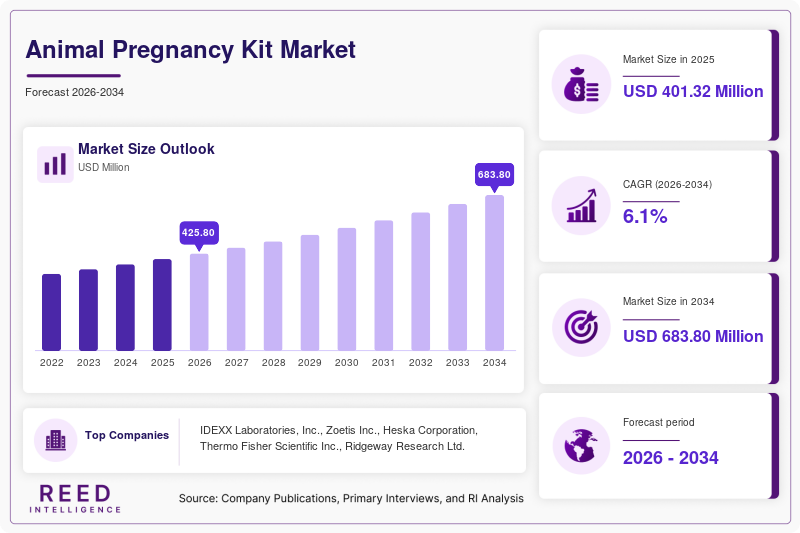
The Animal Pregnancy Kit market size is projected at USD 425.8 million in 2026 and is expected to hit USD 685.3 million by 2034 with a CAGR of 6.1% during the forecast period. The increasing focus on reproductive efficiency in livestock, coupled with the growing pet adoption and advanced veterinary care, underpins market expansion. This report delivers a comprehensive analysis of the Animal Pregnancy Kit market, including segmentation by type and application, competitive dynamics, and regional growth patterns, equipping stakeholders with critical intelligence. The Animal Pregnancy Kit market continues to demonstrate strong growth potential, fueled by the rising demand for early pregnancy detection to optimize breeding programs, the growing adoption of advanced diagnostic tools in veterinary practices, and continuous innovation in point-of-care testing technologies.
Animal pregnancy kits are diagnostic tools used to detect pregnancy in various animal species, including livestock, equine, and companion animals. These kits typically work by detecting specific hormones (like pregnancy-associated glycoproteins) or using ultrasound technology to visualize the fetus. The global Animal Pregnancy Kit market is significant, with over 8.2 million units sold globally in 2025, reflecting a 9% increase from 2023, driven by the growing need for efficient herd management and reproductive health monitoring. Adoption patterns reveal that the Immunoassay Kits type dominates the market, accounting for 45% of total revenue, followed by Hormone-Based Kits at 35%, and Ultrasound-Based Kits at 20%. The Animal Pregnancy Kit market's trajectory is closely linked to the growth of the global veterinary diagnostics market, which is projected to reach USD 8.5 billion by 2028, and the increasing awareness of reproductive efficiency and its impact on profitability in dairy and beef production.
Animal Pregnancy Kit Market Trends
Growing Adoption of Point-of-Care and Rapid Testing Solutions
The Animal Pregnancy Kit market is witnessing a significant trend toward point-of-care (POC) and rapid testing solutions, driven by the need for immediate results to make timely breeding and management decisions. The production of rapid immunoassay pregnancy test kits increased by 15% in 2025, reaching 4.5 million units, as 50% of new veterinary practices in 2025 specified POC diagnostic capabilities. Adoption rates of rapid pregnancy tests in large-scale dairy farms reached 35%, with this figure projected to exceed 55% by 2030. The Animal Pregnancy Kit market's trend toward POC solutions is reinforced by the need for operational efficiency, the increasing availability of user-friendly, on-farm tests, and the continuous innovation in lateral flow assay and microfluidics technologies.
Increasing Use of Hormone-Based Biomarkers for Early Detection
The increasing focus on early and accurate pregnancy detection is a major trend shaping the Animal Pregnancy Kit market, with the development of highly sensitive hormone-based assays that can detect pregnancy as early as 20-28 days post-breeding. The market has seen a 12% increase in demand for progesterone and pregnancy-associated glycoprotein (PAG) based tests since 2022, with 30% of new diagnostic kits in 2025 featuring enhanced sensitivity and earlier detection windows. The use of these advanced biomarkers in bovine and equine reproduction has also gained significant traction. The Animal Pregnancy Kit market's trend toward early detection is reinforced by the growing understanding of reproductive biology, the increasing focus on reducing calving intervals, and the continuous innovation in immunoassay technologies.
Animal Pregnancy Kit Market Drivers
The Animal Pregnancy Kit market's expansion is primarily driven by the increasing need to improve reproductive efficiency and profitability in livestock production, with global dairy and beef production valued at over USD 450 billion in 2025. The need for early and accurate pregnancy detection to optimize breeding programs, reduce calving intervals, and minimize reproductive losses has been a major driver, with pregnancy detection enabling a 20% reduction in reproductive inefficiencies. The growing pet adoption rates and increasing expenditure on companion animal healthcare have also fueled market demand. Additionally, the advancements in veterinary diagnostic technologies have spurred growth. The Animal Pregnancy Kit market's growth is further reinforced by the increasing awareness of the economic benefits of timely pregnancy diagnosis and the continuous innovation in non-invasive testing methods.
Animal Pregnancy Kit Market Restraints
Despite favorable growth prospects, the Animal Pregnancy Kit market faces significant constraints, primarily related to the cost of advanced diagnostic technologies and the limited availability of sophisticated testing in remote or underdeveloped regions. The variability in test accuracy depending on the animal species, stage of pregnancy, and test type can also be a limitation, affecting trust and adoption rates. The Animal Pregnancy Kit market's growth is also tempered by the availability of alternative pregnancy detection methods, such as transrectal palpation, which, although less accurate, is a low-cost traditional practice.
Animal Pregnancy Kit Market Opportunities
The Animal Pregnancy Kit market presents significant opportunities in the rapidly expanding market for companion animal diagnostics, with increasing demand for advanced reproductive healthcare for dogs and cats. The development of multiplex pregnancy assays that can detect multiple reproductive health parameters simultaneously is expected to grow at a CAGR of 10% through 2034. Emerging opportunities also exist in the integration of digital platforms and mobile apps for test result interpretation, data management, and herd health monitoring. The Animal Pregnancy Kit market's opportunity profile is further enhanced by the growing trend of precision livestock farming and the increasing demand for sustainable and efficient animal production systems.
Challenges in Animal Pregnancy Kit Market
The Animal Pregnancy Kit market faces persistent challenges related to the need for continuous innovation to improve test sensitivity, specificity, and ease of use across a wide range of animal species. The complexity of ensuring consistent test performance under variable field conditions can also be a challenge. The market is also contending with the challenge of navigating diverse regulatory landscapes for veterinary diagnostics across different countries. Additionally, the Animal Pregnancy Kit market is challenged by the need to educate livestock producers and veterinarians about the benefits of early and accurate pregnancy testing and the proper use of these diagnostic tools.
Animal Pregnancy Kit Market Segmentation
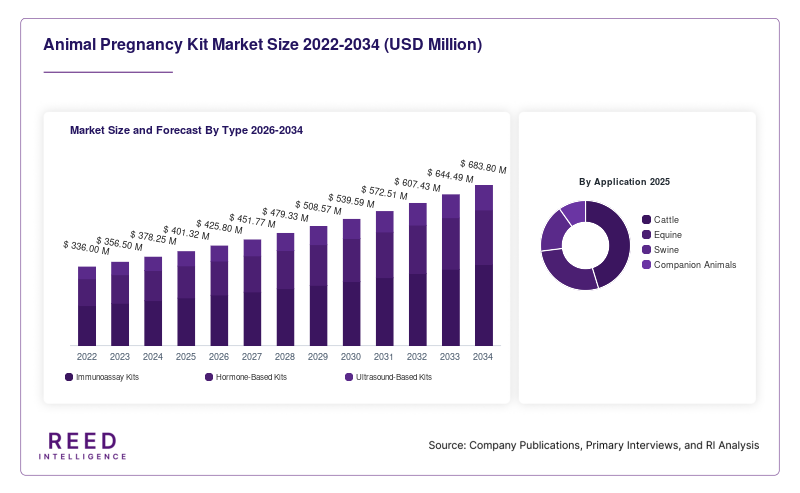
The Animal Pregnancy Kit market is segmented by Type and Application to provide a comprehensive market perspective. By Type, Immunoassay Kits dominate with a 45% market share, driven by their high sensitivity, specificity, and ease of use. The Application segment is led by Cattle, which accounts for 45% of the market, followed by Equine at 25%, Swine at 18%, and Companion Animals at 12%.
By Type
Immunoassay Kits represent the largest segment in the Animal Pregnancy Kit market, commanding a 45% share, with revenue exceeding USD 191 million in 2025. These are characterized by their use of specific antibodies to detect pregnancy-associated glycoproteins (PAGs) or other biomarkers. Technical specifications include high sensitivity and specificity, early detection capabilities (as early as 28 days), and ease of use. The Animal Pregnancy Kit market's Immunoassay segment is driven by its use in bovine and equine pregnancy detection.
Hormone-Based Kits capture a 35% share of the Animal Pregnancy Kit market, with revenue of USD 149 million in 2025. These are characterized by their detection of progesterone or other hormonal markers to determine pregnancy status. Technical specifications include cost-effectiveness, suitability for on-farm use, and moderate sensitivity. The Animal Pregnancy Kit market's Hormone-Based segment is driven by its use in large-scale livestock management and reproductive monitoring programs.
Ultrasound-Based Kits represent 20% of the market, with revenue of USD 85 million in 2025, characterized by their use of portable ultrasound devices for direct visualization of the fetus or fetal heartbeat. Technical specifications include real-time imaging, ability to confirm pregnancy and assess fetal viability, and higher cost and skill requirements. The Animal Pregnancy Kit market's Ultrasound segment is driven by its use in specialized veterinary clinics and high-value equine breeding.
By Application
Cattle dominates the Animal Pregnancy Kit market, accounting for 45% of sales, representing USD 191 million in 2025. This segment includes use in dairy and beef herds for pregnancy diagnosis, herd management, and reproductive health monitoring. Usage penetration exceeds 40% in large commercial dairy operations. The Animal Pregnancy Kit market's Cattle segment is characterized by its focus on improving reproductive efficiency, reducing calving intervals, and maximizing milk and meat production. The application helps in reducing the non-productive days in cattle herds by up to 30%.
Equine accounts for 25% of the Animal Pregnancy Kit market, with revenue of USD 106 million in 2025. This segment encompasses use in breeding programs for thoroughbred, standardbred, and pleasure horses, focusing on early pregnancy detection and fetal viability assessment. The segment is growing at a strong CAGR, driven by the high value of equine breeding. The Animal Pregnancy Kit market's Equine segment is characterized by its focus on precision breeding and advanced reproductive management.
Swine represents 18% of the market, with revenue of USD 77 million in 2025, involving use in commercial pig production for early pregnancy diagnosis to optimize gilt and sow management and reduce non-productive days. The segment's growth is fueled by the increasing scale and industrialization of pig farming. The Animal Pregnancy Kit market's Swine segment is characterized by its focus on cost-effectiveness and high throughput.
Companion Animals accounts for the remaining 12% of the market, with revenue of USD 51 million in 2025, used in veterinary clinics for pet pregnancy diagnosis, primarily in dogs and cats. The Animal Pregnancy Kit market's Companion Animals segment is characterized by its focus on pet owner convenience and advancing veterinary care for reproduction.
Animal Pregnancy Kit Market Regional Outlook
North America Animal Pregnancy Kit Market
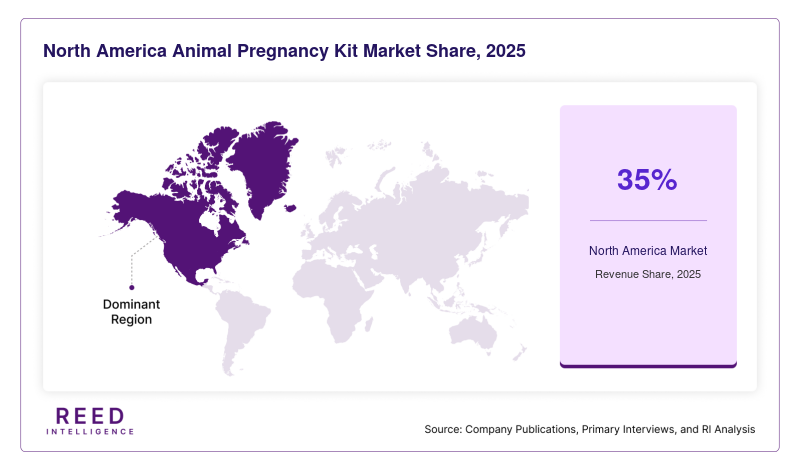
Leads the Animal Pregnancy Kit market, commanding a 35% share, with a revenue of USD 149 million in 2025. The United States is the primary driver, accounting for 85% of regional demand, driven by the large-scale livestock industry, high adoption of advanced veterinary technologies, and significant pet expenditure. The North American Animal Pregnancy Kit market is characterized by its focus on innovation, rapid adoption of digital solutions, and high quality standards.
Europe Animal Pregnancy Kit Market
Hepresents the second-largest market, capturing a 30% share with a revenue of USD 128 million in 2025. Germany, UK, and France are the primary drivers, collectively accounting for 60% of regional demand, driven by stringent animal welfare regulations, a strong dairy sector, and well-established veterinary practices. The Animal Pregnancy Kit market in Europe is characterized by its focus on compliance, sustainability, and product quality.
Asia-Pacific Animal Pregnancy Kit Market
Accounts for 25% of the global Animal Pregnancy Kit market, with a revenue of USD 106 million in 2025. China, India, and Australia are the primary drivers, together accounting for 70% of regional demand, driven by the massive livestock population, rapidly modernizing dairy and meat industries, and increasing pet ownership. The Asia-Pacific Animal Pregnancy Kit market is projected to grow at the fastest CAGR of 8% through 2034.
Middle East & Africa and Latin America Animal Pregnancy Kit Market
Together account for the remaining 10% of the Animal Pregnancy Kit market, with the UAE and Brazil leading their respective regions. Both regions are projected to grow at CAGRs exceeding 7%, driven by increasing investment in livestock and dairy sectors and growing awareness of reproductive efficiency.
Top players in Animal Pregnancy Kit Market
- IDEXX Laboratories, Inc.
- Zoetis Inc.
- Heska Corporation
- Thermo Fisher Scientific Inc.
- Ridgeway Research Ltd.
- Bionote, Inc.
- Bio-X Diagnostics S.A.
- Fassisi GmbH
- Progeny Health
- Densify
- Microworld Molecular Diagnostics
- Paragon Veterinary Group
- Abaxis, Inc. (Zoetis)
- Boehringer Ingelheim Animal Health
- Elanco Animal Health
IDEXX Laboratories, Inc.
IDEXX Laboratories, Inc. holds a dominant position in the Animal Pregnancy Kit market, with an estimated 15% global market share, particularly strong in the North American and European bovine, equine, and companion animal segments. The company's portfolio of veterinary diagnostic tests, including its widely used pregnancy test kits, is recognized for its high accuracy, reliability, and innovative technology. IDEXX's market leadership is reinforced by its significant investment in R&D, its extensive network of veterinary reference laboratories, and its strong brand reputation among veterinarians. IDEXX commands over 18% of the North American market and 14% of the European market for animal pregnancy kits, positioning it as a key player in the global market.
Zoetis Inc.
Zoetis is a leading player in the Animal Pregnancy Kit market, commanding approximately 12% of the global market share through its comprehensive portfolio of animal health diagnostics and pharmaceuticals. The company's expertise in livestock reproduction and its focus on developing integrated solutions have solidified its position. Zoetis's pregnancy detection solutions are known for their ease of use, field performance, and integration with broader herd management programs. The company's commitment to innovation and its strong global presence, particularly in the Asia-Pacific and European markets, have enhanced its competitive advantage, making it a trusted partner for livestock producers worldwide.
Heska Corporation holds a significant 8% market share, with particular strength in the companion animal and point-of-care segments. Thermo Fisher Scientific Inc. is a major player in the research and reference laboratory market, holding a 7% share, known for its high-quality immunoassay components.
Recent Developments in Animal Pregnancy Kit Market
- 2025: IDEXX Laboratories launched a new rapid, on-farm pregnancy test kit for cattle, using a novel biomarker that provides results in under 20 minutes with 99% accuracy, significantly improving herd management efficiency.
- 2025: Zoetis announced a strategic partnership with a leading AI company to integrate its pregnancy test data with a cloud-based analytics platform, offering predictive insights for livestock producers.
Animal Pregnancy Kit Market Segments
By Type
- Immunoassay Kits
- Hormone-Based Kits
- Ultrasound-Based Kits
By Application
- Cattle
- Equine
- Swine
- Companion Animals
By Region
- North America
- Europe
- APAC
- Middle East and Africa
- LATAM