Animal Workstation Market Size, Share & Demand Report By Product Type (Anesthesia Workstations, Imaging-Integrated Workstations, Surgical Workstations, Ventilated Containment Workstations, Behavioral Analysis Workstations), By Application (Pharmaceutical and Biotechnology Research, Infectious Disease Studies, Toxicology Testing, Neuroscience Research, Veterinary Research), By End Use (Research Laboratories, Contract Research Organizations, Academic Institutes, Pharmaceutical Companies, Veterinar
USD 3950
Market Overview
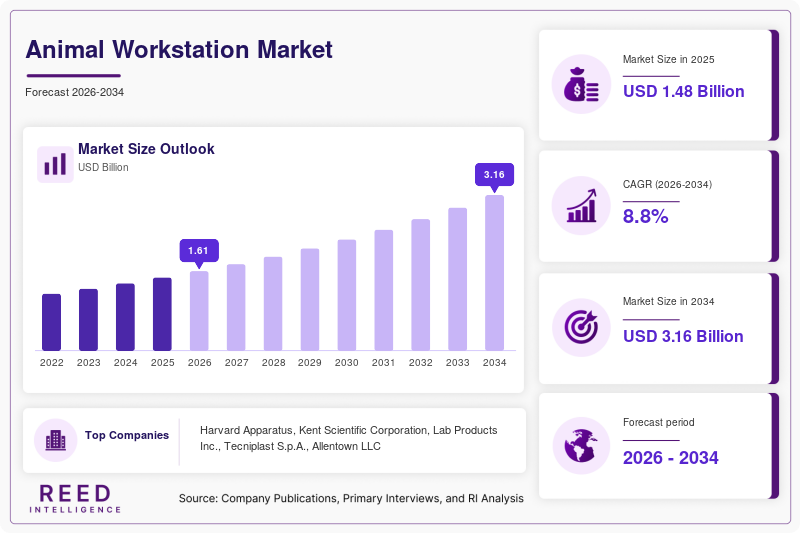
The global Animal Workstation Market size was valued at USD 1.48 billion in 2026 and is projected to reach USD 2.91 billion by 2034, expanding at a CAGR of 8.8% during the forecast period from 2026 to 2034. The market continues to gain momentum due to the growing use of advanced laboratory infrastructure across veterinary research facilities, pharmaceutical laboratories, academic institutes, and biotechnology companies. Animal workstations are increasingly used for controlled handling, anesthesia delivery, imaging, surgery, and containment applications during preclinical and translational research activities. The expansion of biomedical research programs and rising investments in laboratory animal welfare standards are supporting the steady adoption of technologically advanced animal workstation systems.
A major factor contributing to market growth is the increasing focus on infectious disease research and vaccine development across global healthcare systems. Research institutions and pharmaceutical companies are investing in automated and contamination-controlled animal workstations to improve operational accuracy, reduce handling risks, and maintain compliance with laboratory safety regulations. Demand is also rising from contract research organizations that require modular workstation systems capable of supporting high-volume animal testing and monitoring procedures. In addition, advancements in ergonomic workstation design, integrated monitoring software, and air filtration technologies are improving efficiency and supporting broader adoption across developed and emerging economies.
Key Highlights
- North America dominated the market with a 36.4% share in 2025, while Asia Pacific is expected to grow at the fastest CAGR of 10.9% during 2026–2034.
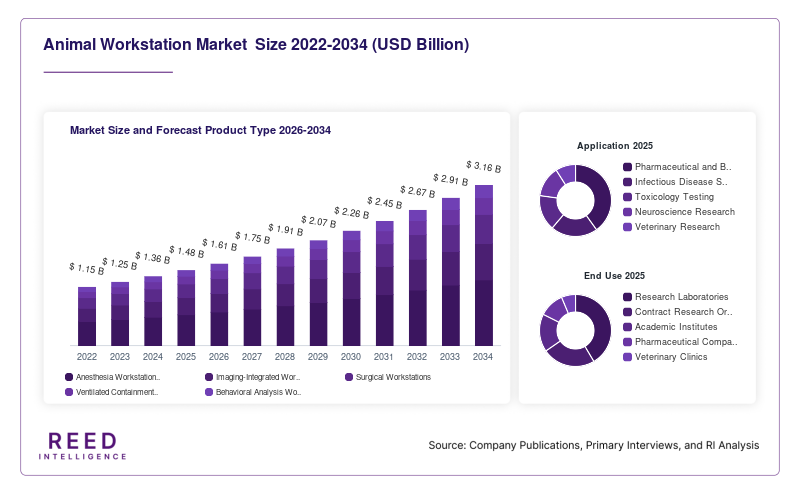
- By product type, anesthesia workstations accounted for the largest share of 39.1%, while imaging-integrated workstations are projected to grow at a CAGR of 11.7%.
- By application, pharmaceutical and biotechnology research led with a 43.6% share, whereas infectious disease studies are expected to expand at a CAGR of 11.4%.
- By end use, research laboratories held the dominant share of 46.8%, while contract research organizations are anticipated to grow at a CAGR of 10.8%.
- The United States remained the dominant country, with market values of USD 462 million in 2024 and USD 508 million in 2025.
Market Trends
Integration of Smart Monitoring and Digital Connectivity
The Animal Workstation Market is witnessing a gradual shift toward digitally connected and automated workstation platforms that improve laboratory efficiency and animal handling precision. Manufacturers are integrating touchscreen control systems, automated airflow monitoring, anesthesia management modules, and cloud-based data storage into workstation designs. These technologies allow research teams to monitor environmental parameters, track experimental workflows, and maintain regulatory documentation more effectively. The adoption of smart systems is particularly strong among pharmaceutical companies and academic research institutions conducting long-term preclinical studies. Automated monitoring capabilities also help reduce manual intervention, which minimizes contamination risks and improves workflow consistency. As laboratories continue to modernize infrastructure, the demand for integrated animal workstations with advanced analytics and remote monitoring capabilities is expected to increase significantly.
Rising Preference for Modular and Ergonomic Workstation Designs
Laboratories are increasingly prioritizing flexible workstation configurations that can adapt to different animal species, experimental protocols, and research environments. Modular animal workstations are gaining popularity because they provide scalability and allow facilities to upgrade systems without replacing complete laboratory infrastructure. Ergonomic design improvements are also becoming a major purchasing consideration, especially in high-volume research centers where technicians operate workstations for extended periods. Manufacturers are introducing adjustable-height units, compact mobile systems, and noise-reduction technologies to improve operator comfort and laboratory productivity. The trend toward modular systems is also supported by the growing number of contract research organizations that require customizable workstations for diverse projects. As laboratory space optimization becomes more important, demand for portable and multi-functional animal workstation systems is expected to remain strong throughout the forecast period.
Market Drivers
Expansion of Pharmaceutical and Biotechnology Research Activities
The rapid growth of pharmaceutical and biotechnology research activities is one of the primary drivers supporting the Animal Workstation Market. Drug discovery programs, vaccine development initiatives, and translational medicine projects require controlled laboratory environments that ensure safe and efficient animal handling procedures. Pharmaceutical companies are investing heavily in modern laboratory infrastructure to improve research productivity and comply with evolving regulatory standards. Animal workstations equipped with integrated ventilation systems, anesthesia delivery mechanisms, and imaging capabilities are becoming essential for conducting reliable preclinical studies. The increasing prevalence of chronic diseases and the growing demand for innovative therapies are also encouraging research institutions to expand animal testing facilities. As global research spending continues to increase, laboratories are expected to adopt technologically advanced workstation systems that support precision research and operational safety.
Growing Emphasis on Laboratory Safety and Animal Welfare Compliance
Rising awareness regarding laboratory safety standards and animal welfare regulations is significantly contributing to market growth. Government agencies and research oversight organizations are implementing stricter guidelines related to animal handling, contamination control, and technician safety during experimental procedures. As a result, laboratories are upgrading traditional animal handling systems with enclosed and ventilated workstations designed to minimize exposure risks. Institutions are also focusing on improving research reproducibility and maintaining ethical standards during animal studies. Advanced workstations help laboratories maintain stable environmental conditions, reduce animal stress, and improve procedural consistency. In addition, universities and research centers are increasingly allocating budgets toward compliant laboratory infrastructure to meet accreditation requirements. These regulatory and operational priorities are expected to continue driving long-term demand for advanced animal workstation technologies.
Market Restraint
High Equipment Costs and Complex Maintenance Requirements
The high initial investment associated with advanced animal workstation systems remains a significant restraint for market expansion, particularly among small research laboratories and academic institutions with limited budgets. Modern workstations equipped with automated controls, integrated imaging systems, advanced filtration units, and digital monitoring software often involve substantial procurement and installation costs. In addition, laboratories must allocate financial resources for maintenance services, calibration procedures, software updates, and technician training programs. These operational requirements can increase the total cost of ownership over time. Smaller facilities in developing regions often continue using conventional equipment due to budget limitations and limited technical expertise. Delays in infrastructure modernization can reduce adoption rates in cost-sensitive markets. Furthermore, complex maintenance requirements and the need for specialized support personnel may discourage some laboratories from investing in technologically sophisticated workstation platforms, thereby limiting broader market penetration.
Market Opportunities
Increasing Investments in Emerging Research Infrastructure
Emerging economies are creating favorable opportunities for the Animal Workstation Market due to rising investments in healthcare research infrastructure and biotechnology innovation. Countries across Asia Pacific, Latin America, and the Middle East are expanding biomedical research programs to strengthen domestic pharmaceutical production and improve public health preparedness. Governments and private organizations are allocating funding toward laboratory modernization initiatives, including the establishment of advanced animal research facilities. This trend is creating strong demand for cost-effective and scalable workstation systems capable of supporting multiple research applications. International collaborations between academic institutions and biotechnology firms are also increasing the installation of standardized laboratory equipment across developing markets. As research ecosystems continue to expand in these regions, manufacturers have opportunities to introduce customized workstation solutions tailored to local operational and regulatory requirements.
Growth Potential in Personalized Medicine and Translational Research
The growing focus on personalized medicine and translational research is expected to generate substantial opportunities for manufacturers operating in the Animal Workstation Market. Precision medicine programs require extensive preclinical validation processes involving advanced animal models and highly controlled experimental conditions. Research organizations are adopting specialized workstations that support imaging, behavioral analysis, surgical procedures, and physiological monitoring for targeted therapy development. The expansion of gene therapy, oncology research, and immunology studies is also increasing the need for sophisticated laboratory systems that ensure data accuracy and reproducibility. In addition, biotechnology startups are investing in compact and multifunctional workstation platforms that optimize limited laboratory space while supporting complex research workflows. As translational research becomes more integrated with clinical development strategies, demand for technologically advanced animal workstations is likely to increase steadily.
Segmental Analysis
By Product Type
Anesthesia workstations represented the dominant subsegment within the Animal Workstation Market in 2024, accounting for approximately 39.1% of total revenue. These systems are widely used across pharmaceutical laboratories, veterinary clinics, and academic research institutions for controlled animal sedation and surgical procedures. Their popularity is supported by the increasing demand for precise anesthesia administration and integrated safety features that reduce procedural risks during preclinical experiments. Modern anesthesia workstations include automated gas delivery systems, airflow regulation modules, and monitoring interfaces that improve operational accuracy. Research facilities are increasingly prioritizing advanced anesthesia systems because they support compliance with laboratory safety standards while improving animal welfare outcomes. The growing volume of surgical research and toxicology studies is expected to sustain demand for these systems across major healthcare and research markets.
By Application
Pharmaceutical and biotechnology research accounted for the largest share of the Animal Workstation Market in 2024, contributing approximately 43.6% of overall revenue. The segment’s dominance is closely linked to the growing number of drug discovery programs, vaccine development initiatives, and translational research projects worldwide. Animal workstations are essential in these applications because they provide contamination-controlled environments that improve research consistency and support regulatory compliance. Pharmaceutical companies are increasingly adopting automated workstation systems with integrated monitoring technologies to improve laboratory productivity and reduce operational errors. The rising prevalence of chronic diseases and increasing investment in precision medicine are also supporting segment expansion. As research pipelines continue to grow, demand for advanced workstation systems in pharmaceutical and biotechnology laboratories is expected to remain strong.
By End Use
Research laboratories held the dominant share of the Animal Workstation Market in 2024, accounting for approximately 46.8% of total revenue. Academic institutions, biomedical research centers, and government-funded laboratories represent key users within this segment. These facilities require advanced workstations to support animal handling, imaging, surgery, and behavioral analysis procedures across multiple research disciplines. Increasing funding for translational medicine, oncology studies, and neurological research is encouraging laboratories to invest in modern workstation technologies. Research facilities are also focusing on improving workflow efficiency and maintaining compliance with ethical animal handling regulations. The adoption of modular and digitally connected workstation systems is growing because laboratories increasingly prioritize operational flexibility and long-term scalability. Rising collaboration between universities and pharmaceutical companies is expected to further support segment growth.
Regional Analysis
North America
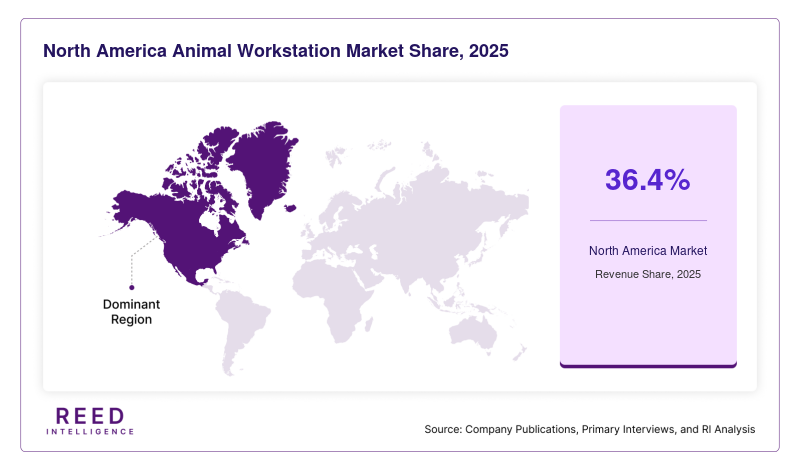
North America accounted for the largest share of the Animal Workstation Market in 2025, representing approximately 36.4% of global revenue. The region is projected to expand at a CAGR of 8.3% during the forecast period due to continued investments in pharmaceutical research, biotechnology innovation, and laboratory automation. The presence of major research institutions, well-established healthcare infrastructure, and strong funding support for biomedical studies contributes significantly to market growth. In addition, increasing adoption of digital laboratory management systems and automated animal handling technologies is supporting the expansion of advanced workstation installations across research facilities.
The United States remains the dominant contributor within North America due to its extensive pharmaceutical industry and high research expenditure levels. One major growth factor is the rising number of infectious disease and oncology research programs requiring advanced laboratory animal handling systems. Federal funding for vaccine development and translational medicine initiatives is also encouraging universities and biotechnology companies to upgrade existing laboratory infrastructure. Canada is witnessing steady demand as academic institutions increase investments in ethical research practices and laboratory modernization projects.
Europe
Europe held a substantial share of the Animal Workstation Market in 2025 and is expected to record stable growth at a CAGR of 7.9% through 2034. The region benefits from stringent laboratory safety standards and a strong focus on animal welfare compliance across research activities. Pharmaceutical companies and academic institutions are increasingly adopting enclosed and ventilated workstation systems to improve research consistency and maintain operational safety standards. Demand is particularly strong in countries with advanced biotechnology sectors and government-supported research programs. Growing collaboration between universities and healthcare organizations is also supporting the installation of integrated laboratory infrastructure.
Germany represents the leading country within the European market due to its strong pharmaceutical manufacturing base and extensive biomedical research ecosystem. A unique growth factor supporting the German market is the increasing emphasis on automation in laboratory operations. Research centers are integrating digitally connected workstations to improve workflow efficiency and reduce manual handling errors. The United Kingdom and France are also contributing to regional growth through rising investments in clinical research and biotechnology innovation initiatives focused on precision medicine and chronic disease management.
Asia Pacific
Asia Pacific is projected to register the fastest growth in the Animal Workstation Market, with a forecast CAGR of 10.9% during 2026–2034. The region is experiencing rapid expansion in pharmaceutical manufacturing, contract research activities, and biomedical research infrastructure development. Governments across several Asian economies are increasing healthcare research budgets and supporting domestic biotechnology industries through funding programs and policy incentives. The growing number of preclinical studies and rising demand for laboratory automation are encouraging research facilities to adopt modern workstation systems equipped with advanced ventilation and monitoring technologies.
China dominates the Asia Pacific market due to large-scale investments in pharmaceutical production and research infrastructure development. One key growth factor is the expansion of contract research organizations providing preclinical testing services for international pharmaceutical companies. These organizations require scalable and efficient workstation systems capable of supporting high-volume animal studies. India and Japan are also witnessing growing demand driven by expanding biotechnology sectors, increasing academic research activities, and rising awareness regarding laboratory safety standards and ethical animal handling practices.
Middle East & Africa
The Middle East & Africa Animal Workstation Market is expected to grow steadily during the forecast period, supported by increasing investments in healthcare infrastructure and biomedical research capabilities. Although the regional market currently accounts for a smaller share of global revenue, governments are gradually strengthening research ecosystems through public funding and international partnerships. Universities and healthcare organizations are adopting advanced laboratory systems to improve research quality and support disease surveillance programs. Demand for animal workstations is also increasing in veterinary research and pharmaceutical testing applications across selected regional markets.
Saudi Arabia remains one of the leading contributors within the Middle East & Africa region due to ongoing healthcare modernization initiatives and expanding research facilities. A unique factor supporting market growth is the government’s focus on developing biotechnology and life sciences industries under long-term economic diversification strategies. Research institutions are investing in laboratory infrastructure upgrades to improve compliance with international safety standards. South Africa is also contributing to market development through increasing investments in infectious disease research and veterinary science programs.
Latin America
Latin America is anticipated to witness moderate growth in the Animal Workstation Market during the forecast period, supported by the expansion of pharmaceutical research and academic laboratory infrastructure. The region is gradually adopting modern laboratory technologies to improve research capabilities and comply with international standards related to animal handling and contamination control. Increasing partnerships between regional universities and multinational pharmaceutical companies are encouraging investments in advanced workstation systems. The demand for integrated anesthesia and monitoring workstations is also rising in veterinary research and biomedical laboratories.
Brazil represents the dominant market within Latin America due to its growing pharmaceutical sector and increasing public investment in healthcare research. One major growth factor is the expansion of academic research collaborations focused on infectious disease studies and vaccine development. Research institutions are modernizing laboratory environments to support advanced preclinical testing procedures and improve operational efficiency. Mexico is also witnessing growing adoption of animal workstation systems due to the increasing presence of contract research organizations and biotechnology startups.
Competitive Landscape
The Animal Workstation Market is characterized by moderate competition, with established laboratory equipment manufacturers focusing on product innovation, automation technologies, and strategic partnerships to strengthen their market presence. Companies are increasingly investing in ergonomic workstation designs, advanced ventilation systems, and integrated monitoring software to address evolving laboratory requirements. Market participants are also expanding distribution networks across emerging economies where investments in biomedical research infrastructure are rising steadily.
Harvard Apparatus remains one of the leading companies in the market due to its broad portfolio of laboratory research systems and strong presence across academic and pharmaceutical institutions. The company recently introduced upgraded anesthesia workstation solutions equipped with enhanced digital monitoring interfaces for preclinical studies. Other major players are also emphasizing acquisitions and collaborative research agreements to expand technological capabilities and improve customer reach. Manufacturers are focusing on modular workstation systems that support multi-application research environments while reducing installation complexity and operational costs.
Key Players
- Harvard Apparatus
- Kent Scientific Corporation
- Lab Products Inc.
- Tecniplast S.p.A.
- Allentown LLC
- SOMNOmedics GmbH
- VetEquip Inc.
- Braintree Scientific Inc.
- Patterson Scientific
- Lomir Biomedical Inc.
- Bioseb
- Charles River Laboratories
- LEEC Limited
- Midmark Corporation
- Phoenix Research Labs
Recent Developments
- In February 2026, Tecniplast S.p.A. introduced a modular animal workstation platform featuring integrated airflow monitoring and digital environmental control capabilities for biomedical laboratories.
- In August 2025, Harvard Apparatus expanded its preclinical research equipment portfolio by launching upgraded anesthesia workstations with touchscreen interfaces and automated safety alerts.
- In November 2025, Allentown LLC announced a partnership with a biotechnology research institute to develop advanced containment workstation systems for infectious disease applications.
- In March 2026, Kent Scientific Corporation launched compact imaging-integrated workstations designed for small laboratory facilities focused on translational research programs.
Animal Workstation Market Segments
Product Type
- Anesthesia Workstations
- Imaging-Integrated Workstations
- Surgical Workstations
- Ventilated Containment Workstations
- Behavioral Analysis Workstations
Application
- Pharmaceutical and Biotechnology Research
- Infectious Disease Studies
- Toxicology Testing
- Neuroscience Research
- Veterinary Research
End Use
- Research Laboratories
- Contract Research Organizations
- Academic Institutes
- Pharmaceutical Companies
- Veterinary Clinics
By Region
- North America
- Europe
- APAC
- Middle East and Africa
- LATAM