Anionic Dispersants Market Size, Share Demand Report By Type (Lignosulfonates, Naphthalene Sulfonates, Polycarboxylates, Phosphate Esters, Acrylic-Based Dispersants), By Application (Paints and Coatings, Agrochemicals, Detergents, Ceramics, Pulp and Paper, Textile Processing, Others), By End Use (Construction Chemicals, Industrial Cleaning, Automotive, Agriculture, Packaging, Manufacturing Industries, Others), By Region & Segment Forecasts, 2026–2034
USD 3950
Market Overview
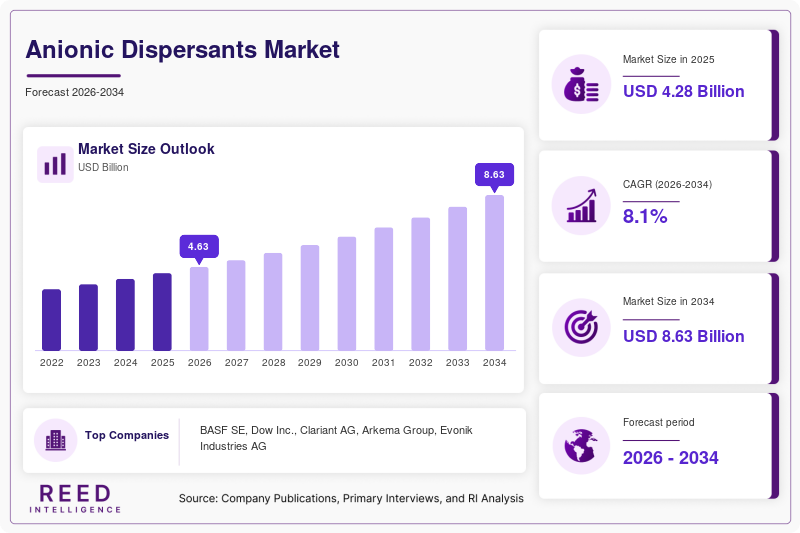
The global Anionic Dispersants Market size was valued at USD 4.28 billion in 2026 and is projected to reach USD 7.96 billion by 2034, expanding at a CAGR of 8.1% during the forecast period from 2026 to 2034. The market continues to witness stable growth due to rising demand for high-performance formulations across paints and coatings, agrochemicals, construction chemicals, detergents, ceramics, and pulp and paper industries. Anionic dispersants are widely used to improve particle distribution, reduce agglomeration, and enhance product stability in liquid and solid formulations. Increasing industrial production and infrastructure development across emerging economies are supporting the consumption of specialty additives, including dispersants.
One of the major global factors supporting market expansion is the growing demand for water-based formulations across industrial sectors. Manufacturers are increasingly shifting toward environmentally compliant and low-VOC products, especially in paints, coatings, and cleaning applications. Anionic dispersants play a critical role in maintaining stability and viscosity control in water-based systems. This transition has encouraged chemical manufacturers to invest in advanced polymer dispersant technologies with improved compatibility and sustainability profiles. In addition, rising investments in construction activities, automotive coatings, and agricultural productivity enhancement are creating consistent demand for efficient dispersion technologies across developed and developing economies.
Key Highlights
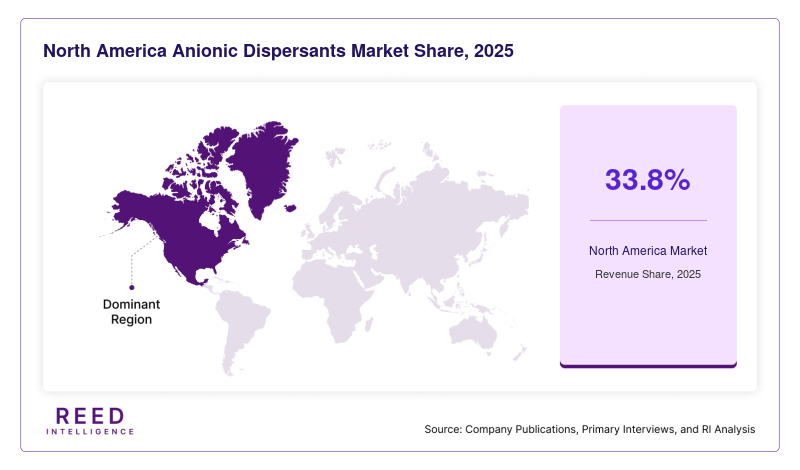
- North America dominated the market with a 33.8% share in 2025, while Asia Pacific is expected to grow at the fastest CAGR of 10.9% during 2026–2034.
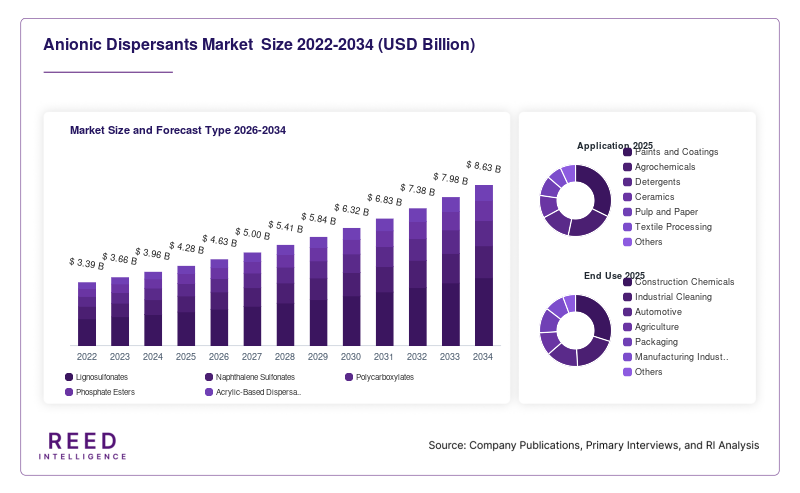
- By type, lignosulfonates accounted for the largest share of 36.4%, while polycarboxylate dispersants are projected to grow at a CAGR of 11.6%.
- By application, paints and coatings led with a 39.2% share, whereas agrochemicals are expected to expand at a CAGR of 10.8%.
- By end use, construction chemicals held the largest share of 31.7%, while industrial cleaning applications are projected to grow at a CAGR of 10.2%.
- The United States remained the dominant country, with market values of USD 690 million in 2024 and USD 748 million in 2025.
Market Trends
Expansion of Sustainable Water-Based Coating Technologies
The increasing use of sustainable water-based coatings across automotive, construction, packaging, and furniture industries is becoming a major trend within the Anionic Dispersants Market. Manufacturers are gradually replacing solvent-based formulations with water-based alternatives to comply with stricter environmental regulations and emission reduction goals. Anionic dispersants are essential in these systems because they help stabilize pigments and fillers while maintaining uniform consistency and long-term storage stability. Demand for eco-friendly paints and industrial coatings has increased significantly in Asia Pacific and Europe due to government policies focused on reducing volatile organic compound emissions. This trend is encouraging chemical companies to develop bio-based and low-toxicity dispersants suitable for modern coating systems. Advanced dispersants with multifunctional properties, including improved wetting and reduced foam generation, are also gaining commercial attention.
Rising Adoption of High-Performance Additives in Agrochemical Formulations
The growing use of advanced agrochemical formulations is another major trend shaping the Anionic Dispersants Market. Agricultural producers are increasingly adopting suspension concentrates, wettable powders, and liquid fertilizer formulations that require efficient particle dispersion for improved field performance. Anionic dispersants are widely utilized in these products because they help prevent sedimentation and ensure uniform application across crops. Rising global food demand and declining arable land availability are encouraging the use of high-efficiency crop protection chemicals. Agrochemical manufacturers are therefore investing in dispersant technologies that enhance formulation stability under varying environmental conditions. The trend is particularly strong in countries such as China, India, Brazil, and Argentina, where agricultural modernization programs are expanding rapidly. Growing focus on precision farming and controlled-release agrochemical products is further supporting demand for specialized dispersant systems.
Market Drivers
Growing Infrastructure Development and Construction Activities
Rapid infrastructure expansion across residential, commercial, and industrial sectors is one of the primary growth drivers for the Anionic Dispersants Market. Construction chemicals, cement additives, ceramic products, and coatings heavily depend on dispersants to improve material handling, stability, and overall product performance. Governments in emerging economies are investing heavily in transportation infrastructure, housing development, smart cities, and industrial corridors. This has significantly increased demand for paints, concrete admixtures, and construction materials that utilize anionic dispersants. In addition, modern construction practices require advanced chemical formulations capable of delivering durability and consistent performance under demanding conditions. The construction sector in Asia Pacific and the Middle East is particularly contributing to rising dispersant consumption due to rapid urbanization and industrial expansion. The increasing use of high-strength concrete and specialized coatings is also accelerating market demand.
Increasing Demand from the Paints and Coatings Industry
The expanding global paints and coatings industry is another major factor supporting the growth of the Anionic Dispersants Market. These dispersants are widely used in decorative paints, industrial coatings, automotive finishes, and protective coatings because they help maintain pigment distribution and improve product appearance. Growth in automotive manufacturing, renovation activities, and industrial maintenance projects is creating strong demand for coating additives worldwide. Manufacturers are also focusing on premium coating products with improved gloss, durability, and corrosion resistance, which require advanced dispersant technologies. In developed markets, renovation and refurbishment activities are driving coating consumption, while developing economies are experiencing increased demand due to rapid construction and manufacturing growth. Technological advancements in pigment dispersion and resin compatibility are further encouraging the adoption of specialized anionic dispersants in high-performance coating formulations.
Market Restraint
Volatility in Raw Material Prices and Regulatory Compliance Challenges
Fluctuating raw material prices remain a significant restraint affecting the growth of the Anionic Dispersants Market. Many dispersants are manufactured using petrochemical derivatives and specialty polymers whose prices are influenced by crude oil fluctuations, supply chain disruptions, and geopolitical instability. Sudden changes in feedstock costs directly impact production expenses and profit margins for manufacturers. Small and medium-scale producers often face difficulty in maintaining stable pricing structures, particularly in highly competitive regional markets. In addition, transportation costs and energy price increases continue to add operational pressure across the chemical manufacturing sector.
The market also faces growing regulatory scrutiny regarding environmental safety, chemical toxicity, and wastewater management. Several countries have introduced stricter regulations governing chemical additives used in coatings, detergents, and industrial formulations. Compliance with evolving environmental standards requires continuous investment in product reformulation, testing, and certification processes. For example, some traditional dispersant chemistries are being replaced due to concerns related to biodegradability and aquatic toxicity. These regulatory pressures may increase production costs and slow the commercialization of certain formulations, particularly in cost-sensitive markets where manufacturers operate with limited research and development budgets.
Market Opportunities
Development of Bio-Based and Renewable Dispersant Technologies
The increasing emphasis on sustainable chemical manufacturing is creating strong opportunities for bio-based anionic dispersants. Industries are actively seeking renewable alternatives to petroleum-derived additives in order to reduce environmental impact and support long-term sustainability goals. Manufacturers are therefore investing in dispersants derived from lignin, plant-based feedstocks, and renewable polymers. These products are gaining interest across coatings, agriculture, and cleaning applications due to their lower toxicity profiles and improved biodegradability. Growing consumer preference for environmentally responsible products is also influencing industrial purchasing decisions. As governments continue to strengthen environmental regulations and carbon reduction initiatives, demand for sustainable dispersant technologies is expected to accelerate significantly during the forecast period. Companies that develop cost-effective renewable dispersants with competitive performance characteristics are likely to gain substantial growth opportunities.
Expansion of Industrial Manufacturing in Emerging Economies
Rapid industrialization in emerging economies presents another major opportunity for the Anionic Dispersants Market. Countries across Asia Pacific, Latin America, and parts of Africa are witnessing expanding manufacturing activity in construction materials, ceramics, textiles, agriculture, and industrial coatings. These sectors require efficient dispersion technologies to improve product quality and operational efficiency. Increasing foreign direct investment and government support for domestic manufacturing are encouraging the establishment of new industrial facilities and chemical processing plants. Rising middle-class populations and urban infrastructure projects are also increasing demand for paints, detergents, and processed materials that utilize anionic dispersants.
Emerging economies additionally offer opportunities for localized production and supply chain optimization. International manufacturers are expanding regional manufacturing capabilities to reduce transportation costs and strengthen market presence. Technological partnerships between global chemical producers and regional distributors are supporting product accessibility in underserved markets. As industrial standards continue to improve across developing regions, demand for high-performance specialty additives is expected to rise steadily throughout the forecast period.
Segmental Analysis
By Type
Lignosulfonates accounted for the largest share of the Anionic Dispersants Market in 2024, representing 36.4% of total revenue. These dispersants are widely utilized across construction chemicals, ceramics, animal feed, and industrial formulations due to their cost efficiency and effective particle stabilization properties. Lignosulfonates are derived from wood-processing byproducts, making them relatively economical compared to synthetic alternatives. Their ability to improve workability and reduce water consumption in concrete applications has significantly increased demand from infrastructure and construction industries. In addition, the growing preference for renewable and bio-based chemical additives is supporting wider acceptance of lignosulfonate-based dispersants across environmentally conscious industries. Manufacturers are also focusing on enhancing product purity and compatibility to improve performance in high-demand industrial applications.
Polycarboxylate dispersants are expected to witness the fastest CAGR of 11.6% during the forecast period due to their superior dispersion efficiency and compatibility with advanced formulations. These dispersants provide excellent particle separation, reduced viscosity, and enhanced stability in coatings, ceramics, and high-performance construction materials. Increasing demand for premium-grade coatings and self-leveling concrete products is accelerating adoption of polycarboxylate technologies. The segment is also benefiting from ongoing innovation in polymer chemistry, enabling manufacturers to develop customized dispersants with improved electrolyte tolerance and thermal stability. Growth in industrial automation and precision manufacturing processes is further encouraging the use of advanced dispersant systems. Rising investments in sustainable infrastructure and high-performance industrial applications are expected to continue supporting segment expansion throughout the forecast timeline.
By Application
Paints and coatings represented the dominant application segment in the Anionic Dispersants Market, accounting for 39.2% of total revenue in 2024. Dispersants play a critical role in maintaining pigment stability, improving gloss consistency, and preventing sedimentation in coating formulations. Increasing demand for decorative paints, automotive coatings, and industrial protective coatings has contributed significantly to segment growth. Urban development projects and residential construction activities are increasing the use of architectural coatings globally. In addition, industrial sectors such as marine, aerospace, and automotive manufacturing require advanced coating technologies capable of delivering corrosion resistance and long-term durability. Manufacturers are increasingly incorporating high-performance dispersants into water-based formulations to improve application efficiency and meet environmental compliance standards. Technological advancements in resin compatibility and pigment processing are further supporting the growth of this application segment.
Agrochemicals are projected to register the fastest CAGR of 10.8% during the forecast period due to rising global food demand and increasing focus on agricultural productivity. Anionic dispersants are extensively used in pesticide suspensions, herbicide formulations, and fertilizer solutions to improve particle distribution and formulation stability. The shift toward precision agriculture and controlled-release agrochemical products is encouraging the adoption of advanced dispersant technologies. Developing countries are increasingly investing in modern agricultural practices to enhance crop yield and reduce losses caused by pests and diseases. Climatic uncertainties and shrinking arable land availability are also supporting demand for efficient crop protection products. In addition, agrochemical manufacturers are focusing on dispersants capable of maintaining formulation stability under varying storage and environmental conditions, further contributing to rapid segment growth.
By End Use
Construction chemicals held the largest share of the Anionic Dispersants Market in 2024, contributing 31.7% of total market revenue. The segment benefits from growing infrastructure development and increasing demand for high-performance building materials. Anionic dispersants are widely utilized in concrete admixtures, cement processing, gypsum products, and ceramic applications because they improve workability and particle distribution. Governments across emerging economies are investing heavily in transportation infrastructure, residential housing, and industrial construction projects. This has significantly increased consumption of construction additives capable of improving material strength and application efficiency. The demand for sustainable construction materials and energy-efficient buildings is also encouraging the use of advanced dispersant technologies. Manufacturers continue to develop formulations with enhanced compatibility and reduced water requirements to support modern construction practices.
Industrial cleaning applications are expected to expand at the fastest CAGR of 10.2% throughout the forecast period. Rising awareness regarding hygiene standards, industrial maintenance, and operational efficiency is increasing demand for high-performance cleaning formulations. Anionic dispersants are used in industrial detergents and cleaning agents to improve dirt suspension and prevent redeposition on surfaces. Rapid industrialization across manufacturing, food processing, healthcare, and transportation sectors is creating strong demand for specialized cleaning chemicals. The segment is also benefiting from stricter sanitation regulations and growing emphasis on workplace safety. Manufacturers are increasingly introducing environmentally compliant cleaning formulations with biodegradable dispersants to align with sustainability initiatives. The growing use of automated cleaning systems and industrial processing equipment is expected to further strengthen demand for advanced cleaning additives over the coming years.
Regional Analysis
North America
North America accounted for 33.8% of the global Anionic Dispersants Market in 2025 and is expected to maintain a stable growth trajectory with a CAGR of 7.4% during the forecast period. The region benefits from strong demand across paints and coatings, construction chemicals, detergents, and industrial cleaning applications. The presence of advanced manufacturing infrastructure and established specialty chemical producers supports steady product innovation and commercialization. Increasing investments in sustainable industrial processes are also contributing to the adoption of water-based formulations that require efficient dispersant technologies.
The United States remained the dominant country in North America due to high industrial output and strong demand from automotive coatings and construction sectors. Rising renovation activities and infrastructure modernization programs are increasing consumption of specialty additives across the country. Another important growth factor is the growing preference for environmentally compliant formulations in industrial applications. Chemical producers are focusing on low-VOC coating systems and biodegradable dispersants to meet changing regulatory standards and customer expectations.
Europe
Europe represented 27.1% of the global Anionic Dispersants Market in 2025 and is projected to expand at a CAGR of 7.2% through 2034. Demand for sustainable and high-performance chemical additives continues to support market growth across the region. Strict environmental regulations related to industrial emissions and chemical safety are encouraging manufacturers to shift toward advanced water-based technologies. The region also benefits from strong research and development capabilities within the specialty chemicals sector. Increasing adoption of eco-friendly coatings and industrial formulations is further strengthening dispersant demand.
Germany emerged as the dominant country within the European market due to its strong automotive manufacturing base and advanced industrial coating industry. The country has significant demand for dispersants used in paints, pigments, and engineered materials. A unique growth factor supporting the German market is the rapid integration of sustainable chemistry initiatives across manufacturing industries. Companies are increasingly investing in renewable raw materials and energy-efficient production systems, which is accelerating the development and adoption of advanced dispersant technologies.
Asia Pacific
Asia Pacific held 24.9% of the global Anionic Dispersants Market in 2025 and is expected to record the fastest CAGR of 10.9% during the forecast period. Rapid urbanization, expanding industrial production, and rising infrastructure investments are major contributors to regional market growth. Countries across the region are witnessing increasing consumption of coatings, agrochemicals, detergents, and construction materials. Growing manufacturing capacity and improving access to specialty chemicals are further supporting dispersant demand. International chemical companies are also strengthening regional production facilities to capture expanding industrial opportunities.
China dominated the Asia Pacific market due to its extensive manufacturing ecosystem and strong demand from construction and industrial sectors. The country remains a major producer and consumer of paints, ceramics, agrochemicals, and detergents that utilize dispersant technologies. One unique growth factor driving the Chinese market is the rapid expansion of electric vehicle manufacturing and related industrial coatings demand. Advanced coating systems used in battery components and vehicle production require efficient dispersion performance, which is creating additional opportunities for anionic dispersant suppliers.
Middle East & Africa
The Middle East & Africa accounted for 7.2% of the global Anionic Dispersants Market in 2025 and is anticipated to grow at a CAGR of 8.3% through 2034. Infrastructure development projects and industrial diversification strategies are supporting market expansion across the region. Governments are investing in construction, manufacturing, and water treatment projects to reduce economic dependence on oil revenues. These developments are increasing demand for construction chemicals, industrial coatings, and cleaning products that require dispersant additives. Growing industrial activity in Gulf countries is also contributing to stable market growth.
Saudi Arabia emerged as the dominant country within the regional market due to extensive construction and industrial development initiatives. Large-scale infrastructure programs and expanding petrochemical production capacities continue to support chemical additive demand across the country. A notable growth factor is the government’s focus on economic diversification and domestic manufacturing expansion under long-term development strategies. This has encouraged investment in local specialty chemical production and increased adoption of advanced industrial formulations that utilize anionic dispersants.
Latin America
Latin America represented 7.0% of the global Anionic Dispersants Market in 2025 and is forecast to grow at a CAGR of 8.0% during the study period. The region is experiencing rising demand for dispersants in agricultural chemicals, paints, and industrial cleaning products. Expanding urban populations and infrastructure modernization projects are increasing the use of construction materials and decorative coatings. Agricultural production also remains an important contributor to regional chemical consumption. Growing industrialization and increasing investment in manufacturing activities are gradually supporting specialty additive demand across major economies.
Brazil dominated the Latin American market owing to its large agricultural sector and expanding industrial base. The country has strong demand for dispersants used in agrochemical formulations, coatings, and cleaning products. One unique growth factor influencing the Brazilian market is the increasing adoption of advanced crop protection solutions aimed at improving agricultural productivity. Farmers and agrochemical producers are investing in high-performance formulations capable of delivering stable and effective field applications, which is supporting long-term demand for anionic dispersants.
Competitive Landscape
The Anionic Dispersants Market is moderately fragmented, with several multinational and regional chemical companies competing through product innovation, strategic partnerships, and capacity expansion initiatives. Leading market participants are focusing on sustainable product development, customized formulations, and expansion into high-growth emerging markets. Companies are investing in advanced polymer technologies and bio-based dispersant solutions to strengthen their competitive positioning and meet evolving regulatory requirements.
BASF SE remains one of the leading participants in the global market due to its broad specialty chemicals portfolio, extensive distribution network, and strong research capabilities. The company continues to invest in sustainable dispersant technologies designed for water-based coatings and industrial applications. Dow Inc., Clariant AG, Arkema Group, and Evonik Industries AG also maintain strong market positions through diversified product offerings and long-term partnerships with industrial manufacturers.
Recent industry developments include production capacity expansions in Asia Pacific, new product launches focused on low-VOC applications, and collaborations aimed at improving renewable raw material integration. Companies are increasingly emphasizing digital manufacturing processes and supply chain optimization to improve operational efficiency. Competitive intensity is expected to increase further as manufacturers continue to develop application-specific dispersants for coatings, agrochemicals, construction chemicals, and industrial cleaning sectors.
Key Players
- BASF SE
- Dow Inc.
- Clariant AG
- Arkema Group
- Evonik Industries AG
- Croda International Plc
- Solvay SA
- Nouryon
- Ashland Inc.
- Kao Corporation
- Huntsman Corporation
- Elementis Plc
- Kemira Oyj
- Borregaard ASA
- SNF Group
Recent Developments
- BASF SE introduced a new water-based polymer dispersant portfolio in 2025 focused on improving pigment stability in industrial coating applications.
- Clariant AG expanded its specialty chemical production facility in China in 2024 to strengthen regional supply capabilities for dispersants and coating additives.
- Evonik Industries AG announced a strategic collaboration with a renewable raw material supplier in 2025 to develop sustainable bio-based dispersant solutions for industrial formulations.
- Dow Inc. launched an advanced dispersant technology platform in 2024 designed for low-VOC architectural coatings and high-performance construction materials.
- Arkema Group increased research investment in polymer dispersant technologies aimed at improving formulation efficiency for agrochemical and ceramic applications.
Anionic Dispersants Market Segments
Type
- Lignosulfonates
- Naphthalene Sulfonates
- Polycarboxylates
- Phosphate Esters
- Acrylic-Based Dispersants
Application
- Paints and Coatings
- Agrochemicals
- Detergents
- Ceramics
- Pulp and Paper
- Textile Processing
- Others
End Use
- Construction Chemicals
- Industrial Cleaning
- Automotive
- Agriculture
- Packaging
- Manufacturing Industries
- Others
By Region
- North America
- Europe
- APAC
- Middle East and Africa
- LATAM