Anodic Aluminum Oxide Wafer Market Size, Share & Demand Report By Type (Porous AAO Wafers, Barrier AAO Wafers, Ultra-thin AAO Wafers), By Application (Semiconductor Fabrication, Filtration Systems, Biomedical Applications, Energy Storage), By End-Use Industry (Electronics, Healthcare, Energy, Research & Development), By Distribution Channel (Direct Sales, Distributors, Online Channels) & Segment Forecasts, 2025–2034
USD 3950
Market Overview
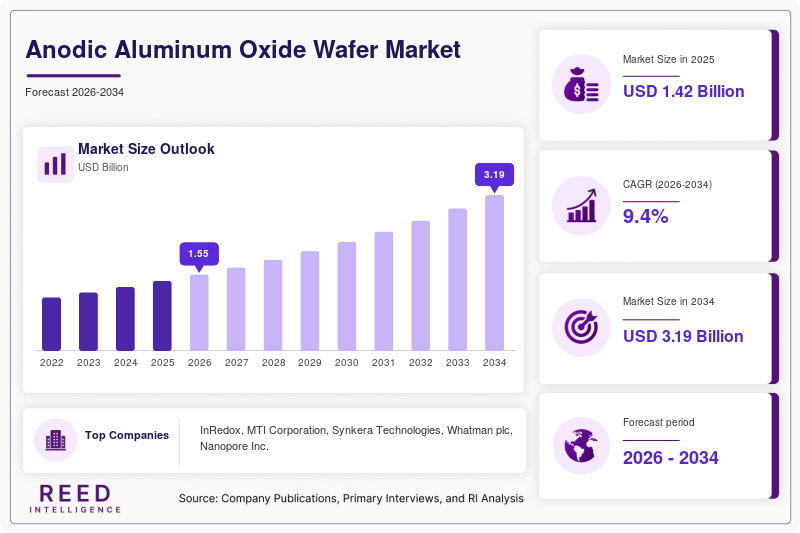
The global Anodic Aluminum Oxide Wafer Market size was valued at USD 1.42 billion in 2025 and is projected to reach USD 3.18 billion by 2034, expanding at a CAGR of 9.4% during the forecast period (2025–2034). The market growth has been supported by increasing demand for high-precision nanostructured materials across semiconductor, photonics, and biomedical industries. Anodic aluminum oxide (AAO) wafers, known for their uniform nanoporous structures and tunable properties, have become essential substrates for advanced manufacturing and research applications.
A major global factor contributing to market expansion has been the rapid advancement in nanotechnology-driven electronics. The growing need for miniaturized devices, improved energy storage solutions, and enhanced filtration technologies has driven adoption of AAO wafers in both industrial and research settings. Additionally, rising investments in semiconductor fabrication and material science research have further strengthened the demand outlook.
Key Highlights
- North America dominated the market with a 34.6% share in 2025, while Asia Pacific is expected to register the fastest CAGR of 10.8% (2025–2034).
- By type, porous AAO wafers held the largest share, while ultra-thin AAO wafers are projected to grow at a CAGR of 11.2%.
- By application, semiconductor fabrication was the leading segment, whereas biomedical applications are anticipated to grow at a CAGR of 10.5%.
- The United States led globally, with a market size of USD 410 million in 2025, expected to reach USD 445 million in 2026.
Market Trends
Integration of AAO Wafers in Advanced Nanofabrication
The integration of anodic aluminum oxide wafers into advanced nanofabrication processes has emerged as a significant trend shaping the Anodic Aluminum Oxide Wafer Market. AAO wafers provide highly ordered nanoporous structures that serve as templates for nanowire growth, quantum dot fabrication, and nanoscale patterning. This property has enabled their widespread adoption in electronics, optics, and sensing devices.
Industries are increasingly leveraging AAO wafers to improve device performance while maintaining cost efficiency. The trend is particularly evident in semiconductor manufacturing, where AAO substrates facilitate precise patterning and improved material deposition. As device architectures become more complex, the need for reliable and scalable nanostructures is rising, driving further integration of AAO-based solutions.
Growing Adoption in Biomedical and Filtration Applications
Another notable trend influencing the Anodic Aluminum Oxide Wafer Market is the increasing use of AAO wafers in biomedical and filtration applications. Their biocompatibility, chemical stability, and controllable pore dimensions make them suitable for drug delivery systems, biosensors, and tissue engineering scaffolds.
The healthcare sector has witnessed a surge in demand for advanced materials that enable precise filtration and targeted therapy. AAO wafers are being utilized in diagnostic tools and lab-on-chip devices, offering improved sensitivity and efficiency. Moreover, their application in water and air filtration systems has gained traction due to rising environmental concerns and stricter regulatory frameworks.
Market Drivers
Expansion of Semiconductor and Electronics Industry
The expansion of the semiconductor and electronics industry is a primary driver of the Anodic Aluminum Oxide Wafer Market. With increasing global demand for consumer electronics, data centers, and communication devices, manufacturers are focusing on advanced materials that enhance device efficiency and reliability.
AAO wafers play a critical role in enabling nanoscale fabrication and improving device performance. Their unique structural properties allow for precise control over electrical and optical characteristics, making them indispensable in next-generation semiconductor applications. As the industry continues to evolve towards smaller and more efficient components, the demand for AAO wafers is expected to rise significantly.
Moreover, the proliferation of technologies such as artificial intelligence, Internet of Things (IoT), and 5G networks has intensified the need for high-performance materials. This has further accelerated the adoption of AAO wafers in electronic manufacturing processes.
Rising Investment in Nanotechnology Research
Increasing investment in nanotechnology research has also contributed significantly to the growth of the Anodic Aluminum Oxide Wafer Market. Governments and private organizations worldwide are funding research initiatives aimed at developing innovative materials and technologies.
AAO wafers are widely used as templates for nanostructure fabrication, making them essential in experimental and commercial applications. Research activities focusing on energy storage, photonics, and biosensing have created new avenues for AAO wafer utilization.
Furthermore, collaborations between academic institutions and industry players have facilitated the commercialization of advanced AAO-based solutions. This has resulted in increased production capabilities and improved product quality, supporting market expansion.
Market Restraint
High Production Costs and Process Complexity
One of the major challenges facing the Anodic Aluminum Oxide Wafer Market is the high production cost and complexity associated with manufacturing AAO wafers. The anodization process requires precise control over parameters such as voltage, temperature, and electrolyte composition to achieve uniform pore structures.
These stringent requirements increase operational costs and limit scalability, particularly for small and medium-sized manufacturers. Additionally, variations in production conditions can lead to inconsistencies in wafer quality, affecting their performance in critical applications.
The need for specialized equipment and skilled labor further adds to the overall cost burden. As a result, the adoption of AAO wafers may be restricted in price-sensitive markets. Although ongoing research aims to simplify production processes and reduce costs, these challenges remain a significant restraint for market growth.
Market Opportunities
Emerging Applications in Energy Storage Technologies
The growing demand for efficient energy storage solutions presents a significant opportunity for the Anodic Aluminum Oxide Wafer Market. AAO wafers are being explored for use in batteries and supercapacitors due to their high surface area and structural stability.
These properties enable improved charge storage and faster energy transfer, making AAO-based materials suitable for next-generation energy devices. As the adoption of electric vehicles and renewable energy systems increases, the demand for advanced energy storage materials is expected to rise.
Companies are investing in research to develop AAO-based electrodes and separators that enhance battery performance. This trend is likely to create new growth opportunities for market players.
Growth in Photonics and Optical Devices
Another promising opportunity lies in the use of AAO wafers in photonics and optical devices. Their ability to manipulate light at the nanoscale makes them suitable for applications such as sensors, lasers, and optical filters.
The increasing demand for high-performance optical components in telecommunications and medical devices is driving the adoption of AAO wafers. Innovations in nanophotonics are expected to further expand their application scope.
As industries continue to explore new ways to enhance optical performance, AAO wafers are likely to play a crucial role in the development of advanced photonic systems.
Segmental Analysis
By Type
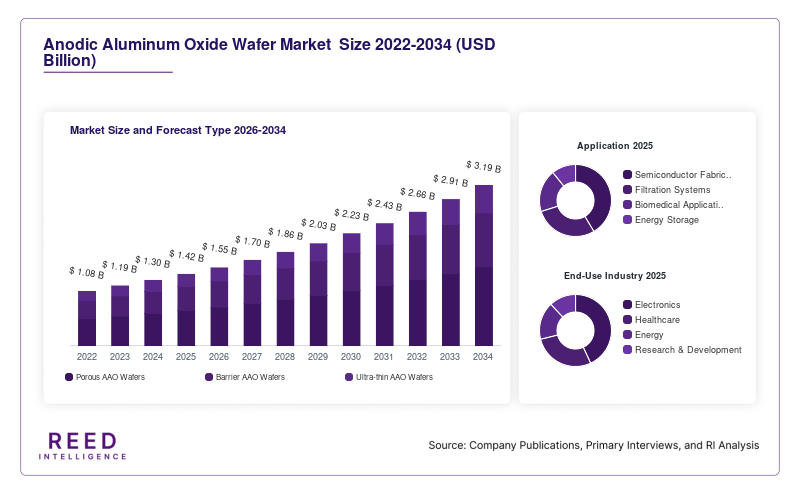
Porous AAO wafers dominated the Anodic Aluminum Oxide Wafer Market in 2025, accounting for 58.4% of the total share. Their widespread use in nanofabrication and filtration applications has contributed to their leading position.
Ultra-thin AAO wafers are expected to grow at the fastest CAGR of 11.2%, driven by increasing demand for miniaturized electronic devices. Their lightweight structure and enhanced performance capabilities make them suitable for advanced applications.
By Application
Semiconductor fabrication held the largest share of 42.7% in 2025, reflecting the critical role of AAO wafers in electronics manufacturing.
Biomedical applications are projected to grow at a CAGR of 10.5%, supported by increasing demand for advanced medical devices. Their biocompatibility and precision make them ideal for healthcare applications.
By End-Use Industry
The electronics industry dominated with a 46.9% share in 2025, driven by rising demand for high-performance materials.
The healthcare sector is expected to grow at a CAGR of 10.1%, fueled by advancements in medical technology and increasing adoption of innovative materials.
By Distribution Channel
Direct sales accounted for 61.2% of the market share in 2025, as manufacturers prefer direct engagement with industrial clients.
Online distribution channels are expected to grow at a CAGR of 9.8%, driven by digital transformation and increasing accessibility.
Regional Analysis
North America
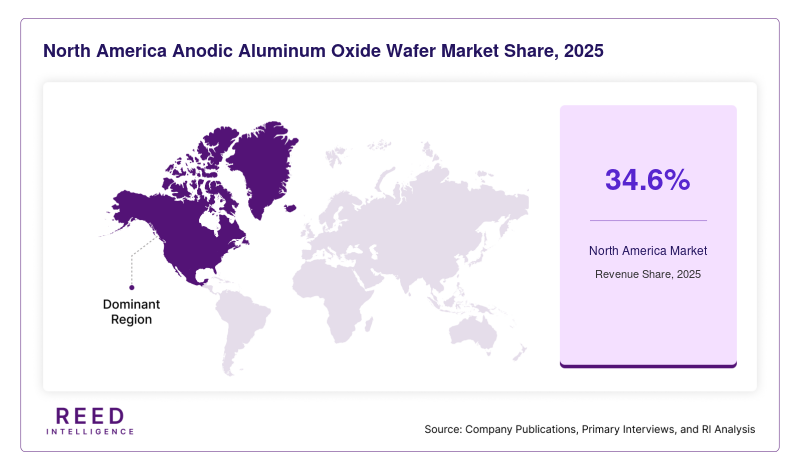
North America accounted for 34.6% of the Anodic Aluminum Oxide Wafer Market share in 2025 and is expected to grow at a CAGR of 8.9% during the forecast period. The region’s growth is supported by strong technological infrastructure and high investment in research and development activities.
The United States dominated the regional market due to its advanced semiconductor industry and presence of leading research institutions. Increased funding for nanotechnology projects has driven the adoption of AAO wafers across multiple applications.
Europe
Europe held a 26.3% share in 2025 and will expand at a CAGR of 8.5% through 2034. The region has shown steady growth due to increasing focus on sustainable technologies and advanced manufacturing.
Germany emerged as the leading country, driven by its strong industrial base and emphasis on innovation. The country’s investments in precision engineering and material science have supported the growth of AAO wafer applications.
Asia Pacific
Asia Pacific captured 22.8% of the market share in 2025 and is projected to grow at the fastest CAGR of 10.8%. Rapid industrialization and expansion of electronics manufacturing have contributed to regional growth.
China led the region due to its large-scale semiconductor production and government support for advanced materials research. The country’s focus on technological self-sufficiency has boosted demand for AAO wafers.
Middle East & Africa
The Middle East & Africa accounted for 8.1% of the market share in 2025 and will grow at a CAGR of 7.6%. The region’s growth is driven by increasing investments in research infrastructure and industrial diversification.
The United Arab Emirates dominated the market, supported by government initiatives to develop high-tech industries. The country’s focus on innovation has encouraged the adoption of advanced materials such as AAO wafers.
Latin America
Latin America held a 8.2% share in 2025 and is expected to grow at a CAGR of 7.9%. The region is gradually expanding due to increasing industrialization and technological adoption.
Brazil emerged as the leading country, driven by its growing electronics and research sectors. The country’s investments in innovation have supported the demand for AAO wafers in various applications.
Competitive Landscape
The Anodic Aluminum Oxide Wafer Market is moderately competitive, with key players focusing on innovation and strategic partnerships. Leading companies are investing in research and development to enhance product quality and expand application areas.
The market leader, InRedox, has recently introduced advanced AAO wafers with improved pore uniformity, strengthening its position. Other players are also focusing on expanding production capacities and entering emerging markets.
Competitive strategies include product differentiation, technological advancements, and collaborations with research institutions. These initiatives are expected to drive market competition and innovation.
Key Players
- InRedox
- MTI Corporation
- Synkera Technologies
- Whatman plc
- Nanopore Inc.
- SmartMembranes GmbH
- Aalen University Nanotechnology Group
- PlasmaChem GmbH
- Omega Optical LLC
- Elmarco s.r.o.
- AAO Technologies Ltd.
- Nanoshell LLC
- Porous Materials Inc.
- Advancell Technologies
- Nanostructured & Amorphous Materials Inc.
Recent Developments
- 2025: InRedox launched next-generation AAO wafers with enhanced structural consistency.
- 2024: Synkera Technologies expanded its production facility to meet growing demand.
- 2024: SmartMembranes GmbH introduced hybrid AAO membranes for filtration applications.
- 2023: MTI Corporation partnered with research institutions to develop advanced nanomaterials.
- 2023: PlasmaChem GmbH invested in R&D to improve wafer customization capabilities.
Anodic Aluminum Oxide Wafer Market Segments
Type
- Porous AAO Wafers
- Barrier AAO Wafers
- Ultra-thin AAO Wafers
Application
- Semiconductor Fabrication
- Filtration Systems
- Biomedical Applications
- Energy Storage
End-Use Industry
- Electronics
- Healthcare
- Energy
- Research & Development
Distribution Channel
- Direct Sales
- Distributors
- Online Channels
By Region
- North America
- Europe
- APAC
- Middle East and Africa
- LATAM