Anti Biofilm Wound Dressing Market Size, Share & Demand Report By Type (Silver-based Dressings, Iodine-based Dressings, PHMB Dressings, Others), By Material (Foam Dressings, Hydrogel Dressings, Alginate Dressings, Film Dressings), By Application (Chronic Wounds, Acute Wounds), By End-Use (Hospitals, Clinics, Home Healthcare), By Distribution Channel (Hospital Pharmacies, Retail Pharmacies, Online Pharmacies), By Region & Segment Forecasts, 2025–2034
USD 3950
Market Overview
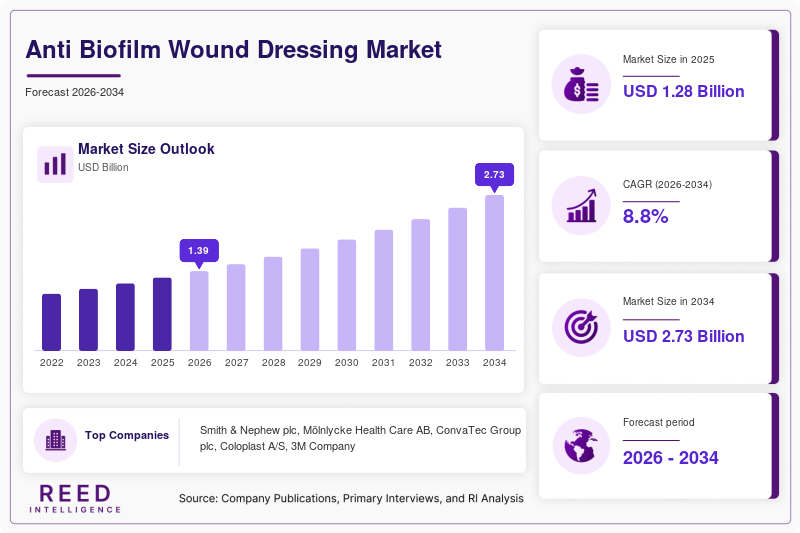
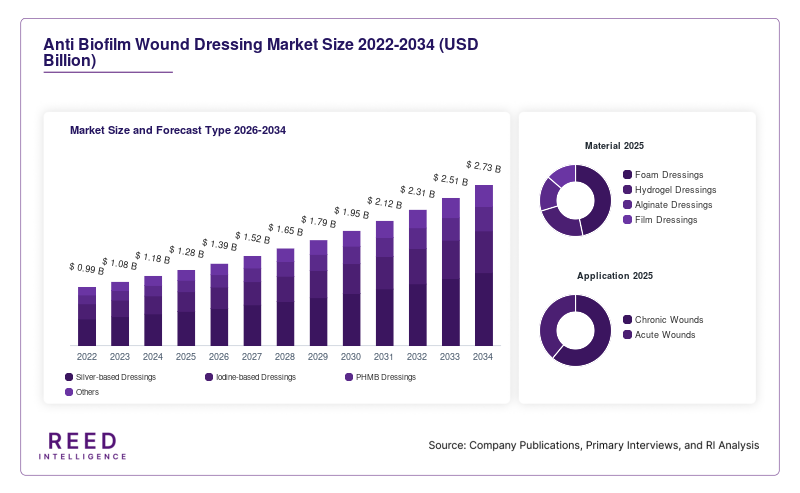
The Anti Biofilm Wound Dressing Market size was valued at approximately USD 1.28 billion in 2025 and is projected to reach USD 2.74 billion by 2034, expanding at a CAGR of 8.8% during the forecast period (2025–2034). The market growth is primarily supported by the increasing global burden of chronic wounds, including diabetic foot ulcers, pressure ulcers, and venous leg ulcers, which require advanced wound care solutions to prevent infection and accelerate healing.
A key global factor driving the Anti Biofilm Wound Dressing Market is the rising prevalence of antimicrobial resistance (AMR). Traditional wound care products often fail to effectively manage biofilms—structured communities of bacteria that impede healing. Anti-biofilm dressings are specifically designed to disrupt these bacterial colonies, improving patient outcomes and reducing healthcare costs associated with prolonged treatments.
Key Highlights
- North America dominated the market with a 38.6% share in 2025, while Asia Pacific is projected to grow at the fastest CAGR of 10.6%.
- Silver-based dressings emerged as the leading subsegment under type with a 34.2% share, whereas iodine-based dressings are expected to grow fastest at a 9.7% CAGR.
- Hospitals represented the dominant end-use segment with 46.5% share, while home healthcare is projected to expand at 10.2% CAGR.
- The United States led the market with USD 410 million in 2025 and is estimated to reach USD 445 million in 2026.
Market Trends
Integration of Advanced Antimicrobial Technologies
A notable trend shaping the Anti Biofilm Wound Dressing Market is the increasing integration of advanced antimicrobial agents such as silver nanoparticles, iodine complexes, and polyhexamethylene biguanide (PHMB) into wound dressings. These materials offer enhanced efficacy in disrupting biofilms and preventing microbial colonization. Manufacturers are investing in research and development to improve the sustained release of antimicrobial agents, ensuring long-lasting protection. The growing preference for multifunctional dressings that combine moisture management with infection control is also reinforcing this trend. Additionally, the use of nanotechnology is enabling the development of highly efficient dressings with improved biocompatibility and reduced toxicity.
Shift Toward Home-Based Wound Care Solutions
Another key trend is the increasing shift toward home-based wound care, driven by rising healthcare costs and patient preference for convenient treatment options. Anti-biofilm wound dressings are being designed for ease of use, allowing patients or caregivers to manage wounds outside clinical settings. Telehealth integration and remote monitoring tools are further supporting this transition. The aging population and the growing number of patients with chronic conditions are also contributing to the demand for home healthcare solutions. As a result, manufacturers are focusing on user-friendly packaging, extended wear time, and reduced dressing change frequency to cater to this segment.
Market Drivers
Rising Incidence of Chronic Wounds
The increasing prevalence of chronic wounds is a major driver of the Anti Biofilm Wound Dressing Market. Conditions such as diabetes, obesity, and vascular diseases are contributing to the growing number of patients with non-healing wounds. Chronic wounds often harbor biofilms, which delay healing and increase the risk of infection. Anti-biofilm dressings are specifically designed to address this challenge, making them an essential component of modern wound care. Healthcare providers are increasingly adopting these products to improve treatment outcomes and reduce hospital readmissions.
Growing Focus on Infection Prevention in Healthcare Settings
Healthcare facilities are placing a stronger emphasis on infection prevention and control, which is driving demand for advanced wound care products. Hospital-acquired infections (HAIs) remain a significant concern, leading to increased adoption of anti-biofilm dressings that can effectively prevent microbial growth. Regulatory guidelines and quality standards are encouraging the use of innovative wound care solutions. Additionally, the economic burden associated with infections is prompting healthcare providers to invest in preventive measures, further supporting market growth.
Market Restraint
High Cost of Advanced Wound Dressings
One of the primary restraints in the Anti Biofilm Wound Dressing Market is the relatively high cost of advanced wound care products. Anti-biofilm dressings incorporate specialized materials and technologies, which increase their production costs compared to traditional dressings. This price difference can limit their adoption, particularly in low- and middle-income countries where healthcare budgets are constrained.
The lack of reimbursement policies in certain regions further exacerbates this issue, making it difficult for patients to access these products. Healthcare providers may also be hesitant to adopt high-cost solutions without clear evidence of cost-effectiveness. Although these dressings can reduce long-term treatment costs by accelerating healing, the initial investment remains a barrier.
Market Opportunities
Expansion in Emerging Markets
Emerging economies present significant growth opportunities for the Anti Biofilm Wound Dressing Market. Countries in Asia Pacific, Latin America, and the Middle East are experiencing rapid improvements in healthcare infrastructure and increased healthcare spending. The rising prevalence of chronic diseases in these regions is also driving demand for advanced wound care solutions.
Manufacturers are focusing on expanding their presence in these markets through partnerships, distribution agreements, and localized production. Government initiatives aimed at improving healthcare access are further supporting market growth. As awareness of advanced wound care technologies increases, the adoption of anti-biofilm dressings is expected to rise significantly.
Technological Innovations in Wound Care Products
Continuous advancements in wound care technologies are creating new opportunities in the market. Innovations such as smart dressings with sensors for real-time monitoring, bioactive materials, and personalized treatment solutions are gaining traction. These technologies can enhance treatment outcomes and improve patient compliance.
The integration of digital health tools with wound care products is also opening new avenues for market growth. Companies are investing in research to develop next-generation dressings that offer superior performance and ease of use. As these innovations become more widely available, they are expected to drive the adoption of anti-biofilm wound dressings.
Segmental Analysis
By Type
Silver-based dressings dominated the Anti Biofilm Wound Dressing Market with a 34.2% share in 2025. These dressings are widely used due to their strong antimicrobial properties and effectiveness in disrupting biofilms.
Iodine-based dressings are expected to be the fastest-growing subsegment, with a projected CAGR of 9.7%. Their ability to provide broad-spectrum antimicrobial activity and improved safety profile will drive their adoption. Increasing clinical evidence supporting their efficacy will further boost growth.
By Material
Foam dressings held the largest share at 31.6% in 2025, owing to their high absorbency and comfort. These dressings are commonly used for managing exudative wounds.
Hydrogel dressings are projected to grow at the fastest CAGR of 10.1%. Their ability to maintain a moist wound environment and promote healing will support their increasing adoption. Advancements in hydrogel formulations will further enhance their effectiveness.
By Application
Chronic wounds dominated the segment with a 52.8% share in 2025, driven by the high prevalence of conditions such as diabetic ulcers and pressure sores.
Acute wounds are expected to grow at a CAGR of 9.3%. Increasing surgical procedures and trauma cases will drive demand for advanced wound care products in this segment.
By End-Use
Hospitals accounted for the largest share of 46.5% in 2025, as they are the primary centers for wound care treatment and management.
Home healthcare is anticipated to grow at the fastest CAGR of 10.2%. The shift toward outpatient care and the need for cost-effective treatment options will drive growth in this segment.
By Distribution Channel
Hospital pharmacies dominated with a 42.1% share in 2025, reflecting their role in supplying advanced wound care products.
Online pharmacies are expected to grow at a CAGR of 11.4%, driven by increasing digitalization and convenience. The rising adoption of e-commerce platforms for healthcare products will support this growth.
Regional Analysis
North America
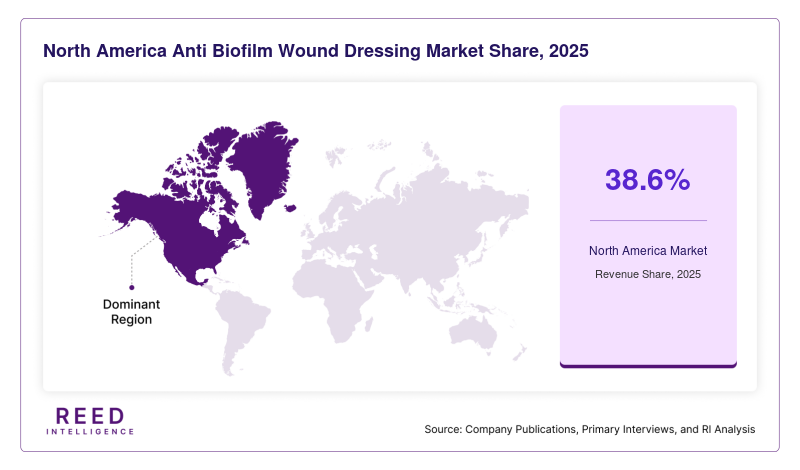
North America accounted for 38.6% of the Anti Biofilm Wound Dressing Market share in 2025 and is expected to grow at a CAGR of 7.9% during the forecast period. The region has a well-established healthcare system and high adoption of advanced wound care products.
The United States dominated the regional market due to the high prevalence of chronic wounds and strong healthcare infrastructure. The presence of leading market players and continuous innovation in wound care technologies are key growth factors. Additionally, increasing healthcare expenditure and awareness about infection prevention are supporting market expansion.
Europe
Europe held a 27.4% market share in 2025 and is projected to grow at a CAGR of 8.2% through 2034. The region benefits from strong regulatory frameworks and a focus on patient safety.
Germany emerged as the dominant country in Europe, driven by its advanced healthcare system and emphasis on quality care. The increasing aging population and rising incidence of chronic diseases are contributing to the demand for anti-biofilm wound dressings. Government support for healthcare innovation is also playing a significant role in market growth.
Asia Pacific
Asia Pacific captured 21.8% of the market share in 2025 and is anticipated to grow at the fastest CAGR of 10.6%. Rapid urbanization and improving healthcare infrastructure are key factors driving growth in this region.
China led the regional market due to its large patient population and increasing healthcare investments. The growing prevalence of diabetes and related complications is driving demand for advanced wound care products. Additionally, rising awareness and government initiatives to improve healthcare access are supporting market expansion.
Middle East & Africa
The Middle East & Africa accounted for 6.5% of the market share in 2025 and is expected to grow at a CAGR of 8.5%. The region is witnessing gradual improvements in healthcare infrastructure.
Saudi Arabia dominated the market due to increasing healthcare spending and government initiatives to enhance medical services. The rising prevalence of chronic diseases and growing awareness about advanced wound care are contributing to market growth.
Latin America
Latin America held a 5.7% market share in 2025 and is projected to grow at a CAGR of 8.7% during the forecast period. The region is experiencing steady growth in healthcare investments.
Brazil emerged as the leading country in Latin America, supported by its large population and improving healthcare system. The increasing burden of chronic wounds and rising adoption of advanced wound care products are driving market growth.
Competitive Landscape
The Anti Biofilm Wound Dressing Market is moderately competitive, with several global and regional players focusing on product innovation and strategic partnerships. Key companies are investing in research and development to introduce advanced wound care solutions with improved efficacy.
A leading player in the market is Smith & Nephew plc, which has a strong portfolio of advanced wound care products. The company recently launched a next-generation antimicrobial dressing designed to enhance biofilm disruption and accelerate healing.
Other major players include Mölnlycke Health Care, ConvaTec Group, Coloplast Corp., and 3M Company. These companies are focusing on expanding their product offerings and strengthening their global presence through mergers, acquisitions, and collaborations.
Key Players
- Smith & Nephew plc
- Mölnlycke Health Care AB
- ConvaTec Group plc
- Coloplast A/S
- 3M Company
- B. Braun Melsungen AG
- Medline Industries, Inc.
- Cardinal Health, Inc.
- Integra LifeSciences Holdings Corporation
- PAUL HARTMANN AG
- Organogenesis Holdings Inc.
- Advancis Medical
- Derma Sciences (Integra)
- Acelity L.P. Inc.
- Winner Medical Co., Ltd.
Recent Developments
- 2024: A major market player introduced a biofilm-targeting silver dressing with extended wear time.
- 2024: Strategic collaboration between wound care companies to develop next-generation antimicrobial solutions.
- 2023: Expansion of manufacturing facilities in Asia Pacific to meet rising demand.
- 2023: Launch of smart wound dressings with integrated monitoring capabilities.
- 2023: Increased investment in R&D for biofilm-resistant materials.
Anti Biofilm Wound Dressing Market Segments
Type
- Silver-based Dressings
- Iodine-based Dressings
- PHMB Dressings
- Others
Material
- Foam Dressings
- Hydrogel Dressings
- Alginate Dressings
- Film Dressings
Application
- Chronic Wounds
- Acute Wounds
End-Use
- Hospitals
- Clinics
- Home Healthcare
Distribution Channel
- Hospital Pharmacies
- Retail Pharmacies
- Online Pharmacies
By Region
- North America
- Europe
- APAC
- Middle East and Africa
- LATAM