Anti Caking Agents For Fertilizer Market Size, Share Demand Report By Type (Fatty Amines, Polymer-Based Agents, Surfactants, Mineral Oil-Based Agents, Others), By Fertilizer Type (Urea, Ammonium Nitrate, Phosphate Fertilizers, Potash Fertilizers, Compound NPK Fertilizers), By End Use (Fertilizer Manufacturers, Agricultural Cooperatives, Distributors, Specialty Agriculture Suppliers) By Region & Segment Forecasts, 2026–2034
USD 3950
Market Overview
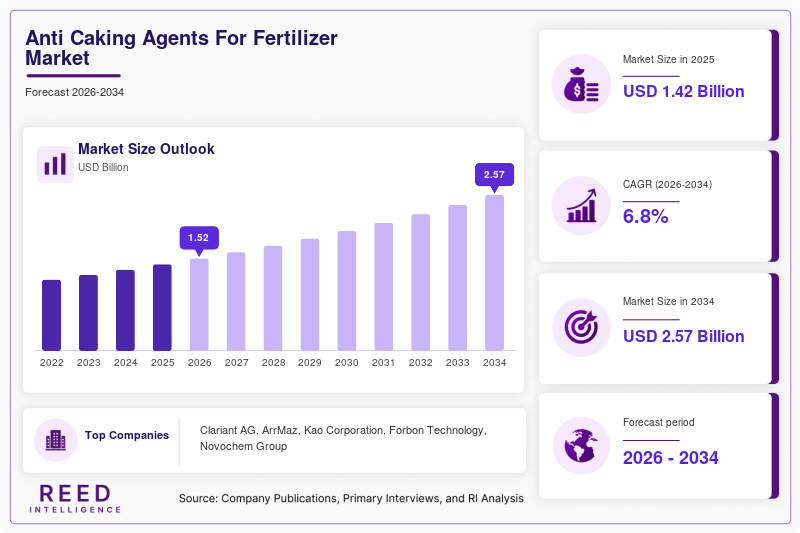
The global Anti Caking Agents For Fertilizer Market size was valued at USD 1.42 billion in 2026 and is projected to reach USD 2.41 billion by 2034, expanding at a CAGR of 6.8% during the forecast period from 2026 to 2034. The market is gaining consistent momentum due to rising global fertilizer consumption, expanding agricultural output requirements, and the increasing need for efficient fertilizer storage and transportation. Anti-caking agents play a critical role in preserving fertilizer granule integrity by preventing moisture absorption, clumping, and degradation during storage, handling, and distribution. Growing demand for high-efficiency fertilizers in both developed and emerging agricultural economies has supported the adoption of advanced coating additives. A major global factor supporting market expansion is the increasing pressure on food systems driven by population growth, which has intensified fertilizer production and supply chain optimization. Fertilizer manufacturers are increasingly investing in specialty additives that improve product shelf life and maintain free-flowing properties, particularly in humid climatic regions. The transition toward bulk fertilizer exports and large-scale mechanized farming has further elevated the need for anti-caking technologies. Product innovation, including bio-based and environmentally compliant anti-caking formulations, is also shaping industry dynamics as sustainability standards become more relevant across agriculture inputs.
Key Highlights
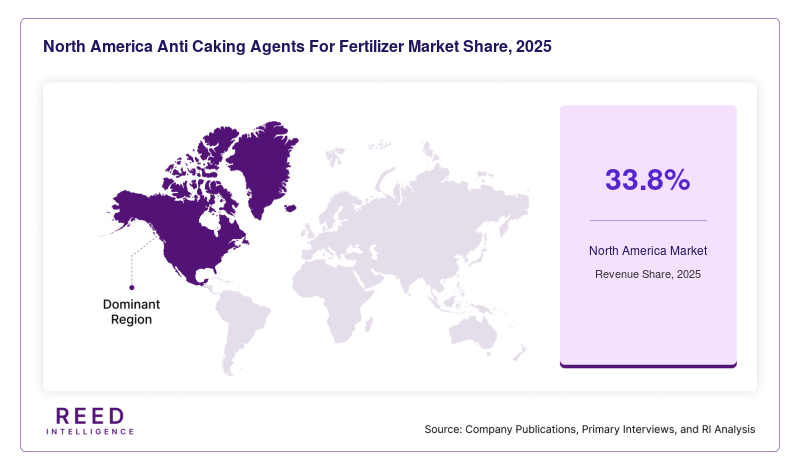
- North America dominated the market with a 33.8% share in 2025.
- Asia Pacific is expected to grow at the fastest CAGR of 8.4% during 2026–2034.
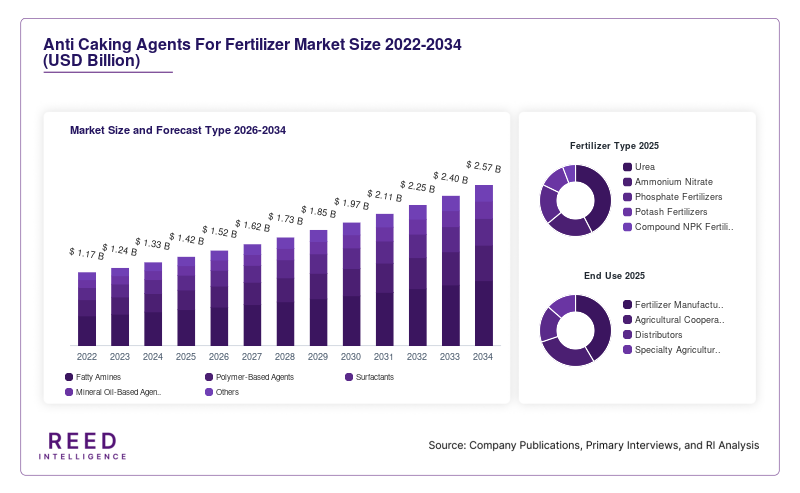
- By type, fatty amines accounted for the largest share of 36.9%, while polymer-based anti-caking agents are projected to grow at a CAGR of 8.9%.
- By fertilizer type, urea fertilizers led with a 39.4% share, whereas compound NPK fertilizers are expected to expand at a CAGR of 8.2%.
- The United States remained the dominant country, with market values of USD 348 million in 2024 and USD 372 million in 2025.
Market Trends
Rising preference for multifunctional fertilizer coatings
The market is experiencing a shift from conventional anti-caking solutions toward multifunctional coating systems that combine anti-caking, dust suppression, and moisture resistance properties. Fertilizer manufacturers are increasingly selecting integrated additive systems to reduce operational complexity while improving product performance. These coatings are especially useful for urea and ammonium nitrate products, which are highly sensitive to moisture and temperature fluctuations. The trend is particularly visible in large fertilizer export markets where extended storage and international logistics demand higher product stability. Manufacturers are also using tailored formulations based on climate conditions, enabling more region-specific product development and strengthening premium product adoption.
Expansion of sustainable and biodegradable additive technologies
Environmental regulations and sustainability commitments are encouraging the use of biodegradable and low-toxicity anti-caking agents. Traditional petroleum-derived chemicals are gradually being supplemented by plant-based oils, bio-polymers, and mineral-origin additives. This trend is expanding in Europe and parts of Asia Pacific where agricultural input sustainability is becoming a procurement factor. Companies are investing in research to create formulations that do not compromise soil health or contribute to chemical residue accumulation. The shift toward green chemistry in fertilizer additives is also opening new opportunities for differentiation, especially among producers targeting premium agricultural and specialty crop sectors.
Market Drivers
Increasing global fertilizer production and cross-border trade
Rising crop demand and shrinking arable land availability are driving higher fertilizer usage worldwide, directly supporting anti-caking agent demand. Fertilizers often travel long distances through ports, warehouses, and retail channels before reaching end users, making storage stability essential. Anti-caking agents reduce lump formation and maintain fertilizer flowability, improving logistics efficiency and minimizing product waste. Global trade in urea, phosphate, and NPK fertilizers has increased significantly, particularly between Asia, North America, and Latin America. As fertilizer production volumes rise, manufacturers are prioritizing product preservation technologies to improve operational margins and reduce product returns.
Growth in precision agriculture and premium fertilizer formulations
Precision agriculture practices are increasing demand for high-performance fertilizers with consistent granule quality and nutrient delivery. Anti-caking agents help preserve granule uniformity, which is critical for automated spreading systems and controlled nutrient application. Commercial farming operations increasingly require fertilizers that remain physically stable in variable climatic conditions. Specialty fertilizers, coated blends, and micronutrient-enriched products also depend on advanced anti-caking technologies to ensure physical compatibility. This growing integration between fertilizer quality and agricultural technology is strengthening the strategic importance of anti-caking agents across modern crop production systems.
Market Restraint
Volatility in raw material pricing and regulatory compliance challenges
The Anti Caking Agents For Fertilizer Market faces challenges due to fluctuating prices of chemical feedstocks such as surfactants, polymers, and specialty oils used in formulation production. Variability in petroleum prices and supply chain disruptions can increase manufacturing costs and compress supplier margins. Smaller manufacturers often struggle to maintain competitive pricing while meeting evolving environmental and agricultural safety standards. Regulatory frameworks concerning chemical residues, biodegradability, and environmental toxicity are becoming stricter, particularly in Europe. Compliance requires reformulation, certification, and additional testing expenses, which may slow product launches. For example, manufacturers supplying multiple international markets often need region-specific formulations to meet differing standards, increasing operational complexity and reducing scalability for some producers.
Market Opportunities
Rapid agricultural modernization in emerging economies
Emerging agricultural markets across Asia Pacific, Africa, and Latin America present strong growth potential due to rising fertilizer penetration and infrastructure modernization. Governments in countries such as India, Brazil, and Indonesia are investing in agricultural productivity and fertilizer subsidy programs. As these markets expand fertilizer production and storage infrastructure, demand for anti-caking solutions is expected to increase substantially. Humid climates in many developing economies also create favorable conditions for caking, making anti-caking agents operationally important. Suppliers that offer cost-effective, climate-adapted solutions can gain significant market access in these regions.
Development of customized formulations for climate-specific storage conditions
There is increasing opportunity for producers to develop regionally optimized anti-caking agents based on temperature, humidity, and fertilizer composition. Tropical climates require stronger moisture barriers, while colder regions may prioritize dust control and flowability. Customized additive technologies allow suppliers to build stronger relationships with fertilizer manufacturers seeking differentiated performance. Digital monitoring of storage conditions and fertilizer quality analytics may further support precision formulation development. Companies that integrate formulation science with customer-specific logistics needs are likely to capture higher-value contracts and long-term industrial partnerships.
Segmental Analysis
By Type
Fatty amines dominated the Anti Caking Agents For Fertilizer Market in 2024, accounting for 36.9% of total share. These agents are widely used due to their strong moisture resistance, cost efficiency, and compatibility with multiple fertilizer compositions. Fatty amines provide effective coating performance across urea, ammonium nitrate, and phosphate fertilizers, making them a preferred option for bulk industrial use. Their proven ability to reduce clumping under humid conditions supports widespread commercial adoption. Large fertilizer manufacturers often favor these additives because they balance operational performance with manageable production costs. Their market leadership is also supported by broad global availability and mature supply chains.
Polymer-based anti-caking agents are projected to grow at the fastest CAGR of 8.9% through 2034. These solutions offer enhanced durability, multifunctional performance, and compatibility with premium fertilizer formulations. Their ability to integrate anti-caking with dust suppression and controlled-release support makes them attractive for modern fertilizer systems. As fertilizer producers move toward advanced formulations, polymer technologies are gaining importance. Their performance advantages in export logistics and specialty agriculture are expected to support sustained expansion.
By Fertilizer Type
Urea fertilizers held the largest market share at 39.4% in 2024 due to their extensive global usage and high susceptibility to moisture-induced caking. Urea’s widespread role in nitrogen delivery makes it one of the most traded fertilizers globally, creating substantial anti-caking demand. Storage and transportation challenges, especially in humid climates, increase the importance of specialized coatings. Manufacturers prioritize anti-caking solutions for urea because caking directly affects product usability, packaging efficiency, and customer satisfaction. The segment’s scale and sensitivity to environmental conditions ensure sustained anti-caking agent demand.
Compound NPK fertilizers are expected to expand at the fastest CAGR of 8.2% during the forecast period. Their increasing use in precision agriculture and balanced nutrient management is supporting segment growth. NPK blends often contain multiple chemical interactions that can elevate caking risk, making specialized anti-caking formulations essential. Rising adoption in commercial agriculture and high-value crop sectors is further supporting this category.
By End Use
Large-scale fertilizer manufacturers represented the dominant end-use segment in 2024 with 61.3% market share. These companies integrate anti-caking agents directly into production lines to maintain quality consistency and optimize logistics. Bulk production, long-distance transportation, and export commitments make anti-caking technologies operationally essential. Major manufacturers also benefit from economies of scale, allowing broader use of advanced formulations. Their control over supply chains supports stronger purchasing power and technology integration.
Agricultural cooperatives and fertilizer distributors are projected to witness the fastest CAGR of 7.8% through 2034. This growth is driven by increasing localized fertilizer blending, regional warehousing, and customized distribution networks. As distributors seek to reduce product loss and improve shelf life, anti-caking adoption is increasing beyond primary manufacturing facilities. Expanding rural fertilizer access programs are also supporting this segment’s growth.
Regional Analysis
North America
North America accounted for 33.8% of the global Anti Caking Agents For Fertilizer Market share in 2025 and is projected to grow at a CAGR of 5.9% through 2034. The region benefits from advanced fertilizer manufacturing infrastructure, large-scale agricultural operations, and high adoption of specialty crop nutrition products. Strong logistics networks and extensive grain production also increase demand for storage-efficient fertilizer solutions.
The United States dominates the regional market due to large domestic fertilizer production and significant exports. A unique growth factor is the widespread use of precision agriculture systems that require consistent fertilizer granule quality for automated application equipment. This technological dependence supports steady anti-caking agent demand across commercial farming.
Europe
Europe held 24.6% of the market share in 2025 and is forecast to expand at a CAGR of 6.1% during the assessment period. Demand is supported by stringent fertilizer quality regulations and growing interest in sustainable agricultural additives. The region’s emphasis on environmental compliance is accelerating innovation in biodegradable anti-caking technologies.
Germany leads the European market due to its advanced chemical manufacturing base and fertilizer technology expertise. A distinct growth factor is the increasing adoption of environmentally compliant fertilizer additives that align with EU sustainability frameworks, driving premium product demand.
Asia Pacific
Asia Pacific represented 22.9% of the global market in 2025 and is expected to register the fastest CAGR of 8.4% through 2034. Expanding agricultural production, fertilizer subsidies, and rising food security initiatives are major growth contributors. High humidity levels in many countries also create strong practical demand.
China dominates the regional market due to its large fertilizer manufacturing output and extensive agricultural sector. A unique growth factor is large-scale domestic fertilizer consumption combined with strong industrial exports, which increases the need for storage and shipping stability solutions.
Middle East & Africa
Middle East & Africa captured 10.1% of market share in 2025 and is projected to grow at a CAGR of 7.2%. Expanding fertilizer manufacturing hubs in Gulf countries and agricultural development initiatives in Africa are driving adoption. Climatic extremes also increase fertilizer preservation needs.
Saudi Arabia is the dominant country due to its large petrochemical-linked fertilizer industry. A unique growth factor is export-focused fertilizer production, which requires anti-caking performance for long-distance international supply chains.
Latin America
Latin America accounted for 8.6% of the global market share in 2025 and is anticipated to grow at a CAGR of 7.6% through 2034. Expanding soybean, corn, and sugarcane cultivation is increasing fertilizer demand. Regional agricultural exports are also strengthening fertilizer handling requirements.
Brazil leads the market due to its agricultural scale and fertilizer import dependency. A unique growth factor is high fertilizer usage in commercial agribusiness combined with tropical humidity, which significantly increases anti-caking application requirements.
Competitive Landscape
The Anti Caking Agents For Fertilizer Market is moderately consolidated, with leading players focusing on product innovation, sustainability, and regional expansion. Clariant remains a leading participant due to its broad specialty chemical portfolio and customized fertilizer additive solutions. The company recently expanded its agricultural additives portfolio with environmentally adaptive formulations. ArrMaz, Kao Corporation, Forbon Technology, and Novochem Group are also significant market participants. These companies are strengthening market positions through customized product development, strategic partnerships, and improved climate-specific performance technologies. Competitive differentiation increasingly centers on regulatory compliance, multifunctional additive capabilities, and integration with premium fertilizer production systems.
Key Players
- Clariant AG
- ArrMaz
- Kao Corporation
- Forbon Technology
- Novochem Group
- Chemipol S.A.
- Michelman Inc.
- Filtra Catalysts & Chemicals Ltd.
- Fertibon Products Pvt. Ltd.
- Tolsa Group
- Neelam Aqua & Speciality Chem Pvt. Ltd.
- Amit Trading Company
- Hubei Forbon Technology Co., Ltd.
- Dorf Ketal Chemicals
- Solvay SA
Recent Developments
- Clariant introduced a new biodegradable fertilizer coating additive platform in 2025 targeting sustainable agriculture markets.
- Forbon Technology expanded production capacity in Asia to support growing fertilizer additive demand.
- ArrMaz launched advanced moisture-resistant anti-caking formulations designed for tropical fertilizer storage conditions.
Anti Caking Agents For Fertilizer Market Segments
Type
- Fatty Amines
- Polymer-Based Agents
- Surfactants
- Mineral Oil-Based Agents
- Others
Fertilizer Type
- Urea
- Ammonium Nitrate
- Phosphate Fertilizers
- Potash Fertilizers
- Compound NPK Fertilizers
End Use
- Fertilizer Manufacturers
- Agricultural Cooperatives
- Distributors
- Specialty Agriculture Suppliers
By Region
- North America
- Europe
- APAC
- Middle East and Africa
- LATAM