Anti Corrosion Bag Market Size, Share & Demand Report By Material Type (Polyethylene-Based Bags, Polypropylene-Based Bags, Biodegradable Anti Corrosion Bags, Multilayer Barrier Bags), By Application (Automotive Component Packaging, Electronics Equipment Protection, Industrial Machinery Packaging, Aerospace Component Protection, Marine Equipment Packaging), By End-Use Industry (Automotive, Electronics and Semiconductor, Aerospace and Defense, Industrial Manufacturing, Oil and Gas, Marine and Ship
USD 3950
Market Overview
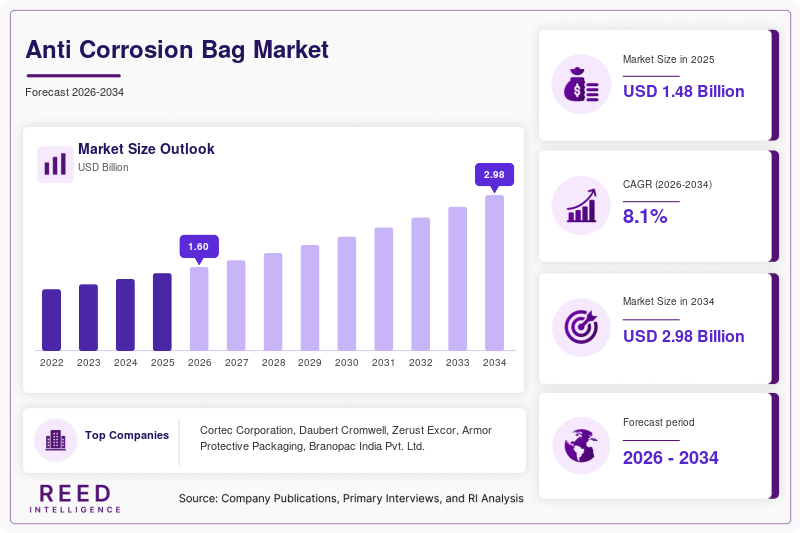
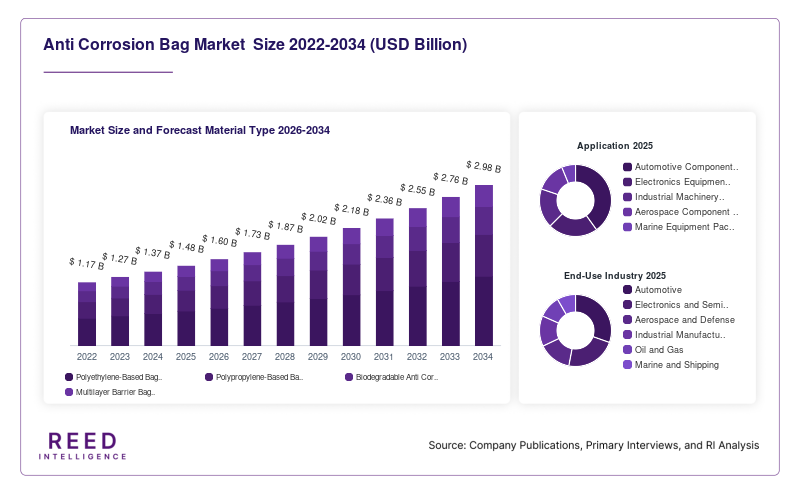
The global Anti Corrosion Bag Market size was valued at USD 1.48 billion in 2026 and is projected to reach USD 2.76 billion by 2034, expanding at a CAGR of 8.1% during the forecast period from 2026 to 2034. The market is experiencing steady expansion due to the growing requirement for corrosion protection solutions across automotive, electronics, aerospace, heavy machinery, and industrial equipment sectors. Anti corrosion bags are increasingly adopted for protecting metal parts, precision instruments, and industrial components during storage and transportation. Manufacturers are investing in advanced vapor corrosion inhibitor technologies to improve packaging efficiency and reduce maintenance costs associated with rust damage.
The expansion of international trade and cross-border shipment of industrial machinery has created favorable conditions for market growth. Companies involved in export-oriented manufacturing are increasingly using anti corrosion bags to ensure product durability during long transit periods. Rising industrialization in emerging economies and the growing focus on sustainable packaging materials have further supported market penetration. In addition, stricter quality assurance standards in automotive and electronics manufacturing are encouraging the use of reliable corrosion prevention packaging.
Key Highlights
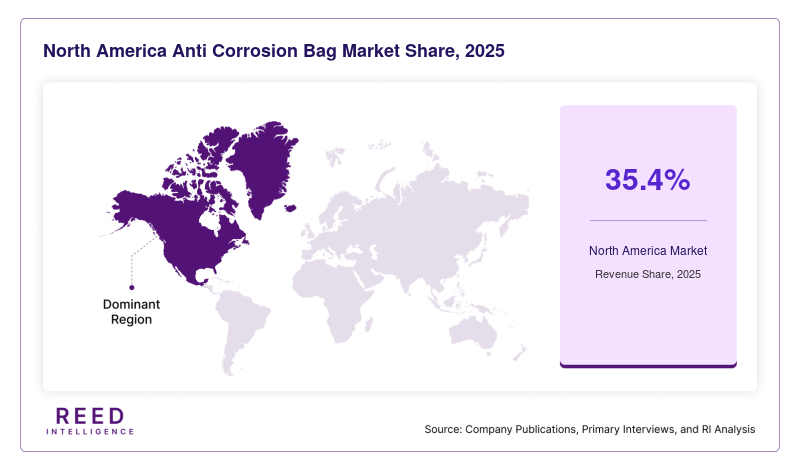
- North America dominated the market with a 35.4% share in 2025, while Asia Pacific is expected to grow at the fastest CAGR of 9.8% during 2026–2034.
- By material type, polyethylene-based anti corrosion bags accounted for the largest share of 42.1%, while biodegradable corrosion protection bags are projected to grow at a CAGR of 10.7%.
- By application, automotive component packaging led with a 39.6% share, whereas electronics equipment protection is expected to expand at a CAGR of 10.2%.
- The United States remained the dominant country, with market values of USD 410 million in 2024 and USD 445 million in 2025.
Market Trends
Rising Adoption of Sustainable Corrosion Protection Packaging
The demand for environmentally responsible packaging materials is influencing product innovation in the Anti Corrosion Bag Market. Industrial buyers are increasingly shifting toward recyclable and biodegradable anti corrosion bags to reduce environmental impact and comply with sustainability regulations. Manufacturers are focusing on developing packaging materials that offer strong corrosion protection while minimizing plastic waste generation. Several industrial companies are integrating reusable vapor corrosion inhibitor packaging systems into supply chains to improve operational efficiency and reduce disposal costs.
The transition toward sustainable manufacturing practices in automotive and electronics industries is further supporting this trend. Export-oriented companies are seeking lightweight and recyclable packaging solutions that reduce transportation costs and carbon emissions. Market participants are also introducing solvent-free and low-emission corrosion inhibitor technologies that improve workplace safety. Growing awareness regarding circular economy initiatives across Europe and North America is expected to accelerate the adoption of eco-friendly anti corrosion bags throughout the forecast period.
Increased Integration of Smart Packaging Technologies
The integration of smart monitoring technologies into industrial packaging systems is emerging as an important trend across the Anti Corrosion Bag Market. Manufacturers are developing advanced anti corrosion bags equipped with humidity indicators, temperature-sensitive labels, and moisture monitoring systems to ensure product integrity during transportation and storage. These technologies are particularly useful for aerospace, electronics, and defense industries where sensitive components require continuous monitoring.
Industrial companies are increasingly investing in smart logistics systems that provide real-time visibility into product conditions during shipping. The combination of anti corrosion packaging with digital tracking technologies improves supply chain transparency and reduces the risk of material damage. Growth in e-commerce distribution of industrial components and rising demand for predictive maintenance solutions are supporting further innovation in smart packaging applications. This trend is expected to encourage long-term investments in technologically advanced anti corrosion packaging products.
Market Drivers
Expansion of Automotive and Industrial Manufacturing Activities
The expansion of automotive manufacturing and industrial production activities is a major factor supporting the growth of the Anti Corrosion Bag Market. Automotive manufacturers rely heavily on corrosion protection packaging to safeguard metal parts, engine components, and spare parts during domestic and international transportation. Increasing production of electric vehicles and industrial machinery has significantly increased the volume of components requiring long-term protection against moisture and oxidation.
Industrial sectors such as heavy equipment manufacturing, steel processing, and mechanical engineering are also driving demand for anti corrosion packaging solutions. Manufacturers are prioritizing product durability and reducing financial losses associated with rust damage during storage. The growing complexity of global supply chains has increased the need for dependable packaging systems capable of maintaining product quality across long transit periods. Rising investments in industrial automation and infrastructure development projects are expected to further strengthen market demand.
Growth in International Trade and Export Packaging Requirements
The steady increase in international trade activities is contributing significantly to the adoption of anti corrosion bags across multiple industries. Exporters of machinery, electronics, automotive parts, and industrial tools require effective corrosion protection to maintain product performance during overseas transportation. Long shipping durations and exposure to varying climatic conditions increase the risk of corrosion damage, encouraging companies to invest in specialized packaging solutions.
Governments in developing economies are supporting export-oriented manufacturing through industrial incentives and infrastructure improvements, creating additional opportunities for packaging manufacturers. Companies are also focusing on reducing replacement and maintenance expenses caused by rust-related damage during transit. Anti corrosion bags provide cost-effective protection for sensitive metal products without requiring extensive maintenance procedures. Increasing trade between Asia Pacific, Europe, and North America is expected to support stable market expansion over the coming years.
Market Restraint
Fluctuating Raw Material Prices and Limited Awareness in Small Industries
Volatility in raw material prices remains a significant challenge for manufacturers operating in the Anti Corrosion Bag Market. The production of anti corrosion bags depends heavily on polymer-based materials such as polyethylene, polypropylene, and multilayer barrier films. Variations in crude oil prices and supply chain disruptions can increase manufacturing costs and reduce profit margins for packaging producers. Smaller manufacturers often face difficulties in maintaining stable pricing structures, particularly in highly competitive regional markets.
Limited awareness regarding advanced corrosion protection packaging among small and medium-sized enterprises also restricts market growth in certain developing economies. Many small industrial operators continue to rely on conventional packaging methods that provide lower corrosion resistance but involve lower upfront costs. This can slow the adoption of technologically advanced anti corrosion bags despite their long-term operational advantages. In addition, some end users perceive corrosion prevention packaging as an additional operational expense rather than a preventive investment. Such perceptions may reduce product penetration in cost-sensitive industries and delay broader market adoption.
Market Opportunities
Increasing Demand from Electronics and Semiconductor Industries
The growing electronics and semiconductor manufacturing sector presents substantial growth opportunities for the Anti Corrosion Bag Market. Sensitive electronic components and semiconductor equipment require advanced protection against moisture and oxidation during storage and transportation. Anti corrosion bags are increasingly used to maintain the quality and performance of microchips, connectors, sensors, and circuit boards. Rising demand for consumer electronics, industrial automation systems, and communication equipment is expected to support further market expansion.
Several electronics manufacturers are establishing new production facilities in Asia Pacific to meet rising global demand, creating additional opportunities for corrosion protection packaging suppliers. Anti corrosion bags with static shielding and moisture barrier properties are becoming increasingly important for electronics logistics operations. The transition toward high-value electronic manufacturing and miniaturized components is expected to encourage greater use of advanced packaging materials with enhanced corrosion resistance.
Expansion of Defense, Aerospace, and Marine Applications
The increasing requirement for long-term storage and transportation of critical equipment in defense, aerospace, and marine sectors is creating favorable opportunities for market participants. Aircraft components, naval equipment, military machinery, and precision instruments require effective corrosion prevention due to exposure to harsh environmental conditions. Anti corrosion bags help reduce maintenance expenses and improve equipment lifespan in these industries.
Governments across multiple countries are increasing investments in defense modernization programs and aerospace manufacturing facilities, contributing to the demand for protective packaging solutions. Marine transportation companies are also adopting corrosion-resistant packaging to protect metal components exposed to high humidity and saline environments. Market participants are introducing customized anti corrosion bags designed specifically for military-grade and aerospace-grade applications. The combination of high-value equipment and stringent quality standards is expected to create long-term growth potential for advanced corrosion protection packaging technologies.
Segmental Analysis
By Material Type
Polyethylene-based anti corrosion bags accounted for the largest share of 42.1% in 2024 due to their cost efficiency, flexibility, and strong moisture resistance properties. These bags are widely used across automotive, machinery, and industrial manufacturing sectors because they provide reliable protection against oxidation and environmental exposure. Polyethylene materials also offer lightweight packaging advantages, reducing transportation expenses for industrial suppliers and exporters. Their compatibility with vapor corrosion inhibitor technologies has further strengthened adoption among manufacturers seeking long-term protection for metal components.
The widespread availability of polyethylene materials and established production infrastructure continue to support market dominance. Industrial users prefer polyethylene anti corrosion bags because they can be customized in different thickness levels and sizes according to application requirements. In addition, these bags are suitable for both domestic and international transportation of industrial goods. The combination of affordability, durability, and compatibility with automated packaging systems has allowed polyethylene-based products to maintain a significant position within the overall market.
By Application
Automotive component packaging held the largest market share of 39.6% in 2024 due to the extensive use of anti corrosion bags for protecting engine parts, transmission systems, brake components, and spare parts during transportation and storage. Automotive manufacturers and suppliers rely on corrosion prevention packaging to reduce financial losses associated with rust damage and maintain product quality standards. The expansion of international automotive supply chains has increased the requirement for reliable packaging solutions capable of protecting components during long shipping durations.
The growing production of electric vehicles and hybrid vehicles has further strengthened the use of anti corrosion bags in automotive manufacturing operations. Companies involved in aftermarket automotive parts distribution are also increasing the adoption of vapor corrosion inhibitor packaging to improve inventory management and reduce maintenance expenses. Anti corrosion bags provide operational advantages by minimizing the need for oil-based protective coatings, thereby improving packaging efficiency and reducing environmental impact within automotive logistics systems.
By End-Use Industry
The automotive industry accounted for the largest share of 36.8% in 2024 due to increasing vehicle production and expanding global supply chain operations. Automotive manufacturers require corrosion-resistant packaging solutions to protect high-value metal components during warehousing and shipment. Anti corrosion bags are extensively used for safeguarding spare parts, chassis components, engine systems, and transmission assemblies from moisture-related damage. The rising complexity of automotive manufacturing operations and just-in-time inventory management practices have increased dependence on efficient protective packaging.
The transition toward electric mobility and advanced vehicle technologies has also contributed to higher demand for anti corrosion packaging solutions. Automotive suppliers are focusing on minimizing maintenance expenses and product rejection rates associated with corrosion damage. In addition, the increasing export of automotive components from Asia Pacific and Europe to global markets is supporting the long-term adoption of advanced packaging materials. The automotive sector is expected to remain a stable revenue contributor for anti corrosion bag manufacturers.
Regional Analysis
North America
North America accounted for 35.4% of the global Anti Corrosion Bag Market share in 2025 and is expected to maintain stable growth throughout the forecast period with a CAGR of 7.4% from 2026 to 2034. The region benefits from strong industrial manufacturing infrastructure and high adoption of advanced packaging technologies. Automotive, aerospace, electronics, and defense sectors continue to generate substantial demand for corrosion prevention packaging. Companies in the region are increasingly investing in sustainable and recyclable anti corrosion bags to comply with environmental regulations and improve operational efficiency.
The United States remains the dominant country within North America due to its large industrial base and strong export activities involving machinery and automotive components. The growing demand for electric vehicle production and industrial automation equipment has increased the requirement for reliable corrosion protection solutions. Manufacturers are also focusing on smart packaging integration and high-performance vapor corrosion inhibitor technologies. These factors continue to strengthen the regional position of the United States within the global market landscape.
Europe
Europe represented 27.1% of the global Anti Corrosion Bag Market in 2025 and is projected to expand at a CAGR of 7.7% during the forecast period. The region benefits from strong automotive manufacturing activities, advanced logistics networks, and strict product quality standards. Countries across Europe are increasingly adopting eco-friendly corrosion protection materials in response to sustainability regulations. The growing focus on reducing industrial waste and improving packaging recyclability is encouraging innovation among regional manufacturers.
Germany remains the leading country in the European market due to its strong automotive engineering sector and export-oriented manufacturing economy. Industrial machinery producers and automotive suppliers in Germany extensively use anti corrosion bags for shipping precision metal components across international markets. The country’s focus on high-value manufacturing and advanced engineering standards has encouraged the adoption of technologically advanced packaging materials. Continued investment in electric vehicle production and industrial automation is expected to support further market growth.
Asia Pacific
Asia Pacific held 23.6% of the global Anti Corrosion Bag Market share in 2025 and is expected to register the fastest CAGR of 9.8% from 2026 to 2034. Rapid industrialization, expanding manufacturing activities, and increasing exports of industrial goods are supporting market development across the region. Countries such as China, India, Japan, and South Korea are witnessing growing demand for corrosion prevention packaging in automotive, electronics, and heavy machinery sectors. Rising investments in logistics infrastructure are also contributing to market expansion.
China remains the dominant country in the Asia Pacific market due to its large-scale manufacturing ecosystem and extensive export activities. The country’s electronics and automotive industries require advanced packaging solutions to protect products during long-distance transportation. Government initiatives supporting industrial modernization and export competitiveness are creating additional opportunities for packaging manufacturers. Increasing production of semiconductor devices and industrial equipment is expected to strengthen demand for high-performance anti corrosion bags.
Middle East & Africa
The Middle East & Africa region accounted for 7.2% of the global Anti Corrosion Bag Market in 2025 and is projected to grow at a CAGR of 7.9% during the forecast period. Industrial diversification initiatives and expanding infrastructure projects are contributing to rising demand for corrosion protection packaging across the region. Oil and gas industries require specialized packaging solutions to protect metal equipment from harsh environmental conditions. Growing investments in logistics and transportation infrastructure are also supporting market growth.
Saudi Arabia remains the dominant country in the regional market due to large-scale industrial development programs and increasing investments in manufacturing sectors. The country’s oil refining and petrochemical industries generate significant demand for anti corrosion packaging products. Industrial operators are increasingly focusing on reducing equipment maintenance costs and improving storage efficiency. Government-supported industrial expansion strategies are expected to encourage the adoption of advanced corrosion protection technologies across multiple sectors.
Latin America
Latin America captured 6.7% of the global Anti Corrosion Bag Market share in 2025 and is expected to expand at a CAGR of 7.2% from 2026 to 2034. Growth in automotive production, mining activities, and industrial exports is supporting the regional market. Companies involved in machinery manufacturing and agricultural equipment production are increasingly using anti corrosion bags to protect products during storage and transportation. The gradual modernization of logistics networks is also contributing to higher adoption rates.
Brazil continues to dominate the Latin American market due to its strong industrial manufacturing base and expanding automotive sector. The country’s mining and agricultural equipment industries require corrosion-resistant packaging solutions for export operations. Increasing participation in international trade and rising awareness regarding preventive maintenance practices are encouraging the use of advanced packaging materials. Local manufacturers are also investing in cost-effective and recyclable anti corrosion packaging solutions to improve competitiveness.
Competitive Landscape
The Anti Corrosion Bag Market is moderately fragmented, with both global packaging companies and regional manufacturers competing through product innovation, sustainability initiatives, and strategic partnerships. Leading companies are investing in advanced vapor corrosion inhibitor technologies, recyclable materials, and customized industrial packaging solutions to strengthen their market positions. Competitive strategies also include expansion of production facilities, mergers, and long-term supply agreements with automotive and industrial manufacturers.
Cortec Corporation remains one of the leading participants in the market due to its extensive portfolio of corrosion prevention packaging products and strong global distribution network. The company recently introduced advanced biodegradable anti corrosion packaging solutions designed for industrial export applications. Other major participants are also focusing on sustainable material development and smart packaging integration to improve competitiveness.
Key Players
- Cortec Corporation
- Daubert Cromwell
- Zerust Excor
- Armor Protective Packaging
- Branopac India Pvt. Ltd.
- Aicello Corporation
- Transilwrap Company Inc.
- Green Packaging Inc.
- Protective Packaging Corporation
- Nefab Group
- MetPro Group
- Haver Plastics
- Intertape Polymer Group
- Safepack Industries Ltd.
- Rust-X
Recent Developments
- In February 2026, Cortec Corporation launched a biodegradable anti corrosion bag series designed for automotive export packaging and industrial equipment storage applications.
- In August 2025, Zerust Excor expanded its manufacturing facility in Southeast Asia to increase production capacity for vapor corrosion inhibitor packaging products.
- In November 2025, Daubert Cromwell introduced smart anti corrosion bags equipped with humidity monitoring indicators for aerospace and electronics transportation.
- In January 2026, Branopac India Pvt. Ltd. announced a strategic partnership with logistics providers to improve corrosion-resistant packaging distribution across Asia Pacific.
- In September 2025, Armor Protective Packaging developed multilayer anti corrosion barrier bags aimed at marine and heavy machinery applications.
Anti Corrosion Bag Market Segments
Material Type
- Polyethylene-Based Bags
- Polypropylene-Based Bags
- Biodegradable Anti Corrosion Bags
- Multilayer Barrier Bags
Application
- Automotive Component Packaging
- Electronics Equipment Protection
- Industrial Machinery Packaging
- Aerospace Component Protection
- Marine Equipment Packaging
End-Use Industry
- Automotive
- Electronics and Semiconductor
- Aerospace and Defense
- Industrial Manufacturing
- Oil and Gas
- Marine and Shipping
By Region
- North America
- Europe
- APAC
- Middle East and Africa
- LATAM