Anti Migrating Agent Market Size, Share & Demand Report By Type (Polymer-Based Anti Migrating Agents, Silicone-Based Anti Migrating Agents, Wax-Based Anti Migrating Agents, Nano-Additive Formulations, Others), By Application (Packaging Materials, Automotive Coatings, Adhesives and Sealants, Industrial Coatings, Printing Inks, Rubber Processing, Others), By End-Use Industry (Plastics and Polymers, Automotive, Construction, Healthcare, Electronics, Consumer Goods, Others), By Region & Segment Fore
USD 3950
Market Overview
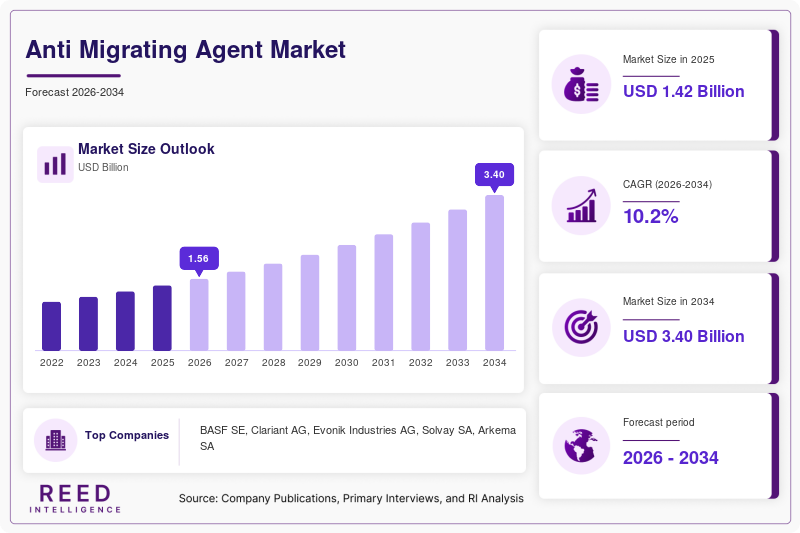
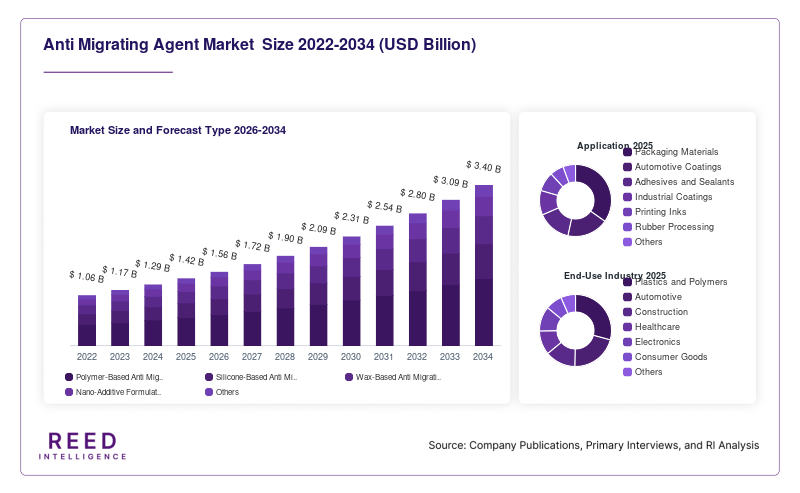
The global Anti Migrating Agent Market size was valued at approximately USD 1.42 billion in 2026 and is projected to reach nearly USD 3.08 billion by 2034, expanding at a CAGR of 10.2% during the forecast period from 2026 to 2034. Anti migrating agents are widely used in coatings, plastics, adhesives, inks, rubber compounds, and polymer applications to prevent color bleeding, material degradation, and additive migration across substrates. The market continues to gain traction as manufacturers focus on extending product durability, improving visual consistency, and maintaining regulatory compliance in industrial and consumer applications. Growing adoption of high-performance polymers and advanced packaging materials across automotive, construction, electronics, and healthcare industries has created a stable demand environment for anti migrating solutions.
One major global factor supporting market growth is the rapid expansion of sustainable and high-performance packaging solutions. Flexible packaging manufacturers are increasingly using anti migrating agents to prevent ink transfer, pigment migration, and contamination in multilayer packaging structures. The rising demand for food-safe packaging materials and recyclable polymer systems has encouraged companies to integrate advanced additive technologies that improve product stability while maintaining environmental standards. In addition, increasing infrastructure development and automotive production across emerging economies continue to support higher consumption of specialty chemicals used in polymer stabilization and coating enhancement.
Key Highlights
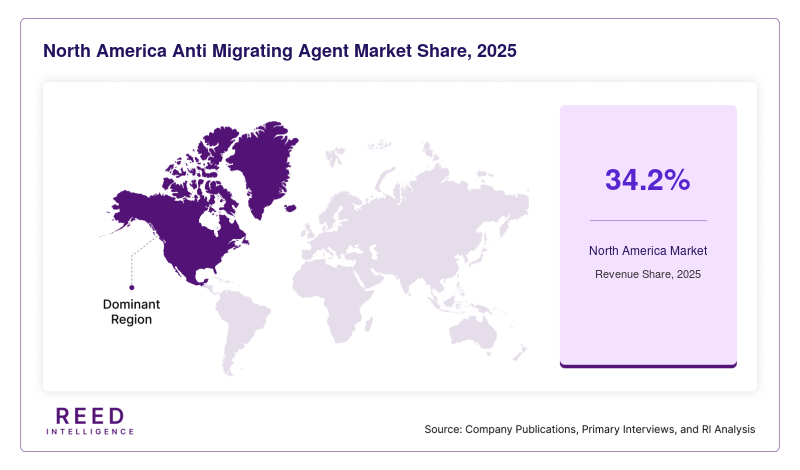
- North America dominated the market with a 34.2% share in 2025.
- Asia Pacific is expected to grow at the fastest CAGR of 11.8% during 2026–2034.
- By type, polymer-based anti migrating agents accounted for the largest share of 39.4%.
- while nano-additive formulations are projected to grow at a CAGR of 12.6%.
- By application, packaging materials led with a 36.8% share.
- whereas automotive coatings are expected to expand at a CAGR of 11.9%.
- By end-use industry, plastics and polymers held the dominant share of 42.1%, while healthcare materials are projected to grow at a CAGR of 12.1%.
- The United States remained the dominant country, with market values of USD 462 million in 2024 and USD 505 million in 2025.
Market Trends
Rising Adoption of Sustainable Additive Technologies
Manufacturers across the chemical and polymer industries are increasingly shifting toward sustainable additive technologies that reduce environmental impact while maintaining product efficiency. Anti migrating agents with low volatile organic compound content and recyclable compatibility are becoming more common in packaging, coatings, and adhesive applications. Companies are investing in bio-based polymer additives that can improve resistance against color transfer and additive migration without affecting substrate quality. Demand for eco-friendly materials from food packaging producers and consumer goods manufacturers has accelerated the development of water-based and solvent-free anti migrating formulations. Regulatory pressure regarding chemical safety and waste reduction is also influencing product innovation strategies across North America and Europe.
The trend is further supported by rising consumer awareness regarding sustainable packaging and environmentally responsible industrial materials. Large packaging converters and automotive coating suppliers are integrating advanced anti migrating technologies into production lines to improve recyclability and maintain compliance with international material standards. Several manufacturers are also introducing multifunctional additives that combine migration resistance with thermal stability and UV protection. These developments are helping producers reduce operational complexity and improve long-term performance in demanding industrial environments.
Increasing Use of Advanced Polymer Systems in Industrial Manufacturing
Industrial manufacturers are increasingly adopting advanced polymer systems to improve mechanical strength, flexibility, and durability in finished products. This shift has increased the need for anti migrating agents that stabilize pigments, plasticizers, and additives within complex polymer structures. High-performance polymers used in automotive interiors, medical devices, electrical components, and construction materials require enhanced migration resistance to maintain appearance and functionality over long operating cycles. The growing use of multilayer polymer films and engineered plastics has further accelerated demand for specialized migration control technologies.
The electronics and automotive sectors are playing a major role in this trend as manufacturers focus on lightweight materials and premium surface finishes. Anti migrating agents help prevent discoloration, surface contamination, and additive separation in high-temperature environments. In addition, rapid industrialization in Asia Pacific has expanded production capacity for polymers and specialty coatings, creating stronger demand for advanced chemical additives. Market participants are therefore increasing research investments to develop customized anti migrating solutions for industry-specific performance requirements.
Market Drivers
Expansion of Flexible Packaging and Food Safety Standards
The rapid expansion of the global flexible packaging industry continues to drive strong demand for anti migrating agents. Food packaging manufacturers require specialized additives that prevent ink transfer, chemical migration, and pigment bleeding between packaging layers. Rising consumption of packaged foods, beverages, pharmaceuticals, and personal care products has increased the use of multilayer polymer films and advanced coating systems. Anti migrating agents help maintain product quality and shelf stability while supporting compliance with food safety regulations. As governments continue implementing stricter standards regarding packaging contamination and chemical exposure, manufacturers are increasing the adoption of migration-resistant formulations.
The demand for lightweight and recyclable packaging materials has also contributed to market growth. Packaging companies are focusing on improving material performance without compromising sustainability goals. Anti migrating additives enhance adhesion stability and reduce defects during storage and transportation. The e-commerce industry has further strengthened packaging demand due to higher shipping volumes and increased use of protective polymer materials. These combined factors are expected to maintain stable long-term growth for anti migrating agent suppliers.
Growth in Automotive and Construction Coating Applications
The automotive and construction sectors are generating substantial demand for high-performance coatings and polymer additives, creating favorable conditions for the Anti Migrating Agent Market. Vehicle manufacturers increasingly rely on specialty coatings and engineered plastics to improve durability, visual quality, and resistance to environmental stress. Anti migrating agents are widely used in automotive interiors, dashboards, sealants, and protective coatings to prevent color fading, additive migration, and material degradation. Rising production of electric vehicles and lightweight automotive components has further accelerated the use of advanced polymer systems.
In the construction industry, anti migrating agents are incorporated into paints, sealants, waterproof coatings, and insulation materials to improve long-term structural performance. Rapid urbanization and infrastructure development across Asia Pacific, the Middle East, and Latin America are increasing the demand for durable building materials. Commercial construction projects increasingly require coatings that can withstand moisture, UV exposure, and chemical interaction over extended periods. As a result, chemical manufacturers are developing high-efficiency anti migrating additives that support both industrial performance and regulatory compliance.
Market Restraint
Volatility in Raw Material Prices and Regulatory Compliance Challenges
Fluctuating raw material prices remain a major challenge for manufacturers operating in the Anti Migrating Agent Market. Many anti migrating formulations rely on specialty chemicals, petrochemical derivatives, polymer compounds, and performance additives that are directly affected by changes in crude oil prices and supply chain disruptions. Price instability can increase manufacturing costs and reduce profit margins for small and medium-sized producers. In addition, supply shortages of specialty ingredients may delay production schedules and impact long-term procurement contracts. Companies operating across multiple regions also face currency fluctuations and transportation cost increases that further affect pricing stability.
Regulatory compliance presents another important restraint, particularly in food packaging, healthcare, and consumer goods applications. Governments and international regulatory bodies continue to implement stricter standards regarding chemical migration, environmental safety, and material toxicity. Manufacturers are required to invest significantly in product testing, certification, and research to ensure compliance with evolving regulations. Smaller companies may struggle to manage these costs while maintaining competitive pricing. For example, packaging manufacturers supplying food-grade materials often require extensive validation of anti migrating additives before commercial approval, increasing product development timelines and operational complexity.
Market Opportunities
Growing Demand for High-Performance Medical and Healthcare Materials
The healthcare and medical materials industry presents strong growth opportunities for anti migrating agent manufacturers. Medical packaging, diagnostic devices, tubing systems, and wearable healthcare products increasingly rely on advanced polymers and specialty coatings that require migration-resistant performance. Anti migrating agents help maintain material integrity, reduce contamination risks, and support long-term stability in sensitive healthcare environments. Rising healthcare expenditure, aging populations, and expanding pharmaceutical production across emerging economies are increasing demand for high-quality medical materials.
The shift toward single-use medical devices and sterile packaging solutions has also accelerated the need for advanced additive technologies. Hospitals and pharmaceutical companies are focusing on durable, lightweight, and chemically stable materials that meet strict regulatory standards. Anti migrating agents contribute to improved safety and reduced interaction between packaging layers and medical contents. In addition, ongoing investments in biotechnology and laboratory infrastructure are expected to create new application areas for specialized migration-control additives over the forecast period.
Expansion of Electric Vehicle and Electronics Manufacturing
The growing production of electric vehicles and advanced electronic devices offers significant opportunities for the Anti Migrating Agent Market. Electric vehicle manufacturers increasingly use engineered plastics, lightweight coatings, insulation materials, and high-performance adhesives to improve battery efficiency and vehicle durability. Anti migrating agents are essential in maintaining thermal stability and preventing additive separation within sensitive electronic and polymer systems. As electric vehicle adoption rises globally, the demand for specialized chemical additives is expected to increase steadily.
Consumer electronics manufacturers are also expanding their use of advanced polymers in smartphones, wearable devices, displays, and semiconductor packaging. Anti migrating agents help improve surface consistency, prevent discoloration, and maintain performance under varying temperature conditions. Asia Pacific countries such as China, South Korea, Japan, and India are investing heavily in electronics manufacturing capacity, creating strong regional demand for specialty additives. Companies developing nano-based and multifunctional anti migrating solutions are expected to gain competitive advantages in these rapidly expanding industrial sectors.
Segmental Analysis
By Type
Polymer-based anti migrating agents accounted for the largest market share of approximately 39.4% in 2024 due to their extensive use across coatings, plastics, adhesives, and packaging applications. These additives are widely preferred because they provide strong compatibility with multiple polymer systems while improving stability and migration resistance. Manufacturers across automotive, construction, and industrial sectors increasingly use polymer-based formulations to reduce color bleeding, additive separation, and material degradation. Their cost efficiency and adaptability in large-scale manufacturing processes have further strengthened market adoption. In addition, polymer-based anti migrating agents support enhanced durability and surface consistency in demanding industrial environments. Rising production of engineered plastics and multilayer packaging films continues to support strong demand for these formulations across developed and emerging economies.
Nano-additive formulations are projected to witness the fastest CAGR of 12.6% during the forecast period due to increasing demand for high-performance and multifunctional additive technologies. Nano-based anti migrating agents offer improved dispersion properties, stronger thermal stability, and enhanced resistance against chemical interaction. These advanced formulations are increasingly used in electronics, automotive coatings, and specialty healthcare materials where precise material performance is critical. Manufacturers are investing in nanotechnology research to develop additives capable of improving migration resistance while maintaining lightweight and sustainable product characteristics. The growth of electric vehicles, smart electronics, and advanced industrial coatings is expected to accelerate the adoption of nano-additive formulations across multiple high-value applications over the next decade.
By Application
Packaging materials represented the dominant application segment and accounted for nearly 36.8% of the market share in 2024. The segment continues to benefit from rising global demand for food-safe packaging, flexible polymer films, and multilayer protective materials. Anti migrating agents are widely incorporated into packaging structures to prevent contamination, pigment transfer, and additive migration between substrate layers. Food and beverage companies increasingly require packaging materials that maintain shelf stability and comply with strict regulatory standards. The rapid growth of e-commerce and packaged consumer products has also increased the use of durable packaging solutions with improved chemical resistance. In addition, recyclable and lightweight packaging trends are encouraging manufacturers to adopt advanced additive technologies that support both sustainability goals and long-term product integrity.
Automotive coatings are expected to expand at the fastest CAGR of 11.9% through 2034 due to increasing demand for lightweight vehicles and durable coating systems. Automotive manufacturers are using advanced polymer coatings and engineered plastics to improve fuel efficiency, aesthetic appeal, and resistance to environmental exposure. Anti migrating agents help maintain color consistency, reduce additive separation, and improve surface stability under varying temperature conditions. The rapid growth of electric vehicle production is also contributing to higher consumption of specialty coatings and performance additives. Manufacturers are focusing on premium interior finishes and protective exterior coatings that require enhanced migration resistance for long operational lifecycles. These trends are expected to create substantial growth opportunities for anti migrating additive suppliers in the automotive sector.
By End-Use Industry
The plastics and polymers industry held the largest share of approximately 42.1% in 2024 due to the widespread use of anti migrating agents in industrial polymer production and processing. Polymer manufacturers rely on migration-resistant additives to improve mechanical performance, maintain product appearance, and reduce degradation during long-term use. These additives are extensively utilized in consumer goods, packaging materials, automotive components, and industrial equipment. Increasing production of engineered plastics and specialty polymers has strengthened the demand for advanced migration-control technologies. In addition, manufacturers are developing recyclable polymer systems that require improved additive compatibility and long-term stability. The ongoing expansion of industrial manufacturing and consumer packaging applications continues to support strong growth in this end-use segment.
Healthcare materials are projected to witness the fastest CAGR of 12.1% during the forecast period due to rising demand for safe, durable, and contamination-resistant medical products. Anti migrating agents are increasingly used in medical packaging, diagnostic equipment, pharmaceutical containers, and wearable healthcare devices. The healthcare industry requires advanced polymer materials that can maintain structural integrity and reduce chemical interaction over extended periods. Growing pharmaceutical production and increasing healthcare investments across emerging economies are supporting market expansion.
Regional Analysis
North America
North America accounted for approximately 34.2% of the global Anti Migrating Agent Market in 2025 and maintained its position as the largest regional market. The region is projected to expand at a CAGR of 9.4% during the forecast period due to strong demand from packaging, automotive, and healthcare industries. High investment in specialty chemicals and advanced polymer technologies has supported consistent market expansion across the United States and Canada. In addition, strict regulatory standards related to food-safe packaging and industrial coatings continue to encourage the adoption of high-performance migration-resistant additives.
The United States remained the dominant country within North America due to its advanced manufacturing infrastructure and strong presence of multinational chemical companies. The country recorded market values of USD 462 million in 2024 and USD 505 million in 2025. One unique growth factor supporting the market is the rapid expansion of sustainable packaging manufacturing across the country. Food and beverage companies are increasingly using recyclable multilayer packaging systems that require specialized anti migrating formulations to ensure product safety and long-term material stability.
Europe
Europe represented nearly 27.6% of the global market in 2025 and is expected to grow at a CAGR of 9.1% between 2026 and 2034. The region benefits from strong regulatory oversight regarding chemical safety, packaging standards, and environmental sustainability. European manufacturers continue to invest in low-emission coatings, eco-friendly polymer systems, and recyclable packaging technologies that require advanced anti migrating additives. The automotive industry also remains a major contributor to market demand, particularly in Germany, France, and Italy.
Germany emerged as the leading country in the European market due to its strong industrial manufacturing base and technological expertise in specialty chemicals. One unique factor supporting market growth in Germany is the country’s leadership in automotive engineering and industrial coatings production. Manufacturers are increasingly integrating high-performance polymer additives into electric vehicle components and industrial applications to improve material durability, reduce migration risks, and comply with environmental regulations across the European Union.
Asia Pacific
Asia Pacific held approximately 24.9% of the Anti Migrating Agent Market in 2025 and is projected to witness the fastest CAGR of 11.8% through 2034. Rapid industrialization, urban infrastructure development, and rising packaging demand are major factors supporting regional growth. Countries across the region are expanding manufacturing operations for plastics, adhesives, coatings, and consumer electronics, increasing the consumption of specialty additives. The growing middle-class population and rising demand for packaged consumer products have also strengthened the need for migration-resistant materials.
China remained the dominant country in the Asia Pacific region due to its extensive chemical manufacturing capacity and strong industrial production base. One unique growth factor in China is the rapid expansion of electronics and electric vehicle manufacturing facilities. Domestic producers are increasingly investing in high-performance polymers and advanced coating technologies to improve product quality and meet export standards. This industrial expansion is expected to create sustained demand for anti migrating agents across multiple downstream sectors.
Middle East & Africa
The Middle East & Africa region accounted for around 6.4% of the global market in 2025 and is anticipated to grow at a CAGR of 8.7% during the forecast period. Increasing investments in infrastructure, construction materials, and industrial coatings are supporting market expansion across the region. Governments are focusing on industrial diversification and local manufacturing development, which has increased the use of advanced polymer additives in construction and packaging applications. The expansion of food processing and pharmaceutical industries is also contributing to regional demand growth.
Saudi Arabia emerged as the leading country within the Middle East & Africa market due to large-scale petrochemical investments and growing industrial manufacturing capabilities. One unique growth factor supporting the Saudi market is the development of integrated chemical production hubs linked to infrastructure and industrial diversification programs. These initiatives are increasing domestic production of specialty polymers and coatings, creating favorable opportunities for anti migrating agent suppliers serving industrial and packaging applications.
Latin America
Latin America captured approximately 6.9% of the global Anti Migrating Agent Market in 2025 and is forecast to grow at a CAGR of 8.9% through 2034. The market is benefiting from increasing packaging demand, growth in construction activities, and expansion of regional manufacturing industries. Countries across the region are adopting advanced coating and polymer technologies to improve product durability and export competitiveness. The growing food and beverage industry has also strengthened demand for migration-resistant packaging materials that comply with international quality standards.
Brazil remained the dominant country in Latin America due to its strong industrial base and expanding consumer goods sector. One unique growth factor supporting the Brazilian market is the increasing investment in flexible packaging and agricultural chemical packaging solutions. Domestic manufacturers are focusing on improving packaging performance and shelf stability for export-oriented industries. This trend has accelerated the adoption of anti migrating additives in multilayer films, industrial coatings, and polymer-based packaging products.
Competitive Landscape
The Anti Migrating Agent Market remains moderately consolidated, with major specialty chemical manufacturers focusing on product innovation, sustainability, and regional expansion strategies. Leading companies are investing in research and development to improve additive efficiency, enhance regulatory compliance, and support high-performance polymer applications. Strategic collaborations with packaging, automotive, and electronics manufacturers have become increasingly important as demand for customized migration-control solutions continues to grow.
BASF SE remains one of the leading participants in the market due to its extensive specialty chemicals portfolio and strong global distribution network. The company recently expanded its sustainable additive development program to support recyclable polymer applications and environmentally compatible coating technologies. Other major players including Clariant AG, Evonik Industries AG, Solvay SA, and Arkema SA are strengthening their market presence through acquisitions, capacity expansion projects, and advanced formulation launches.
Key Players
- BASF SE
- Clariant AG
- Evonik Industries AG
- Solvay SA
- Arkema SA
- Dow Inc.
- LANXESS AG
- Croda International Plc
- Songwon Industrial Co., Ltd.
- ADEKA Corporation
- Avient Corporation
- SI Group Inc.
- Tosaf Group
- Ampacet Corporation
- SABO S.p.A.
Recent Developments
- BASF SE introduced a new low-emission anti migrating additive platform in 2025 designed for recyclable food packaging applications and multilayer polymer films.
- Clariant AG expanded its specialty additives production facility in Asia Pacific during 2024 to support growing demand from electronics and automotive coating manufacturers.
- Evonik Industries AG launched a nano-based migration-control additive in 2025 focused on improving thermal stability and UV resistance in advanced polymer systems.
- Arkema SA entered a strategic collaboration with regional packaging manufacturers in 2024 to develop sustainable anti migrating solutions for flexible packaging applications.
Anti Migrating Agent Market Segments
Type
- Polymer-Based Anti Migrating Agents
- Silicone-Based Anti Migrating Agents
- Wax-Based Anti Migrating Agents
- Nano-Additive Formulations
- Others
Application
- Packaging Materials
- Automotive Coatings
- Adhesives and Sealants
- Industrial Coatings
- Printing Inks
- Rubber Processing
- Others
End-Use Industry
- Plastics and Polymers
- Automotive
- Construction
- Healthcare
- Electronics
- Consumer Goods
- Others
By Region
- North America
- Europe
- APAC
- Middle East and Africa
- LATAM