Anti Tank Missile Market Size, Share & Demand Report By Type (Guided Missiles, Unguided Missiles, Fire-and-Forget Missiles), By Launch Platform (Infantry-Based Systems, Vehicle-Mounted Systems, Helicopter-Launched Systems), By Range (Short Range, Medium Range, Long Range), By End Use (Military Forces, Defense Research Organizations), By Region & Segment Forecasts, 2025–2034
USD 3950
Market Overview
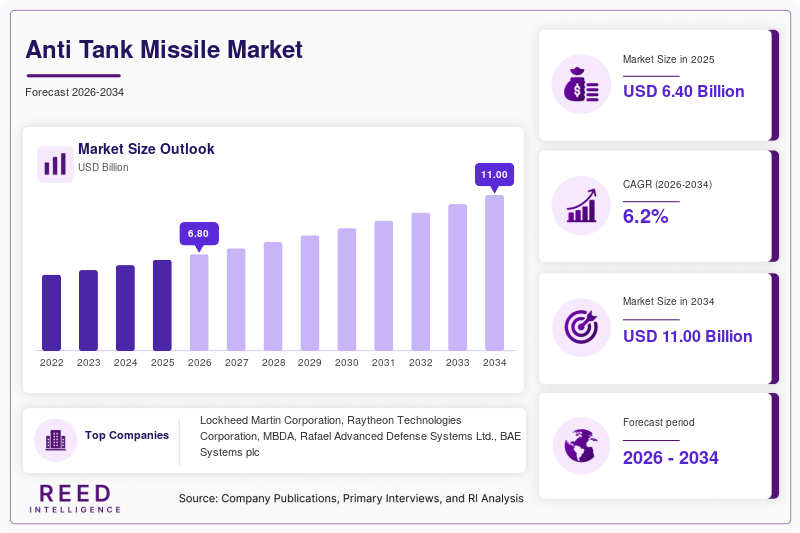
According to Reed Intelligence the Anti Tank Missile Market size was valued at USD 6.4 billion in 2024 and is projected to reach USD 10.9 billion by 2033, expanding at a compound annual growth rate (CAGR) of 6.2% from 2025 to 2033. Anti-tank missiles are precision-guided weapon systems designed to neutralize armored vehicles and fortified positions. Their integration with advanced targeting technologies and modern battlefield systems has strengthened their role in land warfare strategies.
One major factor supporting market growth globally has been the ongoing modernization of military ground forces. Many defense ministries have been replacing legacy anti-armor systems with advanced guided missile platforms capable of long-range precision engagement and enhanced survivability. These systems enable infantry units, armored vehicles, and helicopters to counter heavily armored threats with improved accuracy. Defense spending on tactical missile programs has therefore increased across both developed and emerging economies, supporting steady demand for next-generation anti-tank missile platforms.
Key Highlights
- Dominant Region: North America held 34.1% share in 2025; Asia Pacific will be the fastest-growing region with a CAGR of 7.4% (2025–2033).
- Leading Segment:Guided missiles led the type segment with 78% share in 2024, while fire-and-forget missiles will grow fastest at 7.1% CAGR.
- Leading Launch Platform:Infantry-based launch systems dominated with 41% share in 2024, while vehicle-mounted systems will expand at 6.9% CAGR.
- Dominant Country: The United States Anti Tank Missile Market reached USD 1.7 billion in 2024 and USD 1.8 billion in 2025.
Market Trends
Integration of Advanced Guidance Technologies
The Anti Tank Missile Market has witnessed a growing shift toward advanced guidance and targeting technologies. Modern anti-tank missiles increasingly feature imaging infrared seekers, laser guidance, and dual-mode targeting systems that improve engagement accuracy. Fire-and-forget systems allow operators to launch missiles and immediately relocate, improving battlefield survivability. These technological improvements enhance operational efficiency for infantry and armored units. As defense programs emphasize precision engagement capabilities, missile manufacturers have been integrating sensor fusion technologies and artificial intelligence-assisted targeting into next-generation platforms.
Increasing Deployment of Portable Missile Systems
Portable anti-tank missile systems have gained attention due to their flexibility in modern combat scenarios. Lightweight launchers and compact missile units enable infantry forces to operate independently in diverse terrains including urban environments. Portable systems can be rapidly deployed and require fewer logistical resources compared with heavy weapon systems. Many armed forces are therefore investing in shoulder-launched or tripod-mounted missiles that can neutralize armored threats with minimal setup time. This trend has strengthened demand for compact missile systems within the Anti Tank Missile Market, particularly among countries focused on improving mobile ground combat capabilities.
Market Drivers
Rising Global Defense Modernization Programs
Defense modernization initiatives have been a significant driver of growth in the Anti Tank Missile Market. Governments worldwide have been allocating larger budgets toward upgrading military equipment and replacing aging missile systems. Modern anti-tank missiles provide improved penetration capability, longer operational range, and higher precision compared with earlier generations. As ground combat tactics evolve, military planners increasingly emphasize the need for mobile and accurate anti-armor systems that can operate effectively in dynamic battlefield conditions.
Growing Demand for Precision Strike Capabilities
Modern warfare strategies emphasize precision engagement to reduce collateral damage while maintaining tactical effectiveness. Anti-tank missile systems offer high accuracy and targeted strike capability against armored vehicles, bunkers, and fortified positions. Advances in digital targeting, thermal imaging, and command guidance technologies have improved strike accuracy significantly. These capabilities have increased the operational value of anti-tank missiles across multiple military units including infantry, mechanized forces, and airborne platforms. As armed forces seek reliable solutions to counter armored threats, demand within the Anti Tank Missile Market continues to expand.
Market Restraint
High Development and Procurement Costs
High development and procurement costs represent a significant challenge for the Anti Tank Missile Market. Advanced missile systems incorporate sophisticated guidance technologies, propulsion mechanisms, and specialized warhead designs. These components require extensive research, testing, and certification before deployment, which significantly increases production costs.
Many developing economies face budget constraints that limit large-scale procurement of advanced missile platforms. Even for developed nations, the cost of integrating new missile systems into existing military infrastructure can be substantial. Expenses associated with training personnel, maintaining missile inventories, and upgrading launch platforms further increase total ownership costs.
Additionally, the lifecycle management of missile systems requires continuous maintenance and modernization to remain operationally relevant. These financial pressures can delay procurement programs and reduce the pace of adoption in certain regions. While technological innovation continues to enhance the effectiveness of anti-tank missile systems, high investment requirements remain a notable restraint influencing market expansion.
Market Opportunities
Development of Next-Generation Smart Missiles
The development of smart missile technologies presents notable opportunities within the Anti Tank Missile Market. Modern missiles are increasingly equipped with multi-mode guidance systems that combine infrared imaging, laser guidance, and data-link communication. These technologies enable real-time targeting updates and improved strike precision. Smart missile platforms can also adapt to changing battlefield conditions by adjusting flight paths and targeting parameters. As defense research organizations continue to invest in advanced missile development programs, demand for next-generation systems is expected to expand.
Increasing Defense Collaboration and Export Programs
International defense cooperation has created new opportunities for missile manufacturers. Several countries are forming partnerships to jointly develop missile systems and expand export capabilities. Collaborative defense programs allow participating nations to share technological expertise while reducing development costs. In addition, growing demand for advanced anti-tank missile systems among emerging defense markets has encouraged manufacturers to expand export activities. These partnerships are expected to support sustained growth across the Anti Tank Missile Market during the forecast period.
Segmental Analysis
By Type
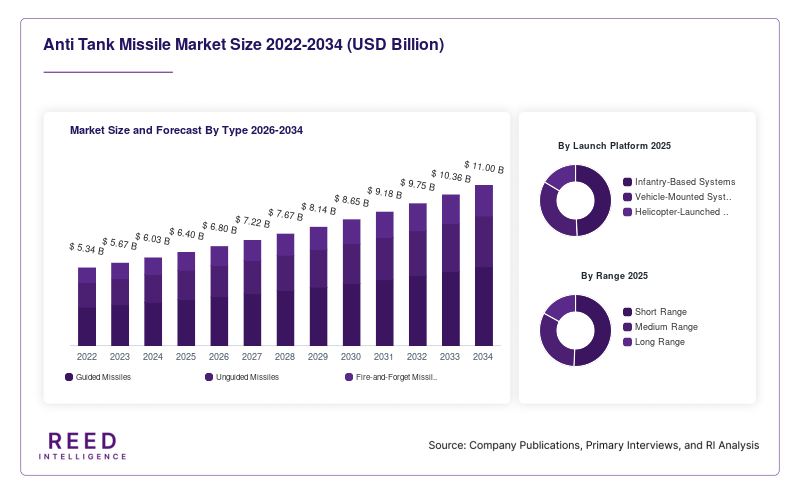
Guided missiles dominated the Anti Tank Missile Market in 2024, accounting for approximately 78% share of total market revenue. Guided anti-tank missiles offer improved targeting accuracy and longer engagement range compared with unguided systems. These missiles typically use laser guidance, infrared imaging, or command guidance technologies that enable operators to engage armored targets with greater precision. Their widespread adoption across infantry units and armored platforms supported their leading market share.
Fire-and-forget missiles will represent the fastest-growing subsegment, expanding at a CAGR of 7.1% from 2025 to 2033. These missile systems allow operators to launch a missile and immediately relocate without maintaining continuous target tracking. This capability improves survivability for military personnel and enhances operational flexibility in dynamic combat environments. Continued technological improvements in seeker systems will support the growth of this subsegment.
By Launch Platform
Infantry-based launch systems held the largest share of the Anti Tank Missile Market in 2024, accounting for 41% of total revenue. Portable launchers provide flexibility and mobility for ground forces operating in varied terrains. These systems are widely used in tactical missions where rapid deployment and minimal logistical requirements are important. Their compact design and ease of operation have contributed to widespread adoption among military forces.
Vehicle-mounted launch platforms will experience the fastest growth, with a projected CAGR of 6.9% during the forecast period. These systems enable armored vehicles to carry multiple missiles and engage targets at extended ranges. Integration with modern targeting systems and battlefield communication networks will strengthen the operational efficiency of vehicle-mounted missile platforms.
By Range
Short-range missiles dominated the Anti Tank Missile Market in 2024 with around 46% share. These missile systems are typically deployed by infantry units and light vehicles for close-range engagement against armored threats. Their relatively simple design and quick deployment capabilities have supported their widespread use in tactical operations.
Long-range missile systems will grow at the fastest CAGR of 7.3% from 2025 to 2033. These missiles allow military forces to engage armored targets from greater distances while maintaining high strike accuracy. Extended-range capability improves operational safety for launch units and enhances battlefield coverage.
By End Use
Military forces represented the dominant end-use segment in 2024, accounting for over 90% share of the Anti Tank Missile Market. National defense organizations remain the primary users of anti-tank missile systems, deploying them across infantry, armored vehicle, and helicopter units. Procurement programs conducted by government defense agencies continue to support demand for advanced missile systems.
Defense research and development organizations will represent the fastest-growing segment, expanding at a CAGR of 6.6% through 2033. Increasing investments in next-generation missile development programs will encourage collaboration between defense agencies and research institutions. These initiatives will support the development of innovative missile technologies and strengthen future market growth.
Regional Analysis
North America
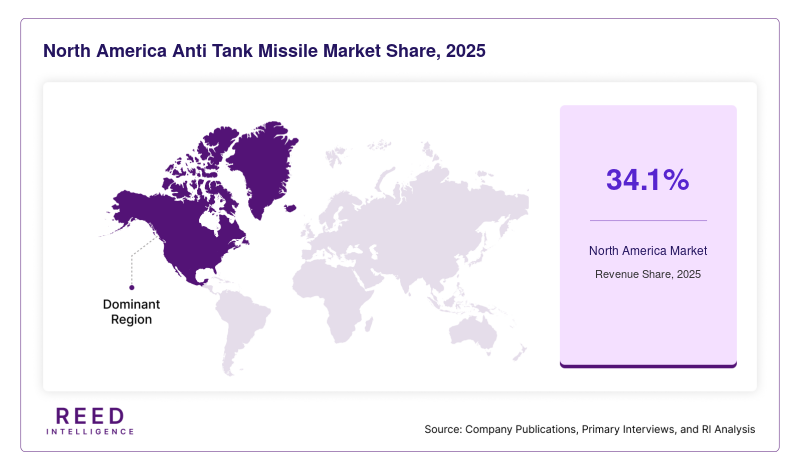
North America accounted for 34.1% share of the Anti Tank Missile Market in 2025 and was among the largest regional markets. The region’s market growth will expand at a CAGR of 5.7% from 2025 to 2033. The presence of large defense contractors and established missile manufacturing infrastructure supported the region’s market size. Government investments in tactical missile systems and advanced battlefield technologies also contributed to the regional industry outlook.
The United States dominated the regional market due to its extensive defense research programs and established military procurement systems. The country’s defense industry has continued to focus on improving missile precision, range, and operational flexibility. Continuous testing and development of advanced missile platforms strengthened the production capabilities of domestic manufacturers. The integration of anti-tank missile systems into multiple military units also contributed to sustained demand across the country.
Europe
Europe held a 24.6% share of the Anti Tank Missile Market in 2025 and will grow at a CAGR of 6.0% through 2033. Several European countries maintain strong missile development capabilities and invest in advanced defense technologies. Regional defense organizations have focused on improving ground combat capabilities and ensuring operational readiness of military forces.
France represented a dominant country within the regional market. The country has supported domestic missile development programs through collaboration between government agencies and defense manufacturers. These initiatives have strengthened the production of advanced missile systems for both domestic use and international export markets. Continued technological innovation within the country’s defense sector has contributed to steady growth in missile system production.
Asia Pacific
Asia Pacific accounted for 21.9% share of the Anti Tank Missile Market in 2025 and will expand at the fastest CAGR of 7.4% during the forecast period. Several countries in the region have been increasing investments in military modernization programs to enhance national defense capabilities. This trend has supported the procurement of advanced missile systems and improved ground warfare technologies.
India emerged as a major country contributing to regional market growth. The country has expanded domestic missile development programs and strengthened its defense manufacturing capabilities. Collaboration between national defense research organizations and local manufacturers has supported the production of indigenous missile systems. These initiatives have contributed to the development of modern anti-tank missile platforms designed for diverse operational environments.
Middle East & Africa
The Middle East & Africa accounted for 11.2% share of the Anti Tank Missile Market in 2025 and will grow at a CAGR of 6.5% through 2033. Countries across the region maintain strong defense procurement activities aimed at strengthening ground combat capabilities. Increasing military investments and procurement of advanced tactical systems have supported regional demand.
Saudi Arabia represented a leading country within the regional market. The nation has maintained significant defense expenditure and continues to invest in advanced military equipment. Strategic defense procurement programs have supported the acquisition of modern missile systems designed for armored threat neutralization. These initiatives have strengthened the country’s defense infrastructure and supported regional market growth.
Latin America
Latin America held 8.2% share of the Anti Tank Missile Market in 2025 and will expand at a CAGR of 5.4% during the forecast period. Several countries within the region have been gradually upgrading military equipment and strengthening defense capabilities. Investments in advanced tactical systems have contributed to the region’s steady market development.
Brazil emerged as a dominant country in the regional market. The country has expanded its defense manufacturing capacity and supported the development of advanced military technologies. Domestic defense organizations have collaborated with international partners to improve missile system design and production capabilities. These initiatives have contributed to the gradual expansion of anti-tank missile system adoption within the country.
Competitive Landscape
The Anti Tank Missile Market is characterized by the presence of established global defense manufacturers that focus on advanced missile development and strategic partnerships. Companies invest heavily in research and development to improve missile accuracy, range, and operational efficiency. Collaboration with government defense agencies and international defense programs also plays a significant role in strengthening market positions.
Lockheed Martin Corporation remained a major market participant due to its extensive missile system portfolio and advanced research capabilities. The company has continued to develop next-generation missile systems designed for enhanced targeting precision and improved operational performance.
Other key companies such as Raytheon Technologies Corporation, MBDA, Rafael Advanced Defense Systems Ltd., and BAE Systems plc also maintain strong positions in the global market. These organizations focus on technological innovation, defense contracts, and international export programs to support their long-term growth within the Anti Tank Missile Market.
Key Players
- Lockheed Martin Corporation
- Raytheon Technologies Corporation
- MBDA
- Rafael Advanced Defense Systems Ltd.
- BAE Systems plc
- Saab AB
- Thales Group
- Northrop Grumman Corporation
- Bharat Dynamics Limited
- Israel Aerospace Industries
- L3Harris Technologies Inc.
- Roketsan A.S.
- General Dynamics Corporation
- Elbit Systems Ltd.
- Denel Dynamics
Recent Developments
- Several defense manufacturers have introduced next-generation anti-tank missile systems with enhanced infrared guidance technologies to improve targeting accuracy.
- Defense organizations in Asia Pacific have increased domestic missile development initiatives, supporting indigenous production capabilities.
- Collaborative missile development programs between international defense companies have expanded technology sharing and joint manufacturing activities.
- Manufacturers have continued to invest in extended-range missile platforms designed for modern armored warfare scenarios.
Anti Tank Missile Market Segments
By Type
- Guided Missiles
- Unguided Missiles
- Fire-and-Forget Missiles
By Launch Platform
- Infantry-Based Systems
- Vehicle-Mounted Systems
- Helicopter-Launched Systems
By Range
- Short Range
- Medium Range
- Long Range
By End Use
- Military Forces
- Defense Research Organizations
By Region
- North America
- Europe
- APAC
- Middle East and Africa
- LATAM