Anti Vibration Mounts Market Size, Share & Demand Report By Type (Elastomer Mounts, Hydraulic Mounts, Spring Mounts), By Application (Automotive Systems, Industrial Machinery, Marine Applications, Railway & Transportation Systems), By End-Use (Aerospace & Defense, Energy & Power, Construction & Infrastructure), By Region & Segment Forecasts, 2026–2034
USD 3950
Market Overview
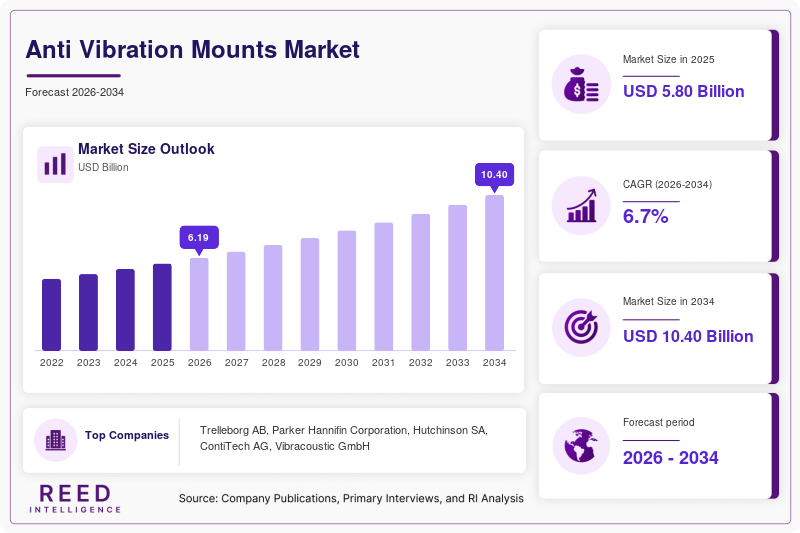
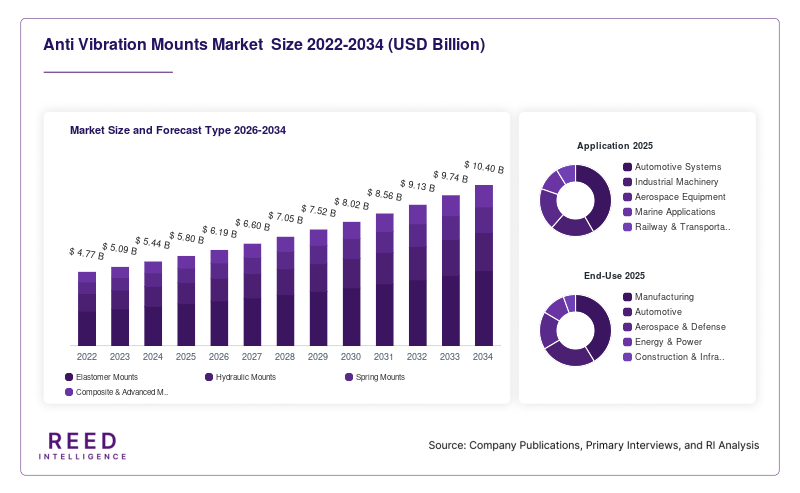
The Anti Vibration Mounts Market size was valued at approximately USD 5.8 billion in 2026 and is projected to reach USD 9.7 billion by 2034, growing at a CAGR of 6.7% during the forecast period (2026–2034). Anti-vibration mounts are essential components used to reduce noise, shock, and vibration in machinery and equipment across multiple industries, including automotive, aerospace, manufacturing, and construction. Their ability to enhance equipment lifespan and improve operational efficiency continues to support widespread adoption.
A major global factor driving market growth is the rising emphasis on industrial automation and precision engineering. As manufacturing facilities adopt advanced machinery with higher operating speeds and tighter tolerances, the need for vibration isolation solutions becomes increasingly critical. This trend is particularly visible in emerging economies, where rapid industrialization is leading to increased investment in production infrastructure. Additionally, regulatory frameworks focusing on workplace safety and noise reduction are further encouraging the integration of anti-vibration systems.
Key Highlights
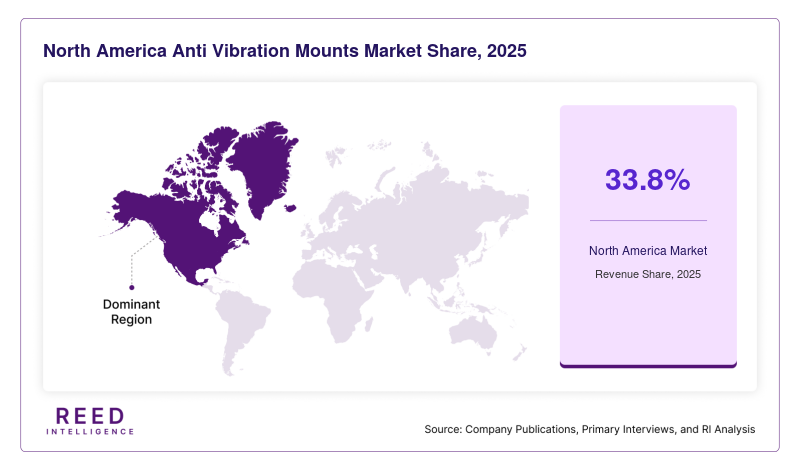
- North America dominated the market with a 33.8% share in 2025.
- Asia Pacific is expected to grow at the fastest CAGR of 8.4% during 2026–2034.
- By type, elastomer mounts accounted for the largest share of 42.1%.
- while hydraulic mounts are projected to grow at a CAGR of 7.9%.
- By application, automotive systems led with a 39.6% share, whereas industrial machinery is expected to expand at a CAGR of 7.5%.
- The United States remained the dominant country, with market values of USD 1.12 billion in 2024 and USD 1.20 billion in 2025.
Market Trends
Increasing integration of advanced materials in vibration isolation systems
The market is experiencing a shift toward the use of advanced materials such as high-performance elastomers, thermoplastic polymers, and hybrid composites. These materials provide improved damping characteristics, longer service life, and resistance to harsh environmental conditions, including extreme temperatures and chemical exposure. Manufacturers are investing in material science to develop mounts that offer better load-bearing capacity while maintaining flexibility. This trend is particularly relevant in aerospace and automotive sectors, where performance requirements are stringent. The use of lightweight materials is also helping reduce overall system weight, contributing to energy efficiency and lower emissions in vehicles and industrial equipment.
Rising demand from electric vehicles and renewable energy sectors
The growing adoption of electric vehicles (EVs) is influencing the demand for specialized anti-vibration mounts. EVs operate differently from traditional internal combustion engine vehicles, resulting in unique vibration and noise patterns. As a result, manufacturers are developing customized mounting solutions to address these challenges. Similarly, renewable energy systems such as wind turbines and solar tracking systems require effective vibration control to maintain operational stability and efficiency. The increasing global focus on sustainability and clean energy is expected to create steady demand for vibration isolation technologies across these emerging applications.
Market Drivers
Expansion of industrial automation and smart manufacturing
The rapid adoption of automation technologies across manufacturing industries is a key driver of the Anti Vibration Mounts Market. Automated systems operate at high speeds and require precision alignment, making them highly sensitive to vibration. Anti-vibration mounts help maintain stability, reduce wear and tear, and improve overall equipment performance. Industries such as electronics, pharmaceuticals, and food processing are increasingly relying on automated production lines, thereby boosting demand for vibration control solutions. Additionally, the integration of IoT-enabled monitoring systems is encouraging the use of advanced mounts that can support predictive maintenance strategies.
Growth in automotive production and technological advancements
The automotive industry continues to be a major contributor to market growth. Increasing vehicle production, particularly in emerging economies, is driving the demand for anti-vibration components used in engines, suspensions, and chassis systems. Technological advancements in vehicle design, including the shift toward electric and hybrid vehicles, are further influencing product development. Anti-vibration mounts play a crucial role in enhancing passenger comfort by reducing noise and vibration levels. Moreover, stringent regulations related to vehicle safety and noise emissions are encouraging manufacturers to adopt high-quality vibration isolation systems.
Market Restraint
High cost and maintenance challenges associated with advanced mounts
One of the key restraints in the Anti Vibration Mounts Market is the relatively high cost of advanced vibration isolation systems. Products made from specialized materials or designed for high-performance applications often involve significant manufacturing and installation expenses. This can limit their adoption, particularly among small and medium-sized enterprises with budget constraints. Additionally, maintenance and replacement costs can add to the overall lifecycle expenses. In industries where equipment operates under extreme conditions, mounts may require frequent inspection and servicing, which can disrupt operations and increase downtime. These factors collectively pose challenges to market growth, especially in cost-sensitive regions.
Market Opportunities
Increasing adoption in renewable energy infrastructure
The expansion of renewable energy projects presents a significant opportunity for the Anti Vibration Mounts Market. Wind turbines, for instance, require effective vibration damping to ensure structural stability and prevent mechanical failures. Similarly, solar tracking systems benefit from vibration control to maintain alignment and efficiency. As governments and private organizations invest in clean energy initiatives, the demand for reliable vibration isolation solutions is expected to grow. This trend is particularly prominent in regions focusing on energy transition and sustainability goals.
Development of customized solutions for niche applications
There is growing demand for customized anti-vibration mounts tailored to specific industrial applications. Industries such as aerospace, defense, and healthcare require specialized solutions that meet unique performance criteria. Manufacturers are increasingly offering application-specific designs, including mounts with integrated sensors and smart features. These innovations enable real-time monitoring and improved performance, creating new revenue streams. The ability to provide customized solutions also enhances customer satisfaction and strengthens market competitiveness, making this a promising area for future growth.
Segmental Analysis
By Type
Elastomer mounts dominated the market in 2024, accounting for approximately 42.1% of the total share. These mounts are widely used due to their cost-effectiveness, flexibility, and ability to absorb vibrations across a wide range of frequencies. Industries such as automotive and industrial machinery rely heavily on elastomer mounts for their durability and ease of installation. Their resistance to environmental factors such as moisture and temperature variations further enhances their applicability. The widespread availability of elastomer materials and their adaptability to different load conditions contribute to their dominant position in the market.
Hydraulic mounts are expected to be the fastest-growing subsegment, with a projected CAGR of 7.9% during the forecast period. These mounts offer superior vibration damping performance, particularly in applications requiring precise control. The growth of this subsegment is driven by increasing demand in automotive and aerospace industries, where advanced vibration isolation is critical. Hydraulic mounts are designed to handle dynamic loads and provide enhanced stability, making them suitable for high-performance applications. Technological advancements in design and materials are further supporting their adoption.
By Application
Automotive systems accounted for the largest share of 39.6% in 2024. Anti-vibration mounts are extensively used in vehicles to reduce noise and improve ride comfort. Components such as engines, transmissions, and suspension systems rely on these mounts for effective vibration isolation. The growing demand for passenger vehicles and advancements in automotive technology are driving the adoption of anti-vibration solutions. Additionally, the shift toward electric vehicles is creating new opportunities for specialized mounts designed to address unique vibration patterns.
Industrial machinery is expected to be the fastest-growing application segment, with a CAGR of 7.5% during the forecast period. The increasing adoption of automation and high-speed machinery is driving demand for vibration control solutions. Anti-vibration mounts help improve equipment performance, reduce maintenance costs, and enhance operational efficiency. Industries such as manufacturing, construction, and energy are investing in advanced machinery, further supporting the growth of this segment.
By End-Use
The manufacturing sector held the largest share in 2024, accounting for approximately 36.8% of the market. The sector’s reliance on heavy machinery and automated systems drives the demand for vibration isolation solutions. Anti-vibration mounts help maintain equipment stability, reduce wear and tear, and improve productivity. The increasing focus on efficiency and cost reduction is encouraging manufacturers to adopt advanced vibration control technologies.
The renewable energy sector is expected to be the fastest-growing end-use segment, with a CAGR of 8.1% during the forecast period. The expansion of wind and solar energy projects is driving demand for anti-vibration mounts. These systems require effective vibration damping to ensure stability and efficiency. The growing emphasis on sustainability and clean energy is expected to create significant opportunities for this segment.
Regional Analysis
North America
North America accounted for approximately 33.8% of the global market share in 2025 and is expected to grow at a CAGR of 6.1% during the forecast period. The region’s strong industrial base, coupled with high adoption of advanced manufacturing technologies, supports steady demand for anti-vibration mounts. The presence of established automotive and aerospace industries further contributes to market growth. Additionally, stringent regulations related to workplace safety and noise control are encouraging the use of vibration isolation solutions across various sectors.
The United States dominates the regional market due to its extensive industrial infrastructure and technological advancements. A key growth factor is the increasing investment in automation and smart manufacturing systems. Companies are focusing on improving operational efficiency and reducing equipment downtime, which drives the adoption of high-performance anti-vibration mounts.
Europe
Europe held a market share of around 27.4% in 2025 and is projected to grow at a CAGR of 5.8% through 2034. The region’s emphasis on sustainability and energy efficiency is influencing the adoption of advanced vibration control technologies. Industries such as automotive, renewable energy, and heavy machinery are key contributors to market demand. Regulatory frameworks promoting noise reduction and environmental protection also play a significant role in market expansion.
Germany is the leading country in the European market, driven by its strong manufacturing and automotive sectors. A unique growth factor is the region’s focus on precision engineering and high-quality production standards. This has led to increased demand for reliable and durable vibration isolation solutions across various applications.
Asia Pacific
Asia Pacific is expected to be the fastest-growing region, with a CAGR of 8.4% during the forecast period, and accounted for 24.6% of the market in 2025. Rapid industrialization, urbanization, and infrastructure development are key factors driving market growth. The region is witnessing significant investments in manufacturing and construction, leading to increased demand for anti-vibration mounts. Additionally, the growing automotive industry is further supporting market expansion.
China dominates the Asia Pacific market due to its large-scale industrial activities and manufacturing capabilities. A key growth factor is the increasing adoption of automation technologies in production facilities. This trend is driving the demand for advanced vibration control solutions to ensure equipment stability and efficiency.
Middle East & Africa
The Middle East & Africa region accounted for approximately 7.2% of the market share in 2025 and is expected to grow at a CAGR of 5.5% during the forecast period. The region’s growth is supported by investments in infrastructure development and industrial projects. The oil and gas sector remains a major contributor to demand for anti-vibration mounts, particularly in equipment used in harsh operating environments.
Saudi Arabia is a dominant country in this region, driven by its focus on industrial diversification and infrastructure development. A unique growth factor is the expansion of large-scale construction and energy projects, which require reliable vibration isolation solutions to ensure operational efficiency and safety.
Latin America
Latin America held a market share of around 7.0% in 2025 and is projected to grow at a CAGR of 5.9% through 2034. The region’s market growth is driven by increasing industrialization and infrastructure development. Sectors such as mining, construction, and manufacturing are key contributors to demand for anti-vibration mounts. Additionally, the growing automotive industry is supporting market expansion.
Brazil is the leading country in Latin America, supported by its strong industrial base. A key growth factor is the increasing investment in manufacturing and infrastructure projects. This is driving the demand for vibration control solutions to improve equipment performance and reduce maintenance costs.
Competitive Landscape
The Anti Vibration Mounts Market is characterized by the presence of several established players focusing on product innovation and strategic partnerships. Companies are investing in research and development to introduce advanced materials and designs that enhance performance and durability. The market is moderately fragmented, with key players competing on product quality, pricing, and technological capabilities.
Trelleborg AB is considered a leading player in the market, known for its extensive portfolio of vibration isolation solutions. The company has recently focused on expanding its product offerings through advanced material technologies. Other major players are also adopting strategies such as mergers, acquisitions, and collaborations to strengthen their market position. The increasing demand for customized solutions is encouraging companies to enhance their design capabilities and offer application-specific products.
Key Players
- Trelleborg AB
- Parker Hannifin Corporation
- Hutchinson SA
- ContiTech AG
- Vibracoustic GmbH
- Sumitomo Riko Company Limited
- LORD Corporation
- GMT Rubber-Metal-Technic Ltd
- Bridgestone Corporation
- Yamashita Rubber Co., Ltd.
- AV Industrial Products Ltd
- ACE Controls Inc.
- Rosta AG
- Karman Rubber Company
- Fibet Group Ltd
Recent Developments
- Trelleborg AB introduced a new range of high-performance elastomer mounts designed for electric vehicle applications, focusing on improved durability and noise reduction.
- Parker Hannifin Corporation expanded its vibration control product line with advanced hydraulic mounts aimed at industrial automation systems.
- ContiTech AG announced a collaboration with an automotive manufacturer to develop customized anti-vibration solutions for next-generation vehicles.
Anti Vibration Mounts Market Segments
Type
- Elastomer Mounts
- Hydraulic Mounts
- Spring Mounts
- Composite & Advanced Material Mounts
Application
- Automotive Systems
- Industrial Machinery
- Aerospace Equipment
- Marine Applications
- Railway & Transportation Systems
End-Use
- Manufacturing
- Automotive
- Aerospace & Defense
- Energy & Power
- Construction & Infrastructure
By Region
- North America
- Europe
- APAC
- Middle East and Africa
- LATAM