Antimicrobial Glass Powder Market Size, Share & Demand Report By Type (Silver-Based, Zinc-Based, Copper-Based), By Application (Healthcare Surfaces, Food Packaging, Consumer Goods, Construction Materials), By End-Use Industry (Healthcare, Construction, Electronics, Packaging), By Formulation (Powder, Liquid), By Region & Segment Forecasts, 2025–2034
USD 3950
Market Overview
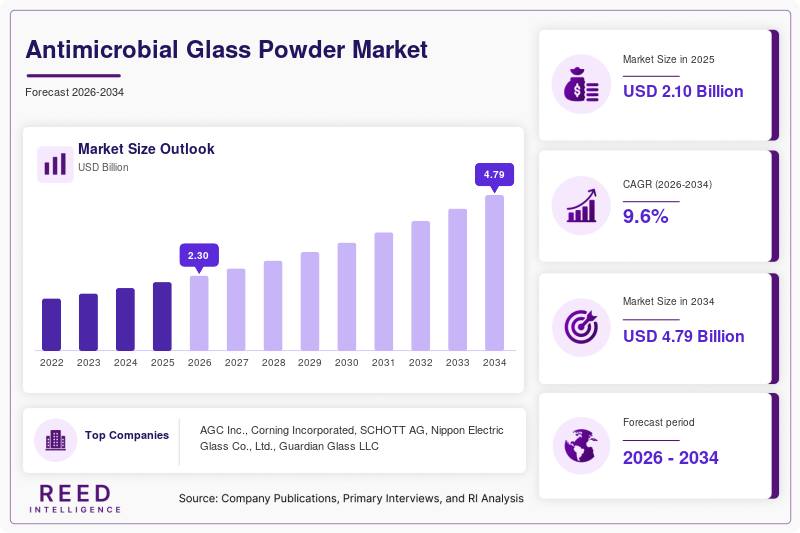
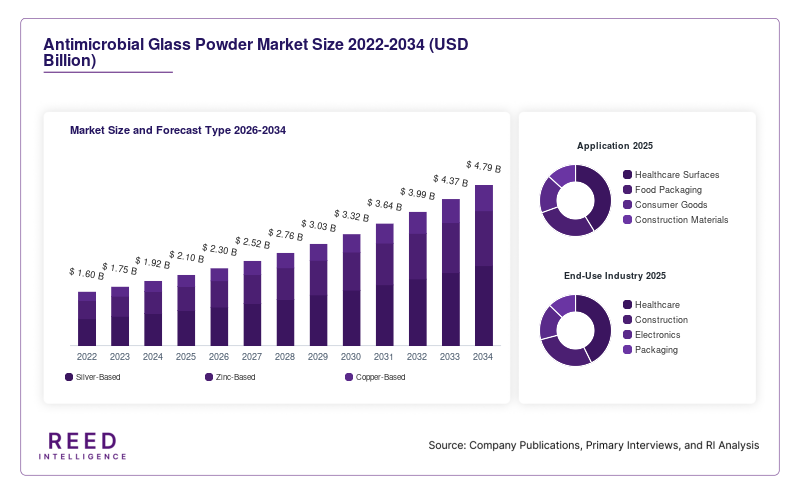
The global Antimicrobial Glass Powder Market size was valued at approximately USD 2.1 billion in 2025 and is projected to reach USD 4.8 billion by 2034, expanding at a CAGR of 9.6% during the forecast period (2025–2034). The market has gained steady traction due to the increasing emphasis on hygiene, infection prevention, and surface safety across industries such as healthcare, construction, packaging, and consumer goods.
A key global factor supporting market growth has been the heightened awareness of antimicrobial solutions following the COVID-19 pandemic. Governments, institutions, and private enterprises have accelerated the adoption of antimicrobial materials to reduce pathogen transmission in high-contact environments. Antimicrobial glass powder, with its ability to inhibit bacterial growth when incorporated into coatings, plastics, and surfaces, has emerged as a reliable and durable solution.
Key Highlights
- North America dominated the market with a 34% share in 2025, while Asia Pacific is projected to register the fastest CAGR of 11.2% during the forecast period.
- By type, silver-based antimicrobial glass powder led with a 46% share, while zinc-based variants are expected to grow fastest at a CAGR of 10.8%.
- By application, healthcare surfaces accounted for the largest share at 39%, whereas food packaging is projected to expand at a CAGR of 11.5%.
- The U.S. remained the dominant country with a market size of USD 620 million in 2025, rising to USD 675 million in 2026.
Market Trends
Integration of Antimicrobial Materials in Smart Infrastructure
The integration of antimicrobial glass powder into smart building materials is a prominent trend shaping the Antimicrobial Glass Powder Market. Developers are increasingly incorporating antimicrobial coatings into high-touch surfaces such as door handles, elevators, and glass panels. This trend aligns with the broader smart infrastructure movement, where hygiene and sustainability are prioritized alongside automation and energy efficiency. As urbanization increases globally, the demand for safer public spaces is expected to drive continued adoption.
Rising Adoption in Consumer Electronics and Appliances
Manufacturers of consumer electronics and home appliances are integrating antimicrobial glass powder into product surfaces to enhance hygiene. Devices such as smartphones, touchscreens, refrigerators, and washing machines are being designed with antimicrobial coatings to appeal to health-conscious consumers. This trend is particularly evident in premium product segments, where differentiation through hygiene features is gaining importance. The increasing penetration of electronics in daily life further amplifies the relevance of antimicrobial solutions.
Market Drivers
Increasing Demand for Infection Control Solutions
The growing need for infection prevention across healthcare facilities, public infrastructure, and residential spaces is a major driver for the Antimicrobial Glass Powder Market. Hospitals, clinics, and laboratories require surfaces that minimize microbial contamination, leading to increased adoption of antimicrobial materials. This demand is further supported by stricter hygiene regulations and standards imposed by health authorities worldwide.
Expansion of Construction and Infrastructure Projects
Rapid urbanization and infrastructure development have significantly contributed to market growth. Antimicrobial glass powder is widely used in architectural coatings, tiles, and glass panels to enhance hygiene in public spaces such as airports, malls, and office buildings. As construction activities continue to expand in emerging economies, the demand for antimicrobial materials is expected to rise steadily.
Market Restraint
High Production Costs and Limited Awareness in Emerging Markets
One of the major challenges facing the Antimicrobial Glass Powder Market is the relatively high cost of production associated with advanced antimicrobial formulations. The incorporation of materials such as silver and other specialized compounds increases manufacturing expenses, which can limit adoption in cost-sensitive markets.
Additionally, awareness regarding the benefits and long-term value of antimicrobial glass powder remains limited in several developing regions. Many end-users continue to rely on conventional materials due to lower upfront costs and lack of regulatory enforcement. This combination of high costs and limited awareness restricts market penetration, particularly in small-scale industries and less-developed economies. Overcoming this restraint will require cost optimization strategies and targeted awareness campaigns.
Market Opportunities
Growth in Healthcare Infrastructure Investments
The expansion of healthcare infrastructure globally presents a strong growth opportunity for the Antimicrobial Glass Powder Market. New hospitals, diagnostic centers, and specialized care facilities are increasingly incorporating antimicrobial materials into their design and operations. As healthcare systems prioritize infection control, the demand for durable antimicrobial coatings and surfaces is expected to increase significantly.
Rising Demand in Food Packaging Applications
The use of antimicrobial glass powder in food packaging materials is emerging as a promising opportunity. The ability to inhibit microbial growth helps extend shelf life and maintain food quality, making it highly valuable for packaged food products. With the growing demand for safe and hygienic food packaging solutions, manufacturers are exploring innovative applications of antimicrobial materials, which is expected to drive market growth in this segment.
Segmental Analysis
By Type
Silver-based antimicrobial glass powder dominated the market in 2025, accounting for approximately 46% of the total share. Its superior antimicrobial properties and long-lasting effectiveness made it the preferred choice across various applications.
Zinc-based antimicrobial glass powder is projected to be the fastest-growing subsegment, with a CAGR of 10.8% during the forecast period. The growth is attributed to its cost-effectiveness and lower toxicity compared to silver-based alternatives, making it suitable for broader applications.
By Application
Healthcare surfaces represented the largest application segment, holding around 39% of the market share in 2025. The need for infection control in hospitals and medical facilities drove the adoption of antimicrobial glass powder in this segment.
Food packaging is expected to be the fastest-growing application, with a CAGR of 11.5%. The increasing demand for safe and hygienic packaging solutions, along with advancements in packaging technologies, will support growth in this segment.
By End-Use Industry
The healthcare industry dominated the market in 2025, accounting for approximately 41% of the share. The critical need for maintaining sterile environments and reducing hospital-acquired infections contributed to its leading position.
The construction industry is projected to grow at the fastest CAGR of 10.9%. The increasing use of antimicrobial materials in building surfaces and infrastructure projects will drive growth in this segment.
By Formulation
Powder formulations held the largest share of 58% in 2025 due to their ease of incorporation into various materials such as coatings and plastics.
Liquid formulations are expected to grow at a CAGR of 10.5% as they offer enhanced dispersion and application flexibility, particularly in coatings and sprays.
Regional Analysis
North America
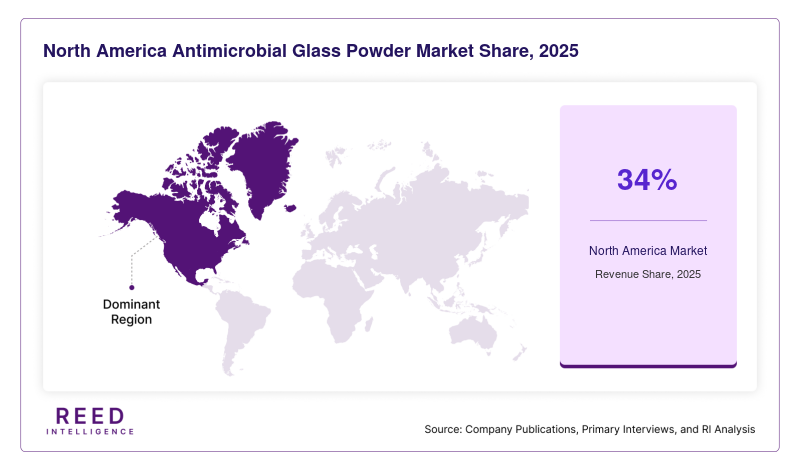
North America accounted for approximately 34% of the Antimicrobial Glass Powder Market share in 2025 and is expected to grow at a CAGR of 8.7% during the forecast period. The region's mature healthcare infrastructure and strong regulatory framework supported its dominant position.
The United States led the regional market due to the widespread adoption of antimicrobial materials in healthcare and construction sectors. The presence of advanced manufacturing capabilities and a high level of awareness regarding hygiene standards contributed significantly to market growth. Increasing investments in smart buildings and public infrastructure further supported demand.
Europe
Europe held around 26% of the market share in 2025 and is projected to grow at a CAGR of 8.9% from 2025 to 2034. The region’s focus on sustainability and stringent health regulations drove the adoption of antimicrobial materials.
Germany emerged as the leading country, supported by its strong industrial base and emphasis on innovation in materials science. The country’s robust construction sector and increasing use of antimicrobial coatings in public infrastructure played a crucial role in market expansion.
Asia Pacific
Asia Pacific captured approximately 24% of the market share in 2025 and is anticipated to grow at the fastest CAGR of 11.2% during the forecast period. Rapid urbanization and industrialization were key factors driving growth in the region.
China dominated the regional market due to its large-scale manufacturing capabilities and extensive construction activities. The country’s growing focus on public health and hygiene standards, along with increasing investments in infrastructure development, contributed to strong demand for antimicrobial glass powder.
Middle East & Africa
The Middle East & Africa region accounted for around 9% of the market share in 2025 and is expected to grow at a CAGR of 9.3% during the forecast period. The region witnessed increasing adoption of antimicrobial materials in commercial and hospitality sectors.
The United Arab Emirates led the market due to its advanced infrastructure projects and focus on high-quality building standards. The growing tourism sector and investments in smart city initiatives further supported the adoption of antimicrobial solutions.
Latin America
Latin America held approximately 7% of the market share in 2025 and is projected to grow at a CAGR of 9.0% during the forecast period. The region experienced gradual growth driven by improving healthcare infrastructure and construction activities.
Brazil dominated the regional market, supported by its expanding urban population and increasing demand for hygienic materials in residential and commercial spaces. Government initiatives aimed at improving public health standards also contributed to market growth.
Competitive Landscape
The Antimicrobial Glass Powder Market is moderately fragmented, with several global and regional players competing based on product innovation and application development. Key companies are focusing on expanding their product portfolios and strengthening their distribution networks.
A leading player in the market has been continuously investing in research and development to enhance the performance of antimicrobial materials. The company recently introduced a new generation of glass powder with improved durability and broader antimicrobial effectiveness, targeting healthcare and construction applications.
Other players are emphasizing strategic partnerships and collaborations to expand their market presence and cater to emerging demand in developing regions. Competitive strategies also include mergers, acquisitions, and capacity expansions to strengthen market positioning.
Key Players
- AGC Inc.
- Corning Incorporated
- SCHOTT AG
- Nippon Electric Glass Co., Ltd.
- Guardian Glass LLC
- Ferro Corporation
- Glassflake Ltd.
- Mo-Sci Corporation
- Ishizuka Glass Co., Ltd.
- Potters Industries LLC
- Advanced Glassfiber Yarns LLC
- 3M Company
- Saint-Gobain S.A.
- Tosoh Corporation
- Sumitomo Metal Mining Co., Ltd.
Recent Developments
- A major manufacturer launched an advanced antimicrobial glass powder with enhanced multi-pathogen resistance.
- Several companies expanded production capacities to meet rising global demand.
- Strategic collaborations were formed to integrate antimicrobial materials into smart building solutions.
- New product innovations focused on eco-friendly and cost-effective formulations.
Antimicrobial Glass Powder Market Segments
Type
- Silver-Based
- Zinc-Based
- Copper-Based
Application
- Healthcare Surfaces
- Food Packaging
- Consumer Goods
- Construction Materials
End-Use Industry
- Healthcare
- Construction
- Electronics
- Packaging
Formulation
- Powder
- Liquid
By Region
- North America
- Europe
- APAC
- Middle East and Africa
- LATAM