Antioxidant BHT Market Size, Share & Demand Report By Type (Food-Grade BHT, Industrial-Grade BHT, Pharmaceutical-Grade BHT), By Application (Food Additives, Plastics and Rubber, Cosmetics, Pharmaceuticals, Others), By End-Use Industry (Food and Beverage, Automotive, Packaging, Cosmetics and Personal Care, Pharmaceuticals) By Region & Segment Forecasts, 2026–2034
USD 3950
Market Overview
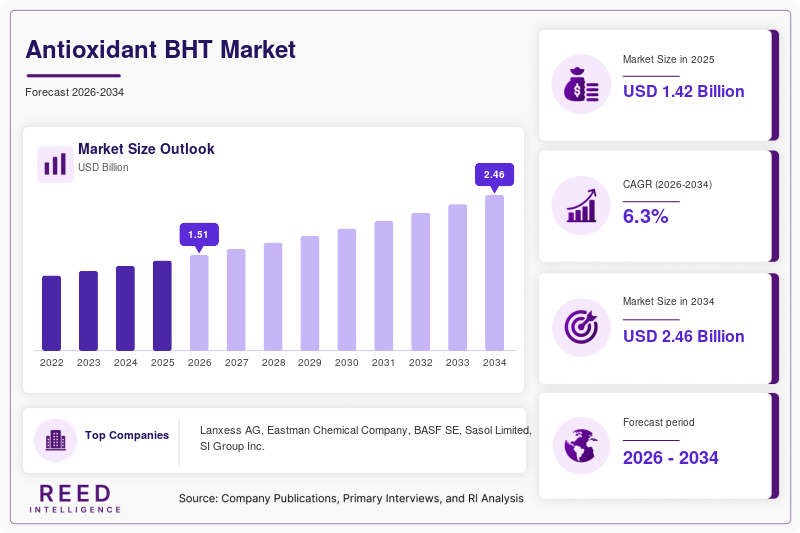
The global Antioxidant BHT Market was valued at approximately USD 1.42 billion in 2026 and is projected to reach USD 2.31 billion by 2034, expanding at a CAGR of 6.3% during the forecast period (2026–2034). The steady rise in demand for food preservation, polymer stabilization, and personal care formulations continues to support market expansion. BHT (butylated hydroxytoluene) is widely used as a synthetic antioxidant due to its cost-effectiveness and ability to extend shelf life by preventing oxidation in fats, oils, and polymers.
A key global factor driving the growth of the Antioxidant BHT Market is the increasing consumption of processed and packaged foods. As urbanization accelerates and consumer lifestyles evolve, there is a higher reliance on convenience foods that require longer shelf life. BHT plays a vital role in maintaining product stability and quality, which makes it an essential additive in the food and beverage industry.
Key Highlights
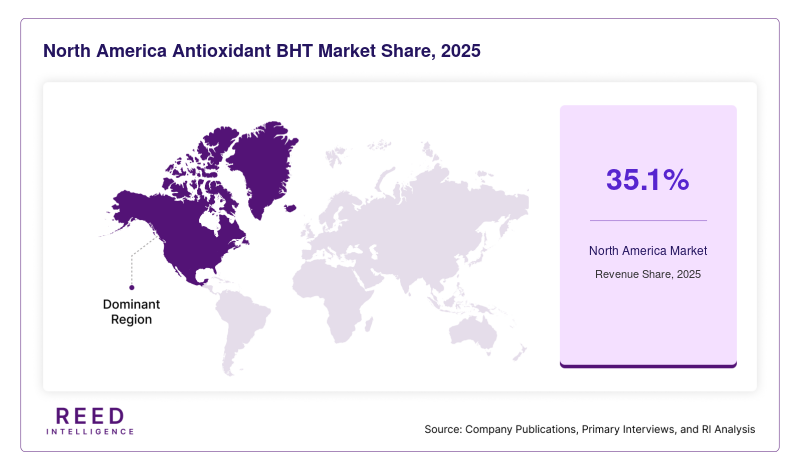
- North America dominated the market with a 35.1% share in 2025.
- Asia Pacific is expected to grow at the fastest CAGR of 7.4% during 2026–2034.
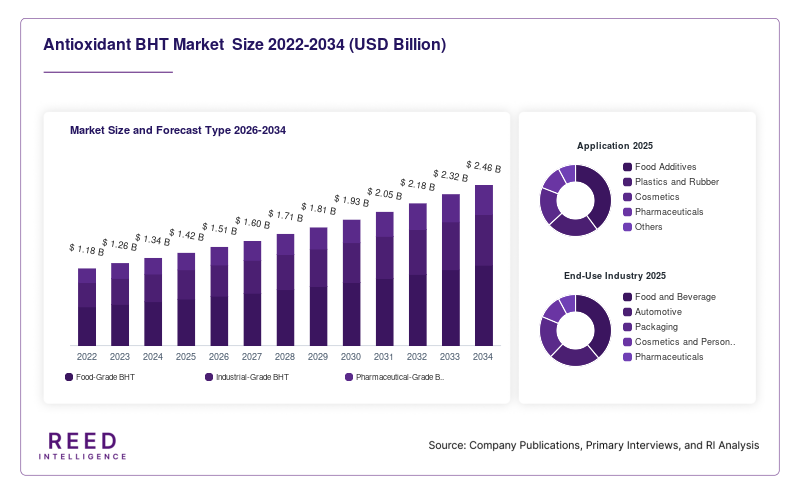
- By type, food-grade BHT accounted for the largest share of 44.3%.
- while pharmaceutical-grade BHT is projected to grow at a CAGR of 7.9%.
- By application, food additives led with a 39.8% share, whereas plastics and rubber stabilization is expected to expand at a CAGR of 7.1%.
- The United States remained the dominant country, with market values of USD 420 million in 2024 and USD 455 million in 2025.
Market Trends
Rising demand for clean-label alternatives influencing product reformulation
One of the notable trends in the Antioxidant BHT Market is the growing influence of clean-label preferences among consumers. While BHT remains widely used, manufacturers are increasingly reformulating products to balance synthetic and natural antioxidants. This trend is not eliminating BHT usage but reshaping how it is applied, especially in combination with other stabilizers. Food producers are optimizing BHT concentration levels to meet regulatory requirements and consumer expectations without compromising shelf life. This evolving demand is also prompting innovation in formulation techniques where BHT is used more efficiently, supporting its continued relevance in processed food, cosmetics, and pharmaceutical applications.
Expansion of polymer and rubber industries supporting BHT consumption
Another key trend is the expansion of the polymer and rubber industries, particularly in emerging economies. BHT is widely used as a stabilizer in plastics, synthetic rubber, and lubricants to prevent degradation caused by oxidation. With increasing infrastructure development, automotive production, and packaging demand, the need for durable materials has risen significantly. Manufacturers are integrating BHT into high-performance materials to enhance product longevity and resistance to environmental stress. This trend is particularly evident in Asia Pacific, where industrial growth and manufacturing output continue to accelerate, thereby strengthening demand for antioxidant additives like BHT.
Market Drivers
Increasing demand for processed and packaged food products
The rising consumption of processed and packaged foods is a major driver for the Antioxidant BHT Market. Urbanization, busy lifestyles, and growing disposable incomes have led to increased reliance on ready-to-eat and convenience food products. These products require effective preservation solutions to maintain quality, flavor, and nutritional value during storage and transportation. BHT plays a critical role in preventing oxidation of fats and oils, which helps extend product shelf life. Food manufacturers are increasingly incorporating BHT into a wide range of products, including snacks, cereals, and baked goods, thereby contributing to sustained market demand.
Growth of the cosmetics and personal care industry
The expanding cosmetics and personal care sector is another significant factor driving the market. BHT is widely used in skincare, haircare, and cosmetic formulations as an antioxidant that prevents product degradation. With rising consumer awareness regarding product stability and quality, manufacturers are focusing on formulations that maintain effectiveness over time. The growth of e-commerce platforms and increasing demand for premium beauty products have further supported the use of BHT in formulations. This driver is particularly strong in regions with growing middle-class populations, where spending on personal care products continues to increase.
Market Restraint
Regulatory concerns and health-related scrutiny limiting adoption
One of the primary restraints affecting the Antioxidant BHT Market is the increasing regulatory scrutiny regarding its safety and potential health effects. Various regulatory bodies across regions have imposed limits on the allowable concentration of BHT in food and cosmetic products. Concerns related to long-term consumption and possible adverse health impacts have led to cautious use among manufacturers. For instance, some food producers are shifting toward natural antioxidants such as tocopherols to meet evolving regulatory and consumer expectations. This shift can reduce demand for BHT in certain applications. Additionally, labeling requirements and compliance costs can increase operational complexity for manufacturers, further restraining market growth.
Market Opportunities
Emerging applications in pharmaceutical formulations
A significant opportunity in the Antioxidant BHT Market lies in its expanding use in pharmaceutical applications. BHT is increasingly utilized to stabilize active pharmaceutical ingredients and prevent oxidative degradation in drug formulations. As the pharmaceutical industry grows, particularly in developing economies, the demand for stable and effective drug formulations is rising. BHT offers cost advantages and proven efficacy, making it suitable for a wide range of pharmaceutical products. This opportunity is further supported by increasing research and development activities aimed at enhancing drug stability and shelf life, thereby opening new avenues for market growth.
Growing demand in emerging economies across industrial sectors
Emerging economies present substantial growth opportunities for the Antioxidant BHT Market. Rapid industrialization, urbanization, and expanding manufacturing sectors in regions such as Asia Pacific and Latin America are driving demand for BHT across multiple applications. Industries including plastics, rubber, and food processing are experiencing significant growth, which in turn increases the need for antioxidants. Governments in these regions are also investing in infrastructure and industrial development, further supporting market expansion. The availability of cost-effective manufacturing and rising domestic consumption create a favorable environment for BHT adoption in these markets.
Segmental Analysis
By Type
Food-grade BHT dominated the market with a share of 44.3% in 2024. Its extensive use in preserving food products such as snacks, oils, and baked goods has contributed to its leading position. Food-grade BHT is widely preferred due to its effectiveness in preventing oxidation and extending shelf life. Manufacturers in the food industry rely on this type to maintain product quality during storage and transportation. The increasing consumption of processed foods globally has further strengthened demand for food-grade BHT, making it a key segment in the market.
Pharmaceutical-grade BHT is expected to grow at the fastest CAGR of 7.9% during the forecast period. This growth is driven by increasing demand for stable pharmaceutical formulations. BHT is used to protect active ingredients from oxidation, ensuring product efficacy and shelf life. The expanding pharmaceutical industry, particularly in emerging markets, is creating new opportunities for this segment. Additionally, ongoing research into advanced drug formulations is further supporting the adoption of pharmaceutical-grade BHT.
By Application
Food additives accounted for the largest share of 39.8% in 2024. BHT is widely used in food products to prevent oxidation and maintain freshness. The segment benefits from the growing demand for packaged and processed foods, particularly in urban areas. Food manufacturers are increasingly incorporating BHT into their products to enhance shelf life and reduce waste. This has made food additives the dominant application segment in the market.
Plastics and rubber stabilization is projected to grow at a CAGR of 7.1%. The increasing demand for durable materials in automotive, construction, and packaging industries is driving growth in this segment. BHT is used to prevent degradation of polymers, ensuring product longevity and performance. The expansion of manufacturing activities in emerging economies is further supporting the growth of this segment.
By End-Use Industry
The food and beverage industry held the largest share of 41.2% in 2024. The widespread use of BHT as a preservative in food products has driven its dominance in this segment. The industry’s need for cost-effective and efficient preservation solutions continues to support demand. Increasing consumer preference for convenience foods has further strengthened the use of BHT in this sector.
The cosmetics and personal care industry is expected to grow at a CAGR of 6.8%. The rising demand for stable and long-lasting cosmetic products is driving the adoption of BHT in this segment. Manufacturers are focusing on formulations that maintain product quality over time, which has increased the use of antioxidants. The growth of the beauty industry, particularly in emerging markets, is further contributing to segment expansion.
Regional Analysis
North America
North America accounted for a market share of approximately 35.1% in 2025 and is expected to grow at a CAGR of 5.8% during the forecast period. The region’s mature food processing and packaging industries continue to drive demand for BHT. Additionally, the presence of established polymer and chemical manufacturing sectors supports steady consumption. Regulatory frameworks in North America are well-defined, which helps maintain consistent usage levels of BHT across applications.
The United States remains the dominant country in the region due to its strong industrial base and high consumption of processed foods. A unique growth factor is the increasing demand for high-performance packaging materials that require antioxidant stabilization. This has encouraged manufacturers to integrate BHT into advanced material formulations, thereby sustaining market growth.
Europe
Europe held a market share of around 27.4% in 2025 and is projected to grow at a CAGR of 5.5% through 2034. The region’s stringent regulatory environment influences the use of BHT, particularly in food and cosmetics. However, demand remains stable due to its widespread use in industrial applications such as plastics and rubber. The region’s focus on sustainability is also shaping the way BHT is utilized.
Germany leads the European market, supported by its robust chemical and manufacturing industries. A unique growth factor is the region’s emphasis on high-quality industrial materials, which require effective antioxidant solutions. This has ensured continued demand for BHT in specialized applications despite regulatory challenges.
Asia Pacific
Asia Pacific is expected to grow at the fastest CAGR of 7.4% during the forecast period, with a market share of 24.8% in 2025. Rapid industrialization and urbanization are driving demand for BHT across multiple sectors. The expanding food processing industry and increasing production of plastics and rubber are key contributors to regional growth.
China dominates the Asia Pacific market due to its large manufacturing base and growing domestic consumption. A unique growth factor is the rapid expansion of the automotive and packaging industries, which rely heavily on polymer stabilization. This has significantly increased the demand for BHT in the region.
Middle East & Africa
The Middle East & Africa region accounted for a market share of 6.3% in 2025 and is expected to grow at a CAGR of 5.9%. Growth in this region is supported by increasing investments in food processing and petrochemical industries. The demand for BHT is also rising due to its application in preserving food products under extreme climatic conditions.
Saudi Arabia leads the regional market, driven by its expanding industrial sector. A unique growth factor is the region’s focus on developing local manufacturing capabilities, which increases the demand for chemical additives such as BHT in various industrial processes.
Latin America
Latin America held a market share of 6.4% in 2025 and is projected to grow at a CAGR of 6.1%. The region’s growing food and beverage industry is a major driver of BHT demand. Additionally, increasing industrial activities in plastics and rubber manufacturing contribute to market growth.
Brazil is the dominant country in Latin America, supported by its large consumer base and expanding industrial sector. A unique growth factor is the rising demand for packaged food products, which requires effective preservation solutions. This has led to increased adoption of BHT in the region.
Competitive Landscape
The Antioxidant BHT Market is moderately fragmented, with several key players competing on the basis of product quality, pricing, and distribution networks. Leading companies are focusing on expanding their production capacities and enhancing their product portfolios to meet growing demand. Strategic collaborations, mergers, and acquisitions are also common in the market as companies seek to strengthen their market position.
Lanxess AG is considered a leading player in the market due to its strong global presence and extensive product offerings. The company recently expanded its antioxidant production capabilities to meet increasing demand from the polymer industry. Other major players are also investing in research and development to improve product efficiency and comply with regulatory standards.
Key Players
- Lanxess AG
- Eastman Chemical Company
- BASF SE
- Sasol Limited
- Oxiris Chemicals S.A.
- Finoric LLC
- Impextraco NV
- Twinkle Chemi Lab Pvt. Ltd.
- Zhejiang NHU Co., Ltd.
- SI Group Inc.
- Camlin Fine Sciences Ltd.
- Spectrum Chemical Manufacturing Corp.
- Triveni Chemicals
- Parchem Fine & Specialty Chemicals
- Merck KGaA
Recent Developments
- Several companies have expanded their production facilities to meet rising demand from the polymer and food industries.
- Manufacturers are investing in research to improve the efficiency and safety profile of BHT formulations.
- Strategic partnerships between chemical companies and food manufacturers have increased the adoption of BHT in new product lines.
Antioxidant BHT Market Segments
Type
- Food-Grade BHT
- Industrial-Grade BHT
- Pharmaceutical-Grade BHT
Application
- Food Additives
- Plastics and Rubber
- Cosmetics
- Pharmaceuticals
- Others
End-Use Industry
- Food and Beverage
- Automotive
- Packaging
- Cosmetics and Personal Care
- Pharmaceuticals
By Region
- North America
- Europe
- APAC
- Middle East and Africa
- LATAM